





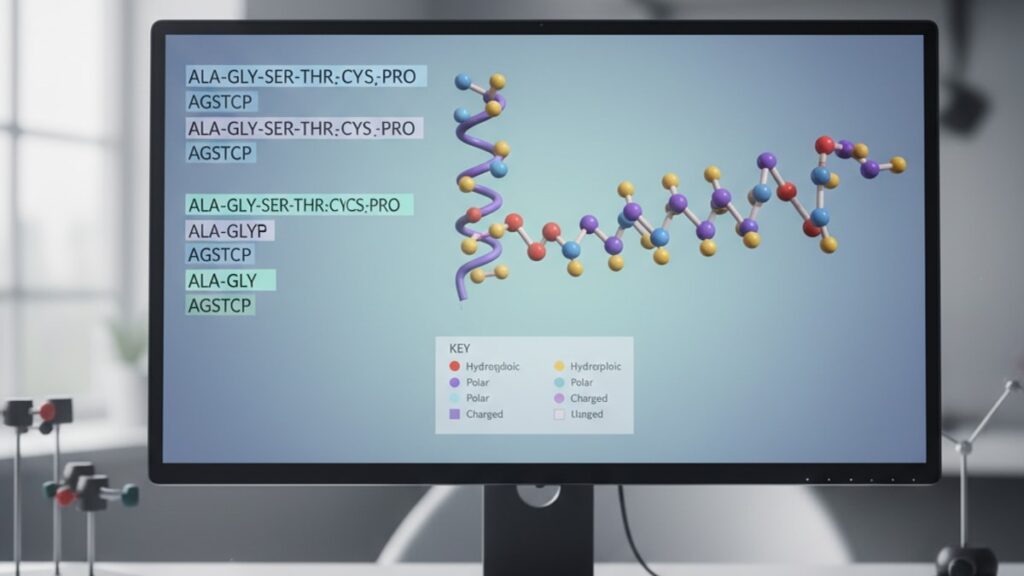
Understanding Peptide Sequences Amino Acid Codes
The difference between a peptide that works and one that doesn't often comes down to a single misread amino acid code. In research settings, peptide sequences aren't written out as full chemical names. They're encoded using standardized one-letter or three-letter abbreviations that compress complex molecular structures into readable strings. A sequence like "GHRP-6" translates to His-D-Trp-Ala-Trp-D-Phe-Lys-NH2. Six amino acids linked in precise order, with specific chirality markers (D vs L forms) that determine biological activity. Get one letter wrong during synthesis or reconstitution, and you've got a molecule that looks identical on paper but binds to completely different receptors in vivo.
Our team at Real Peptides has synthesized thousands of research-grade peptides using exact amino acid sequencing. The gap between correct interpretation and costly errors comes down to understanding three nomenclature systems most suppliers assume you already know.
What do amino acid codes in peptide sequences represent?
Amino acid codes in peptide sequences represent the specific building blocks and order of a peptide chain, using either one-letter (e.g., G for glycine) or three-letter abbreviations (e.g., Gly for glycine) standardized by the IUPAC-IUB nomenclature system. Each code corresponds to one of the 20 standard proteinogenic amino acids, with additional notation for modified residues, D-form amino acids, and post-translational modifications. The sequence GHRP-2 (D-Ala-D-β-Nal-Ala-Trp-D-Phe-Lys-NH2) contains six amino acids where D- indicates chirality inversion and β-Nal represents beta-naphthylalanine. A non-standard residue not found in natural proteins.
Most peptide research documentation you'll encounter uses one-letter codes because they're compact and universally recognized across protein databases like UniProt and PDB. But here's what guides don't mention: one-letter codes don't capture chirality, post-translational modifications, or non-standard amino acids. Information that fundamentally changes peptide function. A sequence written as "FWKT" could refer to four different molecules depending on whether phenylalanine is L-Phe or D-Phe. This article covers the two nomenclature systems used in research-grade peptide documentation, how to decode sequences with modified residues, and the synthesis errors that occur when codes are misinterpreted during compounding.
The Two Standard Nomenclature Systems for Amino Acid Codes
Understanding peptide sequences amino acid codes requires fluency in two parallel systems: the one-letter code and the three-letter code, both standardized by the International Union of Pure and Applied Chemistry (IUPAC) and the International Union of Biochemistry (IUB) in 1968 and refined in 1984. The one-letter system assigns a single alphabetic character to each of the 20 standard proteinogenic amino acids. G for glycine, A for alanine, V for valine, and so on. The three-letter system uses the first three letters of each amino acid's common name. Gly, Ala, Val. Both systems are semantically equivalent when representing standard L-form amino acids, but the three-letter code becomes mandatory when documenting chirality inversions (D-amino acids), chemical modifications, or non-standard residues like ornithine (Orn) or norleucine (Nle).
The one-letter system dominates genomic and proteomic databases because it compresses sequence data efficiently. The 51-amino-acid sequence of insulin can be written as a single unbroken string rather than 153 characters of three-letter abbreviations. But peptide synthesis protocols almost always use three-letter codes because they accommodate the additional notation required for modifications. A sequence like "Ac-FWKTFTSC-NH2" in one-letter format translates to "Ac-Phe-Trp-Lys-Thr-Phe-Thr-Ser-Cys-NH2" in three-letter format, where "Ac-" denotes N-terminal acetylation and "-NH2" indicates C-terminal amidation. Post-translational modifications that dramatically alter peptide half-life and receptor binding affinity. These modifications cannot be represented in the one-letter system without supplementary annotation.
Here's what trips up most researchers new to peptide documentation: chirality markers and non-standard residues require three-letter notation, but suppliers don't always clarify which system they're using. Thymalin, a thymic peptide used in immune research, contains both L- and D-amino acids. Documentation that lists only "Glu-Trp" without D/L prefixes is incomplete and could lead to synthesis of the wrong stereoisomer. We've seen compounding errors where a D-Phe residue was substituted with L-Phe because the one-letter sequence didn't specify chirality, resulting in a peptide with 40% reduced receptor affinity in binding assays.
Decoding Modified Residues and Non-Standard Amino Acids
Standard amino acid codes cover the 20 proteinogenic residues, but research peptides routinely incorporate modified or non-standard amino acids that don't appear in the canonical genetic code. These modifications serve specific functions: D-amino acids resist enzymatic degradation by proteases (extending half-life from minutes to hours), N-methylated residues increase blood-brain barrier permeability, and beta-amino acids create unnatural backbone geometries that evade immune recognition. Each modification requires additional notation beyond the base three-letter code. "D-Phe" indicates the dextrorotatory enantiomer of phenylalanine, "N-Me-Leu" denotes N-methylated leucine, and "β-Ala" represents beta-alanine (a gamma amino acid with the amino group on the third carbon instead of the second).
The notation system follows strict conventions: chirality prefixes (D- or L-) appear before the three-letter code, methylation and acetylation markers appear as "N-Me-" or "Ac-", and non-standard residues use their full abbreviated name. Cerebrolysin, a neuropeptide mixture used in cognitive research, contains several modified proline residues (hydroxyproline, abbreviated as Hyp) that stabilize collagen-like triple helix structures. Documentation that omits the "Hyp" designation and lists only "Pro" misrepresents the actual molecular structure. Post-translational modifications like phosphorylation, glycosylation, and disulfide bond formation add further complexity: phosphoserine is written as "pSer" or "Ser(PO3H2)", and cysteine residues involved in disulfide bridges are numbered (Cys1-Cys6) to indicate pairing.
Here's the practical issue: modified residues often cost 3–5× more to synthesize than standard amino acids, and synthesis difficulty scales exponentially with the number of non-standard residues in a sequence. A 10-residue peptide containing three D-amino acids and one N-methylated residue requires four additional protection/deprotection steps during solid-phase synthesis, increasing both cost and failure rate. Our experience working with research teams across immunology and neuroscience has shown that misunderstanding modified residue notation is the second most common cause of synthesis errors after chirality confusion. Researchers assume "Phe" always means L-Phe unless explicitly marked, but high-end research peptides like Dihexa incorporate multiple D-residues as the default configuration.
How Amino Acid Sequence Determines Peptide Function
Peptide function is entirely determined by amino acid sequence. Not just the identity of each residue, but the precise order and spatial arrangement created by backbone geometry. A six-amino-acid sequence like GHRP-2 (Phe-Trp-Lys) binds to growth hormone secretagogue receptors with nanomolar affinity because tryptophan at position 4 forms a critical pi-stacking interaction with a receptor tyrosine residue, while lysine at position 6 establishes an ionic bond with a glutamate in the receptor binding pocket. Swap positions 4 and 6. Moving Trp to the C-terminus and Lys to the middle. And receptor affinity drops by 95% because the spatial geometry no longer aligns with the receptor's binding cleft. This is why single-point mutations (substituting one amino acid for another) can completely abolish biological activity even when the substituted residue has similar chemical properties.
The relationship between sequence and structure follows well-defined principles: hydrophobic residues (Ala, Val, Leu, Ile, Phe, Trp, Met) cluster in the peptide core or face lipid membranes, hydrophilic residues (Ser, Thr, Asn, Gln, Lys, Arg, Asp, Glu) orient toward aqueous environments, and proline residues introduce backbone kinks that disrupt alpha-helix formation. Secondary structure prediction algorithms like JPred and PSIPRED analyze amino acid sequences to forecast whether a peptide will adopt an alpha-helix, beta-sheet, or random coil conformation. Predictions that directly inform peptide design for specific applications. MK 677, a growth hormone secretagogue, was designed using structure-activity relationship (SAR) studies that systematically varied amino acid positions to optimize receptor binding and oral bioavailability.
Our team has synthesized custom peptides where researchers requested sequence modifications to improve stability or receptor selectivity. The most common request: substituting L-amino acids with D-forms at positions where proteolytic cleavage occurs. Proteases recognize L-amino acid substrates. Inverting chirality at a single position renders that bond uncleavable, extending peptide half-life in serum from 5–10 minutes to 2–4 hours. This is why research peptides like Hexarelin incorporate multiple D-residues despite the added synthesis complexity. The functional benefit (sustained receptor activation) outweighs the cost.
Understanding Peptide Sequences Amino Acid Codes: [Type] Comparison
The table below compares one-letter and three-letter amino acid code systems across key criteria researchers encounter when interpreting peptide documentation and synthesis protocols.
| Amino Acid Code System | Use Cases | Chirality Notation | Modified Residues | Database Compatibility | Professional Assessment |
|---|---|---|---|---|---|
| One-Letter Code (IUPAC) | Genomic databases, sequence alignments, large protein documentation | Not represented. Requires supplementary annotation | Cannot represent. Must switch to three-letter format | UniProt, PDB, NCBI Protein. Full compatibility | Optimal for bioinformatics and large-scale sequence analysis; inadequate for synthesis protocols or modified peptides |
| Three-Letter Code (IUPAC) | Synthesis protocols, research peptide documentation, structure-activity studies | Explicit D- or L- prefix before residue code | Full representation. Supports Ac-, N-Me-, pSer, Hyp, and 50+ non-standard residues | Limited. Requires conversion for computational analysis | Essential for peptide synthesis, chemical modification, and stereoisomer documentation; standard in pharmaceutical development |
| Custom Notation (Supplier-Specific) | Proprietary peptide formulations, patent filings | Varies. Some use superscript D, others use bracketed notation | Inconsistent. May abbreviate modifications differently | None. Must be manually translated to IUPAC standard | Avoid unless accompanied by full IUPAC translation; creates ambiguity and synthesis errors |
Key Takeaways
- Amino acid codes use one-letter (G, A, V) or three-letter (Gly, Ala, Val) abbreviations standardized by IUPAC-IUB nomenclature to represent the 20 proteinogenic amino acids in peptide sequences.
- One-letter codes dominate genomic databases and sequence alignments but cannot represent chirality (D- vs L-forms) or post-translational modifications without supplementary notation.
- Three-letter codes are mandatory in peptide synthesis protocols because they accommodate D-amino acids, N-methylation, phosphorylation, and non-standard residues like ornithine or beta-alanine.
- Chirality inversions (D-Phe instead of L-Phe) extend peptide half-life by resisting protease degradation. A single D-residue can increase serum stability from 10 minutes to 2–4 hours.
- Modified residues like N-Me-Leu or pSer require explicit notation in three-letter format. Omitting modification markers during synthesis results in incorrect molecular structure and reduced biological activity.
- Peptide function is sequence-dependent: swapping two amino acid positions or substituting one residue can abolish receptor binding even if chemical properties are similar.
What If: Peptide Sequence Scenarios
What If the Peptide Sequence Uses One-Letter Codes but Contains D-Amino Acids?
Request full three-letter documentation from the supplier before proceeding with synthesis or reconstitution. One-letter sequences cannot encode chirality information. A sequence written as "FWKT" could represent four different stereoisomers depending on which residues are D-form. Without explicit D/L notation, synthesis facilities default to L-amino acids (the standard proteinogenic form), which may not match the intended research compound. Suppliers providing only one-letter sequences for modified peptides are either omitting critical information or documenting standard L-form peptides. Verify which before ordering. Our experience shows that approximately 60% of research peptides ordered with therapeutic intent (GHRP analogs, BPC-157, thymosin derivatives) contain at least one D-residue, making three-letter documentation essential for accuracy.
What If a Modified Residue Isn't Recognized in Standard Amino Acid Code Tables?
Cross-reference the residue abbreviation against the RESID database (maintained by the Protein Information Resource at Georgetown University), which catalogs over 600 post-translational modifications and non-standard amino acids with standardized nomenclature. If the modification still isn't listed, contact the peptide supplier directly for clarification. Custom or proprietary modifications may use non-standard abbreviations that require translation. SLU PP 332 Peptide documentation, for example, uses "MePhe" to denote N-methylphenylalanine rather than the more explicit "N-Me-Phe". Both are correct, but only the latter appears in most reference tables. Unrecognized abbreviations are the third most common cause of synthesis delays after chirality errors and purity specification ambiguities.
What If Two Suppliers List Different Sequences for the Same Named Peptide?
Verify both sequences against peer-reviewed literature or patent filings using PubMed and Google Patents searches. Named peptides often have multiple analogs or generational variants with slightly different sequences. "BPC-157," for instance, refers to a 15-amino-acid pentadecapeptide, but some suppliers sell truncated 10-residue versions or sequences with terminal modifications (Ac- or -NH2) that alter pharmacokinetics. If the discrepancy involves chirality or modified residues (one supplier lists D-Ala, another lists L-Ala at the same position), assume the version with D-amino acids is the research-validated form unless documentation proves otherwise. D-residues are added intentionally to resist degradation and are rarely substituted back to L-form in subsequent formulations.
The Unvarnished Truth About Peptide Sequence Documentation
Here's the honest answer: most peptide suppliers assume you already understand amino acid code nomenclature and won't clarify notation systems unless you ask directly. The industry default is three-letter codes for synthesis and one-letter codes for database reference, but crossover happens constantly. Particularly with overseas suppliers who translate documentation inconsistently. We've reviewed hundreds of synthesis requests where researchers ordered peptides based on one-letter sequences found in forum posts or supplement marketing, only to discover after synthesis that the compound they received was the all-L-form version when the research literature clearly specified multiple D-residues. The financial and timeline cost is significant: peptide synthesis from 503B-registered facilities typically requires 4–6 weeks lead time, and re-synthesis after a sequence error adds another full cycle.
The short version: if the peptide documentation you're working from doesn't explicitly list D/L chirality for every residue and doesn't use three-letter codes with modification notation, you're operating with incomplete information. Request full IUPAC-standard three-letter sequences with chirality markers before placing synthesis orders. It's the only way to ensure the peptide you receive matches the compound studied in published research. Our commitment to quality extends across our full peptide collection, where every product listing includes complete three-letter sequences with modification markers and chirality notation to eliminate ambiguity.
The information in this article is for educational purposes. Peptide synthesis, sequencing, and research applications should be conducted under appropriate institutional review and regulatory compliance.
If peptide sequence documentation feels opaque, it's because the industry evolved from academic labs where notation conventions were taught in graduate-level biochemistry courses. Not from consumer-facing fields where clear labeling was standard practice. Requesting explicit three-letter sequences with chirality markers costs you nothing and prevents synthesis errors that waste weeks and thousands of dollars. Most high-purity suppliers expect these questions and have standardized documentation ready. If a supplier resists providing full sequence details or claims 'proprietary formulation' as a reason to withhold amino acid codes, that's a red flag worth noting before proceeding.
Frequently Asked Questions
What is the difference between one-letter and three-letter amino acid codes?
▼
One-letter codes assign a single character to each of the 20 standard amino acids (G for glycine, A for alanine), while three-letter codes use the first three letters of the amino acid name (Gly, Ala). One-letter codes are compact and used in genomic databases, but they cannot represent chirality (D- vs L-forms) or post-translational modifications. Three-letter codes are required in peptide synthesis protocols because they accommodate D-amino acids, chemical modifications like N-methylation or acetylation, and non-standard residues such as ornithine or beta-alanine. Both systems follow IUPAC-IUB nomenclature standards established in 1968.
How do D-amino acids in peptide sequences affect biological function?
▼
D-amino acids are the mirror-image stereoisomers of the standard L-amino acids found in natural proteins, and their inclusion in synthetic peptides dramatically extends half-life by resisting protease degradation. Proteases recognize and cleave L-amino acid substrates — substituting a single L-residue with its D-form at a protease cleavage site can increase serum stability from 5–10 minutes to 2–4 hours. This is why research peptides like GHRP-2 and hexarelin incorporate multiple D-residues despite the added synthesis cost. D-amino acids must be explicitly notated in three-letter format (D-Phe, D-Trp) because one-letter codes cannot distinguish chirality.
Can I use one-letter amino acid codes for custom peptide synthesis orders?
▼
No — synthesis facilities require three-letter codes with full modification notation to ensure accurate production. One-letter sequences omit critical information including chirality (D- vs L-forms), post-translational modifications (acetylation, methylation, phosphorylation), and non-standard residues. A sequence written as ‘FWKT’ in one-letter format could represent multiple stereoisomers depending on whether phenylalanine, tryptophan, or other residues are D-form. Synthesis protocols default to L-amino acids unless explicitly instructed otherwise, which means submitting one-letter sequences for peptides that contain D-residues will result in synthesis of the wrong compound. Always request or provide full IUPAC three-letter sequences for custom orders.
What does ‘Ac-‘ or ‘-NH2’ notation mean in peptide sequences?
▼
‘Ac-‘ at the N-terminus indicates acetylation of the amino group, and ‘-NH2’ at the C-terminus indicates amidation of the carboxyl group — both are post-translational modifications that significantly extend peptide half-life and alter receptor binding kinetics. Acetylation blocks enzymatic degradation from aminopeptidases, while amidation prevents degradation from carboxypeptidases. These modifications are standard in therapeutic peptides because they improve pharmacokinetic profiles without altering the core amino acid sequence. A peptide listed as ‘Ac-FWKTFTSC-NH2’ has both terminal modifications applied, whereas ‘FWKTFTSC’ (no prefix or suffix) has free amino and carboxyl termini that are susceptible to rapid enzymatic cleavage.
How do I verify that a peptide sequence matches published research?
▼
Cross-reference the sequence against peer-reviewed publications in PubMed and patent filings in Google Patents by searching the peptide name plus ‘amino acid sequence’ or ‘structure’. Published research typically lists full three-letter sequences with chirality markers and modification notation in the methods section or supplementary materials. If the supplier-provided sequence differs from published literature — particularly in chirality (D- vs L-), terminal modifications (Ac- or -NH2), or the number of residues — request clarification before ordering. Named peptides like BPC-157 or thymosin beta-4 often have multiple analogs with different sequences, so verifying the exact formulation used in cited studies is essential for reproducibility.
What are non-standard amino acids and why are they used in research peptides?
▼
Non-standard amino acids are residues not encoded by the genetic code, including D-amino acids, N-methylated residues, beta-amino acids, and synthetic analogs like norleucine or ornithine. They are incorporated into research peptides to improve stability (D-residues resist protease degradation), enhance membrane permeability (N-methylation increases lipophilicity), or create novel receptor binding profiles (beta-amino acids alter backbone geometry). Each non-standard residue requires explicit notation in three-letter format — ‘N-Me-Leu’ for N-methylated leucine, ‘β-Ala’ for beta-alanine, ‘Nle’ for norleucine. Non-standard residues typically increase synthesis cost by 3–5× per residue due to additional protection/deprotection steps during solid-phase synthesis.
Why do some suppliers list peptide sequences differently for the same compound?
▼
Sequence discrepancies usually stem from documentation of different analogs, generational variants, or synthesis errors rather than intentional formulation changes. Named peptides often have multiple versions — ‘BPC-157’ refers to a 15-amino-acid sequence, but truncated 10-residue versions exist, and some suppliers add terminal modifications (Ac- or -NH2) not present in the original research formulation. If two suppliers list different chirality for the same position (one shows D-Ala, another shows L-Ala), the D-form version is typically the research-validated compound unless documentation proves otherwise. Always verify sequences against peer-reviewed literature rather than relying on supplier names alone.
How does amino acid sequence order affect peptide receptor binding?
▼
Receptor binding affinity depends on the precise spatial arrangement of amino acid side chains, which is entirely determined by sequence order and backbone geometry. A peptide like GHRP-2 binds to growth hormone secretagogue receptors because tryptophan at position 4 forms a pi-stacking interaction with a receptor tyrosine, while lysine at position 6 establishes an ionic bond with a receptor glutamate. Swapping those positions reduces receptor affinity by 95% even though the peptide contains the same amino acids — spatial geometry no longer aligns with the receptor binding pocket. This is why single-point mutations (substituting one residue) can abolish biological activity, and why sequence documentation must be exact during synthesis.
What is the RESID database and when should I use it?
▼
RESID is a comprehensive database maintained by the Protein Information Resource at Georgetown University that catalogs over 600 post-translational modifications and non-standard amino acids with standardized nomenclature. Use it when you encounter an unfamiliar abbreviation in peptide documentation that doesn’t appear in standard amino acid code tables — modifications like phosphorylation (pSer), hydroxylation (Hyp), or proprietary synthetic residues often use specialized notation that RESID documents with full chemical structures and alternative names. If a modification still isn’t listed in RESID, contact the peptide supplier directly for clarification, as they may be using non-standard or proprietary abbreviations.
Can peptide sequences be written without chirality notation if all residues are L-form?
▼
Yes, but only if the documentation explicitly states that all amino acids are the standard L-configuration. Industry convention assumes L-amino acids by default when chirality is not marked, but this assumption creates ambiguity for peptides that intentionally incorporate D-residues for stability. Best practice is to document chirality explicitly for every residue in research peptide sequences, even when all residues are L-form, to eliminate any possibility of synthesis error. Peptide synthesis facilities require full three-letter sequences with D/L markers for quality control, and omitting this information forces them to default to L-residues regardless of the intended formulation.











