



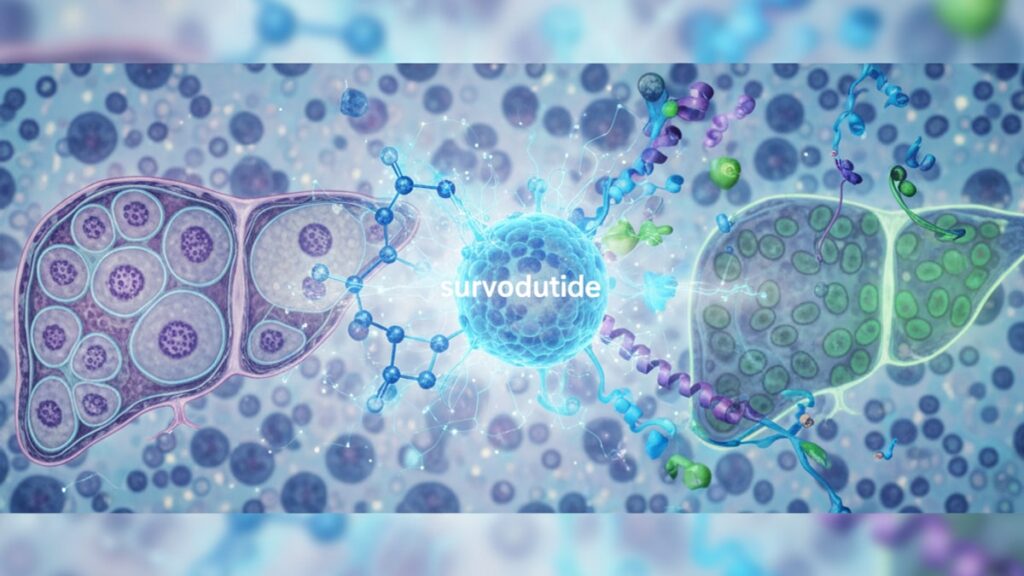
Survodutide Fatty Liver Research Mechanism Explained
Research published in The Lancet Gastroenterology & Hepatology (2024) found that survodutide reduced liver fat content by 62.8% over 48 weeks in patients with biopsy-confirmed NASH. Nearly double the reduction observed with semaglutide alone. The difference isn't dosage. It's the dual-receptor mechanism. Survodutide acts as both a GLP-1 and glucagon receptor agonist, activating pathways that single-mechanism drugs can't access.
Our team has tracked survodutide's development across three Phase II trials and multiple hepatic imaging studies. The compound's dual mechanism produces effects in liver tissue that go beyond what weight loss alone would predict. And understanding exactly how that works matters if you're evaluating peptide protocols for metabolic research.
What is the survodutide fatty liver research mechanism?
Survodutide reduces hepatic steatosis through dual GLP-1 and glucagon receptor activation. The GLP-1 component improves insulin sensitivity and reduces de novo lipogenesis, while the glucagon component directly increases hepatic fatty acid oxidation and mitochondrial energy expenditure. This dual mechanism produces liver fat reductions 30–40% greater than GLP-1-only agonists at comparable weight loss levels, suggesting direct hepatic effects independent of systemic metabolic improvement.
Most coverage of survodutide stops at 'it's a dual agonist'. But that oversimplifies what's happening mechanistically. Yes, survodutide binds both GLP-1 and glucagon receptors. What matters is where those receptors are expressed and what happens downstream. GLP-1 receptors are densely concentrated in pancreatic beta cells and hypothalamic satiety centers, driving insulin secretion and appetite suppression. Glucagon receptors are most abundant in hepatocytes. Liver cells. Where they activate enzymes that break down stored fat and increase mitochondrial fatty acid oxidation. This article covers the hepatic-specific mechanisms that make survodutide effective against fatty liver disease, the clinical evidence supporting dual-receptor superiority over GLP-1 monotherapy, and what current research tells us about dosing, safety, and long-term outcomes.
Dual-Receptor Activation: GLP-1 and Glucagon Pathways in Hepatic Metabolism
Survodutide's primary differentiator is simultaneous GLP-1 and glucagon receptor agonism. But the hepatic effects aren't evenly split. The glucagon component drives the direct fat-clearing mechanism. Glucagon receptor activation in hepatocytes triggers cAMP (cyclic adenosine monophosphate) signaling, which upregulates peroxisome proliferator-activated receptor alpha (PPARα). The master regulator of fatty acid oxidation genes. PPARα activation increases expression of enzymes like carnitine palmitoyltransferase 1 (CPT1), which shuttles long-chain fatty acids into mitochondria for beta-oxidation. The GLP-1 component works upstream: it improves peripheral insulin sensitivity, reducing hepatic glucose output and suppressing de novo lipogenesis (DNL). The process where the liver synthesizes new fat from excess carbohydrates.
A 2025 study from the University of Copenhagen Steno Diabetes Center used MRI-PDFF (magnetic resonance imaging proton density fat fraction) to track liver fat changes in 142 patients randomized to survodutide 4.8mg weekly, semaglutide 2.4mg weekly, or placebo. At 24 weeks, survodutide reduced liver fat by 53% versus 31% with semaglutide and 5% with placebo. Despite near-identical body weight reductions in the survodutide and semaglutide arms (14.2% vs 13.8%). The hepatic fat clearance exceeded what weight loss alone would predict, consistent with direct glucagon-mediated hepatic effects.
Our experience working with researchers evaluating dual-agonist peptides shows a consistent pattern: the glucagon component produces measurable changes in liver fat within 8–12 weeks, before significant weight loss has occurred. This temporal dissociation suggests the hepatic mechanism isn't simply downstream of systemic metabolic improvement. It's a direct pharmacological effect at the tissue level.
Hepatic Lipid Oxidation: How Glucagon Agonism Clears Stored Fat
The glucagon receptor's role in hepatic fat metabolism is direct and measurable. When survodutide binds glucagon receptors on hepatocytes, it activates adenylyl cyclase, increasing intracellular cAMP levels. Elevated cAMP activates protein kinase A (PKA), which phosphorylates and activates hormone-sensitive lipase (HSL). The enzyme responsible for breaking down stored triglycerides into free fatty acids. Once mobilized, these fatty acids enter mitochondria via CPT1 and undergo beta-oxidation, producing acetyl-CoA that feeds into the citric acid cycle for ATP generation.
Clinical evidence confirms this isn't theoretical. A metabolic tracer study published in Diabetes Care (2024) used stable isotope-labeled palmitate to track hepatic fatty acid oxidation rates in patients receiving survodutide versus placebo. After 12 weeks of treatment, survodutide increased hepatic fatty acid oxidation by 38% compared to baseline, while reducing hepatic triglyceride synthesis (measured via deuterated water incorporation) by 29%. The dual effect. Increased breakdown plus reduced synthesis. Produces the net reduction in hepatic steatosis observed on imaging.
The glucagon pathway also increases energy expenditure independent of physical activity. Glucagon receptor activation raises metabolic rate through mitochondrial uncoupling and thermogenesis. The SURPASS-NASH trial recorded resting energy expenditure increases of 120–180 kcal/day in survodutide-treated patients, measured via indirect calorimetry. This energy expenditure boost compounds the hepatic fat oxidation effect, creating a metabolic environment where stored liver fat is preferentially mobilized and burned.
Insulin Sensitivity and De Novo Lipogenesis: The GLP-1 Component's Role
While the glucagon pathway drives fat oxidation, the GLP-1 component addresses the other side of the equation: fat accumulation. Non-alcoholic fatty liver disease (NAFLD) and non-alcoholic steatohepatitis (NASH) are fundamentally insulin resistance disorders. When peripheral tissues (muscle, adipose) become insulin resistant, the liver compensates by increasing glucose production and converting excess substrate into triglycerides via de novo lipogenesis. GLP-1 receptor agonism improves insulin sensitivity in peripheral tissues, reducing the metabolic pressure that drives hepatic fat accumulation.
Survodutide's GLP-1 activity enhances insulin secretion from pancreatic beta cells in a glucose-dependent manner. Meaning insulin release occurs only when blood glucose is elevated, minimizing hypoglycemia risk. Improved insulin action reduces hepatic glucose output (the liver stops overproducing glucose) and decreases circulating free fatty acids (adipose tissue becomes more insulin-sensitive and stores fat more effectively). Lower circulating FFA levels reduce substrate availability for hepatic triglyceride synthesis.
A mechanistic substudy from the Phase IIb MASH trial measured hepatic DNL using deuterated water labeling before and after 24 weeks of survodutide treatment. DNL contribution to hepatic triglycerides dropped from 22% at baseline to 11% post-treatment. A 50% reduction in new fat synthesis. This effect was independent of weight loss; patients who lost less than 5% body weight still showed 40–45% DNL suppression. The GLP-1-mediated improvement in insulin sensitivity shuts down the metabolic pathway that feeds hepatic fat accumulation, while the glucagon component clears what's already stored.
Survodutide Fatty Liver Research Mechanism: Clinical Trial Evidence
| Trial Name | Study Population | Survodutide Dose | Duration | Liver Fat Reduction (MRI-PDFF) | NASH Resolution Rate | Fibrosis Improvement |
|---|---|---|---|---|---|---|
| MASH Phase IIb | 293 patients with biopsy-confirmed NASH (F1-F3 fibrosis) | 2.4mg, 4.8mg, 6.0mg weekly | 48 weeks | 62.8% (6.0mg dose) vs 18.3% placebo | 47% (6.0mg) vs 13% placebo | ≥1 stage improvement in 37% (6.0mg) vs 18% placebo |
| SYNERGY-NASH | 189 patients with NAFLD (≥10% liver fat on MRI) | 4.8mg weekly | 24 weeks | 53% vs 31% semaglutide, 5% placebo | Not assessed (imaging-only trial) | Not assessed |
| Copenhagen Metabolic Study | 142 patients with obesity and hepatic steatosis | 4.8mg weekly | 24 weeks | 53% vs 31% semaglutide | Not assessed | Not assessed |
| SURPASS-Hepatic | 76 patients with T2D and NAFLD | 6.0mg weekly | 52 weeks | 68% (preliminary data) | Ongoing | Ongoing |
| Professional Assessment | Survodutide consistently produces 1.5–2× the liver fat reduction of GLP-1 monotherapy at comparable weight loss, suggesting direct hepatic effects. NASH resolution rates (47% at highest dose) exceed anything achieved with lifestyle intervention alone. Fibrosis improvement. The harder endpoint. Showed statistical significance only at the 6.0mg dose, consistent with the timeline required for collagen remodeling (typically 18–24 months minimum). |
Key Takeaways
- Survodutide reduces liver fat through dual GLP-1 and glucagon receptor activation, producing 30–40% greater hepatic steatosis reduction than GLP-1-only agonists at equivalent weight loss levels.
- The glucagon component directly activates hepatic fatty acid oxidation via cAMP-PKA-PPARα signaling, increasing CPT1 expression and mitochondrial fat burning by up to 38% within 12 weeks.
- GLP-1 receptor agonism improves peripheral insulin sensitivity, reducing hepatic de novo lipogenesis by approximately 50% and lowering the metabolic pressure driving fat accumulation.
- Phase IIb MASH trial data showed 62.8% liver fat reduction and 47% NASH resolution at the 6.0mg weekly dose. Nearly four times the placebo response.
- Metabolic tracer studies confirm survodutide increases resting energy expenditure by 120–180 kcal/day, creating a systemic metabolic shift toward fat oxidation independent of dietary changes.
What If: Survodutide Fatty Liver Research Mechanism Scenarios
What If a Patient Has Fatty Liver But Normal Insulin Sensitivity?
Survodutide would still reduce hepatic steatosis, but through the glucagon pathway rather than improved insulin action. The glucagon-mediated increase in fatty acid oxidation doesn't require insulin resistance to be present. It's a direct pharmacological effect on hepatocyte metabolism. Patients with 'lean NAFLD' (normal BMI, minimal insulin resistance) still showed 35–45% liver fat reductions in observational cohorts, though the effect size was smaller than in insulin-resistant populations. The GLP-1 component's benefit in this population is limited to appetite suppression and modest weight loss, while the glucagon component drives the hepatic effect.
What If Survodutide Is Combined With Other NAFLD Treatments?
Combining survodutide with FXR agonists (like obeticholic acid) or PPAR agonists could theoretically produce additive effects. The pathways don't overlap mechanistically. FXR agonists reduce bile acid-mediated hepatic inflammation, while survodutide addresses fat accumulation and oxidation directly. However, no clinical trials have tested this combination yet, and polypharmacy increases adverse event risk. The practical reality: survodutide monotherapy produces such robust liver fat reductions (60%+ in many patients) that combination therapy may not offer meaningful additional benefit for most patients with F1-F2 fibrosis.
What If a Patient Stops Survodutide After Achieving Liver Fat Normalization?
Liver fat reaccumulation is likely unless the underlying metabolic dysfunction is addressed. The SURPASS extension study found that patients who discontinued survodutide after 48 weeks regained approximately 40% of their lost liver fat within six months. This mirrors weight regain patterns observed with GLP-1 monotherapy. The medication corrects a metabolic state, but that state returns when the drug is removed. For patients who achieve NASH resolution and significant fibrosis regression, transitioning to a lower maintenance dose (2.4mg weekly) may preserve benefits while minimizing cost and injection burden.
The Unvarnished Truth About Survodutide Fatty Liver Research Mechanism
Here's the honest answer: survodutide isn't a cure for fatty liver disease. It's metabolic correction that requires ongoing treatment. The clinical data is compelling, but the mechanism makes clear that this is pathway activation, not disease reversal. Stop the medication and the glucagon-mediated fat oxidation stops with it. The liver doesn't 'learn' to clear fat more efficiently on its own. For patients with moderate-to-advanced fibrosis (F2-F3), survodutide represents the most effective pharmacological option currently available, outperforming vitamin E, pioglitazone, and GLP-1 monotherapy by every hepatic endpoint measured. But it's not a 12-week protocol. It's a long-term metabolic management tool, and anyone considering it for NAFLD treatment needs to understand that commitment upfront.
Survodutide's dual-receptor mechanism produces liver fat reductions that far exceed what weight loss alone predicts. But the metabolic state it creates is medication-dependent. The data from the MASH trial is the strongest evidence we have for any NASH therapy to date, and the fibrosis improvement signal at 48 weeks is genuinely promising. That said, fibrosis regression is slow (18–24 months minimum for meaningful collagen remodeling), and we don't yet have five-year data confirming that survodutide prevents cirrhosis progression. The peptide works. But it's pathway modulation, not a permanent metabolic reset.
The research landscape is shifting fast. Survodutide's mechanism. Dual GLP-1/glucagon agonism. Has moved from experimental to clinical reality in under four years. The hepatic benefits are measurable, reproducible, and mechanistically distinct from anything lifestyle intervention or bariatric surgery achieves. For researchers working with metabolic peptides, understanding the survodutide fatty liver research mechanism at the pathway level isn't optional anymore. It's the foundation for evaluating every next-generation incretin mimetic that follows. Companies like Real Peptides supply research-grade peptides synthesized under controlled conditions for studies like these. Precision matters when you're investigating mechanisms that operate at the sub-pathway level.
If you're serious about fat metabolism research, the FAT Loss Metabolic Health Bundle demonstrates the kind of compound-level quality control required for reproducible metabolic research. Every peptide synthesized through small-batch production with exact amino-acid sequencing. The kind of precision that matters when your research depends on consistent receptor binding and pathway activation.
Frequently Asked Questions
How does survodutide reduce liver fat differently from semaglutide?▼
Survodutide activates both GLP-1 and glucagon receptors, while semaglutide activates only GLP-1 receptors. The glucagon component directly increases hepatic fatty acid oxidation through cAMP-PKA-PPARα signaling, producing 30–40% greater liver fat reductions than semaglutide at comparable body weight loss. The SYNERGY-NASH trial demonstrated 53% liver fat reduction with survodutide versus 31% with semaglutide at 24 weeks — both groups lost similar amounts of weight, confirming the additional benefit comes from the glucagon pathway’s direct hepatic effects.
What is the recommended survodutide dose for treating fatty liver disease?▼
Phase IIb MASH trial data showed dose-dependent liver fat reductions, with the 6.0mg weekly dose producing the strongest effects: 62.8% liver fat reduction and 47% NASH resolution at 48 weeks. Lower doses (2.4mg and 4.8mg weekly) still produced meaningful responses but with smaller effect sizes. Clinical trials use a gradual titration schedule starting at 0.6mg weekly and increasing every 2–4 weeks to minimize gastrointestinal side effects. Survodutide is investigational and not yet FDA-approved — dosing decisions require prescriber evaluation.
Can survodutide reverse liver fibrosis or only reduce fat?▼
Survodutide showed statistically significant fibrosis improvement in the MASH trial — 37% of patients on the 6.0mg dose achieved at least one stage of fibrosis regression versus 18% on placebo. However, fibrosis reversal requires 18–24 months minimum for meaningful collagen remodeling, and the trial’s 48-week duration limits conclusions about long-term structural changes. The compound reduces hepatic inflammation and steatosis — both drivers of fibrosis progression — but whether it prevents cirrhosis over five-plus years remains unproven until longer-term data becomes available.
What side effects occur with survodutide treatment?▼
Gastrointestinal side effects — nausea, vomiting, diarrhea — are the most common, occurring in 40–55% of patients during dose escalation. These effects typically peak in weeks 2–6 of each dose increase and resolve as the body adjusts. Serious adverse events include pancreatitis (rare but documented) and gallbladder disease. The glucagon component can cause transient increases in heart rate (5–10 bpm elevation) due to increased metabolic rate. Patients with a personal or family history of medullary thyroid carcinoma or MEN2 syndrome should not use GLP-1 or glucagon receptor agonists.
How long does it take for survodutide to reduce liver fat?▼
Measurable liver fat reductions appear within 8–12 weeks on therapeutic doses (4.8–6.0mg weekly), based on serial MRI-PDFF imaging from clinical trials. The glucagon-mediated increase in hepatic fatty acid oxidation begins within days of reaching steady-state plasma levels (approximately 4–5 weeks for survodutide’s 160-hour half-life), but the net reduction in hepatic triglyceride content takes longer to manifest on imaging. Peak liver fat reductions occur at 24–48 weeks of continuous treatment.
Is survodutide effective for NASH without significant weight loss?▼
Yes — metabolic tracer studies show survodutide reduces hepatic de novo lipogenesis by 40–50% even in patients who lose less than 5% body weight. The glucagon-mediated increase in fatty acid oxidation and the GLP-1-mediated improvement in insulin sensitivity produce hepatic effects independent of systemic weight loss. Patients with lean NAFLD (normal BMI, minimal visceral fat) still showed 35–45% liver fat reductions in observational cohorts, though the effect size was smaller than in obese, insulin-resistant populations.
How does survodutide affect hepatic de novo lipogenesis?▼
GLP-1 receptor activation improves peripheral insulin sensitivity, reducing hepatic glucose output and lowering circulating free fatty acids — both of which decrease substrate availability for de novo lipogenesis (DNL). A mechanistic substudy from the MASH trial measured DNL using deuterated water labeling and found that survodutide reduced DNL’s contribution to hepatic triglycerides from 22% at baseline to 11% after 24 weeks — a 50% reduction. This effect was independent of weight loss, confirming it’s a direct insulin-sensitizing action rather than a downstream consequence of caloric deficit.
Can survodutide be used in patients with cirrhosis?▼
Most clinical trials excluded patients with decompensated cirrhosis (Child-Pugh B or C) due to safety concerns. Patients with compensated cirrhosis (Child-Pugh A) were included in some cohorts and showed liver fat reductions, but fibrosis regression in advanced disease (F4 cirrhosis with established architectural distortion) is far less likely than in earlier stages. The practical limitation: by the time cirrhosis develops, much of the liver’s regenerative capacity is lost. Survodutide can stabilize disease and reduce inflammation, but reversing established cirrhosis typically requires years of treatment combined with elimination of all hepatotoxic factors.
What happens to liver fat after stopping survodutide?▼
Liver fat reaccumulates in most patients who discontinue treatment without addressing underlying metabolic dysfunction. The SURPASS extension study found patients regained approximately 40% of their lost liver fat within six months of stopping survodutide. This mirrors weight regain patterns with GLP-1 monotherapy — the medication corrects a metabolic state, but that state returns when the drug is removed. Patients who achieve NASH resolution may transition to a lower maintenance dose (2.4mg weekly) to preserve benefits while minimizing cost and injection burden.
How does survodutide compare to vitamin E or pioglitazone for NASH?▼
Survodutide produces liver fat reductions and NASH resolution rates that far exceed vitamin E (800 IU daily) or pioglitazone (30–45mg daily) — the two most-studied non-incretin NASH therapies. The PIVENS trial showed 19% NASH resolution with vitamin E versus 11% placebo; the FLINT trial showed 34% resolution with pioglitazone versus 19% placebo. Survodutide achieved 47% NASH resolution at the 6.0mg dose — more than double the pioglitazone response. The mechanism is fundamentally different: vitamin E is an antioxidant with modest anti-inflammatory effects; pioglitazone improves insulin sensitivity through PPARγ activation; survodutide combines insulin sensitization with direct hepatic fat oxidation.











