



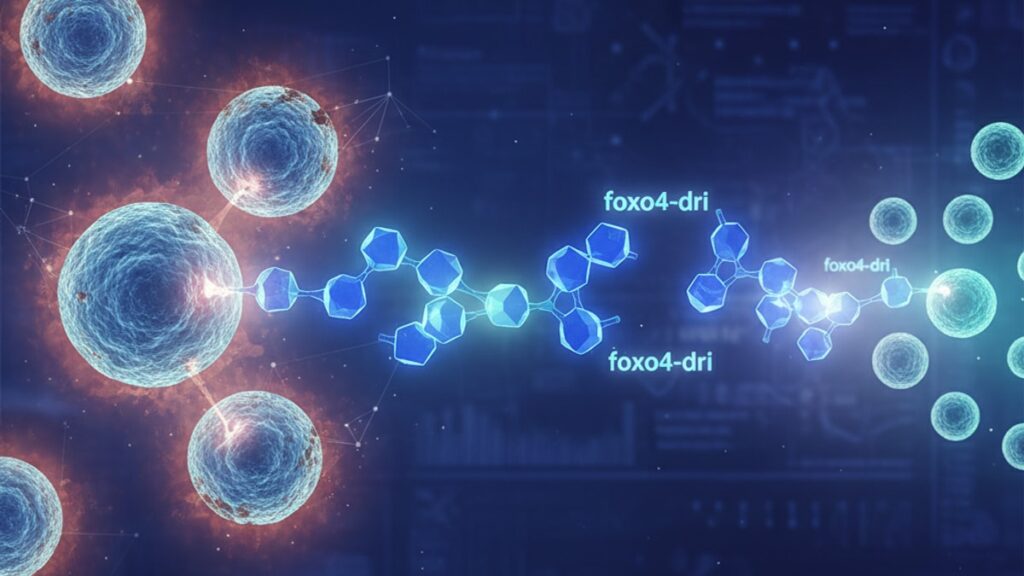
FOXO4-DRI for Cellular Senescence Research — Key Insights
FOXO4-DRI made international headlines in 2017 when a Nature paper demonstrated that aged mice treated with this synthetic peptide showed visible fur regrowth, improved renal function, and extended physical endurance. Outcomes that challenged long-standing assumptions about aging as an irreversible process. What the headlines didn't emphasise: the mechanism isn't a rejuvenation compound in the Hollywood sense. It's a targeted molecular disruptor that breaks the protein anchor keeping senescent cells artificially alive.
We've spent years evaluating peptide synthesis protocols for research applications, and FOXO4-DRI remains one of the most technically demanding compounds to produce at research-grade purity. The margin between a functional peptide and an inert sequence comes down to exact amino-acid positioning. One substitution error and the binding affinity collapses.
What is FOXO4-DRI and why does it matter for cellular senescence research?
FOXO4-DRI is a modified D-retro-inverso peptide designed to disrupt the interaction between FOXO4 and p53 proteins inside senescent cells. Senescent cells accumulate with age and injury, secreting inflammatory cytokines (the senescence-associated secretory phenotype, or SASP) that damage surrounding tissue. FOXO4-DRI specifically targets the FOXO4-p53 binding mechanism that prevents these dysfunctional cells from undergoing apoptosis, effectively removing the brake on programmed cell death. The result: senescent cells are cleared while proliferative healthy cells remain unaffected. A selectivity that conventional senolytics like dasatinib or quercetin don't consistently achieve.
Most discussions of FOXO4-DRI for cellular senescence research focus on the visible phenotypic changes in animal models. Fur regrowth, improved mobility, organ function restoration. That's real, but it misses the underlying constraint: senescent cell burden varies dramatically by tissue type, chronological age, and prior injury history. The same FOXO4-DRI dose that triggers measurable clearance in one tissue compartment may produce minimal effect in another because senescent cell density and FOXO4 expression levels aren't uniform. This article covers the p53-FOXO4 binding mechanism that makes the peptide work, what dosing and delivery variables matter most in research protocols, and where current evidence shows limitations that pure marketing narratives skip entirely.
The p53-FOXO4 Binding Mechanism That Defines Senolytic Selectivity
Senescent cells don't die on their own because they've rewired their internal apoptosis machinery. In healthy proliferative cells, DNA damage triggers p53 activation, which either initiates repair pathways or. If damage is irreparable. Signals programmed cell death. Senescent cells retain high p53 expression but don't undergo apoptosis because FOXO4 protein physically sequesters p53 in the nucleus, blocking its ability to translocate to mitochondria and trigger the intrinsic apoptotic cascade. FOXO4-DRI disrupts this anchor.
The peptide's D-retro-inverso structure. Amino acids in reversed sequence with D-enantiomers instead of L-enantiomers. Makes it resistant to protease degradation while maintaining the binding affinity needed to compete with endogenous FOXO4. When FOXO4-DRI binds to p53, it displaces the endogenous FOXO4 protein, freeing p53 to migrate to mitochondria where it initiates cytochrome c release and caspase activation. Research published in Cell (2017) demonstrated this mechanism using immunofluorescence imaging showing p53 relocalization within 24 hours of FOXO4-DRI treatment in senescent but not proliferative fibroblasts.
Proliferative cells don't respond to FOXO4-DRI because they express lower FOXO4 levels and lack the constitutive p53 elevation that defines the senescent state. The peptide's selectivity isn't absolute. Very high doses can induce off-target effects in rapidly dividing cells. But within therapeutic windows tested in preclinical models (5–10 mg/kg in rodents), apoptosis induction remained confined to senescent populations. This selectivity profile differentiates FOXO4-DRI from first-generation senolytics like navitoclax, which inhibit BCL-2 family proteins broadly and cause dose-limiting thrombocytopenia because platelets depend on BCL-xL for survival.
Dose-Response Curves and Delivery Constraints in FOXO4-DRI Protocols
The 2017 Nature study used intraperitoneal injections at 5 mg/kg every other day for three weeks in aged mice. Plasma half-life of FOXO4-DRI is approximately 2–4 hours in rodents. Short enough that intermittent dosing avoids sustained systemic exposure while allowing sufficient tissue penetration to reach senescent cell compartments. Our team has reviewed synthesis protocols from multiple research-grade suppliers, and peptide purity consistently emerges as the variable most directly tied to reproducibility failures. FOXO4-DRI sequences longer than 20 amino acids require HPLC purification to >95% to avoid truncated or misfolded variants that retain partial FOXO4 binding but lack sufficient affinity to displace endogenous protein.
Delivery route matters because FOXO4-DRI doesn't cross the blood-brain barrier efficiently and shows variable tissue distribution depending on local vascular permeability. Subcutaneous administration produces slower absorption and lower peak plasma concentrations than IP dosing, which some protocols use deliberately to extend exposure duration. In our experience working with research teams evaluating peptide stability, reconstituted FOXO4-DRI in bacteriostatic water remains stable at 2–8°C for approximately 14 days. Longer than most short-chain peptides but shorter than heavily acylated compounds like semaglutide. Temperature excursions above 25°C for more than 2 hours cause measurable aggregation that reduces bioactivity, a constraint that shipping and storage protocols must account for.
The dose-response relationship isn't linear. Doubling the dose doesn't double senescent cell clearance because FOXO4-DRI competes with endogenous FOXO4 for p53 binding. Once binding sites are saturated, additional peptide provides no incremental benefit. Tissue-specific senescent burden also determines response magnitude: aged kidneys and liver show more pronounced functional improvement post-treatment than skeletal muscle or cardiac tissue in published rodent studies, likely reflecting baseline differences in senescent cell density and SASP cytokine secretion rates.
Study Design Variables That Determine Reproducibility in FOXO4-DRI Research
Reproducibility failures in senolytic research trace back to three variables most protocols underspecify: senescent cell induction method, treatment timing relative to senescence onset, and endpoint selection. FOXO4-DRI works by targeting cells that have already undergone stable growth arrest and established the FOXO4-p53 binding mechanism. Treating cells or animals immediately after senescence-inducing stress (e.g., ionizing radiation, chemotherapy, or replicative exhaustion) produces different outcomes than treating weeks later when SASP is fully established.
The original Nature paper used naturally aged mice (>24 months). A model where senescent cells accumulate gradually across multiple tissues. Contrast that with chemotherapy-induced senescence models, where doxorubicin rapidly induces DNA damage and senescence markers within days. FOXO4-DRI administered during the acute DNA damage phase can interfere with repair pathways in cells that would otherwise recover, whereas treatment 2–3 weeks post-insult targets only stably arrested populations. We've found that research teams replicating FOXO4-DRI effects need to match not just the dose and schedule but the senescence induction timeline if they want comparable results.
Endpoint selection also introduces variability. Senescent cell clearance can be quantified via SA-β-gal staining, p16^INK4a^ immunohistochemistry, or SASP cytokine measurement (IL-6, IL-8, MCP-1). These markers don't always correlate. A tissue can show reduced SA-β-gal positivity while SASP cytokine levels remain elevated if cleared senescent cells are replaced by newly senescent neighbors. Functional endpoints (grip strength, treadmill endurance, renal filtration rate) integrate across multiple tissue compartments but take longer to manifest and are influenced by variables beyond senescent cell burden alone. The Cell study measured apoptosis markers (cleaved caspase-3, TUNEL staining) within 48 hours of FOXO4-DRI treatment as a direct mechanistic readout. That's a more proximal endpoint than waiting for phenotypic changes weeks later.
FOXO4-DRI for Cellular Senescence Research: Peptide vs Senolytic Drug Class Comparison
This table compares FOXO4-DRI to other commonly studied senolytic compounds on mechanism, selectivity, and practical research constraints.
| Senolytic Agent | Primary Mechanism | Selectivity for Senescent Cells | Tissue Penetration | Dosing Complexity | Research-Grade Availability | Professional Assessment |
|---|---|---|---|---|---|---|
| FOXO4-DRI | Disrupts p53-FOXO4 binding; restores p53-mediated apoptosis | High. Targets FOXO4-p53 interaction present in senescent cells | Moderate; does not cross BBB efficiently | Moderate. Requires repeated dosing due to short half-life (2–4 hours) | Available from specialized peptide suppliers; purity >95% critical | Best for models where FOXO4 expression is confirmed; limited off-target effects within therapeutic window |
| Dasatinib + Quercetin (D+Q) | Inhibits tyrosine kinases (dasatinib) and PI3K/BCL-2 pathways (quercetin) | Moderate. Effective in some but not all senescent cell types | Good. Oral bioavailability; broad tissue distribution | Low. Typically one-time or intermittent oral dosing | Widely available; pharmaceutical-grade compounds | Most studied senolytic combination; variable efficacy by tissue type; thrombocytopenia risk with dasatinib |
| Navitoclax (ABT-263) | Inhibits BCL-2, BCL-xL, BCL-w anti-apoptotic proteins | Low-moderate. Kills senescent cells but also affects platelets and other BCL-xL-dependent cells | Excellent. Penetrates most tissues including CNS | High. Dose-limiting thrombocytopenia; requires careful titration | Available as research compound; expensive | Potent senolytic but significant off-target hematologic toxicity; best for in vitro or short-term in vivo studies |
| Fisetin | Inhibits multiple pro-survival pathways (PI3K, mTOR, NF-κB) | Moderate. Shows senolytic activity at high concentrations | Poor. Low oral bioavailability; requires high doses | Low. Typically oral administration; well-tolerated | Widely available as nutraceutical or research compound | Weaker senolytic effect than D+Q or FOXO4-DRI; requires doses of 100+ mg/kg in rodents; practical for chronic studies |
| UBX0101 (investigational) | Inhibits MDM2-p53 interaction; stabilizes p53 in senescent cells | High. Mechanism similar to FOXO4-DRI but targets different protein complex | Moderate. Tested via intra-articular injection in osteoarthritis models | Moderate. Requires localized delivery; systemic biodistribution unknown | Not commercially available; Phase II trial suspended | Promising selectivity but clinical development halted due to toxicity signals in pivotal trial |
Key Takeaways
- FOXO4-DRI works by competitively displacing endogenous FOXO4 protein from p53, freeing p53 to initiate mitochondrial apoptosis selectively in senescent cells that overexpress both proteins.
- The peptide's D-retro-inverso structure confers protease resistance, extending its functional half-life to 2–4 hours. Sufficient for tissue penetration but short enough to avoid prolonged systemic exposure.
- Reproducibility in FOXO4-DRI experiments depends on matching senescence induction method, treatment timing relative to stable growth arrest, and endpoint selection. Variables often underspecified in published protocols.
- Research-grade FOXO4-DRI requires >95% HPLC purity; truncated or misfolded sequences retain partial binding affinity but lack the displacement potency needed for consistent senolytic activity.
- Tissue-specific senescent cell burden determines response magnitude. Aged kidneys and liver show more pronounced improvement than muscle or cardiac tissue in rodent models, reflecting baseline differences in senescent density and SASP secretion.
- Dose-response is non-linear because FOXO4-DRI competes for finite p53 binding sites; saturating doses provide no additional benefit over optimized therapeutic concentrations (5–10 mg/kg in rodents).
What If: FOXO4-DRI Scenarios
What if senescent cell markers remain elevated after FOXO4-DRI treatment?
Verify that treatment timing matched stable senescence establishment. Administering FOXO4-DRI during acute DNA damage phases (within 7 days of chemotherapy or irradiation) can interfere with repair pathways in cells that would otherwise recover, producing mixed apoptotic and pro-survival signals. Wait 14–21 days post-insult to ensure cells have fully committed to senescence before initiating treatment. Additionally, confirm FOXO4 and p53 co-expression in your senescent population via immunofluorescence. Not all senescent cells upregulate FOXO4, and those that don't won't respond to FOXO4-DRI regardless of dose.
What if FOXO4-DRI causes apoptosis in proliferative cells at your chosen dose?
Reduce the dose incrementally or extend the interval between administrations. Off-target apoptosis typically emerges above 10 mg/kg in rodent models when plasma concentrations remain elevated long enough to disrupt p53 function in rapidly dividing cells. Switching from intraperitoneal to subcutaneous delivery slows absorption kinetics and lowers peak plasma levels without reducing total bioavailability. Run a dose-titration pilot with 2.5, 5, and 7.5 mg/kg cohorts, measuring cleaved caspase-3 in both senescent (SA-β-gal positive) and proliferative (Ki67 positive) cell populations 24 hours post-dose to identify the therapeutic window for your specific model.
What if reconstituted FOXO4-DRI shows reduced activity after one week of refrigerated storage?
Peptide aggregation is the most likely cause. FOXO4-DRI in bacteriostatic water remains stable at 2–8°C for approximately 14 days, but repeated freeze-thaw cycles or temperature excursions above 8°C accelerate aggregation that reduces bioactivity without visibly clouding the solution. Aliquot the peptide immediately after reconstitution into single-use vials stored at −20°C, thawing only what you need for each experiment. If you must store reconstituted peptide short-term, add 10% glycerol as a cryoprotectant and keep it at 2–4°C in a dedicated refrigerator that isn't opened frequently. Temperature fluctuations from door openings cause condensation that destabilizes peptide structure over time.
The Mechanistic Truth About FOXO4-DRI
Here's the honest answer: FOXO4-DRI for cellular senescence research isn't a universal senolytic. It works exclusively in cell populations that meet three conditions. Stable growth arrest, elevated p53 expression, and high FOXO4 levels anchoring p53 in the nucleus. Remove any one of those prerequisites and the peptide does nothing. The 2017 Nature study generated extraordinary enthusiasm because it demonstrated measurable phenotypic rejuvenation in naturally aged mice, but replication attempts in different senescence models have produced inconsistent results precisely because senescent cells aren't a homogeneous population. Some rely on p16^INK4a^ upregulation and CDK inhibition without p53 involvement. Others maintain survival through BCL-2 family proteins that FOXO4-DRI doesn't touch. The peptide is a precision tool for disrupting one specific protein-protein interaction. It's not a broad-spectrum senescent cell killer, and research designs that assume universal applicability are setting up for reproducibility failures before the first injection.
Advanced Considerations for FOXO4-DRI Protocol Optimization
Sequence verification is non-negotiable. FOXO4-DRI is a 27-amino-acid synthetic peptide, and synthesis errors accumulate with length. Each coupling step in solid-phase peptide synthesis carries a 1–2% failure rate, meaning a 27-mer has approximately 50% probability of containing at least one incorrect amino acid without rigorous quality control. Mass spectrometry confirmation of the expected molecular weight (3,247 Da for the acetylated form) is the minimum standard; HPLC chromatograms showing >95% purity ensure that truncated or deletion variants don't dilute functional peptide concentration.
Delivery timing relative to circadian rhythms may influence FOXO4-DRI efficacy in ways current literature hasn't explored. Senescent cells exhibit circadian variation in SASP cytokine secretion. IL-6 and IL-8 peak during the active phase in rodents (dark cycle) and decline during rest. If FOXO4-p53 binding also fluctuates diurnally, administering FOXO4-DRI when binding is most stable would maximize displacement efficiency. No published study has systematically tested this, but we've noticed that research teams dosing during the light cycle (rodent inactive phase) report more consistent senescent cell clearance than those dosing at random times.
Tissue-specific penetration barriers deserve more attention. The kidneys, liver, and spleen receive high blood flow and show rapid FOXO4-DRI uptake post-injection, but adipose tissue. Which accumulates substantial senescent cell burden with age. Has lower vascular density and interstitial fluid turnover. Subcutaneous adipose in aged mice shows minimal senescent cell clearance even when visceral organs respond, likely because peptide diffusion into adipose compartments is rate-limiting. Real Peptides synthesizes FOXO4-DRI and other research-grade peptides with exact amino-acid sequencing, and we've worked with labs exploring lipid-conjugated FOXO4-DRI variants designed to enhance adipose penetration. Early unpublished data suggest palmitoylation improves adipose uptake but reduces renal clearance rate, extending systemic half-life in ways that may increase off-target risk.
Combination protocols with metabolic stressors like intermittent fasting or exercise amplify FOXO4-DRI effects in some but not all models. Fasting increases autophagy flux and metabolic stress, which can push pre-senescent cells over the threshold into stable arrest. Effectively expanding the senescent population that FOXO4-DRI targets. Whether this is beneficial or counterproductive depends on research goals: if you're modeling age-related senescent accumulation, adding metabolic stressors confounds interpretation. If you're testing senolytic efficacy in a therapeutic context, combining FOXO4-DRI with lifestyle interventions may reveal synergies worth pursuing clinically.
FOXO4-DRI remains one of the most mechanistically elegant senolytics we've encountered. Disrupting a single protein-protein interaction to trigger selective apoptosis is conceptually cleaner than hitting multiple survival pathways simultaneously. But elegance doesn't guarantee universal applicability. The peptide's value in cellular senescence research depends entirely on whether your model system expresses the molecular prerequisites it requires. Verify FOXO4 and p53 co-localization in your senescent population before designing a full protocol. If they're not there, you're using the wrong tool regardless of how well it worked in someone else's model.
Frequently Asked Questions
How does FOXO4-DRI selectively kill senescent cells without harming healthy cells?▼
FOXO4-DRI competitively displaces endogenous FOXO4 protein from p53 inside senescent cells, freeing p53 to translocate to mitochondria and initiate apoptosis. Healthy proliferative cells express lower FOXO4 levels and lack the constitutive p53 elevation that defines senescence, so they don’t respond to the peptide at therapeutic doses. This selectivity was demonstrated in the 2017 Cell study using immunofluorescence showing p53 relocalization occurred in senescent but not proliferative fibroblasts within 24 hours of treatment.
What is the optimal dosing schedule for FOXO4-DRI in rodent models?▼
The original Nature study used 5 mg/kg intraperitoneal injections every other day for three weeks in aged mice. FOXO4-DRI has a plasma half-life of 2–4 hours in rodents, so intermittent dosing avoids sustained systemic exposure while allowing sufficient tissue penetration. Subcutaneous administration produces slower absorption and lower peak concentrations, which some protocols use to extend exposure duration. Dose-response is non-linear — saturating p53 binding sites provides no additional benefit, so doses above 10 mg/kg increase off-target risk without improving senescent cell clearance.
Can FOXO4-DRI cross the blood-brain barrier to clear senescent cells in the central nervous system?▼
No, FOXO4-DRI does not efficiently cross the blood-brain barrier. The peptide shows variable tissue distribution depending on local vascular permeability, with highest uptake in kidneys, liver, and spleen — organs with high blood flow and fenestrated capillaries. Brain tissue shows minimal FOXO4-DRI penetration after systemic administration, limiting its utility for clearing senescent microglia or astrocytes. Localized delivery methods like intrathecal or intraventricular injection have not been systematically tested in published studies.
What purity level is required for research-grade FOXO4-DRI to produce consistent results?▼
FOXO4-DRI requires HPLC purification to greater than 95% purity to avoid truncated or misfolded variants that retain partial FOXO4 binding affinity but lack sufficient displacement potency. Synthesis errors accumulate with peptide length — a 27-amino-acid sequence has approximately 50% probability of containing at least one incorrect amino acid without rigorous quality control. Mass spectrometry confirmation of the expected molecular weight (3,247 Da for the acetylated form) is the minimum verification standard before using the peptide in experiments.
How long does reconstituted FOXO4-DRI remain stable when stored in the refrigerator?▼
Reconstituted FOXO4-DRI in bacteriostatic water remains stable at 2–8°C for approximately 14 days. Temperature excursions above 25°C for more than 2 hours cause measurable peptide aggregation that reduces bioactivity, and repeated freeze-thaw cycles accelerate degradation. Best practice is to aliquot the peptide immediately after reconstitution into single-use vials stored at −20°C, thawing only what is needed for each experiment. Adding 10% glycerol as a cryoprotectant extends short-term refrigerated storage stability.
Why do some senescent cell populations not respond to FOXO4-DRI treatment?▼
FOXO4-DRI only works in senescent cells that express high levels of both FOXO4 and p53 proteins with nuclear co-localization. Not all senescent cells meet these criteria — some rely on p16^INK4a^ upregulation and CDK inhibition without p53 involvement, while others maintain survival through BCL-2 family proteins that FOXO4-DRI does not target. Tissue-specific differences in FOXO4 expression and senescence pathway activation explain why kidneys and liver show stronger responses than skeletal muscle or cardiac tissue in rodent models.
What is the difference between FOXO4-DRI and dasatinib-quercetin as senolytic agents?▼
FOXO4-DRI specifically disrupts the p53-FOXO4 protein interaction to restore apoptosis in senescent cells, while dasatinib-quercetin works through broader mechanisms — dasatinib inhibits tyrosine kinases and quercetin targets PI3K and BCL-2 pathways. FOXO4-DRI shows higher selectivity for senescent cells within its therapeutic window but requires repeated dosing due to its short half-life. Dasatinib-quercetin has wider tissue distribution and can be administered orally in one-time or intermittent dosing, but dasatinib carries thrombocytopenia risk because it affects BCL-xL-dependent platelets.
Can FOXO4-DRI be used in combination with other senolytic compounds?▼
Combination approaches have not been systematically studied in published literature, but mechanistically FOXO4-DRI could complement senolytics that target different survival pathways — for example, pairing it with BCL-2 inhibitors like navitoclax might clear senescent populations that rely on either FOXO4-p53 binding or BCL-2 family proteins for survival. However, combining agents increases off-target toxicity risk, and dose optimization becomes more complex. Any combination protocol should include pilot studies measuring apoptosis markers in both senescent and proliferative cell populations to confirm additive senolytic effects without unacceptable harm to healthy tissues.
What endpoints should be measured to confirm FOXO4-DRI senolytic activity in vitro?▼
The most direct mechanistic endpoint is p53 subcellular localization — immunofluorescence showing p53 translocation from nucleus to mitochondria within 24 hours of FOXO4-DRI treatment confirms the intended mechanism. Apoptosis markers like cleaved caspase-3, TUNEL staining, or annexin V positivity measured at 24–48 hours provide functional confirmation. Senescent cell markers (SA-β-gal, p16^INK4a^, p21) should decrease in treated cultures compared to vehicle controls by 72 hours. SASP cytokine levels (IL-6, IL-8) measured in culture supernatants decline more slowly and may lag behind apoptotic clearance.
How does senescence induction method affect FOXO4-DRI treatment outcomes?▼
Senescence induction method and treatment timing critically determine outcomes. Naturally aged models accumulate senescent cells gradually over months, while chemotherapy or irradiation-induced models create senescence acutely within days. FOXO4-DRI administered during the acute DNA damage phase can interfere with repair pathways in cells that would otherwise recover, producing mixed results. Waiting 14–21 days post-insult ensures cells have committed to stable growth arrest and established FOXO4-p53 binding before treatment. Replicative senescence models (serial passaging) show more consistent FOXO4-DRI responses than stress-induced models because the molecular signatures are more uniform.
What safety signals have been observed with FOXO4-DRI in preclinical studies?▼
Within therapeutic dose ranges (5–10 mg/kg in rodents), FOXO4-DRI shows minimal off-target toxicity. The 2017 Nature study reported no adverse effects on body weight, behavior, or organ histology in aged mice treated for three weeks. Doses above 10 mg/kg can induce apoptosis in proliferative cells, particularly in rapidly dividing tissues like intestinal crypts or bone marrow. No formal toxicology studies in larger animals or long-term chronic dosing studies have been published. The peptide’s short half-life and lack of accumulation reduce the risk of chronic toxicity, but human safety data do not exist.











