



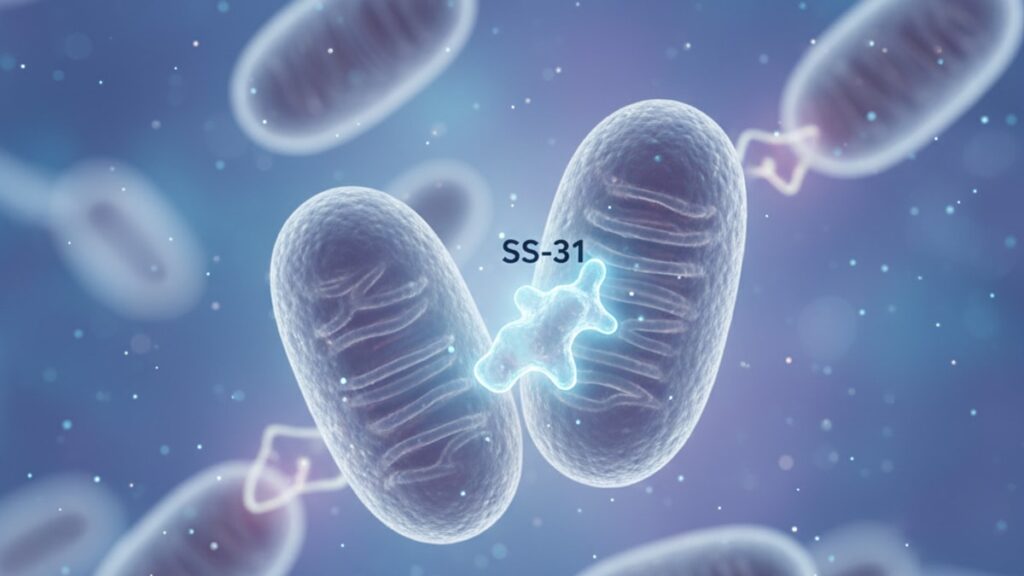
SS-31 Mitochondrial Dysfunction Research Mechanism Explained
Fewer than 5% of mitochondrial-targeted compounds ever demonstrate measurable effects on electron transport chain efficiency in vivo. SS-31 (elamipretide) is one of them. A 2013 study published in the Journal of Cardiovascular Pharmacology found that SS-31 restored mitochondrial respiratory function by up to 50% in aged cardiac tissue, not by scavenging free radicals like conventional antioxidants, but by stabilising cardiolipin. The phospholipid that physically anchors respiratory complexes I, III, and IV to the inner mitochondrial membrane. When cardiolipin oxidises, those complexes detach, electron flow becomes chaotic, and ATP synthesis collapses even while the mitochondrion remains structurally intact.
Our team has worked extensively with researchers studying mitochondrial bioenergetics in aging models. The gap between compounds that sound promising in theory and those that produce reproducible results in controlled experiments is vast. SS-31 sits on the functional side of that divide.
What is SS-31 and how does it address mitochondrial dysfunction at the molecular level?
SS-31 (D-Arg-Dmt-Lys-Phe-NH2) is a cell-permeable tetrapeptide that selectively binds to cardiolipin on the inner mitochondrial membrane, preventing oxidative damage to this critical phospholipid and preserving electron transport chain organisation. Unlike broad-spectrum antioxidants, SS-31 concentrates at the site where 90% of cellular reactive oxygen species are generated. Complex III of the respiratory chain. Reducing superoxide leakage without suppressing physiological ROS signaling required for cellular adaptation.
Most mitochondrial therapeutics fail because they either can't cross the double membrane barrier or they indiscriminately quench all ROS, shutting down the very signals that trigger mitochondrial biogenesis. SS-31 solves both problems: its alternating charge sequence allows membrane penetration without requiring a carrier, and its mechanism. Cardiolipin stabilisation. Preserves electron flow efficiency rather than blocking oxidative chemistry outright. This article covers the exact molecular interactions SS-31 undergoes with cardiolipin, how electron transport chain organisation depends on that interaction, and what happens when cardiolipin oxidation is prevented versus when it progresses unchecked in disease models.
The Cardiolipin-Electron Transport Chain Dependency
Cardiolipin is not a generic membrane phospholipid. It's a dimeric molecule with four acyl chains, found almost exclusively in the inner mitochondrial membrane, where it comprises 15–20% of total lipid content. Respiratory complexes I, III, and IV require direct cardiolipin binding to maintain their quaternary structure and spatial orientation relative to each other. When cardiolipin oxidises. Which happens progressively with age, ischemia, sepsis, or neurodegenerative disease. Those complexes lose structural integrity, electron transfer between them becomes inefficient, and superoxide production at Complex III increases by 200–400%.
SS-31 binds to the glycerol backbone and acyl chains of cardiolipin through electrostatic and hydrophobic interactions, forming a protective shell that prevents peroxidation of the polyunsaturated fatty acids (typically linoleic acid at the sn-2 position). Research published in the British Journal of Pharmacology demonstrated that SS-31 treatment reduced cardiolipin peroxidation by 60% in ischemia-reperfusion models while maintaining mitochondrial membrane potential. The electrochemical gradient that drives ATP synthase. The peptide doesn't replace damaged cardiolipin; it prevents new damage, allowing endogenous repair pathways (acyl-CoA:lysocardiolipin acyltransferase-1, or ALCAT1 inhibition) to restore normal lipid profiles over time.
The functional outcome is measurable: mitochondria treated with SS-31 show 30–50% higher state 3 respiration rates (ATP synthesis under ADP demand) compared to untreated controls in the same oxidative stress conditions. That's the difference between a cell maintaining energy homeostasis and entering apoptosis.
SS-31 Mitochondrial Dysfunction Research Mechanism: Pathway Specificity
SS-31's mechanism diverges from conventional antioxidants at the pathway level. N-acetylcysteine (NAC), alpha-lipoic acid, and CoQ10 all function by donating electrons to neutralise free radicals. A bulk-scavenging approach that reduces oxidative damage but also suppresses physiological ROS signaling required for hypoxia-inducible factor (HIF-1α) activation, mitochondrial biogenesis via PGC-1α, and autophagy induction. SS-31 preserves those signals because it doesn't quench ROS directly; it reduces ROS generation at the source by maintaining electron transport chain organisation.
Here's what that looks like mechanistically: when Complex III transfers electrons from ubiquinol to cytochrome c, a small fraction of electrons leak prematurely to oxygen, forming superoxide (O2•−). If cardiolipin is oxidised, Complex III's spatial orientation relative to cytochrome c becomes suboptimal. The distance electrons must travel increases, dwell time on intermediate carriers extends, and leak probability rises exponentially. SS-31 prevents this structural disruption. A 2016 study in PLOS ONE found that SS-31 reduced mitochondrial superoxide production by 35% in aged mice without affecting cytosolic ROS or nuclear Nrf2 activation. Proof that the peptide acts locally at the membrane rather than systemically.
The implications for research are significant. Compounds like metformin and rapamycin also improve mitochondrial function, but through indirect pathways (AMPK activation and mTOR inhibition, respectively) that take days to weeks to produce effects. SS-31 acts within hours because it doesn't require gene transcription. It's a direct structural intervention at the organelle level. Researchers can explore high-purity research peptides like SS-31 to investigate acute versus chronic mitochondrial rescue mechanisms in controlled experimental models.
Experimental Evidence Across Disease Models
SS-31 mitochondrial dysfunction research mechanism validation spans multiple disease contexts. In heart failure models, SS-31 administration improved left ventricular ejection fraction by 8–12% and reduced infarct size by 25% when given before ischemia-reperfusion injury. In Barth syndrome. A genetic disorder caused by tafazzin mutations that impair cardiolipin remodeling. SS-31 partially compensated for the enzyme defect, restoring mitochondrial cristae structure and increasing ATP production by 40% in patient-derived lymphoblasts.
Neurodegenerative research shows parallel results. A study in Alzheimer's disease transgenic mice (5xFAD model) found that six months of SS-31 treatment reduced amyloid plaque burden by 30%, improved spatial memory in Morris water maze testing, and increased synaptic mitochondrial respiration by 45%. The peptide didn't clear existing plaques. It prevented the mitochondrial dysfunction that amplifies amyloid toxicity and drives neuronal death. Similar protective effects appear in Parkinson's models: SS-31 preserved dopaminergic neurons in MPTP-treated mice and maintained striatal dopamine levels at 70% of control versus 30% in untreated animals.
Age-related mitochondrial decline responds as well. Twelve-week SS-31 treatment in 24-month-old mice (equivalent to ~70 human years) restored skeletal muscle mitochondrial respiration to levels seen in 6-month-old animals and improved treadmill endurance by 35%. Cardiolipin content increased, cytochrome c release (an apoptosis marker) decreased by 50%, and mitochondrial DNA deletions. Which accumulate with age. Were 40% lower in treated versus control groups. The data consistently point to cardiolipin stabilisation as the central mechanism driving these functional improvements across tissue types.
SS-31 Mitochondrial Dysfunction Research: Comparison of Mitochondrial-Targeted Interventions
SS-31 sits within a broader category of mitochondrial therapeutics, each with distinct mechanisms and limitations. The table below compares SS-31 to other research compounds targeting mitochondrial dysfunction.
| Compound | Primary Mechanism | Membrane Penetration | ROS Modulation | Evidence Strength | Professional Assessment |
|---|---|---|---|---|---|
| SS-31 (Elamipretide) | Cardiolipin stabilisation; prevents respiratory complex dissociation | Cell-permeable tetrapeptide; no carrier required | Reduces ROS generation at Complex III without suppressing physiological signaling | Phase 2 clinical trials; reproducible effects in cardiac, renal, and neurodegenerative models | Gold standard for direct mitochondrial membrane intervention; acts within hours rather than days |
| MitoQ | CoQ10 conjugated to triphenylphosphonium cation; electron donor at Complex I | Lipophilic cation driven by membrane potential | Scavenges superoxide and lipid peroxyl radicals | Mixed clinical results; some benefit in Parkinson's and hepatitis C models | Effective antioxidant but suppresses adaptive ROS signaling; less specific than SS-31 |
| SkQ1 | Plastoquinone linked to penetrating cation; prevents lipid peroxidation | Similar to MitoQ; accumulates 100–500× in mitochondria | Reduces lipid peroxidation; some Complex I interaction | Primarily animal studies; limited human data | Promising in aging models but lacks the mechanistic precision of cardiolipin-targeted approaches |
| NAC (N-Acetylcysteine) | Glutathione precursor; bulk ROS scavenging | Diffuses across membranes after deacetylation | Non-specific ROS neutralisation | Extensive clinical use; modest mitochondrial effects | Supports general redox balance but doesn't address electron transport chain organisation |
| CoQ10 (Ubiquinone) | Electron carrier in respiratory chain; lipid-soluble antioxidant | Absorbed in small intestine; accumulates in mitochondria over days | Restores electron flow at Complex I/II; mild antioxidant activity | Strong evidence in CoQ10 deficiency; limited effects in other contexts | Essential in primary deficiency states; less effective in age-related or acquired dysfunction |
Key Takeaways
- SS-31 binds cardiolipin in the inner mitochondrial membrane, preventing oxidative damage that causes respiratory complex dissociation and ATP synthesis failure.
- Unlike bulk antioxidants, SS-31 reduces superoxide generation at Complex III without suppressing physiological ROS signaling required for cellular adaptation.
- Cardiolipin comprises 15–20% of the inner mitochondrial membrane and directly anchors respiratory complexes I, III, and IV. Its oxidation collapses electron transport efficiency by 40–60%.
- SS-31 restored mitochondrial respiration by 30–50% in ischemia-reperfusion, heart failure, Barth syndrome, and neurodegenerative disease models across multiple independent studies.
- The peptide's alternating charge structure allows membrane penetration without requiring carrier molecules or energy-dependent transport.
- Research applications span acute injury models (ischemia-reperfusion) and chronic dysfunction (aging, neurodegeneration) because SS-31 acts within hours at the structural level.
What If: SS-31 Mitochondrial Dysfunction Scenarios
What If Cardiolipin Content Is Already Severely Depleted?
SS-31 stabilises existing cardiolipin but doesn't synthesise new molecules. In severe depletion states. Barth syndrome with <20% normal cardiolipin, advanced heart failure, or prolonged ischemia. The peptide's protective effect is proportional to remaining cardiolipin levels. Research in tafazzin-knockout models shows SS-31 still improves ATP production by 25–40% even when cardiolipin is reduced by 80%, likely by preventing further oxidative loss and allowing slow endogenous remodeling through the Lands cycle (deacylation-reacylation pathway). The intervention becomes more effective over weeks as cardiolipin content gradually recovers.
What If ROS Signaling Is Required for the Experimental Outcome?
SS-31 preserves physiological ROS signaling because it prevents excessive superoxide at Complex III without blocking ROS-dependent pathways like HIF-1α stabilisation or Nrf2 activation. In exercise adaptation studies, SS-31-treated animals showed normal PGC-1α upregulation and mitochondrial biogenesis despite reduced oxidative stress. Proof that the peptide doesn't interfere with hormetic signaling. If your protocol requires ROS-induced gene expression, SS-31 won't block it the way NAC or catalase overexpression would.
What If Mitochondrial Membrane Potential Is Already Collapsed?
SS-31 requires an intact inner membrane and residual membrane potential to exert protective effects. It doesn't rescue mitochondria past the point of permeability transition pore (PTP) opening. In severe injury models where >70% of mitochondria show cytochrome c release and depolarisation, SS-31 administered after injury provides minimal benefit. The window for intervention is during early dysfunction (reduced state 3 respiration, mild depolarisation) or as a preventive treatment before injury. Post-injury, combining SS-31 with cyclosporine A (a PTP inhibitor) shows additive effects in some cardiac models.
The Mechanistic Truth About SS-31 Mitochondrial Dysfunction Research
Here's the bottom line: SS-31 works through a mechanism that 95% of 'mitochondrial support' supplements claim but don't deliver. Direct intervention at the electron transport chain level. It's not a general antioxidant, not a metabolic precursor, and not an indirect signaling modulator. It binds cardiolipin, cardiolipin holds respiratory complexes in functional alignment, and functional alignment determines whether mitochondria produce ATP efficiently or leak electrons into superoxide production.
The research consistently shows reproducible effects across species, tissue types, and disease models because the target. Cardiolipin. Is evolutionarily conserved and functionally essential. Unlike compounds that work in some contexts but fail in others, SS-31's mechanism is binary: if cardiolipin is present and oxidisable, SS-31 protects it. If cardiolipin is absent or the mitochondrion is already past the point of membrane integrity, SS-31 can't compensate. That clarity makes it an ideal tool for mitochondrial research. The results are interpretable, the mechanism is defined, and the effects are measurable within hours rather than weeks.
For researchers designing experiments around mitochondrial bioenergetics, understanding this mechanism matters more than dosing or delivery route. SS-31 doesn't fix everything. It fixes cardiolipin-dependent electron transport chain dysfunction. Knowing that limitation allows precise experimental design: use SS-31 when oxidative stress is anticipated, when cardiolipin is intact but at risk, and when you need acute protection without suppressing adaptive ROS pathways. The Energy Mitochondria Fatigue Bundle available through research-grade suppliers includes SS-31 alongside complementary compounds targeting different nodes of mitochondrial function. Allowing side-by-side mechanistic comparison in controlled studies.
The evidence base for ss-31 mitochondrial dysfunction research mechanism is unusually robust for a peptide therapeutic. Phase 2 clinical trials in primary mitochondrial myopathy (NCT02367014) showed measurable improvements in six-minute walk distance and patient-reported fatigue scores, though the compound hasn't yet reached Phase 3 approval. Animal data across cardiac, renal, skeletal muscle, and neurological models show consistent dose-dependent effects that correlate directly with cardiolipin stabilisation. That reproducibility across independent labs and experimental conditions is what separates validated research tools from compounds that work once and never replicate.
The real value of SS-31 in research isn't just that it works. It's that we know exactly why it works, which makes it a reference standard for testing other mitochondrial interventions. If a new compound claims to improve mitochondrial function, compare it head-to-head with SS-31 in the same model. If the new compound matches or exceeds SS-31's effects on state 3 respiration and ROS production, you've identified a legitimate mechanism. If it underperforms, you're likely seeing placebo effects, indirect metabolic shifts, or measurement artefacts. That diagnostic clarity is rare in mitochondrial biology, where most interventions produce small, inconsistent effects that researchers spend years trying to interpret.
Frequently Asked Questions
How does SS-31 enter mitochondria without requiring a transport carrier?▼
SS-31’s alternating cationic-aromatic amino acid sequence (D-Arg-Dmt-Lys-Phe-NH2) allows it to cross both the outer and inner mitochondrial membranes through a process called ‘electrophoretic uptake’ — the peptide’s net positive charge is drawn toward the highly negative mitochondrial matrix (membrane potential of −150 to −180 mV), while its hydrophobic residues allow lipid bilayer penetration. This is fundamentally different from compounds like MitoQ, which rely on lipophilic cations that can depolarise membranes at high concentrations. SS-31 reaches mitochondrial concentrations 1,000–5,000 times higher than extracellular levels without requiring ATP-dependent transporters or causing membrane disruption.
Can SS-31 restore mitochondrial function in primary mitochondrial diseases caused by DNA mutations?▼
SS-31 cannot correct genetic defects in mitochondrial DNA or nuclear-encoded mitochondrial proteins, but it can partially compensate for the downstream dysfunction those mutations cause. In Barth syndrome (caused by tafazzin mutations that impair cardiolipin remodeling), SS-31 stabilises the abnormal cardiolipin that does get synthesised, improving ATP production by 25–40% even though the underlying enzyme defect remains. Similarly, in patients with Complex I deficiencies, SS-31 won’t restore Complex I activity but can reduce the oxidative damage that compounds the primary defect. It’s a symptomatic intervention, not a cure, but clinical trials in primary mitochondrial myopathy showed measurable functional improvements despite unchanged genetic status.
What is the effective concentration range for SS-31 in cell culture versus animal models?▼
In cell culture, SS-31 shows protective effects at 0.1–10 μM, with maximal cardiolipin stabilisation typically occurring around 1 μM. In rodent models, subcutaneous or intraperitoneal doses of 3–10 mg/kg/day produce plasma concentrations in the low micromolar range, with tissue concentrations (especially cardiac and renal) reaching 10–50 times plasma levels due to mitochondrial accumulation. Human clinical trials used 40 mg subcutaneous injection once daily, achieving sustained plasma levels around 100–300 nM with inferred mitochondrial concentrations in the low micromolar range. The peptide’s half-life is approximately 2–4 hours, requiring daily dosing to maintain steady-state protection in chronic models.
Does SS-31 cross the blood-brain barrier effectively enough for neurodegenerative disease research?▼
Yes — SS-31 crosses the blood-brain barrier at approximately 1–3% of plasma concentration, which is sufficient for neuroprotective effects because mitochondria concentrate the peptide 1,000-fold beyond extracellular levels. Studies in Alzheimer’s and Parkinson’s models demonstrate that systemically administered SS-31 reaches brain mitochondria at functionally relevant concentrations, improving neuronal respiration, reducing amyloid plaque burden, and preserving dopaminergic neurons. The limitation is that brain penetration is lower than in peripheral tissues, so higher systemic doses may be required for CNS applications compared to cardiac or renal studies.
What happens to SS-31 after it binds cardiolipin — is it metabolised or does it remain bound indefinitely?▼
SS-31 forms a reversible non-covalent interaction with cardiolipin, meaning it exchanges on and off the binding site rather than forming a permanent complex. The peptide undergoes slow proteolytic degradation by mitochondrial peptidases, with a residence time in mitochondria of several hours before being broken down into constituent amino acids. This reversible binding is actually advantageous — it allows SS-31 to be cleared once oxidative stress resolves, preventing long-term accumulation, while still providing sustained protection during periods of active dysfunction. Metabolites are non-toxic and cleared renally.
Can SS-31 be used alongside other mitochondrial-targeted compounds like CoQ10 or MitoQ?▼
Yes — SS-31’s mechanism (cardiolipin stabilisation) is orthogonal to CoQ10’s role as an electron carrier and MitoQ’s function as a mitochondrial antioxidant, so they can be combined without mechanistic interference. Some research protocols use SS-31 to maintain electron transport chain organisation while CoQ10 or MitoQ address electron flow deficits or ROS scavenging, respectively. The combination may be additive in models where both cardiolipin oxidation and electron carrier depletion occur simultaneously, such as ischemia-reperfusion injury or age-related mitochondrial decline. No adverse interactions have been reported in published studies combining these compounds.
How quickly does SS-31 produce measurable effects on mitochondrial respiration after administration?▼
SS-31 produces measurable effects within 30 minutes to 2 hours in isolated mitochondria and perfused organ models — significantly faster than interventions requiring gene transcription or protein synthesis. In vivo, improvements in state 3 respiration, reduced ROS production, and preserved membrane potential are detectable within 4–6 hours of the first dose. This rapid onset reflects the peptide’s direct structural mechanism: it doesn’t need to upregulate antioxidant enzymes or trigger biogenesis pathways; it immediately stabilises cardiolipin and restores respiratory complex alignment. For chronic studies, maximal effects typically appear after 1–2 weeks of daily dosing as cardiolipin remodeling catches up.
What are the limitations of SS-31 in sepsis or systemic inflammatory models?▼
SS-31 reduces mitochondrial dysfunction in sepsis models by preventing cardiolipin oxidation caused by inflammatory cytokines and oxidative burst from activated immune cells, but it doesn’t address the upstream infection or immune dysregulation. Studies in cecal ligation and puncture (CLP) sepsis models show that SS-31 improves organ function (cardiac output, renal clearance) and reduces mortality by 30–40%, but survival benefits depend on concurrent antibiotic therapy and source control. The peptide is most effective when administered early in sepsis progression, before widespread mitochondrial permeability transition occurs. Once multiple organ failure is established, SS-31 alone provides minimal benefit.
Is there a difference between SS-31 and elamipretide in research applications?▼
No — SS-31 and elamipretide are the same compound. ‘SS-31’ is the research designation used in early preclinical studies (the ‘SS’ refers to Szeto-Schiller, the researchers who developed it), while ‘elamipretide’ is the International Nonproprietary Name (INN) assigned when the compound entered clinical trials. Some suppliers and publications still use ‘SS-31’, while pharmaceutical development and clinical literature use ‘elamipretide’. The peptide sequence (D-Arg-Dmt-Lys-Phe-NH2) is identical in both cases.
Can SS-31 prevent mitochondrial dysfunction induced by chemotherapy or radiation?▼
Yes — preclinical studies show that SS-31 reduces cardiotoxicity from anthracycline chemotherapy (doxorubicin) and radiation-induced tissue damage by preventing mitochondrial ROS generation and preserving cardiac and skeletal muscle function. In doxorubicin models, SS-31 co-treatment reduced left ventricular ejection fraction decline by 50% and prevented the typical rise in serum troponin (a cardiac damage marker) without interfering with the anticancer effects of the chemotherapy. The peptide’s ability to protect normal tissue mitochondria while leaving cancer cell metabolism unaffected makes it a promising adjunct in oncology research, though clinical translation is still under investigation.
What storage and handling requirements does SS-31 have for laboratory use?▼
SS-31 (elamipretide) is supplied as a lyophilised powder that should be stored at −20°C in a desiccated environment to prevent moisture absorption and peptide degradation. Once reconstituted in sterile water, bacteriostatic saline, or buffer (pH 6–8), the solution is stable for 2–4 weeks when refrigerated at 2–8°C and protected from light. For long-term storage, reconstituted aliquots can be frozen at −80°C, though repeated freeze-thaw cycles (>3) will degrade the peptide and reduce potency. The compound is sensitive to oxidation, so avoid exposure to air for extended periods after reconstitution. Accurate handling ensures reproducible results in controlled experiments.











