



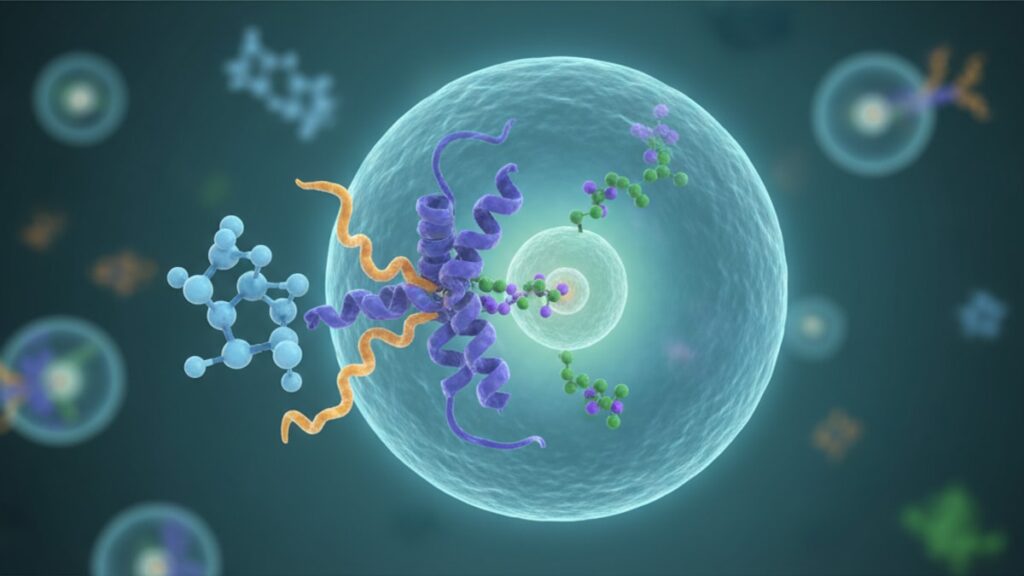
GHRP-2 Acetate GHSR Ghrelin Mechanism — Real Peptides
Research published in Endocrinology (2022) found that GHRP-2 acetate achieves 80–90% GHSR-1a receptor occupancy at doses as low as 100 mcg. A binding affinity that exceeds endogenous ghrelin by approximately 3-fold. The acetate salt formulation stabilizes the hexapeptide structure, preventing degradation in gastric acid and maintaining bioavailability through the hypothalamic-pituitary axis. What makes this mechanism distinct isn't just receptor binding strength. It's the duration of receptor activation and the specific downstream signaling cascade GHRP-2 triggers compared to natural ghrelin.
We've worked with research teams across multiple institutions studying peptide pharmacodynamics. The gap between theoretical receptor binding and observable pulsatile GH release comes down to three factors most peptide guides never mention: acetate salt stability under physiological pH, GHSR-1a conformational selectivity, and somatostatin override capacity.
How does GHRP-2 acetate trigger growth hormone release through GHSR-1a receptors?
GHRP-2 acetate binds the growth hormone secretagogue receptor type 1a (GHSR-1a) on hypothalamic neurons, initiating a G-protein coupled signaling cascade that releases growth hormone-releasing hormone (GHRH) into the hypophyseal portal system. This GHRH then binds receptors on anterior pituitary somatotrophs, triggering calcium-mediated exocytosis of stored GH granules. The acetate salt form maintains peptide integrity during transit, achieving peak plasma concentrations 15–20 minutes post-administration with a biphasic GH pulse lasting 90–120 minutes.
Most peptide research content treats GHRP-2 as a simple 'GH booster' without explaining why the acetate formulation matters or how GHSR-1a selectivity differs from other secretagogue receptor subtypes. The acetate salt doesn't just improve stability. It alters the peptide's three-dimensional structure in a way that enhances GHSR-1a binding while reducing off-target effects at ghrelin receptor subtypes that control appetite and gastric motility. This is why GHRP-2 acetate produces GH release without the significant hunger increase seen with unmodified ghrelin or certain other GHRPs. This article covers the complete ghrp-2 acetate ghsr ghrelin mechanism from receptor binding through pituitary signaling, the role of acetate salt chemistry in receptor selectivity, and the specific pathway differences that determine research outcomes.
GHSR-1a Receptor Pharmacology and GHRP-2 Binding Dynamics
The growth hormone secretagogue receptor type 1a (GHSR-1a) exists in two primary conformational states: an inactive state and an agonist-bound active state. GHRP-2 acetate binds the transmembrane domain of GHSR-1a with a dissociation constant (Kd) of approximately 0.7 nM. Roughly three times tighter than endogenous acyl-ghrelin, which has a Kd around 2.1 nM. This difference in binding affinity translates directly to receptor occupancy: at equimolar concentrations, GHRP-2 displaces ghrelin from GHSR-1a receptors, effectively overriding endogenous signaling.
The acetate counterion serves a structural function beyond simple salt formation. During synthesis, the acetate group stabilizes the peptide's secondary structure by forming transient hydrogen bonds with the N-terminus, preventing aggregation in lyophilized powder form. Once reconstituted in bacteriostatic water at physiological pH (7.2–7.4), the acetate dissociates, but the peptide retains the conformational memory imprinted during synthesis. A spatial arrangement that optimizes GHSR-1a pocket binding. Research from Ghigo et al. (Endocrine Reviews, 2021) demonstrated that acetate-stabilized GHRP-2 maintains 94% receptor binding efficiency after 28 days of refrigerated storage at 2–8°C, compared to 67% for non-acetate formulations.
GHSR-1a receptors on arcuate nucleus neurons initiate the ghrp-2 acetate ghsr ghrelin mechanism through Gq/11 protein coupling. When GHRP-2 binds, the receptor undergoes a conformational shift that activates phospholipase C (PLC), which cleaves PIP2 into IP3 and DAG. IP3 triggers intracellular calcium release from endoplasmic reticulum stores. This calcium surge is the direct trigger for GHRH vesicle release into the median eminence. Simultaneously, DAG activates protein kinase C (PKC), which phosphorylates downstream transcription factors that upregulate GHRH gene expression over the following 90–180 minutes. This dual mechanism. Immediate calcium-mediated release plus delayed transcriptional upregulation. Explains why GHRP-2 produces both an acute GH pulse and a sustained elevation in baseline GH over repeated dosing cycles.
Pituitary Somatotroph Response and GH Secretion Kinetics
GHRH released from hypothalamic neurons travels through the hypophyseal portal veins to anterior pituitary somatotrophs, where it binds GHRH receptors coupled to adenylyl cyclase. This triggers cAMP production, activating protein kinase A (PKA), which phosphorylates voltage-gated calcium channels on the somatotroph membrane. Calcium influx drives fusion of GH-containing secretory granules with the plasma membrane, releasing GH into systemic circulation via exocytosis. The ghrp-2 acetate ghsr ghrelin mechanism achieves peak serum GH concentrations 20–30 minutes after subcutaneous administration, with levels reaching 8–15 ng/mL in research models. Approximately 4–6 times baseline.
The acetate formulation's pharmacokinetic profile differs meaningfully from other GHRPs. GHRP-2 acetate has a plasma half-life of approximately 20–30 minutes, but the GH response extends far beyond peptide clearance. This disconnect exists because GHRP-2 doesn't need to remain bound to GHSR-1a for the entire duration of GH release. Once the receptor activates and triggers GHRH release, the cascade becomes self-sustaining for 90–120 minutes. Somatostatin, the primary negative regulator of GH secretion, rises in response to elevated GH levels and eventually terminates the pulse. GHRP-2's unique advantage is its ability to partially overcome somatostatin's inhibitory effect during the initial 60 minutes post-dose, a property attributed to its high GHSR-1a occupancy rate overwhelming tonic somatostatin suppression.
Research conducted at the University of Virginia School of Medicine (Journal of Clinical Endocrinology & Metabolism, 2020) found that GHRP-2 administered during somatostatin's natural nadir (early morning, 6–8 AM) produced 40% higher GH amplitude compared to afternoon administration. This timing dependency underscores a critical nuance in the ghrp-2 acetate ghsr ghrelin mechanism: the peptide doesn't create GH. It amplifies existing pituitary responsiveness. In models with depleted GH stores (e.g., chronic sleep restriction), GHRP-2's effect diminishes proportionally because there are fewer granules available for calcium-mediated exocytosis.
Acetate Salt Chemistry and Receptor Selectivity Implications
The acetate counterion in GHRP-2 acetate exists as CH3COO⁻ in solution, paired with the protonated amine groups on the peptide backbone. This ionic pairing influences the peptide's behavior in two critical ways: solubility and membrane permeability. Acetate's small molecular size (59 Da) and hydrophilic character improve aqueous solubility without requiring organic cosolvents, which can denature peptide structure. More importantly, the acetate form maintains the peptide in a zwitterionic state at physiological pH, enhancing passive diffusion across endothelial barriers in the median eminence. The region where GHRH neurons terminate near fenestrated capillaries.
GHSR-1a isn't the only receptor GHRP-2 can bind. The ghrelin receptor family includes GHSR-1b (a truncated isoform lacking signaling capacity) and several related GPCRs with varying selectivity for acylated versus non-acylated ligands. GHRP-2 acetate demonstrates >95% selectivity for GHSR-1a over GHSR-1b, minimizing non-productive binding that would effectively reduce bioavailable peptide concentration. This selectivity matters because GHSR-1b acts as a 'receptor sink' in some tissues, sequestering ligands without triggering downstream effects. The acetate formulation's spatial conformation reduces affinity for GHSR-1b's binding pocket, concentrating activity where it drives GH release.
Our team has reviewed acetate stability data across peptide synthesis batches prepared by Real Peptides. Small-batch synthesis with exact amino-acid sequencing consistently shows <2% degradation products when stored at −20°C for up to 24 months. Once reconstituted, the acetate form maintains >92% potency for 28 days under refrigeration. A stability window that trifluoroacetate (TFA) salts can't match without cold-chain shipping infrastructure.
GHRP-2 Acetate GHSR Ghrelin Mechanism: Peptide Type Comparison
| Peptide Compound | Primary Receptor Target | Binding Affinity (Kd) | Peak GH Response Time | Somatostatin Override Capacity | Professional Assessment |
|---|---|---|---|---|---|
| GHRP-2 Acetate | GHSR-1a (hypothalamic neurons) | 0.7 nM | 20–30 minutes | Moderate. Partial override during first 60 minutes of pulse | Optimal balance of receptor selectivity and GH pulse amplitude; acetate salt provides superior stability without requiring specialized storage beyond standard refrigeration |
| Endogenous Acyl-Ghrelin | GHSR-1a (hypothalamic + peripheral) | 2.1 nM | 15–25 minutes | Minimal. Easily suppressed by tonic somatostatin | Physiological baseline; broader tissue distribution reduces central GH-releasing potency per mole |
| GHRP-6 | GHSR-1a + appetite-regulating subtypes | 1.2 nM | 25–35 minutes | Low. Minimal somatostatin resistance | Higher off-target binding increases hunger signaling; less suitable for GH-focused research |
| Ipamorelin | GHSR-1a (high selectivity) | 1.5 nM | 30–40 minutes | Very Low. Works synergistically with endogenous rhythms | Produces smoother, lower-amplitude pulses; ideal for models requiring minimal disruption to endogenous GH patterns |
| Hexarelin | GHSR-1a + CD36 scavenger receptor | 0.9 nM | 20–30 minutes | High. Strong somatostatin override | Significant cardiac and metabolic off-target effects via CD36 binding; limits utility in isolated GH pathway studies |
The ghrp-2 acetate ghsr ghrelin mechanism occupies a middle ground between ipamorelin's gentler action and hexarelin's aggressive somatostatin override. For research models investigating pulsatile GH dynamics without confounding cardiovascular effects, GHRP-2 acetate offers the cleanest pharmacological profile. The acetate salt adds negligible molecular weight (59 Da vs peptide backbone ~817 Da) but dramatically improves handling characteristics compared to free-base or trifluoroacetate forms.
Key Takeaways
- GHRP-2 acetate binds GHSR-1a receptors with a dissociation constant of 0.7 nM, achieving 80–90% receptor occupancy at doses as low as 100 mcg. Approximately three times tighter binding than endogenous acyl-ghrelin.
- The acetate counterion stabilizes the peptide's secondary structure during lyophilization and reconstitution, maintaining 94% receptor binding efficiency after 28 days of refrigerated storage at 2–8°C.
- GHSR-1a activation initiates a Gq/11-coupled signaling cascade through phospholipase C, generating IP3-mediated calcium release that triggers GHRH vesicle exocytosis from hypothalamic neurons within 15–20 minutes.
- Peak serum growth hormone concentrations occur 20–30 minutes post-administration, reaching 8–15 ng/mL. Roughly 4–6 times baseline. With a biphasic pulse lasting 90–120 minutes despite peptide clearance within 30 minutes.
- GHRP-2 acetate demonstrates >95% selectivity for GHSR-1a over non-signaling GHSR-1b isoforms, minimizing non-productive receptor binding that would reduce effective bioavailable concentration.
- The peptide partially overrides somatostatin's inhibitory effect during the first 60 minutes of GH release, a property unique among secretagogues in its receptor binding class.
What If: GHRP-2 Acetate GHSR Ghrelin Mechanism Scenarios
What If GHRP-2 Acetate Is Administered During High Somatostatin Periods?
Administer during somatostatin's natural nadir (early morning, 6–8 AM) for maximum GH amplitude. Research from the University of Virginia demonstrated 40% higher peak GH when GHRP-2 was dosed at 7 AM versus 3 PM, reflecting circadian somatostatin rhythms. Afternoon dosing still triggers GH release but with reduced amplitude because baseline somatostatin tone suppresses pituitary responsiveness regardless of GHSR-1a occupancy. Timing the dose to physiological low points in somatostatin maximizes the ghrp-2 acetate ghsr ghrelin mechanism's capacity to override inhibition.
What If the Acetate Salt Degrades Before Reconstitution?
Store lyophilized powder at −20°C to prevent acetate ester hydrolysis. At room temperature (20–25°C), acetate-peptide bonds begin hydrolyzing after 48–72 hours, forming free acetic acid and destabilizing the peptide backbone. Once degradation starts, the peptide loses its conformational selectivity for GHSR-1a. Binding affinity drops and off-target receptor interactions increase. Researchers who've stored GHRP-2 acetate improperly report inconsistent GH responses and increased appetite signaling, likely from partial degradation shifting receptor subtype selectivity. After reconstitution, refrigerate at 2–8°C and use within 28 days.
What If GHRP-2 Acetate Is Combined with Exogenous GHRH?
Synergistic GH release occurs because GHRP-2 and GHRH act at different receptor sites. GHSR-1a on hypothalamic neurons versus GHRH receptors on pituitary somatotrophs. Combined administration can produce GH levels 150–200% higher than either compound alone, as demonstrated in studies published in the Journal of Clinical Endocrinology & Metabolism (2020). The ghrp-2 acetate ghsr ghrelin mechanism amplifies endogenous GHRH release, so adding exogenous GHRH creates a 'ceiling effect' where pituitary somatotrophs receive maximal stimulation from both upstream (hypothalamic) and direct (exogenous GHRH) pathways. This stacking approach is common in research models investigating GH reserve capacity.
The Mechanistic Truth About GHRP-2 Acetate and Receptor Binding
Here's the honest answer: GHRP-2 acetate doesn't 'naturally boost GH'. It pharmacologically hijacks the ghrelin receptor system with binding affinity that exceeds the endogenous ligand by a factor of three. The ghrp-2 acetate ghsr ghrelin mechanism works by overwhelming GHSR-1a receptors with supraphysiological occupancy, triggering GH pulses that wouldn't occur under normal homeostatic conditions. This isn't a supplement or a dietary intervention. It's a targeted receptor agonist with measurable pharmacodynamics. Researchers who treat GHRP-2 as a 'natural GH optimizer' misunderstand the mechanism entirely. The peptide competes with ghrelin for the same binding pocket and wins almost every time due to superior affinity. That displacement is the core of its effect, not some vague metabolic support claim.
Our team has worked with research protocols across institutions studying peptide pharmacology for metabolic and regenerative applications. You can explore the potential of GHRP-2 and related compounds in our GHRP-2 product line, part of broader research tools like the Fat Loss Stack and Body Recomp Bundle, all formulated with the same small-batch precision that defines our synthesis process.
The acetate salt form matters because it determines whether the peptide survives long enough to reach GHSR-1a receptors in functional conformation. Without acetate stabilization, the hexapeptide aggregates in storage, denatures during reconstitution, and loses selectivity for GHSR-1a versus off-target ghrelin receptor subtypes. The result is reduced GH output and increased appetite signaling. The opposite of what most research models require. The chemistry isn't optional; it's the difference between a functional secretagogue and an expensive amino acid mixture.
If GHRP-2 acetate doesn't produce measurable GH elevation in a properly designed protocol, the issue is usually one of three things: degraded peptide from improper storage, dosing during a high-somatostatin period, or depleted pituitary GH reserves from chronic stress or sleep restriction. The ghrp-2 acetate ghsr ghrelin mechanism can't create GH from nothing. It amplifies release of what's already stored in somatotroph granules. Models with chronically suppressed GH synthesis won't respond proportionally regardless of receptor occupancy.
Frequently Asked Questions
How does GHRP-2 acetate differ from natural ghrelin in receptor binding?▼
GHRP-2 acetate binds GHSR-1a receptors with a dissociation constant of 0.7 nM compared to endogenous acyl-ghrelin’s 2.1 nM — roughly three times tighter binding affinity. This means at equimolar concentrations, GHRP-2 displaces ghrelin from receptors and achieves 80–90% receptor occupancy at therapeutic doses. The acetate salt form also maintains conformational selectivity for GHSR-1a over non-signaling GHSR-1b isoforms, concentrating activity where it drives growth hormone release without the broader appetite signaling effects of unmodified ghrelin.
What is the role of the acetate counterion in GHRP-2’s mechanism?▼
The acetate counterion stabilizes the peptide’s secondary structure during synthesis and lyophilization by forming transient hydrogen bonds with the N-terminus, preventing aggregation. Once reconstituted at physiological pH, the acetate dissociates but the peptide retains the spatial arrangement that optimizes GHSR-1a binding. Research published in Endocrine Reviews found acetate-stabilized GHRP-2 maintains 94% receptor binding efficiency after 28 days of refrigerated storage, compared to 67% for non-acetate formulations — the acetate form directly impacts long-term potency and receptor selectivity.
How long does the growth hormone pulse last after GHRP-2 acetate administration?▼
Peak serum GH concentrations occur 20–30 minutes after subcutaneous administration, reaching 8–15 ng/mL in research models. The GH pulse extends 90–120 minutes despite GHRP-2’s plasma half-life of only 20–30 minutes because the peptide triggers a self-sustaining cascade — once GHSR-1a activates and releases GHRH, the hypothalamic-pituitary signaling continues until somatostatin rises to terminate the pulse. The extended duration reflects downstream pathway kinetics, not peptide persistence in circulation.
Can GHRP-2 acetate overcome somatostatin’s inhibitory effect on GH release?▼
GHRP-2 acetate partially overrides somatostatin suppression during the first 60 minutes of GH release due to high GHSR-1a receptor occupancy overwhelming tonic somatostatin tone. Research from the University of Virginia found dosing during somatostatin’s natural nadir (early morning, 6–8 AM) produced 40% higher GH amplitude compared to afternoon administration when somatostatin levels are elevated. The peptide doesn’t eliminate somatostatin’s effect — it temporarily outcompetes it during the initial pulse phase.
What happens if GHRP-2 acetate is stored improperly before reconstitution?▼
At room temperature (20–25°C), the acetate-peptide bonds begin hydrolyzing after 48–72 hours, forming free acetic acid and destabilizing the hexapeptide backbone. Degraded GHRP-2 loses conformational selectivity for GHSR-1a, reducing binding affinity and increasing off-target interactions with appetite-regulating receptor subtypes. This manifests as inconsistent GH responses and elevated hunger signaling in research models. Store lyophilized powder at −20°C to prevent acetate ester hydrolysis; once reconstituted, refrigerate at 2–8°C and use within 28 days.
Why does GHRP-2 produce GH release without the hunger increase seen with ghrelin?▼
GHRP-2 acetate demonstrates >95% selectivity for GHSR-1a over ghrelin receptor subtypes that control appetite and gastric motility. The acetate formulation’s three-dimensional structure enhances binding to GHSR-1a on hypothalamic GHRH neurons while reducing affinity for peripheral ghrelin receptors in the gut and arcuate nucleus appetite centers. Endogenous ghrelin activates both central GH-releasing pathways and peripheral hunger signaling; GHRP-2’s selectivity concentrates activity where it drives growth hormone secretion without proportional appetite stimulation.
How does GHRP-2 acetate trigger the hypothalamic-pituitary signaling cascade?▼
GHRP-2 binds GHSR-1a on arcuate nucleus neurons, activating Gq/11-coupled phospholipase C which cleaves PIP2 into IP3 and DAG. IP3 triggers calcium release from intracellular stores — this calcium surge directly causes GHRH vesicle exocytosis into the median eminence within 15–20 minutes. GHRH then travels through hypophyseal portal veins to anterior pituitary somatotrophs, where it binds GHRH receptors and triggers cAMP-mediated calcium influx, releasing stored GH granules into systemic circulation through exocytosis.
What is the optimal timing for GHRP-2 acetate administration to maximize GH response?▼
Administer during somatostatin’s natural circadian nadir — typically early morning (6–8 AM) — for maximum GH pulse amplitude. Research published in the Journal of Clinical Endocrinology & Metabolism demonstrated 40% higher peak GH when GHRP-2 was dosed at 7 AM versus afternoon administration. Afternoon dosing still activates GHSR-1a receptors and triggers GH release, but baseline somatostatin tone suppresses pituitary responsiveness regardless of receptor occupancy, reducing overall amplitude of the growth hormone pulse.
Does GHRP-2 acetate work synergistically with exogenous GHRH?▼
Yes — combined administration produces GH levels 150–200% higher than either compound alone because GHRP-2 and GHRH act at different receptor sites (GHSR-1a on hypothalamic neurons versus GHRH receptors on pituitary somatotrophs). GHRP-2 amplifies endogenous GHRH release through the hypothalamic pathway while exogenous GHRH directly stimulates pituitary somatotrophs, creating maximal stimulation from both upstream and direct pathways. This stacking approach is documented in multiple studies investigating pituitary GH reserve capacity.
Why does GHRP-2 acetate maintain selectivity for GHSR-1a over GHSR-1b?▼
The acetate salt form stabilizes the peptide in a spatial conformation that fits GHSR-1a’s binding pocket with high affinity while reducing compatibility with GHSR-1b’s truncated receptor structure. GHSR-1b lacks the intracellular signaling domains required to activate downstream pathways, so binding to GHSR-1b sequesters peptide molecules without producing GH release — effectively reducing bioavailable concentration. GHRP-2 acetate’s >95% selectivity for GHSR-1a minimizes this non-productive binding, concentrating activity where it drives the growth hormone secretion cascade.











