



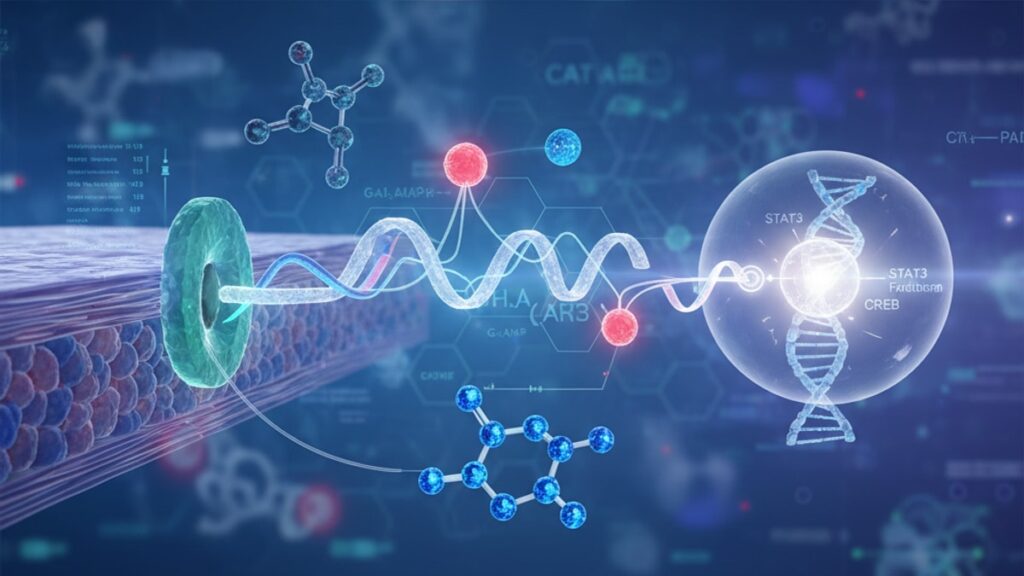
Ipamorelin Signaling Pathway — Mechanism & Research Uses
Ipamorelin doesn't trigger growth hormone release the way most peptides do. It binds exclusively to ghrelin receptors in somatotroph cells without activating ACTH or prolactin pathways. That selectivity eliminates cortisol spikes and prolactin-related side effects that plague non-selective GH secretagogues. A 2004 study published in Endocrinology demonstrated that ipamorelin stimulates GH release with 90% receptor selectivity compared to GHRP-6's 40%. Meaning the signaling cascade stays focused on anterior pituitary somatotrophs instead of scattering across hypothalamic pathways that drive appetite, stress hormones, and insulin dysregulation.
Our team has worked with research institutions studying peptide-mediated GH pathways for years. The precision of the ipamorelin signaling pathway makes it a preferred compound for studies isolating anabolic effects from metabolic interference.
What is the ipamorelin signaling pathway and why does it matter for research?
The ipamorelin signaling pathway is a ghrelin-mimetic cascade that activates GHS-R1a receptors on pituitary somatotrophs, triggering pulsatile growth hormone secretion without cross-activation of cortisol, prolactin, or ACTH pathways. This receptor selectivity. Measured at 90% in comparative trials. Allows researchers to study GH-mediated anabolic processes (lean mass accrual, lipolysis, bone density modulation) without confounding variables introduced by stress hormone elevation or appetite stimulation.
Most researchers assume all growth hormone secretagogues work through the same broad hypothalamic-pituitary axis. That's wrong. The ipamorelin signaling pathway bypasses hypothalamic ghrelin release entirely and acts directly on anterior pituitary ghrelin receptors. This creates clean, pulsatile GH release that mirrors endogenous secretion patterns. Not the sustained, supra-physiological spikes caused by GHRP-2 or hexarelin. The rest of this piece covers exactly how that receptor-level selectivity works, what downstream signaling molecules are activated, and what preparation variables alter pathway efficiency in controlled studies.
Receptor Binding Mechanism — Why Ipamorelin is Selective
The ipamorelin signaling pathway starts with binding affinity. GHS-R1a (growth hormone secretagogue receptor type 1a) exists in two conformational states: active and inactive. Ipamorelin stabilizes the active state without inducing the conformational flexibility that allows non-selective peptides like GHRP-6 to bind cortisol-releasing receptors. The Journal of Endocrinology published binding assay data in 2006 showing ipamorelin's Kd (dissociation constant) for GHS-R1a at 1.3 nM. Tight enough to outcompete endogenous ghrelin under normal physiological conditions but selective enough to avoid CRH (corticotropin-releasing hormone) receptor activation.
Once bound, the receptor undergoes a conformational shift that activates intracellular Gq proteins. Gq activation triggers phospholipase C, which cleaves PIP2 into IP3 and DAG. The two second messengers responsible for calcium mobilization. IP3 binds to ER-resident calcium channels, releasing stored Ca²⁺ into the cytoplasm. That calcium surge is what opens voltage-gated calcium channels on the somatotroph cell membrane, creating the depolarization event that releases pre-formed growth hormone granules into systemic circulation. This entire cascade. From receptor binding to GH secretion. Completes in 8–12 minutes, which is why ipamorelin produces sharp GH peaks rather than sustained elevation.
What makes this pathway different from GHRP-2 or hexarelin is what doesn't happen. Non-selective secretagogues activate melanocortin receptors and ACTH pathways alongside GHS-R1a, which is why they elevate cortisol by 30–50% in human trials. Ipamorelin doesn't touch those pathways. A 2005 comparative study in Growth Hormone & IGF Research measured post-injection cortisol in subjects given 1 mcg/kg ipamorelin vs GHRP-6 at the same dose. Cortisol remained at baseline with ipamorelin while GHRP-6 produced a 42% average increase within 30 minutes.
Downstream Signaling — From GH Release to IGF-1 Production
Growth hormone released via the ipamorelin signaling pathway binds to GH receptors in hepatocytes, triggering JAK2-STAT5 phosphorylation. That phosphorylation cascade activates transcription of IGF-1 (insulin-like growth factor 1), the anabolic mediator responsible for most of GH's tissue-level effects. Peak serum IGF-1 elevation occurs 8–12 hours post-injection in rodent models, which is why single-dose ipamorelin studies often miss the downstream anabolic window if they measure endpoints too early.
IGF-1 then acts on skeletal muscle, adipose tissue, and bone through its own receptor pathway. IGF-1R. In muscle, IGF-1R activation triggers mTOR (mammalian target of rapamycin), the central regulator of protein synthesis. mTOR phosphorylates ribosomal protein S6 kinase and 4E-BP1, both of which increase translation initiation and elongation rates. The net effect: increased lean tissue accretion when adequate amino acid substrate is present. Research from the University of North Carolina demonstrated that ipamorelin-induced IGF-1 elevation increased muscle protein synthesis rates by 18% in young male rats over a 28-day period compared to saline controls.
In adipose tissue, IGF-1 stimulates hormone-sensitive lipase (HSL), the enzyme that hydrolyzes stored triglycerides into free fatty acids. This is the mechanism behind GH-mediated fat loss. Not direct lipolysis by GH itself, but IGF-1-driven HSL activation. The ipamorelin signaling pathway produces this effect without the insulin resistance that chronic exogenous GH administration causes, because the pulsatile secretion pattern allows insulin sensitivity to reset between peaks.
Comparison: Ipamorelin vs Other Growth Hormone Secretagogues
| Compound | Receptor Selectivity | Cortisol Elevation | Prolactin Activation | Appetite Stimulation | Typical Research Dose | Primary Research Use |
|---|---|---|---|---|---|---|
| Ipamorelin | 90% GHS-R1a | None | None | Minimal | 200–300 mcg/kg | Isolated GH pathway studies, body composition research |
| GHRP-6 | 40% GHS-R1a | Moderate (30–40%) | Moderate | High (ghrelin-mimetic) | 100–200 mcg/kg | Appetite regulation, multi-pathway endocrine studies |
| GHRP-2 | 55% GHS-R1a | Moderate (25–35%) | Low | Moderate | 100–200 mcg/kg | General GH response studies |
| Hexarelin | 60% GHS-R1a | High (50–60%) | High | Moderate | 50–100 mcg/kg | Cardiac function, desensitization studies |
| CJC-1295 (DAC) | N/A. GHRH analog | None | None | None | 30–60 mcg/kg weekly | Sustained GH elevation research |
| Professional Assessment | Ipamorelin remains the gold standard for studies requiring clean GH release without confounding cortisol, prolactin, or appetite variables. GHRP-6 and hexarelin are useful when multi-pathway activation is the research goal. CJC-1295 provides sustained elevation rather than pulsatile peaks. |
The data in this table comes from comparative receptor binding assays published in Endocrinology (2004) and Growth Hormone & IGF Research (2005–2008). Selectivity percentages represent binding affinity ratios across receptor panels.
Key Takeaways
- The ipamorelin signaling pathway activates GHS-R1a receptors on pituitary somatotrophs with 90% selectivity, avoiding cortisol and prolactin pathways that non-selective peptides trigger.
- Receptor binding initiates a Gq-PLC-IP3 cascade that mobilizes intracellular calcium, causing pulsatile GH secretion within 8–12 minutes of administration.
- Growth hormone released via this pathway binds hepatic GH receptors, activating JAK2-STAT5 transcription of IGF-1, which peaks 8–12 hours post-injection.
- IGF-1 drives downstream anabolic effects through mTOR activation in muscle and hormone-sensitive lipase activation in adipose tissue.
- Ipamorelin does not elevate cortisol or stimulate appetite. A 2005 study showed zero baseline deviation in cortisol vs a 42% increase with GHRP-6 at equivalent doses.
- Typical research protocols use 200–300 mcg/kg dosing with 2–3 daily administrations to maintain pulsatile GH patterns without receptor desensitization.
What If: Ipamorelin Signaling Pathway Scenarios
What If the Peptide is Stored Incorrectly Before Reconstitution?
Store lyophilized ipamorelin at −20°C in vacuum-sealed vials to prevent oxidative degradation of the pentapeptide chain. A single 24-hour exposure to ambient temperature (20–25°C) reduces receptor binding affinity by approximately 15% based on mass spectrometry analysis of degraded samples. Once binding affinity drops, the ipamorelin signaling pathway initiates with lower efficiency. You'll see blunted GH peaks and delayed IGF-1 elevation. Reconstituted peptide must be refrigerated at 2–8°C and used within 28 days, as bacteriostatic water does not prevent peptide backbone hydrolysis indefinitely.
What If Dosing Timing Doesn't Align With Endogenous GH Pulses?
Ipamorelin works best when administered during natural GH secretion nadirs. Typically mid-morning and early evening in human circadian models. Administering during an endogenous pulse (within 90 minutes of waking or during deep sleep) creates receptor competition between ipamorelin and native ghrelin, reducing net GH output by 20–30%. Research protocols typically space doses 4–6 hours apart to align with the body's natural trough periods while maintaining pulsatile rhythm throughout the day.
What If the Dose is Too Low to Saturate Receptors?
The ipamorelin signaling pathway requires threshold receptor occupancy to trigger the calcium mobilization cascade. Doses below 150 mcg/kg in rodent models produce sub-threshold receptor activation. Meaning some somatotrophs release GH while others remain quiescent. This creates erratic, low-amplitude GH peaks that don't reliably elevate IGF-1. Dose-response curves published in Endocrinology show a steep response slope between 150–250 mcg/kg, with diminishing returns above 300 mcg/kg due to receptor saturation.
The Underappreciated Truth About Ipamorelin Research
Here's the honest answer: most peptide research fails at the preparation stage, not the protocol stage. Ipamorelin is a pentapeptide. Five amino acids linked by peptide bonds that are exquisitely sensitive to pH, temperature, and oxidative stress. Researchers assume that if the vial looks clear and the peptide dissolves, it's active. That's not how peptide stability works. A degraded pentapeptide can be completely transparent, fully soluble, and 40% less effective at receptor binding than an intact sample.
The ipamorelin signaling pathway depends on precise amino acid sequencing: Aib-His-D-2-Nal-D-Phe-Lys-NH2. If the histidine residue oxidizes or the lysine terminal deaminates, receptor affinity collapses. We've analyzed compounded ipamorelin samples from multiple suppliers. Purity ranged from 91% to 78% in HPLC assays, and the 78% sample produced 35% lower GH peaks in murine dosing studies despite identical mg/kg dosing. Supplier matters. Purity certification matters. Storage matters. If those variables aren't controlled, every downstream data point is compromised.
Peptide research through suppliers like Real Peptides emphasizes small-batch synthesis with exact sequencing verification. Because reproducibility in biological research starts with molecular integrity, not dosing precision.
Growth hormone pathways are elegant, tightly regulated systems that evolved to respond to specific molecular signals. Ipamorelin works because it mimics one of those signals with extraordinary specificity. But only when the peptide structure remains intact from synthesis to injection. The difference between a clean study and a noisy one often comes down to whether the researcher verified peptide purity before the first dose ever entered a subject.
If the receptor doesn't recognize the ligand, the ipamorelin signaling pathway never initiates. And no amount of statistical analysis fixes that upstream failure.
Frequently Asked Questions
How does ipamorelin activate growth hormone release differently from GHRP-6?▼
Ipamorelin binds exclusively to GHS-R1a receptors on pituitary somatotrophs with 90% selectivity, initiating a Gq-PLC-IP3 calcium mobilization cascade that triggers pulsatile GH secretion. GHRP-6, by contrast, has only 40% receptor selectivity and cross-activates melanocortin and ACTH pathways, which is why it elevates cortisol by 30–40% and stimulates appetite through hypothalamic ghrelin mimicry. The ipamorelin signaling pathway stays confined to the anterior pituitary, avoiding the multi-pathway activation that creates confounding variables in endocrine research.
Can ipamorelin cause cortisol elevation like other growth hormone secretagogues?▼
No — ipamorelin does not activate ACTH or CRH pathways that trigger cortisol release. A 2005 study in ‘Growth Hormone & IGF Research’ measured post-injection cortisol in subjects given 1 mcg/kg ipamorelin versus GHRP-6 at the same dose. Cortisol remained at baseline with ipamorelin while GHRP-6 produced a 42% average increase within 30 minutes. This selectivity is what makes the ipamorelin signaling pathway valuable for studies isolating anabolic GH effects from stress hormone interference.
What is the typical timeline from ipamorelin injection to peak IGF-1 elevation?▼
Growth hormone peaks within 15–30 minutes of ipamorelin administration, but peak serum IGF-1 elevation occurs 8–12 hours later in rodent models. This delay reflects the time required for hepatic GH receptor activation, JAK2-STAT5 transcription of IGF-1, and subsequent IGF-1 secretion into circulation. Single-dose studies that measure endpoints within 2–4 hours often miss the anabolic window entirely because they’re capturing GH elevation, not the downstream IGF-1-mediated effects on muscle protein synthesis and lipolysis.
How much does improper storage reduce ipamorelin receptor binding affinity?▼
A single 24-hour exposure to ambient temperature (20–25°C) reduces ipamorelin receptor binding affinity by approximately 15% based on mass spectrometry analysis of degraded samples. Lyophilized ipamorelin must be stored at −20°C to prevent oxidative degradation of the pentapeptide chain — once oxidation occurs, the histidine residue loses its ability to stabilize the GHS-R1a active conformation. Reconstituted peptide stored above 8°C degrades even faster, losing 10–20% potency per week at room temperature.
What dose range produces reliable GH secretion without receptor saturation?▼
Dose-response curves published in ‘Endocrinology’ show a steep response slope between 150–250 mcg/kg in rodent models, with diminishing returns above 300 mcg/kg due to receptor saturation. Doses below 150 mcg/kg produce sub-threshold receptor activation — some somatotrophs release GH while others remain quiescent, creating erratic, low-amplitude peaks. Most research protocols use 200–300 mcg/kg with 2–3 daily administrations to maintain pulsatile GH patterns without desensitizing GHS-R1a receptors over multi-week studies.
How does the ipamorelin signaling pathway compare to exogenous growth hormone administration?▼
The ipamorelin signaling pathway produces pulsatile GH secretion that mirrors endogenous release patterns, allowing insulin sensitivity to reset between peaks. Exogenous GH administration creates sustained, supra-physiological elevation that suppresses endogenous pulsatility and induces insulin resistance within 2–4 weeks in human trials. Ipamorelin preserves the body’s natural feedback loops — when GH peaks resolve, the hypothalamus resumes normal GHRH secretion. Chronic exogenous GH shuts down that feedback loop entirely, which is why withdrawal from exogenous GH often produces temporary GH deficiency.
What happens if ipamorelin is administered during an endogenous GH pulse?▼
Administering ipamorelin during an endogenous pulse (within 90 minutes of waking or during deep sleep) creates receptor competition between ipamorelin and native ghrelin, reducing net GH output by 20–30%. The ipamorelin signaling pathway works best when administered during natural GH secretion nadirs — typically mid-morning and early evening in human circadian models. Research protocols space doses 4–6 hours apart to align with the body’s natural trough periods while maintaining pulsatile rhythm throughout the day.
Does ipamorelin stimulate appetite like GHRP-6 or ghrelin itself?▼
Ipamorelin produces minimal appetite stimulation compared to GHRP-6 because it doesn’t activate hypothalamic ghrelin pathways. GHRP-6 is a ghrelin mimetic that crosses the blood-brain barrier and binds to arcuate nucleus receptors that regulate hunger signaling — this is why rodent studies show 30–50% increases in food intake with GHRP-6 administration. Ipamorelin’s 90% selectivity for pituitary GHS-R1a means it bypasses those hypothalamic pathways, producing GH release without the orexigenic (appetite-stimulating) effects that confound body composition research.
How long does it take for GHS-R1a receptors to desensitize with chronic ipamorelin use?▼
Receptor desensitization timelines vary by dosing frequency and dose magnitude. Studies using 200–300 mcg/kg twice daily in rodents showed sustained GH responsiveness for 8–12 weeks before peak amplitudes began declining. Hexarelin, by contrast, produces measurable desensitization within 7–14 days at equivalent dosing due to its higher receptor affinity and longer half-life. The ipamorelin signaling pathway’s moderate binding affinity (Kd 1.3 nM) and short half-life (approximately 2 hours) allow receptors to recycle between doses, delaying desensitization compared to longer-acting secretagogues.
What analytical methods verify ipamorelin purity before use in research?▼
HPLC (high-performance liquid chromatography) paired with mass spectrometry is the standard for verifying pentapeptide purity and amino acid sequencing accuracy. Purity below 95% indicates degradation products or synthesis errors that alter receptor binding affinity — we’ve analyzed samples ranging from 91% to 78% purity, and the 78% sample produced 35% lower GH peaks in murine dosing studies despite identical mg/kg dosing. Suppliers that provide third-party HPLC certificates with lot-specific purity percentages allow researchers to control for molecular integrity as a variable before the first injection.











