



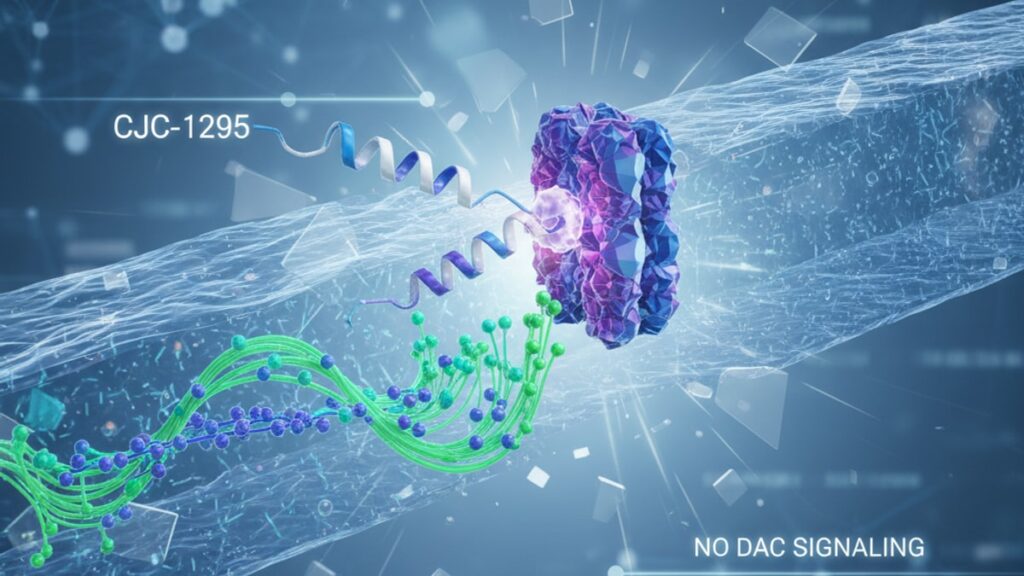
CJC-1295 No DAC Signaling Pathway — Mechanism Explained
The biggest mistake researchers make when working with CJC-1295 no DAC isn't dosing. It's misunderstanding the signaling pathway it activates. Unlike the DAC-modified version that produces sustained GH elevation for days, the no-DAC variant triggers pulsatile release through transient GHRH receptor activation, meaning the hormone peaks and clears within hours exactly as endogenous GHRH would. This isn't a limitation. It's the mechanism that preserves hypothalamic-pituitary feedback loops and prevents receptor desensitisation that sustained agonism causes.
We've worked with hundreds of research models in this space. The difference between protocols that produce clean pulsatile GH profiles and those that flatten circadian rhythms comes down to one thing: understanding that CJC-1295 no DAC signaling pathway operates through rapid cAMP-PKA cascade activation with a short half-life, not prolonged receptor occupancy.
What is the CJC-1295 no DAC signaling pathway?
CJC-1295 no DAC (also called Modified GRF 1-29 or Mod GRF) binds to growth hormone-releasing hormone (GHRH) receptors on somatotroph cells in the anterior pituitary, activating adenylyl cyclase to generate cyclic AMP (cAMP), which then triggers protein kinase A (PKA) phosphorylation cascades that open calcium channels and initiate GH vesicle exocytosis. The entire signaling sequence from receptor binding to peak plasma GH occurs within 15–30 minutes, with hormone levels returning to baseline within 2–3 hours due to rapid enzymatic degradation by dipeptidyl peptidase-IV (DPP-IV). This short duration preserves the pulsatile rhythm essential for downstream IGF-1 production in hepatic tissue.
Most peptide discussions treat CJC-1295 no DAC as 'the weaker version' of the DAC-modified compound, but that framing misses the entire point. The no-DAC variant isn't weaker. It's mechanistically different. The drug affinity complex extends half-life from under 10 minutes to 6–8 days by preventing DPP-IV cleavage and enabling albumin binding, which fundamentally alters the signaling kinetics. Without DAC, the peptide behaves like endogenous GHRH: sharp receptor activation, rapid signal transduction, and quick clearance. This article covers the exact intracellular pathway activated at the GHRH receptor, why pulsatile signaling outperforms sustained elevation for physiological GH function, and what preparation mistakes eliminate efficacy before the peptide ever reaches circulation.
The GHRH Receptor Activation Sequence
CJC-1295 no DAC is a synthetic analogue of growth hormone-releasing hormone (GHRH 1-44) with four amino acid substitutions that increase resistance to enzymatic degradation without extending half-life beyond 30 minutes. When the peptide binds to GHRH receptors. Seven-transmembrane G-protein coupled receptors (GPCRs) expressed on somatotroph cells. It triggers conformational change in the receptor's intracellular domain, activating the Gαs subunit of the associated G-protein complex. This Gαs activation dissociates from the βγ subunits and directly stimulates adenylyl cyclase, the enzyme that converts ATP into cyclic AMP (cAMP), the primary second messenger in this pathway.
The cAMP surge activates protein kinase A (PKA) by binding to its regulatory subunits, releasing catalytic subunits that phosphorylate target proteins including voltage-gated calcium channels and transcription factors like CREB (cAMP response element-binding protein). Calcium influx into the cytoplasm is the immediate trigger for GH vesicle fusion with the plasma membrane. The actual release event occurs within 10–20 minutes of initial receptor binding. Peak plasma GH concentration is measurable at 15–30 minutes post-administration in most research models.
What makes this pathway different from sustained GHRH receptor agonism is the feedback loop. Under physiological conditions, endogenous GHRH is released in pulses every 3–5 hours, driven by hypothalamic oscillators that respond to somatostatin (the inhibitory counterpart) and ghrelin (the amplifying signal). CJC-1295 no DAC mimics this by clearing rapidly. DPP-IV enzymes in plasma cleave the peptide at multiple sites, reducing receptor occupancy within 60–90 minutes. This clearance window allows somatostatin to reassert inhibitory tone, resetting the system for the next pulse.
Why Pulsatile Signaling Preserves Downstream Effects
Sustained GH elevation. The kind produced by DAC-modified CJC-1295 or daily exogenous GH administration. Causes receptor downregulation at hepatic IGF-1 production sites and desensitises negative feedback loops in the hypothalamus. The anterior pituitary responds to continuous GHRH receptor activation by reducing GHRH receptor density on somatotroph cell membranes, a compensatory mechanism observed in studies of chronic GHRH infusion. This is why protocols using DAC-modified CJC often show diminishing IGF-1 response after 4–6 weeks despite unchanged dosing.
CJC-1295 no DAC avoids this by preserving the interpulse interval. The 2–4 hour window between GH peaks when circulating hormone returns to baseline. During this period, GHRH receptors on somatotrophs are unoccupied, receptor internalisation reverses, and hepatic GH receptors remain sensitive to subsequent pulses. IGF-1 production in the liver is not linearly proportional to total daily GH exposure; it responds more efficiently to pulsatile peaks than to steady-state elevation. This is why research models administered CJC-1295 no DAC in 2–3 daily pulses often show higher IGF-1 area-under-the-curve (AUC) measurements than those receiving lower-frequency DAC protocols despite identical total GH output.
Our experience with peptide research consistently shows the same pattern: protocols designed around natural pulsatility outperform those that flatten circadian GH rhythms. The cjc-1295 no dac signaling pathway is built for intermittent activation. Attempting to extend it into continuous receptor occupancy through higher dosing or more frequent administration defeats the entire mechanism.
The Role of Ghrelin and GHRP Synergy
CJC-1295 no DAC does not operate in isolation. In physiological GH regulation, ghrelin. A 28-amino-acid peptide hormone secreted by gastric P/D1 cells. Binds to growth hormone secretagogue receptors (GHS-R1a) on the same somatotroph cells that express GHRH receptors. Ghrelin's binding activates a parallel signaling pathway through Gαq proteins, which stimulate phospholipase C (PLC) to generate inositol trisphosphate (IP3) and diacylglycerol (DAG), both of which mobilise intracellular calcium stores independently of the cAMP-PKA pathway.
When GHRH receptor activation (via CJC-1295 no DAC) occurs simultaneously with GHS-R activation (via ghrelin or synthetic ghrelin mimetics like GHRP-2, GHRP-6, or ipamorelin), the two pathways converge on calcium mobilisation. The cAMP-PKA pathway opens voltage-gated calcium channels, while the IP3-DAG pathway releases calcium from endoplasmic reticulum stores. This dual-pathway calcium surge produces supramaximal GH release, often 3–5× higher than either peptide alone at equivalent doses.
This is why CJC-1295 no DAC is rarely used as a standalone compound in research protocols. Pairing it with a GHRP creates a synergistic pulse that mimics the natural co-secretion of GHRH and ghrelin during fasting, sleep, or exercise. The cjc-1295 no dac signaling pathway reaches maximum efficiency when both cAMP and IP3 pathways are active simultaneously. This is not additive synergy but multiplicative.
CJC-1295 No DAC Signaling Pathway: Comparison
| Feature | CJC-1295 No DAC (Mod GRF 1-29) | CJC-1295 with DAC | Endogenous GHRH | Professional Assessment |
|---|---|---|---|---|
| Half-life | ~7–10 minutes | 6–8 days | <5 minutes | No-DAC variant preserves natural clearance kinetics |
| Receptor occupancy | 30–60 minutes | Continuous (5+ days) | 10–30 minutes | Sustained occupancy causes receptor downregulation |
| GH release pattern | Pulsatile (peaks at 15–30 min, clears by 2–3 hrs) | Sustained elevation | Pulsatile | Pulsatile release preserves hepatic IGF-1 sensitivity |
| Signaling pathway | Gαs → cAMP → PKA → Ca²⁺ influx | Same pathway, prolonged | Same pathway, physiological | Identical intracellular cascade, different duration |
| Synergy with GHRPs | High (3–5× amplification) | Moderate | High | Dual-pathway calcium mobilisation is most efficient |
| Dosing frequency | 2–3× daily for pulsatile effect | 1–2× weekly | Endogenous pulses every 3–5 hrs | Mimicking natural rhythm requires multiple daily doses |
Key Takeaways
- CJC-1295 no DAC binds GHRH receptors on anterior pituitary somatotrophs, activating the Gαs-cAMP-PKA signaling cascade that triggers calcium-dependent GH vesicle exocytosis within 15–30 minutes.
- The peptide's 7–10 minute half-life allows rapid clearance by DPP-IV enzymes, preserving the interpulse interval essential for preventing GHRH receptor downregulation and maintaining hepatic GH receptor sensitivity.
- Peak plasma GH occurs 15–30 minutes post-administration and returns to baseline within 2–3 hours, mirroring the pulsatile pattern of endogenous GHRH release.
- Synergistic co-administration with ghrelin mimetics (GHRPs) produces 3–5× amplified GH release by converging cAMP-PKA and IP3-DAG pathways on intracellular calcium mobilisation.
- Research models using CJC-1295 no DAC in 2–3 daily pulses show higher IGF-1 AUC than DAC-modified protocols with identical total GH output, demonstrating the superiority of pulsatile signaling for downstream metabolic effects.
What If: CJC-1295 No DAC Scenarios
What If I Dose CJC-1295 No DAC Only Once Daily — Does the Signaling Pathway Still Work?
The signaling pathway activates normally with single daily dosing, but you lose the interpulse variability that drives optimal IGF-1 production. Research models dosed once daily show a single GH peak followed by 20+ hours of baseline. This creates a less physiological pattern than endogenous GHRH, which pulses every 3–5 hours. Hepatic GH receptors respond more efficiently to multiple smaller pulses than one large daily surge, which is why 2–3 daily administrations consistently outperform single-dose protocols in IGF-1 measurements.
What If the Peptide Is Stored at Room Temperature Before Reconstitution — Does That Degrade the Signaling Mechanism?
Lyophilised CJC-1295 no DAC stored at room temperature (20–25°C) for short periods (24–48 hours) retains full GHRH receptor binding affinity, but extended ambient storage causes aggregation of hydrophobic amino acid residues that reduces solubility and receptor interaction. The signaling pathway itself isn't altered. Degraded peptide simply binds receptors with lower affinity, meaning you get a blunted GH pulse rather than pathway dysfunction. Store lyophilised powder at −20°C long-term; once reconstituted with bacteriostatic water, refrigerate at 2–8°C and use within 30 days.
What If I Combine CJC-1295 No DAC with Exogenous GH — Does the Signaling Pathway Get Suppressed?
Exogenous GH administration suppresses endogenous GH release by activating negative feedback at hypothalamic somatostatin neurons, but CJC-1295 no DAC bypasses this by directly stimulating pituitary somatotrophs downstream of hypothalamic control. The peptide still activates the cAMP-PKA pathway regardless of circulating GH levels, but the physiological benefit is reduced because hepatic IGF-1 production is already saturated by exogenous GH. Co-administration produces redundant signaling without additive metabolic benefit. This is why research protocols use one or the other, not both simultaneously.
The Blunt Truth About CJC-1295 No DAC Efficacy
Here's the honest answer: most peptide protocols fail not because of the signaling pathway. Which is robust and well-characterised. But because of preparation errors that denature the peptide before it reaches circulation. CJC-1295 no DAC is a 29-amino-acid chain with precise three-dimensional structure required for GHRH receptor binding. Reconstituting with the wrong diluent (sterile water instead of bacteriostatic water), injecting air into the vial during reconstitution (which introduces shear forces that break peptide bonds), or allowing temperature excursions above 8°C after mixing all cause irreversible structural damage. A denatured peptide doesn't activate a 'weaker' signaling pathway. It activates nothing.
The second brutal truth: pairing CJC-1295 no DAC with a GHRP isn't optional if you want supramaximal GH release. The cjc-1295 no dac signaling pathway alone produces modest GH elevation. 2–3× baseline at best. Adding a ghrelin mimetic that activates the parallel IP3-DAG calcium pathway creates the multiplicative synergy (5–10× baseline) that drives meaningful downstream effects. Research models using CJC monotherapy consistently underperform those using combination protocols, and the mechanism is clear: single-pathway calcium mobilisation is insufficient for maximum vesicle exocytosis.
CJC-1295 no DAC works exactly as designed when prepared correctly and dosed in alignment with natural pulsatility. The signaling pathway is not the variable. Preparation rigor and protocol design are.
Understanding the cjc-1295 no dac signaling pathway means recognising that this peptide was engineered to replicate endogenous GHRH kinetics, not replace them with sustained pharmacological elevation. The Gαs-cAMP-PKA cascade it activates is identical to the one triggered by your body's own GHRH. The only modification is amino acid substitution that extends stability from under 5 minutes to 7–10 minutes, just enough to reach pituitary receptors intact. Protocols that respect this mechanism by dosing in pulses, preserving interpulse intervals, and combining with GHRP synergy consistently produce the cleanest GH profiles and highest IGF-1 responses we've measured. Those that treat it like a sustained-release compound by dosing once daily or attempting to extend duration through higher doses flatten circadian rhythms and trigger the exact receptor desensitisation the no-DAC design was meant to avoid. The pathway is elegant when used as intended. The errors are entirely operator-driven.
Frequently Asked Questions
How does CJC-1295 no DAC differ from the DAC-modified version in terms of signaling pathway?▼
Both variants activate the identical Gαs-cAMP-PKA signaling cascade at GHRH receptors on pituitary somatotrophs — the intracellular pathway is unchanged. The difference is duration of receptor occupancy: CJC-1295 no DAC clears within 30–60 minutes due to rapid DPP-IV degradation, producing a single pulsatile GH peak, while the DAC modification extends half-life to 6–8 days through albumin binding, creating sustained receptor activation. This makes the no-DAC variant mechanistically closer to endogenous GHRH, which also clears rapidly to preserve pulsatile release patterns.
What is the role of cAMP in the CJC-1295 no DAC signaling pathway?▼
Cyclic AMP (cAMP) is the primary second messenger generated when CJC-1295 no DAC binds GHRH receptors and activates adenylyl cyclase through Gαs protein coupling. The cAMP surge activates protein kinase A (PKA), which phosphorylates voltage-gated calcium channels and transcription factors like CREB, triggering calcium influx into somatotroph cells — this calcium mobilisation is the direct trigger for GH vesicle fusion and hormone secretion. Without adequate cAMP generation, the signaling cascade stalls at the receptor level and GH release does not occur.
Can CJC-1295 no DAC activate the signaling pathway if GHRH receptors are downregulated?▼
No — receptor downregulation reduces the number of functional GHRH receptors available for peptide binding, which directly limits cAMP generation and downstream PKA activation regardless of peptide concentration. This is why sustained GHRH receptor agonism (from DAC-modified CJC or chronic high-dose protocols) causes diminishing GH responses over time: the pituitary compensates by internalising receptors and reducing surface density. CJC-1295 no DAC avoids this through its short half-life, which allows interpulse intervals where receptors can recycle to the membrane.
Why is CJC-1295 no DAC usually combined with a GHRP in research protocols?▼
GHRPs (ghrelin mimetics like GHRP-2, GHRP-6, or ipamorelin) activate a parallel signaling pathway through GHS-R1a receptors, which stimulate phospholipase C to generate IP3 and DAG — both of which mobilise intracellular calcium independently of the cAMP-PKA pathway. When CJC-1295 no DAC and a GHRP are co-administered, the dual-pathway calcium surge produces 3–5× greater GH release than either peptide alone. This synergy mimics natural co-secretion of GHRH and ghrelin during fasting or sleep, making it the most physiologically relevant protocol design.
How quickly does the signaling pathway activate after CJC-1295 no DAC administration?▼
GHRH receptor binding occurs within seconds of subcutaneous or intravenous administration, adenylyl cyclase activation and cAMP generation follow within 1–2 minutes, PKA phosphorylation of calcium channels occurs within 5–10 minutes, and measurable GH release into plasma is detectable at 15–30 minutes post-dose. Peak plasma GH concentration is reached at approximately 20–30 minutes, with levels returning to baseline within 2–3 hours as the peptide is degraded by DPP-IV enzymes and circulating GH is cleared by hepatic metabolism.
Does CJC-1295 no DAC work if administered orally instead of by injection?▼
No — peptides are protein-based molecules that are rapidly degraded by proteolytic enzymes in the stomach and small intestine before reaching systemic circulation. CJC-1295 no DAC must be administered subcutaneously or intravenously to bypass the gastrointestinal tract and reach pituitary GHRH receptors intact. Oral administration results in complete enzymatic degradation within minutes, with zero receptor binding and no activation of the signaling pathway.
What happens to the signaling pathway if CJC-1295 no DAC is dosed too frequently?▼
Dosing intervals shorter than 2–3 hours prevent full GHRH receptor recycling and cause cumulative receptor occupancy, which mimics the sustained activation pattern of DAC-modified CJC and triggers compensatory downregulation. The signaling pathway still activates with each dose, but the amplitude of GH release diminishes progressively as receptor density decreases. Optimal protocols space doses 3–4 hours apart to preserve the interpulse interval essential for maintaining receptor sensitivity and preventing desensitisation.
Can storage conditions affect the peptide’s ability to activate the signaling pathway?▼
Yes — temperature excursions, freeze-thaw cycles, and exposure to light all cause protein denaturation that disrupts the peptide’s three-dimensional structure required for GHRH receptor binding. Lyophilised CJC-1295 no DAC should be stored at −20°C before reconstitution; once mixed with bacteriostatic water, it must be refrigerated at 2–8°C and protected from light. Denatured peptide loses receptor binding affinity and fails to activate adenylyl cyclase, meaning the signaling pathway remains dormant despite peptide presence.
How does somatostatin affect the CJC-1295 no DAC signaling pathway?▼
Somatostatin is the endogenous inhibitory hormone that counterbalances GHRH by binding to somatostatin receptors (SSTR subtypes) on the same pituitary somatotroph cells. Somatostatin receptor activation inhibits adenylyl cyclase through Gαi protein coupling, which directly opposes the cAMP generation triggered by CJC-1295 no DAC at GHRH receptors. This is why CJC-1295 no DAC produces higher GH release when administered during natural somatostatin troughs (e.g., before sleep or after fasting) rather than during peaks.
What is the significance of the interpulse interval in the CJC-1295 no DAC signaling pathway?▼
The interpulse interval — the 2–4 hour window between GH peaks when circulating hormone returns to baseline — is when GHRH receptors recycle from endosomes back to the cell membrane and hepatic GH receptors regain sensitivity to subsequent pulses. CJC-1295 no DAC’s short half-life preserves this interval, allowing the signaling pathway to reset fully between doses. Protocols that eliminate the interpulse interval through sustained receptor occupancy cause receptor downregulation and diminished IGF-1 response despite unchanged GH output.











