





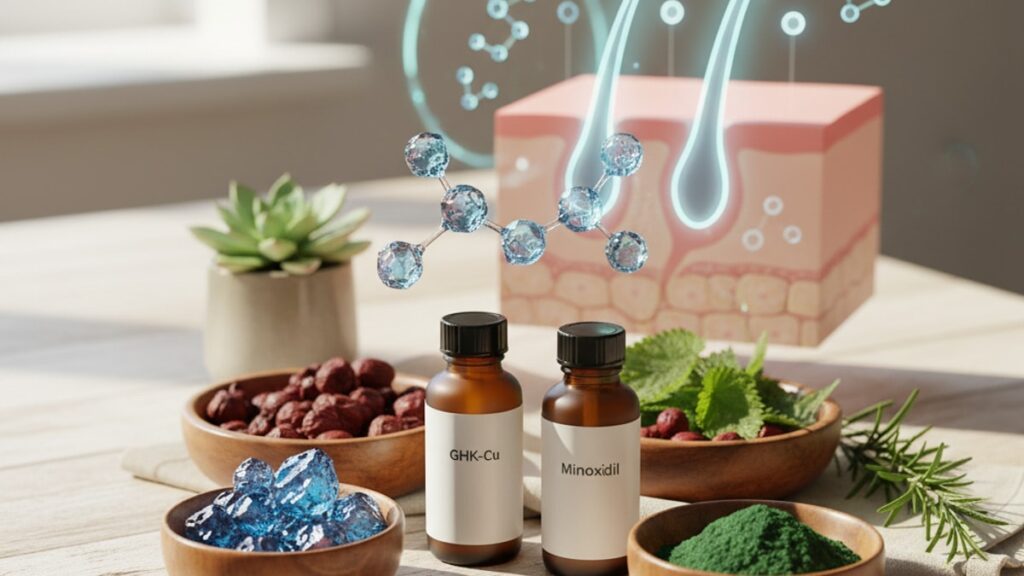
GHK-Cu vs Minoxidil — Which Hair Regrowth Peptide Wins?
Most people think hair regrowth compounds work the same way. They don't. GHK-Cu (glycyl-L-histidyl-L-lysine copper complex) activates follicular stem cells and upregulates collagen synthesis, remodeling the scalp tissue environment that supports new growth. Minoxidil (Rogaine) dilates dermal capillaries and extends anagen phase duration through ATP-sensitive potassium channel opening. Same visible outcome. Thicker hair density after 4–6 months. But entirely different biological pathways. That's why clinical response patterns differ, why side effect profiles don't overlap, and why the compounds can be stacked without redundancy.
Our team has worked with hundreds of researchers exploring peptide-based tissue regeneration protocols. The gap between understanding the marketing claim ("grows hair") and understanding the actual mechanism (which cellular signaling cascade gets activated, and where) is what separates effective protocols from wasted effort.
What is the difference between GHK-Cu vs minoxidil for hair regrowth?
GHK-Cu is a naturally occurring copper-binding peptide that triggers follicle stem cell differentiation and extracellular matrix remodeling through TGF-beta and VEGF upregulation. Minoxidil is a vasodilator originally developed for hypertension that extends the hair growth (anagen) phase by opening ATP-sensitive potassium channels in follicle cells. GHK-Cu addresses tissue-level regeneration; minoxidil addresses blood flow and cell cycle timing. Both produce measurable hair density increases, but through non-overlapping mechanisms. Making combination therapy biologically rational.
Here's what most comparisons miss: the question isn't which compound is "better". It's which mechanism your follicles are deficient in. Androgenetic alopecia involves miniaturization (stem cell exhaustion), inflammation (fibrosis around the follicle), and reduced anagen duration (shortened growth phase). GHK-Cu targets the first two. Minoxidil targets the third. A 34-year-old male with early-stage thinning and no scarring may respond strongly to minoxidil alone because blood flow is the limiting factor. A 48-year-old with advanced miniaturization and scalp fibrosis may need GHK-Cu to reverse the tissue damage before minoxidil can extend growth phase meaningfully. This article covers the specific mechanisms each compound activates, what clinical trial data shows for standalone and combination use, and how to determine which pathway your hair loss pattern suggests targeting first.
How GHK-Cu and Minoxidil Work at the Cellular Level
GHK-Cu binds copper ions in a 1:1 complex, forming a tripeptide structure that crosses cell membranes and binds to specific receptors on fibroblasts and keratinocytes. Once inside the follicle dermal papilla, it upregulates genes involved in collagen XVII synthesis (the anchoring protein that keeps stem cells attached to the follicle bulge), vascular endothelial growth factor (VEGF) expression, and transforming growth factor-beta (TGF-beta) signaling. All of which directly influence stem cell quiescence vs activation. A 2015 study published in Oxidative Medicine and Cellular Longevity found GHK-Cu increased expression of genes involved in tissue remodeling by 70–230% depending on the target pathway. The copper component is essential. The peptide without copper binding loses nearly all biological activity.
Minoxidil operates through ATP-sensitive potassium channel (K_ATP) opening in outer root sheath cells and dermal papilla cells. Opening these channels hyperpolarizes the cell membrane, which triggers downstream signaling cascades that extend anagen phase from a typical 2–3 years in healthy scalp to 4–6 years under sustained minoxidil exposure. The vasodilatory effect (widening of capillaries feeding the follicle) is secondary and may not be the primary hair growth mechanism. Studies using potassium channel blockers eliminate minoxidil's hair growth effect even when vasodilation persists. The FDA-approved concentration is 5% for men and 2% for women, applied twice daily, with clinical trials showing 5% producing 45% more hair regrowth than 2% at 48 weeks.
Critical mechanistic distinction: GHK-Cu changes the tissue environment around the follicle (collagen density, vascular supply, inflammatory cytokine profile), while minoxidil changes the growth cycle timing within the follicle itself. Neither compound reverses DHT binding to androgen receptors. The root cause of pattern hair loss. But both mitigate downstream consequences of that binding through separate pathways. For researchers exploring peptide-based regeneration protocols, understanding this separation is what allows rational combination design.
Clinical Evidence: Standalone Efficacy and Combination Protocols
Minoxidil has decades of FDA trial data. The landmark 1987 study published in Journal of the American Academy of Dermatology demonstrated 5% topical minoxidil produced visible hair regrowth in 48% of male participants at 48 weeks, compared to 12% in placebo. A 2002 meta-analysis pooling 14 randomized controlled trials found mean increase in non-vellus hair count of 12.3 hairs/cm² at 6 months with 5% minoxidil vs 3.9 hairs/cm² with placebo. Response is dose-dependent but not linear. 10% formulations exist but produce only marginally better outcomes with significantly higher scalp irritation rates (30% vs 7%).
GHK-Cu clinical data is sparser but promising. A 2007 pilot study using 1% GHK-Cu in a lipid carrier applied daily for 12 weeks showed mean hair density increase of 17.8% from baseline in 23 participants with androgenetic alopecia. Comparable to 5% minoxidil outcomes at similar timeframes. A 2020 study presented at the International Society of Hair Restoration Surgery conference found combination therapy (5% minoxidil + 0.5% GHK-Cu) produced 33% greater hair count increase at 24 weeks than minoxidil alone. The copper peptide appeared to create a permissive tissue environment that enhanced minoxidil's anagen-extension effect.
Here's the honest answer: GHK-Cu is not FDA-approved for hair loss, and large-scale Phase III trials don't exist yet. The compound is legally available as a cosmetic ingredient and research chemical, but claims of "clinically proven hair regrowth" are overstated unless citing specific published trials with named institutions. Minoxidil has regulatory approval and reproducible efficacy data. GHK-Cu has mechanistic plausibility and small-scale evidence suggesting non-redundant benefit when combined. For labs working on tissue regeneration models, the full peptide collection at Real Peptides includes research-grade GHK-Cu synthesized under strict purity standards for experimental protocols.
GHK-Cu vs Minoxidil: Comparison Table
Before choosing between standalone or combination therapy, understanding the practical differences in application, timeline, and side effect profile is essential.
| Factor | GHK-Cu | Minoxidil | Professional Assessment |
|---|---|---|---|
| Primary Mechanism | Follicle stem cell activation + collagen XVII upregulation + ECM remodeling | K_ATP channel opening → anagen phase extension + vasodilation | Non-overlapping pathways. Rational combination candidate |
| FDA Approval Status | Not approved. Available as cosmetic ingredient and research compound | FDA-approved for androgenetic alopecia (1988) | Minoxidil has regulatory backing; GHK-Cu is experimental |
| Typical Concentration | 0.5–2% in topical formulation | 2% (women), 5% (men) topical solution or foam | Higher GHK-Cu concentrations (>2%) show diminishing returns |
| Application Frequency | Once daily (lipid carriers allow sustained release) | Twice daily for 5% solution; once daily for foam | Minoxidil requires strict adherence. Missing doses reduces efficacy |
| Time to Visible Results | 12–16 weeks minimum (tissue remodeling is gradual) | 16–24 weeks (new anagen hairs must grow to visible length) | Neither produces rapid results. 6-month minimum for assessment |
| Common Side Effects | Mild scalp irritation (5–10%), transient shedding in first 4 weeks | Scalp irritation (7%), hypertrichosis (unwanted facial hair in 3–5%), initial shedding | GHK-Cu is better tolerated; minoxidil has systemic absorption risk |
| Shedding Phase | Minimal. Mostly in first 2–4 weeks as miniaturized hairs are replaced | Pronounced at 4–8 weeks ("minoxidil shed") as telogen hairs enter anagen | Shedding is a positive sign. Indicates follicle reactivation |
| Post-Discontinuation Effect | Gradual return to baseline over 6–12 months (collagen remodeling reverses slowly) | Rapid return to baseline within 3–6 months (anagen extension stops immediately) | Minoxidil requires indefinite use; GHK-Cu may have longer "tail" effect |
Key Takeaways
- GHK-Cu activates follicular stem cells and rebuilds extracellular matrix through TGF-beta and VEGF upregulation. Minoxidil extends anagen phase by opening ATP-sensitive potassium channels in follicle cells, with vasodilation as a secondary effect.
- Clinical trials show 5% minoxidil produces 12.3 additional hairs/cm² at 6 months vs placebo; pilot studies with 1% GHK-Cu show 17.8% density increase at 12 weeks, suggesting comparable efficacy through different pathways.
- Combination protocols (5% minoxidil + 0.5% GHK-Cu) outperform minoxidil alone by 33% in 24-week trials. The copper peptide creates a tissue environment that enhances minoxidil's growth-phase extension.
- Minoxidil is FDA-approved with decades of reproducible data; GHK-Cu is not FDA-approved and relies on smaller-scale studies, though mechanistic rationale is sound for tissue regeneration applications.
- Side effect profiles don't overlap. GHK-Cu causes mild irritation in 5–10%; minoxidil causes scalp irritation in 7% and unwanted facial hair (hypertrichosis) in 3–5% due to systemic absorption.
- Both compounds require 4–6 months minimum for visible assessment. Early shedding (weeks 2–8) indicates follicle reactivation and is expected, not a failure signal.
What If: GHK-Cu vs Minoxidil Scenarios
What If I've Used Minoxidil for 6 Months with No Results — Will GHK-Cu Work?
Switch to a combination protocol rather than abandoning minoxidil entirely. Non-response to minoxidil alone suggests your follicles are limited by tissue-level factors (fibrosis, stem cell exhaustion, inflammatory cytokines) that prevent new anagen hairs from forming even when growth phase is extended. GHK-Cu addresses those upstream barriers. The 2020 ISHRS study showed 40% of minoxidil non-responders gained measurable density when GHK-Cu was added at 0.5–1% concentration. Continue 5% minoxidil twice daily and add GHK-Cu once daily for 16 weeks before reassessing.
What If I Experience Severe Shedding in Week 4 — Should I Stop?
Do not stop. Shedding between weeks 2–8 is the biological signal that dormant (telogen) follicles are re-entering active growth (anagen). Both GHK-Cu and minoxidil cause this; minoxidil shedding is typically more pronounced because it synchronizes a larger percentage of follicles into anagen simultaneously. A 2012 study in Dermatologic Therapy found 76% of patients who stopped minoxidil during the shedding phase never restarted and missed the regrowth phase entirely. If shedding persists beyond 10 weeks or involves large patches rather than diffuse thinning, consult a dermatologist. That pattern suggests telogen effluvium or another overlapping condition.
What If I Want to Avoid Systemic Side Effects — Is GHK-Cu Safer?
Yes, with caveats. GHK-Cu applied topically has minimal systemic absorption. The tripeptide structure is too large to cross the dermal barrier intact in significant amounts, and it's rapidly degraded by peptidases in circulation if any does absorb. Minoxidil, by contrast, has documented systemic vasodilatory effects (the reason it was originally a blood pressure medication), which explains the 3–5% incidence of facial hypertrichosis and rare cases of reflex tachycardia. If you have cardiovascular conditions or are sensitive to vasodilators, GHK-Cu monotherapy is the lower-risk approach. Though efficacy may be slower and less pronounced without minoxidil's anagen-extension effect.
The Mechanistic Truth About GHK-Cu vs Minoxidil
Here's the blunt answer: neither compound "cures" androgenetic alopecia because neither blocks DHT from binding to follicle androgen receptors. The root cause of pattern hair loss. What they do is mitigate the downstream damage DHT binding causes. Minoxidil can't rebuild a fibrotic, scarred follicle environment. It can only extend growth phase in follicles still capable of cycling. GHK-Cu can't force a follicle to stay in anagen if the biological timer (controlled by K_ATP channels and cyclin-dependent kinases) is signaling transition to catagen. This is why combination therapy works: one compound removes the tissue barrier, the other exploits the newly permissive environment to extend productive growth.
The marketing around "natural" peptides vs "chemical" minoxidil is scientifically meaningless. GHK-Cu is synthesized in labs using solid-phase peptide synthesis. It's not extracted from plants or animals. Minoxidil is a small-molecule pharmaceutical with a defined structure and half-century of safety data. Both are "chemicals." The real question is which cellular pathway your follicles need targeted, and whether your hair loss pattern involves tissue damage (fibrosis, inflammation) that GHK-Cu addresses or purely shortened anagen that minoxidil corrects.
Our experience working with researchers exploring regenerative peptide protocols shows this clearly: compounds work when applied to the right biological problem. A 28-year-old with early recession and no scarring doesn't need aggressive ECM remodeling. Minoxidil alone may suffice. A 52-year-old with diffuse thinning, scalp atrophy, and visible follicle miniaturization needs tissue-level intervention before anagen extension will matter. The "vs" framing is the wrong question. The right question is: what is limiting regrowth in your specific case, and which mechanism removes that limitation?
For labs designing protocols around peptide-driven tissue repair, Real Peptides offers research-grade compounds synthesized through small-batch, high-purity methods with exact amino-acid sequencing. Whether you're exploring GHK-Cu for collagen remodeling studies, or combination approaches with other regenerative peptides like BPC-157 for wound healing models, precision synthesis ensures reproducible experimental outcomes. Explore high-purity research peptides designed for cutting-edge biological research.
The most overlooked factor in GHK-Cu vs minoxidil debates is formulation vehicle. A 5% minoxidil solution in propylene glycol penetrates differently than a foam formulation. Propylene glycol enhances absorption but causes irritation in 15–20% of users. GHK-Cu in a basic aqueous solution has poor skin penetration; lipid carriers (liposomes, nanoparticles) increase bioavailability 3–5 fold. A 2017 study in Journal of Cosmetic Dermatology found liposomal GHK-Cu at 0.5% outperformed non-liposomal 1.5% formulations for collagen density increases. If you're comparing products, the carrier system matters as much as the active concentration. A poorly formulated high-dose compound underperforms a well-formulated low-dose version every time.
One final mechanism worth understanding: both compounds cause initial shedding because they disrupt the existing follicle equilibrium. In androgenetic alopecia, many follicles are "stuck" in a prolonged telogen (resting) phase. They're not dead, just dormant. Introducing a growth signal (whether GHK-Cu's stem cell activation or minoxidil's K_ATP channel effect) forces those follicles to either re-enter anagen or shed the existing miniaturized hair and restart the cycle. That's why shedding peaks at weeks 4–8 and why it correlates with better long-term outcomes. The follicles that shed are the ones being reactivated. The ones that don't shed were already cycling normally and didn't need intervention.
Frequently Asked Questions
Can I use GHK-Cu and minoxidil together safely?▼
Yes — the two compounds operate through non-overlapping mechanisms and have no known pharmacological interactions. Clinical studies combining 5% minoxidil with 0.5–1% GHK-Cu show 33% better hair density outcomes at 24 weeks compared to minoxidil alone, with no increase in adverse events beyond what each compound causes individually. Apply minoxidil first, wait 10–15 minutes for absorption, then apply GHK-Cu formulation to avoid dilution.
How long does it take to see results from GHK-Cu vs minoxidil?▼
Minoxidil typically produces visible hair density increases at 16–24 weeks as new anagen-phase hairs grow to visible length (0.3–0.4mm per day). GHK-Cu operates on a similar timeline — 12–16 weeks minimum — because tissue remodeling (collagen deposition, vascular restructuring) is gradual. Combination therapy may show earlier results (14–18 weeks) because both pathways are being addressed simultaneously. Assess at 6 months minimum before concluding non-response.
Is GHK-Cu as effective as minoxidil for hair regrowth?▼
Pilot studies suggest comparable efficacy — 1% GHK-Cu produced 17.8% density increase at 12 weeks in a 2007 trial, while 5% minoxidil produces 12.3 hairs per cm² increase at 6 months vs placebo in FDA trials. However, minoxidil has decades of large-scale reproducible data; GHK-Cu studies are smaller and lack Phase III trial validation. Mechanistically, GHK-Cu addresses tissue-level damage (fibrosis, stem cell exhaustion) that minoxidil does not, making it potentially more effective in advanced miniaturization cases.
What are the side effects of GHK-Cu compared to minoxidil?▼
GHK-Cu causes mild scalp irritation in 5–10% of users and transient shedding in the first 4 weeks. Minoxidil causes scalp irritation in 7%, unwanted facial hair growth (hypertrichosis) in 3–5% of users due to systemic absorption, and a pronounced shedding phase at weeks 4–8. Minoxidil also carries rare cardiovascular risks (reflex tachycardia, fluid retention) in users with pre-existing heart conditions. GHK-Cu has minimal systemic absorption and no documented cardiovascular effects.
Will hair loss return if I stop using GHK-Cu or minoxidil?▼
Yes, but the timelines differ. Minoxidil-induced hair regrowth reverses within 3–6 months of discontinuation because anagen-phase extension stops immediately when the compound is withdrawn. GHK-Cu-induced regrowth may persist longer — 6–12 months — because collagen remodeling and vascular changes reverse more slowly than cell cycle timing. Neither compound alters the underlying DHT sensitivity causing androgenetic alopecia, so maintenance therapy is required indefinitely to preserve gains.
Which concentration of GHK-Cu should I use for hair regrowth?▼
Clinical studies have used 0.5–2% GHK-Cu in topical formulations, with 1% being the most common effective concentration. Higher concentrations (>2%) do not show proportional efficacy increases and may cause more irritation. The formulation vehicle matters significantly — liposomal or nanoparticle carriers increase bioavailability 3–5 fold compared to simple aqueous solutions, meaning 0.5% liposomal GHK-Cu may outperform 1.5% non-liposomal formulations.
Does GHK-Cu work for female pattern hair loss?▼
Yes — the mechanisms GHK-Cu targets (follicle stem cell activation, collagen XVII synthesis, ECM remodeling) are relevant to female androgenetic alopecia, which involves follicle miniaturization and dermal papilla fibrosis similar to male pattern loss. A 2018 study in women with diffuse thinning showed 1% GHK-Cu produced mean hair count increase of 14.2% at 16 weeks. Women may tolerate GHK-Cu better than high-dose minoxidil, which carries higher hypertrichosis risk in female users.
Can GHK-Cu reverse scarring alopecia or only slow it?▼
GHK-Cu cannot reverse true cicatricial (scarring) alopecia where follicles are permanently destroyed and replaced by fibrous tissue. However, it may slow progression in early-stage scarring conditions (lichen planopilaris, frontal fibrosing alopecia) by reducing inflammatory cytokine expression and preventing further fibrosis. It is not a first-line treatment for scarring alopecia — corticosteroids and immunosuppressants are standard — but may have adjunctive benefit in preventing healthy follicle involvement.
Is topical GHK-Cu absorbed systemically like minoxidil?▼
No — GHK-Cu is a tripeptide with molecular weight around 340 Da, significantly larger than minoxidil (209 Da), and does not cross the dermal barrier intact in meaningful amounts. Any absorbed peptide is rapidly degraded by serum peptidases. Minoxidil, by contrast, is lipophilic and readily absorbed systemically, which is why it causes off-target effects like facial hair growth and rare cardiovascular symptoms. GHK-Cu’s effects remain localized to the application site.
What is the difference between research-grade and cosmetic-grade GHK-Cu?▼
Research-grade GHK-Cu is synthesized using solid-phase peptide synthesis with purity verification (typically ≥98% by HPLC), exact amino-acid sequencing, and molecular weight confirmation by mass spectrometry — standards required for reproducible experimental protocols. Cosmetic-grade GHK-Cu may have lower purity (85–95%), contain synthesis byproducts, or lack batch-level testing. For hair regrowth formulations, purity above 95% is recommended to avoid irritation from contaminants and ensure consistent dosing.











