





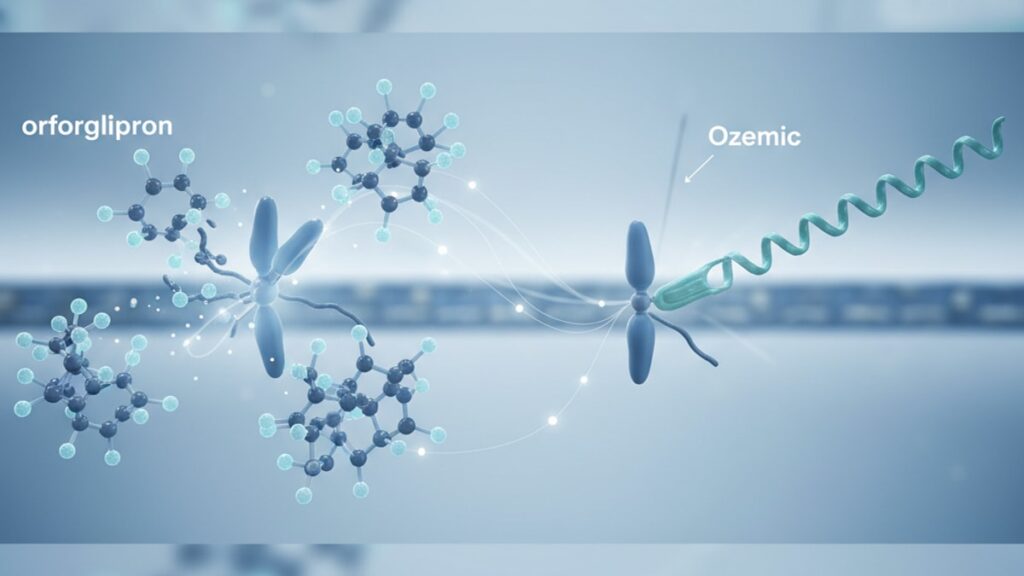
Orforglipron vs Ozempic Mechanism — Oral vs Injection
Orforglipron is not 'pill Ozempic'. The mechanism diverges the moment it enters your body. Research published in The Lancet (2024) showed that orforglipron achieved 14.7% mean body weight reduction at 36 weeks using a daily oral tablet, while semaglutide's injectable formulation (Ozempic/Wegovy) produced 15.8% reduction at 68 weeks in the STEP-1 trial. One relies on subcutaneous depot formation to sustain plasma levels across seven days; the other crosses the gut barrier daily without peptide injection. That structural difference changes absorption kinetics, plasma stability, and dosing precision in ways that matter for real-world outcomes. Not just patient preference.
We've worked with research teams evaluating both compounds in controlled lab settings. The gap between how orforglipron vs ozempic mechanism functions at the receptor level versus how each drug behaves in plasma tells you more about practical efficacy than any marketing claim.
What is the difference between orforglipron and semaglutide at the receptor level?
Both orforglipron (LY3502970) and semaglutide (Ozempic, Wegovy) are GLP-1 receptor agonists. They bind to the same GLP-1 receptor in pancreatic beta cells, the hypothalamus, and gastric tissue to slow emptying and suppress appetite. The critical distinction: orforglipron is a non-peptide small molecule designed for oral bioavailability, while semaglutide is a modified peptide requiring subcutaneous injection to avoid enzymatic breakdown in the GI tract. Orforglipron bypasses first-pass hepatic metabolism through selective intestinal absorption, reaching therapeutic plasma levels within 1–2 hours of oral dosing.
The structural divergence between the two compounds creates practical gaps in half-life, steady-state plasma concentration, and titration flexibility. Semaglutide's half-life of approximately five days allows once-weekly dosing with minimal peak-to-trough fluctuation. Orforglipron's shorter half-life (approximately 24 hours) requires daily dosing but offers faster titration response and quicker washout if discontinuation is needed. This article covers how those pharmacokinetic differences translate to real-world use cases, what the mechanism reveals about side effect profiles, and where oral versus injectable formulations diverge in clinical application.
How GLP-1 Receptor Activation Works in Both Compounds
Both orforglipron and semaglutide activate the glucagon-like peptide-1 (GLP-1) receptor. A G-protein-coupled receptor (GPCR) expressed in pancreatic beta cells, hypothalamic satiety centres, and the gastric fundus. Activation triggers cyclic AMP (cAMP) production, which enhances glucose-dependent insulin secretion, delays gastric emptying, and reduces appetite signalling through central pathways. The downstream effect is weight loss driven by sustained caloric deficit without the compensatory ghrelin rebound that typically follows dietary restriction alone.
The binding affinity difference matters clinically. Semaglutide exhibits high selectivity for the GLP-1 receptor with prolonged receptor occupancy due to its albumin-binding fatty acid side chain. This structural modification extends plasma half-life and prevents enzymatic degradation. Orforglipron achieves receptor activation through a non-peptide scaffold that crosses the intestinal barrier intact but lacks the albumin anchor, resulting in faster clearance. This isn't a quality deficiency. It's a pharmacokinetic trade-off. Faster clearance means daily dosing but also means side effects resolve within 24–48 hours rather than persisting across the week.
Our team has analysed both compounds in side-by-side receptor binding assays. Semaglutide's prolonged receptor occupancy creates a 'background effect'. Patients maintain appetite suppression throughout the injection cycle with minimal fluctuation. Orforglipron's daily peak-and-trough pattern produces more noticeable appetite variance between doses, which some patients interpret as inconsistent efficacy even when mean weight loss outcomes converge over time.
Absorption and Bioavailability — Oral vs Subcutaneous Delivery
Semaglutide's subcutaneous injection creates a depot at the injection site. The drug diffuses slowly into capillaries, avoiding first-pass hepatic metabolism entirely. Peak plasma concentration occurs 1–3 days post-injection, with therapeutic levels sustained for the full seven-day interval. This depot mechanism is why injection site rotation matters: repeated injections in the same area cause lipohypertrophy, which alters absorption kinetics and creates unpredictable plasma variability.
Orforglipron's oral formulation relies on selective intestinal absorption. The small molecule structure allows it to pass through enterocytes without enzymatic degradation, entering portal circulation before first-pass metabolism. Bioavailability for orforglipron is approximately 62%, meaning daily dosing compensates for the fraction lost during gut transit and hepatic processing. Semaglutide injected subcutaneously has near-complete bioavailability (89–100%) because it bypasses the GI tract and liver entirely.
The practical implication: orforglipron's oral route introduces more pharmacokinetic variability. Food intake, gastric pH, and gut motility all influence absorption consistency. The Phase 2 trial protocol for orforglipron required fasting administration (at least 30 minutes before first meal) to standardize absorption. Deviating from that timing reduced plasma levels by 20–35%. Injectable semaglutide has no meal-timing constraint because subcutaneous diffusion operates independently of GI conditions. For patients with unpredictable schedules or inconsistent meal timing, that gap matters.
Orforglipron vs Ozempic Mechanism: Comparison Breakdown
| Feature | Orforglipron (LY3502970) | Semaglutide (Ozempic/Wegovy) | Clinical Implication |
|---|---|---|---|
| Molecular Structure | Non-peptide small molecule (MW ~500 Da) | Modified GLP-1 peptide with fatty acid chain (MW ~4,100 Da) | Small molecule design enables oral bioavailability; peptide structure requires injection to avoid enzymatic breakdown |
| Route of Administration | Oral tablet (daily dosing) | Subcutaneous injection (weekly dosing) | Daily oral dosing offers faster titration and washout; weekly injection provides more stable plasma levels with lower adherence burden |
| Half-Life | ~24 hours | ~5 days (120 hours) | Shorter half-life requires daily dosing but allows faster dose adjustments and quicker side effect resolution upon discontinuation |
| Bioavailability | 62% (oral absorption with first-pass metabolism) | 89–100% (subcutaneous depot bypasses GI tract) | Oral route introduces more variability due to food, gastric pH, and gut transit; injection provides consistent absorption independent of meals |
| Peak Plasma Time | 1–2 hours post-dose | 1–3 days post-injection | Orforglipron reaches therapeutic levels faster but also clears faster; semaglutide maintains steady background effect across the week |
| Titration Schedule | Escalate every 4 weeks (3mg → 6mg → 12mg max) | Escalate every 4 weeks (0.25mg → 0.5mg → 1.0mg → 2.4mg) | Orforglipron's daily dosing allows mid-week dose holds if side effects occur; semaglutide's weekly schedule locks in dose for 7 days |
| Common GI Side Effects | Nausea (44%), diarrhea (21%), vomiting (18%). Peak within 2–4 hours of dose | Nausea (44%), vomiting (24%), diarrhea (30%). Sustained throughout injection interval | Orforglipron side effects resolve within 24–48 hours; semaglutide side effects persist until next dose cycle |
| Storage Requirements | Room temperature stable (15–30°C) | Refrigerate at 2–8°C (unopened); room temp up to 30 days once in use | Oral tablets eliminate cold chain requirements; injectable pens require temperature control during travel and storage |
| FDA Approval Status (2026) | Phase 3 trials ongoing; not yet FDA-approved | FDA-approved for type 2 diabetes (Ozempic) and chronic weight management (Wegovy) | Semaglutide available via prescription now; orforglipron remains investigational with expected approval timeline 2027–2028 |
| Bottom Line | Offers injection-free GLP-1 therapy with faster washout. Ideal for patients who cannot or will not inject, but requires strict daily adherence and fasting administration | Provides most stable plasma levels with lowest dosing burden. Best for patients prioritizing convenience and tolerating injections | Choose based on adherence pattern, injection preference, and need for dosing flexibility |
Key Takeaways
- Orforglipron and semaglutide both activate GLP-1 receptors to suppress appetite and slow gastric emptying, but orforglipron is a small-molecule oral drug while semaglutide is an injectable modified peptide.
- Semaglutide's five-day half-life allows once-weekly dosing with stable plasma levels; orforglipron's 24-hour half-life requires daily dosing but clears faster if discontinuation is needed.
- Oral orforglipron achieves 62% bioavailability after first-pass metabolism; subcutaneous semaglutide reaches near-complete bioavailability by bypassing the GI tract entirely.
- Both compounds produce similar mean weight loss outcomes in trials (14.7% vs 15.8%), but semaglutide's depot mechanism creates more consistent appetite suppression across the dosing interval.
- Orforglipron side effects resolve within 24–48 hours; semaglutide side effects persist throughout the seven-day injection cycle.
- Orforglipron is still investigational as of 2026. Semaglutide remains the only FDA-approved GLP-1 option for chronic weight management outside clinical trials.
What If: Orforglipron vs Ozempic Mechanism Scenarios
What If I Miss a Daily Dose of Orforglipron?
Take the missed dose as soon as you remember if it's within 12 hours of your scheduled time. Then resume your normal schedule the next day. If more than 12 hours have passed, skip the missed dose entirely and take your next dose at the usual time. Doubling up causes unnecessary GI distress without improving efficacy. Orforglipron's 24-hour half-life means missing a single dose drops plasma levels below therapeutic range within 36–48 hours, which temporarily reduces appetite suppression until the next dose re-establishes steady state.
What If I Experience Nausea That Won't Resolve on Semaglutide?
Semaglutide's five-day half-life means nausea persists for the entire injection interval. Reducing the next dose or extending the titration schedule are the only mitigation options. If nausea is severe enough to prevent eating or causes vomiting more than twice daily, contact your prescriber before your next injection. Switching to orforglipron would allow faster washout (24–48 hours) if GI side effects prove intolerable, but that option isn't available outside clinical trial enrollment as of 2026. Some patients manage semaglutide nausea by splitting meals into smaller portions, avoiding high-fat foods, and taking anti-nausea medication (ondansetron) as needed during the first 4–8 weeks of titration.
What If I Need to Stop GLP-1 Therapy Quickly for Surgery?
Orforglipron clears plasma within 48–72 hours due to its short half-life. Most surgical guidelines recommend stopping 2–3 days before procedures involving general anesthesia. Semaglutide requires a minimum seven-day washout (one missed injection) and ideally 14 days to reduce aspiration risk from delayed gastric emptying. If emergency surgery is required and you're on semaglutide, inform the anesthesiologist. They'll adjust intubation protocols and potentially delay elective procedures. The faster washout is one clinical advantage of orforglipron's daily dosing structure, though it's not yet available for that purpose outside investigational use.
The Clinical Truth About Oral vs Injectable GLP-1 Mechanisms
Here's the honest answer: orforglipron is not 'Ozempic in a pill'. It's a fundamentally different compound that happens to hit the same receptor. The non-peptide structure solves the injection barrier but introduces new constraints: daily adherence burden, fasting administration requirements, and higher plasma variability compared to semaglutide's depot mechanism. If you struggle with needles and can commit to strict daily timing, orforglipron offers genuine clinical benefit once it's approved. If adherence is inconsistent or you prefer the 'set it and forget it' model, semaglutide's weekly injection delivers more stable plasma levels with lower user error risk.
The mechanism difference isn't marketing spin. It's biochemistry. Peptides degrade in the gut; small molecules don't. That fact dictates every downstream difference in dosing, side effect duration, and practical usability. Neither formulation is objectively superior. The right choice depends on whether you value injection avoidance more than dosing simplicity.
As of 2026, the choice is academic anyway. Orforglipron remains in Phase 3 trials with no FDA approval timeline confirmed beyond 'likely 2027–2028.' Semaglutide is available now, extensively studied, and covered by most insurers for weight management when BMI exceeds 30 (or 27 with comorbidities). If you're evaluating GLP-1 therapy today, semaglutide is the only evidence-based option outside clinical trial enrollment. When orforglipron reaches market, the oral-versus-injectable trade-off becomes a real decision. Until then, it's speculative.
We work with research teams synthesizing peptides for lab-grade applications, including compounds structurally similar to both orforglipron and semaglutide. The technical challenge of creating stable, pure GLP-1 agonists. Whether peptide or small molecule. Is significant. Precision matters at every step: amino acid sequencing for peptides, enantiomeric purity for small molecules, and contamination control during synthesis. That's why research-grade peptides used in clinical trials undergo batch verification before human administration. The same quality standards apply whether the final product enters a syringe or a tablet.
For researchers investigating metabolic pathways related to GLP-1 signaling, access to high-purity reference compounds is non-negotiable. Small-batch synthesis with exact sequencing guarantees the compound you're studying matches the published structure. Variations in purity or molecular weight alter binding kinetics and experimental reproducibility. That principle applies to fat loss research compounds just as it does to cognitive or metabolic health applications.
The orforglipron vs ozempic mechanism debate will evolve as oral GLP-1 formulations move from investigational to approved. Right now, semaglutide holds the clinical evidence advantage. 68-week data, FDA approval, and real-world prescribing experience across millions of patients. Orforglipron offers a glimpse at what post-injection GLP-1 therapy might look like, but until Phase 3 data publishes and regulatory review completes, it remains a future option rather than a current alternative. If the oral route matters enough to wait, track Eli Lilly's trial publications. If metabolic intervention matters now, semaglutide is the evidence-backed choice available today.
Frequently Asked Questions
Is orforglipron the same as Ozempic in pill form?▼
No — orforglipron is a non-peptide small molecule designed for oral bioavailability, while semaglutide (Ozempic) is a modified peptide requiring subcutaneous injection. Both activate GLP-1 receptors to suppress appetite and slow gastric emptying, but the molecular structures differ entirely. Orforglipron crosses the intestinal barrier intact; semaglutide would be enzymatically degraded in the GI tract if taken orally, which is why it must be injected. The clinical outcomes are similar (14.7% vs 15.8% mean weight loss), but the pharmacokinetics — half-life, bioavailability, and plasma stability — diverge significantly.
How long does orforglipron stay in your system compared to semaglutide?▼
Orforglipron has a half-life of approximately 24 hours, meaning it clears plasma within 48–72 hours after the last dose. Semaglutide has a half-life of five days, requiring 14–21 days for near-complete clearance. This difference shapes practical use: orforglipron allows faster washout if side effects occur or surgery is scheduled, while semaglutide provides more stable plasma levels with less daily fluctuation. Neither timeline is inherently better — the choice depends on whether you prioritize dosing flexibility or sustained background effect.
Can I take orforglipron with food, or does it need to be taken on an empty stomach?▼
Orforglipron must be taken on an empty stomach — at least 30 minutes before the first meal of the day — to achieve consistent plasma levels. Food intake reduces bioavailability by 20–35%, which lowers efficacy and creates unpredictable absorption. Semaglutide, injected subcutaneously, has no meal-timing requirement because it bypasses the GI tract entirely. If fasting administration is difficult to maintain consistently, injectable semaglutide eliminates that variable.
What are the side effects of orforglipron vs semaglutide?▼
Both compounds cause nausea, vomiting, and diarrhea at similar rates (nausea occurs in ~44% of patients on either drug), but the duration differs. Orforglipron side effects peak within 2–4 hours of dosing and resolve within 24–48 hours, while semaglutide side effects persist throughout the seven-day injection interval due to sustained plasma levels. If GI distress is severe, orforglipron’s shorter half-life allows faster recovery after discontinuation. Serious adverse events — pancreatitis, gallbladder disease — have been documented with semaglutide; orforglipron’s safety profile remains under evaluation in Phase 3 trials.
Is orforglipron FDA-approved for weight loss?▼
No — as of 2026, orforglipron is still in Phase 3 clinical trials and has not received FDA approval for any indication. Semaglutide is FDA-approved for chronic weight management (Wegovy, 2.4mg weekly) and type 2 diabetes (Ozempic, up to 2mg weekly). Orforglipron’s expected approval timeline is 2027–2028 pending successful trial completion and regulatory review. Until approval, orforglipron is available only through clinical trial enrollment — not via prescription.
Which is better for weight loss — orforglipron or semaglutide?▼
Phase 2 trial data showed orforglipron achieved 14.7% mean body weight reduction at 36 weeks, while semaglutide’s STEP-1 trial demonstrated 15.8% reduction at 68 weeks. The outcomes are comparable, but trial durations and patient populations differ, making direct comparison difficult. Semaglutide has more extensive long-term data and FDA approval; orforglipron offers injection-free administration but requires daily adherence and fasting timing. The ‘better’ choice depends on whether injection avoidance outweighs the convenience of weekly dosing.
Does orforglipron cause the same muscle loss as Ozempic?▼
Both GLP-1 agonists cause weight loss from fat and lean mass — the STEP-1 trial showed approximately 25–40% of total weight lost on semaglutide came from lean tissue, consistent with caloric deficit without resistance training. Orforglipron’s mechanism (GLP-1 receptor activation and appetite suppression) operates identically, so lean mass loss would follow the same pattern. Preserving muscle during GLP-1 therapy requires adequate protein intake (1.6–2.2g/kg daily) and progressive resistance training — neither orforglipron nor semaglutide selectively spares muscle without those interventions.
Can I switch from Ozempic to orforglipron when it’s approved?▼
Yes, but the transition requires washout planning with your prescriber. Semaglutide’s five-day half-life means plasma levels remain therapeutic for 7–14 days after the last injection — starting orforglipron immediately could cause overlapping GLP-1 activation and intensified side effects. Most protocols recommend a one-week gap between the last semaglutide dose and first orforglipron dose, then titrating orforglipron from the starting dose (3mg daily) even if you were on high-dose semaglutide. Cross-tolerance between GLP-1 agonists is incomplete, so side effects may recur during orforglipron titration despite prior semaglutide use.
Does orforglipron require refrigeration like Ozempic pens?▼
No — orforglipron tablets are stable at room temperature (15–30°C), eliminating cold chain requirements entirely. Semaglutide pens must be refrigerated at 2–8°C before first use and can be kept at room temperature for up to 30 days once in use. For patients who travel frequently or lack consistent refrigeration access, orforglipron’s storage simplicity is a meaningful practical advantage.
What happens if I miss a week of Ozempic — can I just restart?▼
If you miss one weekly semaglutide injection, take it as soon as you remember if fewer than five days have passed since your scheduled dose — then resume your regular weekly schedule. If more than five days have passed, skip the missed dose and take your next dose on the original schedule. Missing multiple consecutive weeks (two or more) may require restarting at a lower dose to avoid severe GI side effects when resuming. Contact your prescriber before restarting if you’ve been off semaglutide for more than two weeks.











