
Research library · 12,634 articles
The peptide research blog
Mechanisms, reconstitution, storage and study summaries — every article cited to the literature, every compound linked to its lab results. Written for laboratory research use.

Oxytocin Storage — Stability, Cold Chain, and Protocol
Oxytocin storage at 2–8°C maintains potency for weeks; excursions above 25°C or freezing denature the peptide irreversibly. Protocol matters more than

Oxytocin Contraindications — Safety Protocols
Oxytocin contraindications include cardiovascular disease, fetal distress, and hypertonic uterine patterns. Research protocols demand strict screening

Oxytocin for Women — Research Applications | Real Peptides
Oxytocin for women influences social bonding, stress response, and reproductive physiology through receptor pathways in the brain and periphery.

Oxytocin Oral vs Injectable — Bioavailability & Research Use
Oxytocin oral vs injectable reveals stark bioavailability differences. Injectable forms reach systemic circulation; oral forms degrade rapidly in the

Oxytocin Interactions — Research Impact | Real Peptides
Most peptide research failures stem from unrecognized oxytocin interactions, not dosing errors. When oxytocin binds to unexpected receptor sites or cross-reacts with vasopressin pathways, study results become unreliable—and most protocols never account for it.

Oxytocin for Bonding — Mechanisms & Research Uses
Oxytocin for bonding works by activating hypothalamic receptors that regulate trust, attachment, and social recognition — here’s what peptide researchers

Oxytocin for Trust — How the ‘Bonding Hormone’ Works
Oxytocin for trust isn’t marketing hype — controlled trials show nasal administration increases trusting behavior in economic exchanges by 17–44%. Here’s

Oxytocin for Pair Bonding — Real Peptides
Oxytocin for pair bonding works through receptor activation in neural circuits that regulate attachment, trust, and social recognition—mechanisms labs can

Oxytocin for Sexual Function — Real Peptides
Most people know oxytocin as the 'bonding hormone,' but few realize it plays a direct, measurable role in sexual arousal, orgasm intensity, and partner attachment through specific receptor pathways in the hypothalamus and spinal cord. Remove it from the equation, and sexual response changes fundamentally—not just emotionally, but physiologically.

Oxytocin for Social Behavior — Neuropeptide Mechanisms
Oxytocin doesn't create social behavior — it amplifies the brain's ability to process social cues that already exist. Remove oxytocin signaling from the amygdala and nucleus accumbens, and social recognition collapses while other cognitive functions remain intact.

Oxytocin for Anxiety Reduction — Real Peptides
Oxytocin for anxiety reduction works by modulating amygdala activity and cortisol response. Research shows intranasal administration influences social

Oxytocin Receptor Agonism — Research Mechanisms
Oxytocin receptor agonism activates OXTR pathways that regulate social bonding, stress response, and metabolic function in research models.

What Is Oxytocin? (The ‘Love Hormone’ Explained)
Oxytocin is a neuropeptide hormone controlling social bonding, childbirth, lactation, and stress response through receptor binding in brain and body

Oxytocin Hypothalamic-Pituitary Modulation — Real Peptides
Oxytocin hypothalamic-pituitary modulation orchestrates neuroendocrine control through targeted receptor signaling in the brain. Precise mechanisms that

Oxytocin FAQ — Answers to Your Top Questions
Oxytocin FAQ covering mechanism, dosing, storage, side effects, research applications, and administration. Get direct answers backed by clinical data.

Oxytocin History — From Discovery to Modern Research
Oxytocin history spans from 1906 discovery to synthetic peptide breakthroughs. Explore the neurohormone’s journey from childbirth aid to bonding research

Oxytocin Myths Debunked — Real Peptides
Oxytocin myths debunked: it’s not just a bonding hormone, doesn’t guarantee trust, and won’t cure autism. Learn what the evidence actually shows.

Oxytocin Science Explained — Mechanisms & Effects
Oxytocin science explained: this neuropeptide regulates social bonding, stress response, and uterine contractions through receptor-mediated pathways.

IGF-1 LR3 for Satellite Cell Activation — Research Insights
IGF-1 LR3 activates quiescent satellite cells through PI3K/Akt signaling, promoting myoblast proliferation and differentiation. Discover precise mechani…

IGF-1 LR3 vs Ipamorelin — Which Peptide for Growth? | Real
Most researchers assume IGF-1 LR3 and Ipamorelin work through the same pathway — they don't. One bypasses the pituitary entirely and binds directly to IGF receptors in muscle and connective tissue, while the other mimics ghrelin to stimulate your body's own growth hormone pulse.

CJC-1295 vs IGF-1 LR3 — Research Peptide Comparison
Most researchers assume CJC-1295 and IGF-1 LR3 work similarly because both support growth pathways — but they don't. One triggers upstream pituitary signaling; the other bypasses it entirely and acts directly on tissue receptors. Choose the wrong peptide for your research model and you're not just measuring different variables — you're measuring different biological systems.

IGF-1 LR3 for Cell Proliferation — Research Insights
IGF-1 LR3 isn't just a longer-lasting variant of native IGF-1—remove the binding protein affinity it normally has, and receptor activation time jumps from minutes to hours, fundamentally changing its proliferative potential in cell culture systems. That single structural modification explains why researchers use it to study mitogenesis pathways that standard IGF-1 preparations can't sustain.

IGF-1 LR3 IGF-1 Receptor Agonism — Mechanism Guide
IGF-1 LR3 IGF-1 receptor agonism works through prolonged binding and reduced IGFBP affinity, extending anabolic signaling beyond native IGF-1. Learn sto…
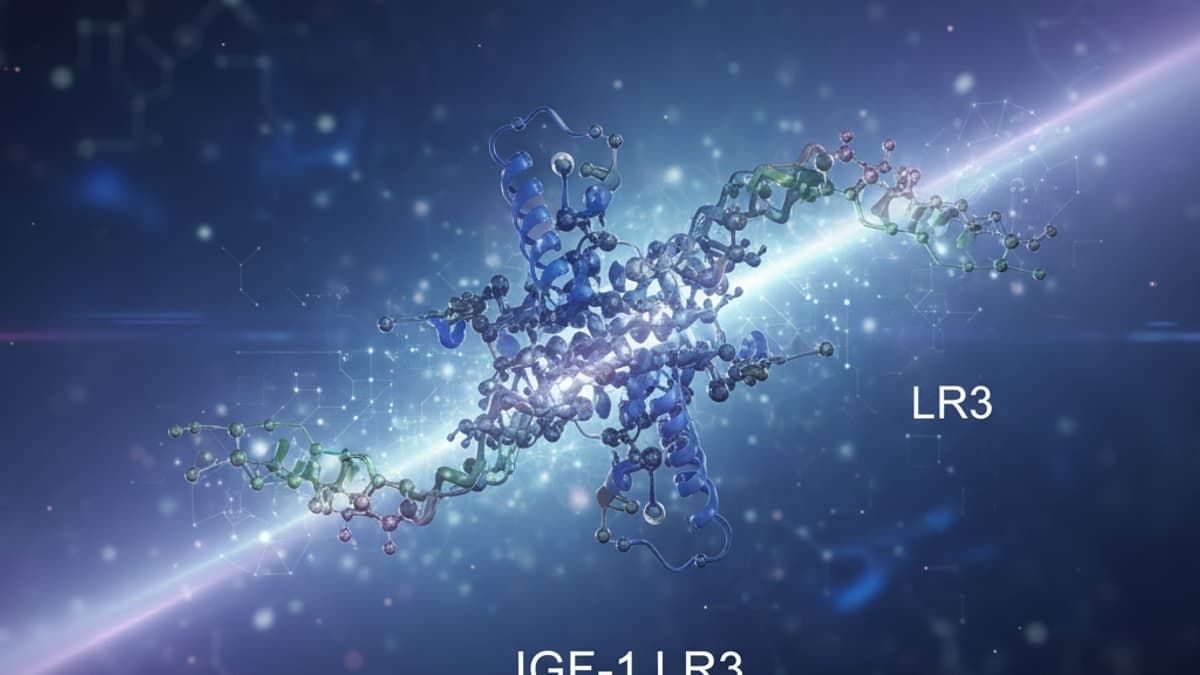
IGF-1 LR3 Science Explained — Mechanisms & Lab Use
IGF-1 LR3 science explained: a synthetic peptide variant that extends half-life from minutes to hours, enabling sustained tissue-level growth signaling …
IGF-1 LR3 FAQ — Dosage, Storage, Safety Explained
IGF-1 LR3 FAQ answers reconstitution, dosing, half-life, and storage questions with research-grade specificity. Get clear answers backed by peptide scie…

IGF-1 LR3 History — Research Evolution | Real Peptides
IGF-1 LR3 history traces to 1990s recombinant protein research, modified for extended half-life and reduced IGFBP binding. Real Peptides supplies resear…

IGF-1 LR3 Extended Half-Life — Research Impact and Dosing
IGF-1 LR3 extended half-life reaches 20-30 hours versus 10-12 for native IGF-1, enabling less frequent dosing and sustained receptor activation in resea…

IGF-1 LR3 Clinical Trials 2026 — Research Status | Real…
IGF-1 LR3 clinical trials in 2026 remain limited to preclinical and small Phase I studies with no large-scale human trials recruiting. See what data exi…

IGF-1 LR3 News 2026 — Research Updates | Real Peptides
IGF-1 LR3 news 2026 reveals stability improvements, dual-receptor binding studies, and contamination alerts from unregulated suppliers—findings every re…

What Is IGF-1 Long R3? (Modified Growth Factor)
IGF-1 Long R3 is a synthetic, extended-half-life analog of human IGF-1 that resists binding protein inactivation. Learn its structure, mechanism, and la…

What Is IGF1 LR3? (Modified Growth Factor Explained)
IGF1 LR3 is a synthetic analog of IGF-1 with extended half-life and reduced IGFBP binding — designed for enhanced bioavailability in research models.

What Is Insulin-like Growth Factor? (IGF Explained) —...
Insulin-like growth factor doesn't just support growth — remove it entirely and children stop growing, adults lose muscle mass despite adequate protein, and metabolic health deteriorates regardless of diet. These peptides orchestrate anabolic signaling that nutrition and exercise alone cannot replicate.

IGF-1 LR3 Muscle Hypertrophy — Research Mechanisms |…
IGF-1 LR3 muscle hypertrophy research involves extended receptor binding and hyperplasia signaling. Research-grade synthesis ensures purity for consiste…

How Long IGF-1 LR3 Vial Lasts? (Storage & Usage) | Real…
An IGF-1 LR3 vial lasts 28 days refrigerated after reconstitution, or months frozen. Improper storage degrades potency within hours—here’s how to preven…

Calculate IGF-1 LR3 Dosage — Research Protocol Guide
Most IGF-1 LR3 research failures happen before the first injection — during the math. Calculate the dosage wrong by just 50 micrograms and you've either wasted the compound or triggered hypoglycemia your study protocol wasn't designed to handle.

IGF-1 LR3 Oral Taste — What Researchers Report | Real…
IGF-1 LR3 oral taste is bitter, metallic, and acidic due to peptide structure. Reconstitution method, pH level, and storage duration all affect flavor i…

IGF-1 LR3 Degradation Reconstituted — Stability Facts
Most researchers don't realize that reconstituted IGF-1 LR3 begins degrading within hours if stored incorrectly. Temperature excursions above 8°C denature the protein structure irreversibly, turning an effective research compound into an inert solution with no visual indicators of the loss.

Travel with IGF-1 LR3 — Storage & Transport Rules
IGF-1 LR3 requires cold chain transport between 2–8°C. Learn temperature controls, TSA rules, border protocols, and storage failures that destroy peptides.

Best Melanotan-1 Supplier — Purity Standards (2026)
The best Melanotan-1 supplier prioritizes third-party purity verification, exact amino-acid sequencing, and small-batch synthesis for research-grade

Melanotan-1 Shipping — Cold Chain Logistics | Real Peptides
Melanotan-1 shipping requires strict 2–8°C cold chain compliance during transit — temperature excursions denature the peptide irreversibly, rendering it…

Buy MT1 — Research-Grade Melanotan 1 | Real Peptides
Buy MT1 from Real Peptides for high-purity research applications. Small-batch synthesis, exact amino-acid sequencing, and verified potency in every vial.

Best Melanotan-1 for Photoprotection — Real Peptides
Melanotan-1 activates melanocortin receptors to boost melanin without UV exposure, offering photoprotection superior to sunscreen alone. Research-grade

Melanotan-1 Benefits — Research Applications | Real Peptides
Most melanocortin research focuses on MT2, but Melanotan-1 offers a distinct receptor selectivity profile that changes everything. Without the broader MC3R and MC4R activity that characterizes its analog, MT1 provides researchers with cleaner melanogenesis data and fewer confounding metabolic variables.

Best Melanotan-1 for Tanning — Purity & Lab Standards
Best Melanotan-1 for tanning depends on synthesis precision and third-party verification — research-grade purity ensures consistent melanogenesis response.

First Time Buying Melanotan-1 — What to Know | Real Peptides
First time buying Melanotan-1 requires understanding purity standards, proper storage at −20°C, and reconstitution with bacteriostatic water.

How Does Melanotan-1 Work? (Mechanism Explained)
Melanotan-1 binds to melanocortin-1 receptors on melanocytes, triggering melanin production without UV exposure — a targeted pathway that’s entirely

Melanotan-1 Half Life — Dosing & Duration | Real Peptides
The melanotan-1 half life of roughly 33 minutes sounds impossibly short — yet this peptide produces skin pigmentation that lasts months. That paradox holds the key to understanding why dosing frequency, injection route, and dose titration matter far more than most peptide protocols acknowledge.

Melanotan-1 Contraindications — Safety Guide
Melanotan-1 contraindications include melanoma history, pregnancy, renal impairment, and autoimmune disorders — critical safety thresholds every

Stop Taking Melanotan-1 — Safe Discontinuation Guide
Stopping Melanotan-1 requires a structured taper protocol to minimize rebound hypopigmentation and receptor downregulation. Learn the exact cessation

Melanotan-1 Oral vs Injectable — Real Peptides
Melanotan-1 oral vs injectable differs dramatically in bioavailability and efficacy. Injectable forms achieve up to 95% absorption while oral peptides

Melanotan-1 Quality Real vs Fake — Verification Guide
Melanotan-1 quality real vs fake separates by visual cues, supplier credentials, and third-party testing—counterfeit peptides lack purity verification and

Melanotan-1 Interactions — What Affects Results | Real
Most Melanotan-1 users don't realize that photosensitizing medications can turn a controlled tanning protocol into a phototoxic reaction. The peptide's melanocyte-stimulating mechanism amplifies UV response — and when combined with antibiotics, retinoids, or even certain supplements, the interaction creates outcomes most guides never mention.

Melanotan-1 for Tanning — Real Peptides
Melanotan-1 doesn't just darken skin — it activates the same melanocortin pathway that UV triggers, but without DNA-damaging radiation exposure. The difference between cosmetic bronzing and genuine photoprotection comes down to receptor specificity most people never hear about.

Melanotan-1 for Skin Pigmentation — Research Insights
Melanotan-1 for skin pigmentation activates melanocortin-1 receptors to stimulate melanin synthesis, offering research applications in photoprotection and

Melanotan-1 for EPP Treatment — Clinical Evidence
Melanotan-1 for EPP treatment increases pain-free sun exposure by inducing melanin production independent of UV damage—backed by Phase III trials.

Is Melanotan-1 Legal? (Regulatory Status Explained)
Melanotan-1 sits in regulatory gray territory — it's not banned as a controlled substance, yet it lacks FDA approval for cosmetic or clinical use. Remove that ambiguity, and you're left with a peptide available for laboratory research but legally off-limits for tanning or pigmentation enhancement in humans under current regulations.

Melanotan-1 Storage — Temperature, Shelf Life & Stability |
Most peptide research failures happen during storage, not administration. A single temperature excursion above 8°C can denature Melanotan-1's structure entirely, turning an effective compound into an expensive saline solution before you ever reconstitute it.

Melanotan-1 Melanogenesis Stimulation — Real Peptides
Melanotan-1 melanogenesis stimulation activates melanocyte pathways via MC1R receptor binding, inducing eumelanin synthesis without UV exposure—learn the

Melanotan-1 FAQ — Research Guide | Real Peptides
Melanotan-1 FAQ answers: Afamelanotide stimulates melanogenesis via MC1R receptor activation. Get research-grade peptides, storage protocols, dosing

Melanotan-1 History — Discovery to Research | Real Peptides
Melanotan-1 history traces a 1980s melanoma prevention project to modern photoprotection and pigmentation research across three decades of refinement.