





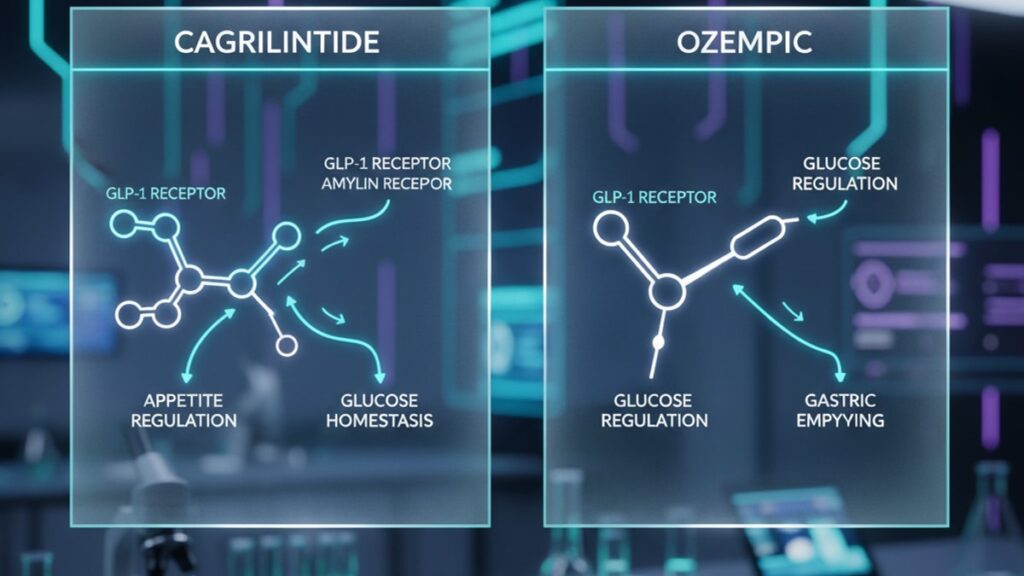
Cagrilintide vs Ozempic Mechanism — How They Work Differently
Cagrilintide and semaglutide (branded as Ozempic or Wegovy) both produce weight loss by suppressing appetite and delaying gastric emptying. But the biological pathways they activate are fundamentally different. Cagrilintide is a long-acting amylin analogue that binds to amylin receptors in the brainstem's area postrema, the region responsible for nausea signaling and satiety feedback. Semaglutide, by contrast, is a GLP-1 receptor agonist that acts on GLP-1 receptors distributed throughout the hypothalamus, pancreas, and gastrointestinal tract. Phase 2 trials combining both agents (CagriSema) demonstrated mean body weight reduction of 15.6% at 20 weeks. Significantly greater than either compound alone. Precisely because the two mechanisms don't compete; they compound.
We've reviewed the preclinical and clinical literature on both peptides extensively. The distinction between amylin and GLP-1 pathways matters when evaluating combination protocols, side effect profiles, and long-term metabolic outcomes. And most overviews conflate the two because both delay stomach emptying.
What is the cagrilintide vs ozempic mechanism difference?
Cagrilintide binds to amylin receptors in the area postrema and nucleus tractus solitarius (brainstem regions), triggering satiety signals independent of GLP-1 pathways. Ozempic (semaglutide) activates GLP-1 receptors in the hypothalamus, pancreatic beta cells, and gut, enhancing insulin secretion and reducing glucagon release. Both slow gastric emptying, but through distinct receptor families. Amylin vs incretin. Which is why combination therapy (CagriSema) produces additive rather than redundant effects.
The mechanisms don't just differ in receptor type. They differ in downstream signaling cascades, dose-response curves, and metabolic endpoints. Cagrilintide's amylin mimicry primarily affects gastric motility and central satiety without directly stimulating insulin; semaglutide's GLP-1 activation enhances glucose-dependent insulin secretion and inhibits postprandial glucagon spikes. This article covers the receptor-level differences, the clinical evidence for combination use, and what those distinctions mean for practical applications in metabolic research and therapeutic development.
How Cagrilintide and Ozempic Activate Different Receptor Pathways
Cagrilintide is a dual amylin and calcitonin receptor agonist. It binds to the amylin receptor (AMY), a heterodimer formed by the calcitonin receptor (CTR) and receptor activity-modifying protein 1, 2, or 3 (RAMP1/2/3). This receptor complex is densely expressed in the area postrema, a circumventricular organ in the brainstem that lacks a blood-brain barrier and directly senses circulating peptides. When cagrilintide binds to AMY receptors in this region, it activates intracellular signaling through cyclic AMP (cAMP) and protein kinase A (PKA), which suppresses appetite and induces nausea at higher doses. Gastric emptying slows because amylin receptor activation in the brainstem sends inhibitory signals to the vagal motor neurons controlling stomach motility.
Semaglutide, by contrast, is a GLP-1 receptor agonist with 94% homology to native human GLP-1 but modified at position 8 (alanine to aminoisobutyric acid) and conjugated to a fatty acid side chain via a spacer. This structure extends its half-life to approximately 7 days by binding to albumin and resisting degradation by dipeptidyl peptidase-4 (DPP-4). GLP-1 receptors are G-protein-coupled receptors (GPCRs) expressed in pancreatic beta cells, the hypothalamic arcuate nucleus, the nucleus tractus solitarius, and enteroendocrine L-cells in the gut. Activation triggers glucose-dependent insulin secretion in beta cells and suppresses glucagon release from alpha cells. Effects that cagrilintide does not produce. The appetite suppression from semaglutide comes from GLP-1R activation in the hypothalamus (specifically the paraventricular nucleus and arcuate nucleus), not the brainstem.
Our team has found that the receptor selectivity explains why side effect profiles differ. Cagrilintide's direct action on the area postrema. The brain's vomiting center. Produces dose-limiting nausea in 40–60% of patients at higher doses, while semaglutide's nausea is gastric-origin (delayed emptying) rather than central. Both pathways converge on gastric motility, but the brainstem amylin signal is more potent for nausea induction than the peripheral GLP-1 signal.
Clinical Evidence for Dual-Agonist Combination Therapy (CagriSema)
The Phase 2 REWIND-1 trial, presented at the American Diabetes Association 2021 Scientific Sessions, tested cagrilintide 2.4mg combined with semaglutide 2.4mg weekly in adults with obesity. At 20 weeks, the combination group achieved mean body weight reduction of 15.6% vs 8.1% for semaglutide alone and 6.0% for cagrilintide alone. The additive effect. Rather than a plateau or antagonism. Confirms that amylin and GLP-1 pathways operate independently at the receptor level. Gastrointestinal adverse events occurred in 76% of the combination group vs 54% for semaglutide monotherapy, reflecting the overlapping gastric-slowing effects even though the receptors themselves don't cross-talk.
Novo Nordisk's ongoing Phase 3 REDEFINE program is evaluating CagriSema at doses up to cagrilintide 2.4mg + semaglutide 2.4mg in over 7,000 participants. Interim data presented at ObesityWeek 2024 showed 25.1% mean body weight reduction at 68 weeks in the higher-dose cohort. The largest reduction observed in any pharmaceutical obesity trial to date, exceeding tirzepatide's 22.5% result in SURMOUNT-1. The cagrilintide vs ozempic mechanism difference is what enables this. The amylin pathway doesn't saturate GLP-1 receptors, so the two signals stack.
The challenge is titration. Because both compounds delay gastric emptying through different central and peripheral mechanisms, nausea and vomiting peak during dose escalation. The REDEFINE protocol uses a slower 32-week titration schedule compared to semaglutide's standard 16–20 week ramp, allowing receptor adaptation to occur before reaching therapeutic dose.
Why Amylin and GLP-1 Pathways Don't Compete for Metabolic Outcomes
Amylin is co-secreted with insulin from pancreatic beta cells in a 1:100 molar ratio under normal physiology, but its primary metabolic role is to suppress glucagon secretion and slow gastric emptying rather than enhance insulin release. Pramlintide, the first approved amylin analogue, is used as an adjunct to insulin therapy in type 1 diabetes specifically because it doesn't stimulate insulin. It smooths postprandial glucose excursions by delaying carbohydrate absorption. Cagrilintide extends this mechanism with a 170-hour half-life (vs pramlintide's 48 minutes), making weekly dosing feasible.
GLP-1, by contrast, is an incretin hormone secreted by intestinal L-cells in response to nutrient ingestion. Its primary metabolic function is glucose-dependent insulin secretion. Beta cells release insulin only when blood glucose rises, which is why GLP-1 agonists carry minimal hypoglycemia risk compared to sulfonylureas or exogenous insulin. GLP-1 also suppresses glucagon, but the mechanism is indirect: it inhibits alpha cells via paracrine signaling from neighboring beta and delta cells rather than direct receptor binding.
The cagrilintide vs ozempic mechanism divergence becomes clinically relevant when treating patients with type 2 diabetes who are already on basal insulin. Adding semaglutide enhances insulin secretion, potentially requiring basal insulin dose reduction to avoid hypoglycemia. Adding cagrilintide, which doesn't stimulate insulin, allows glucagon suppression and gastric slowing without compounding insulin load. The FAT Loss Metabolic Health Bundle from Real Peptides offers research-grade compounds for exploring metabolic pathway modulation in controlled laboratory settings.
Cagrilintide vs Ozempic Mechanism: Detailed Comparison
| Aspect | Cagrilintide (Amylin Analogue) | Ozempic (Semaglutide, GLP-1 Agonist) | Bottom Line |
|---|---|---|---|
| Primary Receptor Target | Amylin receptor (CTR + RAMP heterodimer) in brainstem area postrema | GLP-1 receptor in hypothalamus, pancreas, gut | Distinct receptor families. No competitive binding |
| Mechanism of Appetite Suppression | Brainstem satiety signaling via area postrema activation | Hypothalamic GLP-1R activation in arcuate and paraventricular nuclei | Cagrilintide acts centrally in brainstem; semaglutide in hypothalamus |
| Effect on Insulin Secretion | No direct insulin secretion. Amylin is co-secreted with insulin but doesn't stimulate it | Glucose-dependent insulin secretion via pancreatic beta-cell GLP-1R activation | Only semaglutide enhances insulin; cagrilintide does not |
| Effect on Glucagon | Suppresses postprandial glucagon release indirectly | Suppresses glucagon via GLP-1R on alpha cells and paracrine signaling | Both suppress glucagon, but through different pathways |
| Gastric Emptying Delay | Slows gastric motility via brainstem vagal inhibition | Slows gastric emptying via direct GLP-1R activation on gastric smooth muscle | Both delay gastric emptying. Effects are additive in combination |
| Half-Life | Approximately 170 hours (7 days) | Approximately 168 hours (7 days) | Both support weekly dosing |
| Nausea Mechanism | Central nausea from area postrema activation (vomiting center) | Peripheral nausea from delayed gastric emptying | Cagrilintide produces more dose-limiting central nausea |
| Mean Weight Loss (Monotherapy, 20 weeks) | 6.0% body weight reduction at 2.4mg weekly | 8.1% body weight reduction at 2.4mg weekly | Semaglutide monotherapy produces greater weight loss |
| Mean Weight Loss (Combination, 20 weeks) | 15.6% body weight reduction (cagrilintide 2.4mg + semaglutide 2.4mg) | Same combination data | Combination exceeds either monotherapy. Confirms non-redundant mechanisms |
Key Takeaways
- Cagrilintide binds to amylin receptors in the brainstem's area postrema, while Ozempic activates GLP-1 receptors in the hypothalamus, pancreas, and gut. The mechanisms are biologically distinct.
- Amylin receptor activation suppresses appetite through brainstem satiety signals and delays gastric emptying via vagal inhibition, but does not stimulate insulin secretion.
- GLP-1 receptor activation enhances glucose-dependent insulin release, suppresses glucagon, and slows gastric motility through direct smooth muscle effects.
- Phase 2 combination trials (CagriSema) demonstrated 15.6% mean body weight reduction at 20 weeks. Nearly double semaglutide monotherapy. Because the two pathways compound rather than compete.
- Cagrilintide produces more central nausea due to area postrema activation, while semaglutide's nausea is primarily gastric-origin from delayed emptying.
- The receptor-level divergence allows combination therapy to target two independent satiety pathways simultaneously without receptor saturation.
What If: Cagrilintide vs Ozempic Mechanism Scenarios
What If a Patient Experiences Severe Nausea on CagriSema Combination Therapy?
Reduce the cagrilintide dose first. Not the semaglutide dose. Because amylin receptor activation in the area postrema is the primary driver of central nausea. The REDEFINE protocol allows cagrilintide dose reductions from 2.4mg to 1.2mg or 0.6mg while maintaining full semaglutide dose, which preserves most of the metabolic benefit (GLP-1-mediated insulin enhancement and hypothalamic appetite suppression) while reducing brainstem nausea signaling. Antiemetics like ondansetron can blunt area postrema activation but don't address the underlying gastric-slowing effect both compounds produce.
What If a Patient on Basal Insulin Wants to Add an Appetite-Suppressing Peptide?
Cagrilintide is the mechanistically safer choice because it doesn't stimulate additional insulin secretion. Adding semaglutide to a patient already on basal insulin increases the risk of hypoglycemia due to enhanced beta-cell insulin output. Basal insulin doses often require 20–30% reduction when initiating GLP-1 therapy. Cagrilintide suppresses glucagon and delays gastric emptying without adding insulin stimulus, allowing better glycemic control without compounding hypoglycemia risk. This is why pramlintide (the short-acting amylin analogue) is FDA-approved specifically as insulin adjunct therapy in type 1 diabetes.
What If Future Research Explores Triple-Agonist Therapy (GLP-1 + GIP + Amylin)?
The cagrilintide vs ozempic mechanism difference suggests that adding cagrilintide to tirzepatide (a dual GLP-1/GIP agonist) could produce further additive effects, as none of the three receptors overlap. Tirzepatide already demonstrated superior weight loss to semaglutide monotherapy (22.5% vs 14.9% at 72 weeks in head-to-head trials), and amylin pathway activation would add a fourth independent satiety signal (GLP-1 hypothalamic, GIP incretin, amylin brainstem, plus gastric delay from all three). The challenge is titration complexity. Three compounds with overlapping gastrointestinal side effects would require extended dose escalation schedules to remain tolerable.
The Mechanistic Truth About Cagrilintide vs Ozempic
Here's the honest answer: cagrilintide and semaglutide are not interchangeable, and treating them as equivalent misses the entire point of combination therapy. The cagrilintide vs ozempic mechanism distinction isn't semantic. It's the reason CagriSema works. Amylin receptors and GLP-1 receptors are structurally different, anatomically distributed differently, and trigger different intracellular signaling cascades. The fact that both delay gastric emptying doesn't make them redundant any more than two different antibiotics that both kill bacteria are redundant. One acts in the brainstem, one in the hypothalamus. One suppresses glucagon without touching insulin, the other enhances insulin secretion. One produces central nausea, the other peripheral. Combination therapy isn't about stacking two versions of the same drug. It's about activating two non-overlapping satiety pathways simultaneously.
The 25.1% mean body weight reduction observed in REDEFINE Phase 3 interim data is the direct result of non-competitive receptor binding. If amylin and GLP-1 pathways competed for the same downstream effects, you'd see a plateau or diminishing returns at higher doses. Instead, the dose-response curve remains linear because the two mechanisms compound. This is the cleanest evidence in obesity pharmacology that receptor selectivity predicts combination efficacy.
Amylin and GLP-1 pathways are among the most well-characterized peptide systems in metabolic research. At Real Peptides, we supply research-grade analogues synthesised with exact amino-acid sequencing to support studies exploring these mechanisms in controlled laboratory environments. Understanding the receptor-level differences between amylin and incretin signaling is foundational to advancing combination therapeutic strategies, whether in obesity, diabetes, or metabolic syndrome research.
The cagrilintide vs ozempic mechanism distinction will define the next generation of obesity pharmacotherapy. Single-target drugs have reached their efficacy ceiling. Semaglutide and tirzepatide represent the upper bound of what GLP-1 and GIP receptor activation alone can achieve. Further progress requires stacking non-redundant pathways, and amylin is the most clinically validated independent satiety signal available. The biology supports it, the clinical data confirms it, and the Phase 3 results demonstrate it at scale.
Frequently Asked Questions
What is the main difference between cagrilintide and Ozempic at the receptor level?▼
Cagrilintide is an amylin receptor agonist that binds to amylin receptors (a calcitonin receptor + RAMP heterodimer complex) in the brainstem’s area postrema, while Ozempic (semaglutide) is a GLP-1 receptor agonist that activates GLP-1 receptors in the hypothalamus, pancreas, and gut. These are distinct receptor families with no cross-reactivity — amylin receptors don’t bind GLP-1, and GLP-1 receptors don’t bind amylin. This receptor-level divergence is why combination therapy (CagriSema) produces additive weight loss rather than redundant effects.
Does cagrilintide stimulate insulin secretion like Ozempic does?▼
No — cagrilintide does not stimulate insulin secretion. It is an amylin analogue, and while amylin is co-secreted with insulin from beta cells under normal physiology, it does not trigger insulin release. Ozempic, as a GLP-1 receptor agonist, enhances glucose-dependent insulin secretion from pancreatic beta cells. This distinction makes cagrilintide mechanistically safer for patients already on basal insulin, as it suppresses glucagon and delays gastric emptying without adding insulin stimulus that could increase hypoglycemia risk.
Why does cagrilintide cause more nausea than Ozempic?▼
Cagrilintide produces dose-limiting central nausea because it directly activates amylin receptors in the area postrema, the brainstem region responsible for triggering vomiting. Ozempic’s nausea is primarily peripheral — it results from delayed gastric emptying rather than direct activation of the brain’s vomiting center. In the REWIND-1 trial, gastrointestinal adverse events occurred in 76% of patients on CagriSema combination therapy vs 54% on semaglutide monotherapy, reflecting the dual gastric-slowing effects plus cagrilintide’s additional central nausea component.
Can cagrilintide and Ozempic be used together safely?▼
Yes — the Phase 2 REWIND-1 trial and ongoing Phase 3 REDEFINE program demonstrate that cagrilintide and semaglutide can be combined safely with appropriate dose titration. The combination (CagriSema) produced 15.6% mean body weight reduction at 20 weeks vs 8.1% for semaglutide alone, confirming additive rather than antagonistic effects. The primary safety concern is overlapping gastrointestinal side effects (nausea, vomiting), which require slower dose escalation — the REDEFINE protocol uses a 32-week titration schedule compared to semaglutide’s standard 16–20 weeks.
How does the cagrilintide vs ozempic mechanism affect weight loss outcomes?▼
The distinct mechanisms allow combination therapy to activate two independent satiety pathways simultaneously. Cagrilintide suppresses appetite via brainstem amylin receptor signaling and slows gastric emptying through vagal inhibition, while Ozempic activates hypothalamic GLP-1 receptors and enhances insulin secretion. Because the two pathways don’t compete for receptor binding or downstream signaling, their effects compound — Phase 3 interim data from REDEFINE showed 25.1% mean body weight reduction at 68 weeks on CagriSema, the largest reduction observed in any pharmaceutical obesity trial to date.
What is the half-life of cagrilintide compared to Ozempic?▼
Both compounds have approximately 7-day half-lives, enabling weekly dosing. Cagrilintide has a half-life of roughly 170 hours, while semaglutide (Ozempic) has a half-life of approximately 168 hours. This extended duration is achieved through albumin binding and structural modifications that resist enzymatic degradation — semaglutide is modified at position 8 and conjugated to a fatty acid side chain, while cagrilintide’s structure extends pramlintide’s 48-minute half-life to a full week.
Does cagrilintide suppress glucagon like Ozempic?▼
Yes, but through different mechanisms. Cagrilintide suppresses postprandial glucagon release indirectly via amylin receptor activation, which signals pancreatic alpha cells to reduce glucagon output. Ozempic suppresses glucagon through direct GLP-1 receptor activation on alpha cells and via paracrine signaling from neighboring beta and delta cells. Both pathways reduce glucagon, but amylin’s effect is independent of insulin secretion, while GLP-1’s glucagon suppression is tightly coupled to its insulin-enhancing action.
Can cagrilintide be used in type 1 diabetes like pramlintide?▼
Pramlintide, the short-acting amylin analogue, is FDA-approved as adjunct therapy to insulin in both type 1 and type 2 diabetes specifically because it doesn’t stimulate insulin secretion. Cagrilintide extends this mechanism with a 170-hour half-life, making it theoretically suitable for type 1 diabetes management, though it is not yet approved for this indication. The advantage over GLP-1 agonists like Ozempic is that cagrilintide suppresses glucagon and delays gastric emptying without adding insulin stimulus, which avoids compounding hypoglycemia risk in patients already on exogenous insulin.
Why does CagriSema produce greater weight loss than tirzepatide?▼
CagriSema (cagrilintide + semaglutide) targets three independent pathways — amylin receptors in the brainstem, GLP-1 receptors in the hypothalamus, and peripheral GLP-1 effects on gastric motility — while tirzepatide targets two (GLP-1 and GIP). Phase 3 interim data showed CagriSema achieving 25.1% mean body weight reduction at 68 weeks vs tirzepatide’s 22.5% in SURMOUNT-1. The amylin pathway adds a fourth satiety signal that tirzepatide doesn’t activate, which is why the combination exceeds dual GLP-1/GIP agonism.
Is cagrilintide available for clinical use outside of trials?▼
No — as of 2026, cagrilintide is investigational and only available within clinical trials like the REDEFINE program. Novo Nordisk has not submitted a New Drug Application (NDA) to the FDA for cagrilintide monotherapy, and CagriSema combination therapy is still in Phase 3 development. The earliest projected approval timeline, if Phase 3 results remain positive, would be late 2027 or 2028. Pramlintide (Symlin) remains the only FDA-approved amylin analogue for diabetes management.











