





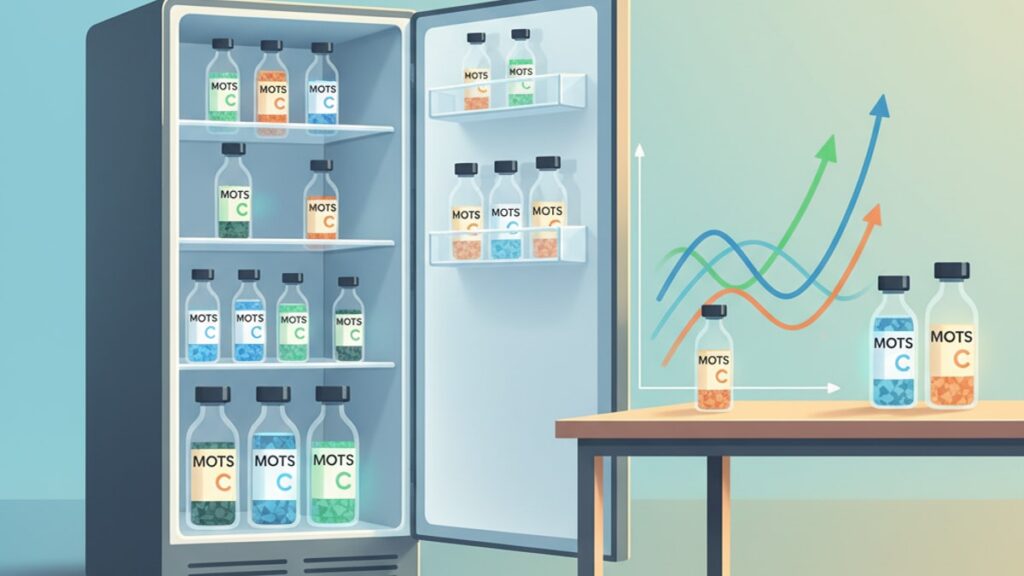
You’ve just received your shipment. Inside, nestled next to a cold pack, is a small vial of lyophilized powder—a molecule with immense research potential. It’s a familiar moment for any dedicated researcher, but it’s immediately followed by a cascade of critical questions, the most pressing of which is often about storage. When it comes to a sophisticated peptide like MOTS-c, that question becomes paramount: does MOTS-c need to be refrigerated?
Let’s be direct. The answer is an unequivocal, absolute yes. Here at Real Peptides, our team handles these delicate molecules every single day, from synthesis to shipment. We’ve seen firsthand how improper storage can completely derail a study, wasting time, resources, and invaluable data. It's not just a best practice; it's a foundational requirement for maintaining the peptide's structural integrity and biological activity. This isn't just about preserving a chemical; it's about protecting the very validity of your work. So let's get into the specifics of why this is so crucial and what our lab’s protocols look like.
First Things First: What Exactly is MOTS-c?
Before we dive deep into the temperature charts and storage protocols, it helps to have a quick refresher on what makes MOTS-c so special. Unlike most peptides, which are encoded by nuclear DNA, MOTS-c is a mitochondrial-derived peptide. This unique origin story places it at the very heart of cellular energy regulation, metabolism, and homeostasis. Its discovery has opened up sprawling new avenues of research into age-related metabolic decline, insulin sensitivity, and cellular resilience.
It’s a molecule that operates on a nuanced, fundamental level within biological systems. Because of this, its structure is everything. Even a slight alteration, a tiny break in its amino acid chain, can render it inert. This inherent fragility is precisely why the conversation around its storage isn't just academic—it's intensely practical. When you're studying a compound that influences the very powerhouses of the cell, you can't afford to work with a degraded or compromised product. Your starting material must be impeccable.
The Big Question: Does MOTS-c Need Refrigeration?
We’ve already given the short answer, but the complete answer is a bit more layered. It depends entirely on the state of the peptide: is it in its lyophilized (freeze-dried powder) form, or has it been reconstituted (mixed into a liquid solution)?
Thinking about these two states as distinct entities is the key to proper handling. One is a state of suspended animation, remarkably stable but still vulnerable. The other is an active, ready-to-use state that is far more susceptible to the ravages of temperature and time. The rules for one are not the rules for the other, and confusing them is one of the quickest ways to compromise your research materials. Our team has found that this distinction is the single most common point of failure for researchers new to handling peptides.
It’s not just about cold; it’s about the right kind of cold at the right time.
Lyophilized vs. Reconstituted: A Tale of Two Stabilities
Understanding the difference between these two forms is non-negotiable. We can't stress this enough. The stability profile shifts dramatically the moment you add a liquid to that vial of powder.
Let's break it down.
The Lyophilized (Powder) State: Dormant but Not Invincible
When you receive your MOTS-c Peptide from us, it arrives as a lyophilized powder. Lyophilization is a sophisticated freeze-drying process where water is removed from the product after it is frozen and placed under a vacuum. This process is the gold standard for preserving delicate biological molecules because it locks the peptide into a stable, solid state, preventing the chemical reactions that degrade it. Think of it as putting the molecule to sleep.
In this dormant, powdered form, MOTS-c is surprisingly resilient. It can withstand shipping at ambient temperatures for a few days without significant degradation, which is why you don't need to panic if the cold pack in your shipment isn't frozen solid upon arrival. However, for long-term storage, refrigeration isn't just recommended; it's essential.
- Short-Term (Weeks to a few Months): Storing the lyophilized powder in a standard refrigerator at 2°C to 8°C (36°F to 46°F) is perfectly acceptable.
- Long-Term (Many Months to Years): For the absolute best preservation, the lyophilized powder should be stored in a freezer at -20°C (-4°F) or colder. At this temperature, molecular motion slows to a crawl, and the peptide can remain stable for a very, very long time.
The Reconstituted (Liquid) State: Active and Highly Vulnerable
This is where the rules change completely. Reconstitution is the process of adding a sterile diluent, typically Bacteriostatic Water, to the lyophilized powder to prepare it for use. The moment you do this, the peptide “wakes up.” It's now in a solution where chemical reactions, like hydrolysis, can occur readily.
Once reconstituted, MOTS-c becomes incredibly sensitive to temperature. Leaving a vial of reconstituted MOTS-c at room temperature for even a day can lead to significant, sometimes catastrophic, degradation. The peptide chain begins to break apart, and its biological activity plummets. We’ve seen it happen.
After reconstitution, the vial must be stored in a refrigerator at 2°C to 8°C. Period. The shelf life of the liquid solution, even when refrigerated, is limited. While the bacteriostatic agent in the water helps prevent microbial growth, it does nothing to stop the slow, inevitable chemical breakdown of the peptide itself. Generally, you should plan to use the reconstituted solution within about 30 days for optimal potency.
One more critical point: Never freeze a reconstituted peptide solution. The formation of ice crystals during the freezing process can exert physical stress on the peptide molecules, shearing and denaturing them. The freeze-thaw cycle is notoriously destructive to the delicate three-dimensional structure of many peptides, including MOTS-c.
The Science Behind Peptide Degradation
So, what's actually happening inside that vial when it's not stored correctly? It’s not magic; it’s chemistry. Three primary culprits are working to destroy your peptide:
-
Hydrolysis: This is the big one for reconstituted peptides. Water molecules in the solution can attack the peptide bonds that link amino acids together, essentially snipping the chain into smaller, inactive fragments. Heat acts as a powerful catalyst for this reaction, dramatically speeding up the process. Every degree above the optimal storage range increases the rate of hydrolysis.
-
Oxidation: Certain amino acids within the MOTS-c sequence are susceptible to damage from oxygen. While this is less of a concern in a sealed, lyophilized vial, it becomes more of a factor once the peptide is reconstituted and exposed to the small amount of oxygen in the vial's headspace and dissolved in the water. Again, heat accelerates these oxidative reactions.
-
Microbial Contamination: If you don't use a sterile diluent like Bacteriostatic Water, bacteria and fungi can grow in the solution. These microbes don't just contaminate your sample; they actively consume the peptide as a food source, completely destroying it. This is why using the correct, sterile reconstitution liquid is just as important as temperature control.
Refrigeration works by slowing all of these processes down. It reduces the kinetic energy of the molecules, making it much harder for destructive reactions to occur. It’s the single most effective tool you have to fight peptide entropy.
Our Team's Protocol: The Real Peptides Storage Standard
At Real Peptides, our commitment to quality doesn’t end when a product leaves our facility. We want to ensure you can maintain that quality all the way through your research. Here’s the exact protocol our own scientists follow and what we recommend for every single one of our clients. This approach, which we've refined over years, delivers real, reliable results.
Step 1: Upon Arrival
As soon as your package arrives, retrieve the contents. Don't let it sit on a loading dock or in a mailroom. Immediately transfer the lyophilized vial(s) of MOTS-c to the appropriate storage condition based on your intended use timeline.
- Using within a few months? Place it in the refrigerator (2°C to 8°C).
- Archiving for longer-term studies? It goes directly into a freezer (-20°C).
Step 2: The Reconstitution Process
When you're ready to begin your experiments, allow the vial to come to room temperature for a few minutes before opening. This prevents condensation from forming inside the vial. Using a sterile syringe, slowly inject the correct volume of high-purity Bacteriostatic Water into the vial, aiming the stream against the glass wall to avoid foaming. Gently swirl or roll the vial between your palms to dissolve the powder. Don't shake it vigorously—that can also damage the peptide.
Step 3: Storing the Reconstituted Solution
Label the vial with the date of reconstitution and the final concentration. Immediately place it in the refrigerator. Store it in the main body of the fridge, not in the door, where temperatures fluctuate wildly every time it's opened. Plan your research to ensure the full amount is used within 30-40 days for maximum confidence in its potency.
This isn't just a list of suggestions. It's the blueprint for successful, repeatable research.
Common Storage Mistakes We've Seen (And How to Avoid Them)
Our customer support team often fields questions that stem from small, avoidable errors in handling. Honestly, we've seen it all. Here are the most common pitfalls that can compromise a perfectly good peptide.
-
The "I'll Do It in a Minute" Mistake: The package arrives during a busy time, and the vial gets left on a lab bench for hours, or even overnight. This is especially damaging in a warm environment. Fix: Make retrieving and storing your peptides an absolute priority the moment they arrive. It takes 60 seconds and saves you from potentially invalidating weeks of work.
-
The "Water is Water" Fallacy: A researcher runs out of bacteriostatic water and decides to use sterile water, or worse, distilled water from the lab tap. This is a catastrophic error. Without the bacteriostatic agent (benzyl alcohol), the vial becomes a perfect petri dish for bacteria. Fix: Always have a sufficient supply of the correct diluent. We offer high-quality Bacteriostatic Water for this very reason. It's a critical, non-negotiable element of your research toolkit.
-
The Freeze/Thaw Cycle Trap: Believing that freezing will make the liquid last longer, a researcher freezes their reconstituted MOTS-c, thaws a bit for use, and repeats. As we covered, this is a peptide death sentence. Fix: Once reconstituted, it lives in the fridge. That's it. If you need to store aliquots for different experiments, it’s better to use multiple vials rather than repeatedly accessing and temperature-cycling a single stock solution.
-
The Refrigerator Door Gamble: Storing peptides in the handy shelves on the fridge door seems convenient, but it's the most thermally unstable part of the unit. Fix: Always store peptides in the main compartment, preferably in a labeled box towards the back, where the temperature is most consistent.
Avoiding these simple mistakes can be the difference between clear, publishable data and ambiguous results that send you back to square one. It's all about discipline and respecting the molecule.
Comparison Table: Storage Conditions and Expected Viability
To make it crystal clear, here’s a simple breakdown of how to handle MOTS-c. We've put this together based on stability data and our extensive in-house experience.
| Peptide State | Storage Location | Temperature Range | Estimated Viability |
|---|---|---|---|
| Lyophilized | Room Temperature | ~25°C (77°F) | Days to a few weeks (Not recommended for storage) |
| Lyophilized | Refrigerator | 2°C to 8°C (36°F-46°F) | Many months (Excellent for short/medium-term) |
| Lyophilized | Freezer | -20°C (-4°F) or colder | Several years (The gold standard for long-term) |
| Reconstituted | Room Temperature | ~25°C (77°F) | Hours (Severe degradation occurs rapidly) |
| Reconstituted | Refrigerator | 2°C to 8°C (36°F-46°F) | ~30-40 days (The only acceptable method) |
| Reconstituted | Freezer | -20°C (-4°F) | Not Recommended (Risk of damage from freezing) |
What Happens if MOTS-c Isn't Stored Correctly?
The consequences of improper storage aren't theoretical. They are tangible and profoundly negative for any research project. When a peptide degrades, you're no longer working with the molecule you think you are. You're working with a fractured, impotent version of it, or a cocktail of its breakdown products.
This leads directly to:
- Inaccurate and Unreliable Data: Your experiments will yield weak, inconsistent, or null results, not because your hypothesis was wrong, but because your primary tool was broken.
- Wasted Resources: Every experiment conducted with a degraded peptide is a waste of time, money, and other valuable lab materials.
- Loss of Confidence: It can be incredibly difficult to troubleshoot failed experiments when you're unaware that your peptide's integrity is the root cause. This can lead researchers down frustrating rabbit holes, questioning their protocols and methods when the real problem was in the fridge.
This is why our entire business model at Real Peptides is built on a foundation of unimpeachable quality and purity. We painstakingly synthesize and verify every batch of our peptides, from MOTS-c to BPC-157 and TB-500, to ensure you start with a perfect product. Proper storage is how you maintain that perfection.
Beyond MOTS-c: A Universal Principle for Peptides
While we've focused on MOTS-c, these principles of cold chain storage and careful handling apply to the vast majority of research peptides. Whether you're working with growth hormone secretagogues like Ipamorelin, metabolic peptides like Tirzepatide, or neurogenic peptides like Dihexa, the fundamental rules remain the same.
Lyophilized is stable but loves the cold for the long haul. Reconstituted is fragile and requires constant refrigeration. It's a universal language in the world of peptide research. Mastering it is a prerequisite for generating high-quality, reproducible data. We believe so strongly in education that we often post handling guides and protocol discussions on our platforms. For a more visual approach to some of these topics, you can always check out our YouTube channel for practical insights.
Our commitment extends across our entire catalog of research peptides. We see ourselves as partners in your discovery process, and providing this crucial handling information is part of that partnership.
Your research is too important to be compromised by a simple mistake in storage. The integrity of your work begins the moment you receive your materials, and maintaining a disciplined approach to handling is the first step toward a successful outcome. By understanding the why behind the cold, you empower yourself to protect your investment and, ultimately, the validity of your data. If you're ready to work with peptides that meet the highest standards of purity from day one, we're here to help you Get Started Today.
Frequently Asked Questions
What happens if my MOTS-c shipment arrives and the ice pack has completely melted?
▼
Don’t panic. Lyophilized (powdered) MOTS-c is stable at ambient temperatures for several days. As long as the vial wasn’t exposed to extreme heat for a prolonged period, it should be fine. Transfer it to a refrigerator or freezer immediately upon arrival.
Can I pre-mix all my MOTS-c at once to save time?
▼
We strongly advise against this. Reconstituted MOTS-c has a limited shelf life of about 30-40 days in the refrigerator. Only reconstitute the amount you confidently plan to use within that timeframe to ensure maximum potency for every experiment.
How can I tell if my reconstituted MOTS-c has degraded?
▼
Visually, you often can’t. The solution may remain clear. The primary indicator of degradation is a loss of expected results in your research (diminished biological activity). This is why adhering to strict storage protocols from the start is so critical.
Is a standard kitchen refrigerator or freezer acceptable for storing peptides?
▼
Yes, for most applications. A standard kitchen refrigerator maintains the 2-8°C range, and a standard freezer is typically -20°C or colder. Just be sure to store the peptides away from the door to avoid temperature fluctuations.
Why can’t I freeze my reconstituted MOTS-c solution?
▼
The process of freezing and thawing can physically damage the peptide’s structure. Ice crystal formation can shear the delicate amino acid chains, rendering the peptide inactive. Once it’s a liquid, it must stay a liquid in the fridge.
What is the difference between bacteriostatic water and sterile water?
▼
Bacteriostatic water contains 0.9% benzyl alcohol, an agent that prevents bacterial growth, making it suitable for multi-use vials. Sterile water has no preservative and should only be used for single-use applications where the entire vial is drawn up at once.
How long can I store lyophilized MOTS-c powder in the freezer?
▼
When stored correctly at -20°C or colder, lyophilized MOTS-c powder can remain stable for several years. This is the ideal method for long-term archiving of the peptide.
Does light affect MOTS-c stability?
▼
While temperature is the primary concern, prolonged exposure to direct UV light can also contribute to the degradation of peptides. We recommend keeping the vials in their original box or in a dark part of your refrigerator or freezer for added protection.
If I reconstitute MOTS-c with more or less water, does that change its stability?
▼
The concentration doesn’t significantly alter the chemical stability of the peptide itself, but the 30-40 day refrigerated shelf life remains the same. Always follow your research protocol for the correct concentration, and record it on the vial.
Can I transport my reconstituted MOTS-c to another lab?
▼
Yes, but it must be kept cold during transport. Use a small cooler with a cold pack to maintain a refrigerated temperature (2-8°C). Do not let the vial come into direct contact with a frozen pack to avoid accidental freezing.
Is it normal for the MOTS-c powder to look like a tiny disc or be barely visible?
▼
Absolutely. Lyophilization often results in the peptide forming a small, solid ‘puck’ or even a fine, almost invisible film at the bottom of the vial. This is normal and doesn’t indicate a problem with the product quantity.











