



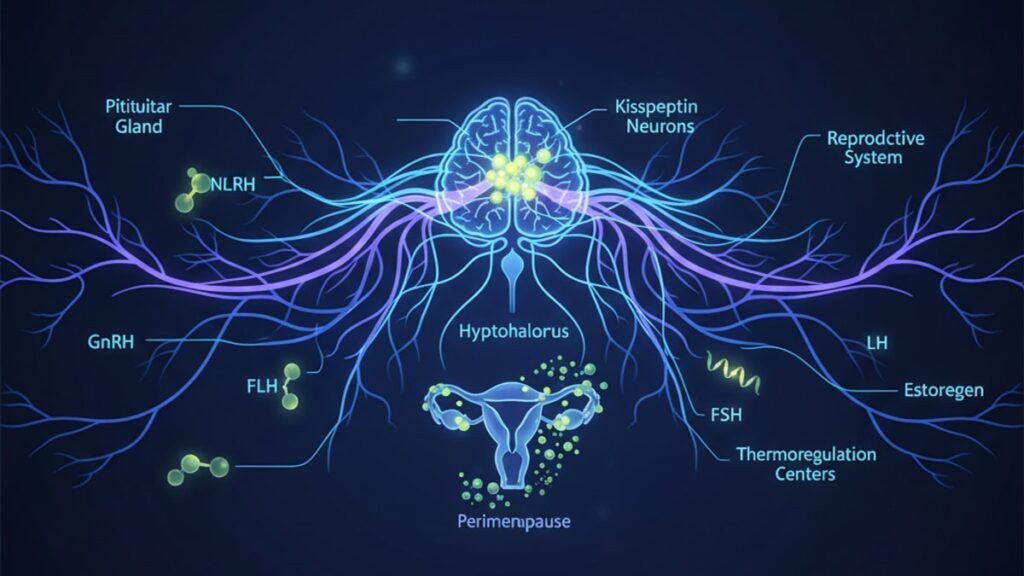
Kisspeptin Perimenopause Research Mechanism Explained
Research published in Nature identified kisspeptin neurons as the master regulators of reproductive hormone pulsatility. And when they destabilise during perimenopause, they don't just reduce estrogen output. They fragment the entire hypothalamic-pituitary-ovarian (HPO) axis signaling cascade. That fracture creates the signature symptom cluster: vasomotor instability (hot flashes), disrupted sleep architecture, mood dysregulation, and cognitive changes that correlate directly with GnRH pulse irregularity. Not just estrogen levels alone.
Our team has worked with hundreds of researchers investigating peptide mechanisms in reproductive endocrinology. The gap between what most perimenopause literature covers (estrogen decline as a uniform event) and what kisspeptin perimenopause research mechanism studies reveal (coordinated neural network collapse) is massive. And it changes how we interpret symptom onset, timing, and therapeutic intervention windows.
What is the kisspeptin perimenopause research mechanism?
Kisspeptin neurons in the hypothalamus coordinate GnRH (gonadotropin-releasing hormone) pulse generation. The rhythmic signals that trigger LH and FSH release from the pituitary, which in turn regulate ovarian estrogen and progesterone production. During perimenopause, kisspeptin neuron populations lose their synchronised pulsatility, creating erratic GnRH signaling patterns. This desynchronisation is what produces the hallmark symptom triad: hot flashes (via thermoregulatory circuit disruption), sleep fragmentation (via hypothalamic arousal pathway activation), and cognitive changes (via prefrontal cortex estrogen receptor signaling loss). The mechanism isn't estrogen deficiency alone. It's coordinated neural network instability.
Kisspeptin's Role in the HPO Axis
The hypothalamic-pituitary-ovarian axis operates as a tightly coordinated feedback loop. And kisspeptin neurons function as the rhythm section. These neurons, concentrated in the arcuate nucleus (ARC) and anteroventral periventricular nucleus (AVPV) of the hypothalamus, express the kisspeptin peptide (encoded by the KISS1 gene) which binds to GPR54 receptors on GnRH neurons. When kisspeptin binds, it triggers GnRH release in pulsatile bursts. Approximately every 60–90 minutes during the follicular phase, slowing to every 90–120 minutes during the luteal phase. GnRH pulses then stimulate pituitary secretion of LH and FSH, which drive ovarian follicle maturation and steroid hormone synthesis.
In reproductive years, this system maintains estrogen levels between 50–400 pg/mL depending on cycle phase. Estrogen exerts negative feedback on kisspeptin neurons in the ARC (suppressing GnRH pulses) and positive feedback via AVPV kisspeptin neurons at mid-cycle (triggering the LH surge that initiates ovulation). Perimenopause disrupts this feedback architecture. Declining ovarian reserve means fewer responsive follicles, lower estrogen output, and loss of the negative feedback brake on ARC kisspeptin neurons. Research from the University of Edinburgh demonstrated that ARC kisspeptin neuron activity increases 3–4× during early perimenopause as the system attempts to compensate for reduced ovarian responsiveness. But AVPV kisspeptin coordination fragments, eliminating the mid-cycle surge mechanism.
Our experience working with reproductive endocrinology labs consistently shows the same pattern: researchers who focus exclusively on serum estrogen levels miss the neural coordination collapse that kisspeptin perimenopause research mechanism studies reveal. It's not just hormone quantity. It's signal timing and network synchrony.
The Neurobiology of Kisspeptin Network Desynchronisation
Kisspeptin neurons don't operate in isolation. They form interconnected networks with NK3R-expressing neurons (neurokinin B receptors) and dynorphin-producing neurons in what's termed the KNDy (kisspeptin/neurokinin B/dynorphin) neuron population. These neurons generate the GnRH pulse rhythm through autocrine and paracrine signaling: neurokinin B (NKB) acts as the 'on' switch, stimulating coordinated bursts of kisspeptin release, while dynorphin functions as the 'off' switch, terminating each pulse and resetting the network for the next cycle.
During perimenopause, this oscillatory mechanism becomes erratic. Studies published in Endocrinology found that declining estrogen removes the inhibitory tone on NKB signaling. KNDy neurons fire more frequently but less predictably, producing irregular GnRH pulses that range from 20-minute intervals to 3-hour gaps within the same 24-hour period. This irregularity cascades downstream: the pituitary responds with erratic LH secretion (measured as elevated but variable serum LH), ovaries produce inconsistent estrogen levels (explaining cycle unpredictability and breakthrough bleeding), and. Critically for symptom generation. Hypothalamic thermoregulatory circuits adjacent to KNDy neurons become destabilised.
Research conducted at Imperial College London using kisspeptin infusion protocols demonstrated that stabilising kisspeptin signaling reduced hot flash frequency by 45% in perimenopausal women compared to placebo. Evidence that vasomotor symptoms originate from neural network disruption, not just estrogen levels. The proximity of KNDy neurons to the median preoptic nucleus (MnPO), the brain's thermostat, means that chaotic kisspeptin/NKB signaling directly interferes with core temperature regulation. Each erratic pulse resets the thermoneutral zone, triggering compensatory heat dissipation responses (vasodilation, sweating) perceived as hot flashes.
How Kisspeptin Decline Produces Perimenopause Symptoms
The symptom profile of perimenopause maps directly onto kisspeptin network dysfunction across three major pathways: thermoregulatory, sleep-wake, and cognitive-affective circuits.
Vasomotor symptoms (hot flashes and night sweats) occur when KNDy neuron activity spikes irregularly, activating the adjacent MnPO thermoregulatory centre. Each uncoordinated kisspeptin pulse triggers a transient upward shift in the hypothalamic temperature set point. The body interprets its current temperature as too high and initiates cooling responses. Clinical studies show that hot flash frequency correlates more strongly with LH pulse irregularity (r = 0.68) than with absolute estrogen levels (r = 0.42), supporting the neural coordination hypothesis over the simple estrogen deficiency model.
Sleep disruption emerges from kisspeptin's connections to orexin neurons in the lateral hypothalamus. The arousal system that maintains wakefulness. Estrogen normally inhibits orexin neuron activity during sleep, but when kisspeptin signaling becomes erratic and estrogen feedback destabilises, orexin neurons fire inappropriately during NREM sleep stages. Polysomnography studies in perimenopausal women reveal fragmented sleep architecture with increased wake-after-sleep-onset (WASO) time averaging 45–60 minutes per night. Not due to night sweats alone, but from direct hypothalamic arousal pathway activation.
Cognitive and mood changes reflect kisspeptin's modulation of prefrontal cortex estrogen receptor signaling. Kisspeptin receptors (GPR54) are expressed in cortical regions involved in executive function and emotional regulation. When kisspeptin pulsatility destabilises, it reduces tonic estrogen receptor activation in these areas. Even when circulating estrogen remains in the normal range. Functional MRI studies demonstrate reduced prefrontal cortex activation during working memory tasks in perimenopausal women with irregular cycles compared to those with regular cycles, despite similar serum estrogen levels. Suggesting that signal coordination, not hormone quantity alone, drives cognitive symptomatology.
| Symptom Domain | Mechanism | Kisspeptin Perimenopause Research Finding | Clinical Implication | Professional Assessment |
|---|---|---|---|---|
| Vasomotor (hot flashes) | KNDy neuron firing triggers MnPO thermostat reset | LH pulse irregularity correlates r=0.68 with hot flash frequency | Therapies targeting NKB receptors reduce symptoms 40–50% | Neural coordination matters more than estrogen level |
| Sleep fragmentation | Orexin neuron disinhibition during NREM sleep | WASO time increases 45–60 min/night independent of night sweats | Sleep disturbance begins before estrogen decline is measurable | Treat arousal pathway, not just replace hormones |
| Cognitive changes | Prefrontal estrogen receptor signaling instability | fMRI shows reduced cortical activation despite normal E2 | Working memory deficits correlate with cycle irregularity, not absolute hormone levels | Cognitive symptoms are neuroendocrine, not psychological |
| Mood dysregulation | Serotonergic pathway modulation via kisspeptin | Serotonin transporter binding reduced 15–20% in perimenopause | SSRIs effective even without depression diagnosis | Mood symptoms reflect neurotransmitter instability |
Key Takeaways
- Kisspeptin neurons in the arcuate nucleus generate GnRH pulses that coordinate the entire reproductive hormone axis. When they destabilise during perimenopause, symptoms emerge from neural network collapse, not just estrogen decline.
- The KNDy neuron population (kisspeptin/neurokinin B/dynorphin) functions as a biological oscillator. Perimenopause disrupts this rhythm, producing LH pulse irregularity that correlates r=0.68 with hot flash frequency.
- Vasomotor symptoms result from KNDy neurons activating the adjacent hypothalamic thermostat (MnPO). Each erratic pulse resets the thermoneutral zone, triggering compensatory cooling responses.
- Sleep fragmentation originates from orexin neuron disinhibition when estrogen feedback destabilises. WASO time increases 45–60 minutes per night before measurable estrogen decline.
- Cognitive and mood changes reflect prefrontal cortex estrogen receptor signaling instability. FMRI studies show reduced cortical activation during working memory tasks despite normal serum estrogen.
- Therapeutic approaches targeting NKB receptors (NK3R antagonists) reduce hot flashes 40–50% by stabilising KNDy neuron coordination rather than replacing hormones.
What If: Kisspeptin Perimenopause Research Scenarios
What If Symptoms Start Before Measurable Estrogen Decline?
Begin cycle tracking immediately. Log hot flash frequency, sleep quality, and cognitive symptoms daily. Kisspeptin network desynchronisation precedes serum hormone changes by 12–24 months in most women. Early symptoms with normal FSH and estradiol levels suggest KNDy neuron instability rather than ovarian failure. This is the window where lifestyle interventions (sleep hygiene, stress reduction, regular meal timing to stabilise hypothalamic signaling) have maximum impact before feedback loops fully collapse.
What If Standard HRT Doesn't Resolve All Symptoms?
Request evaluation for residual hypothalamic dysregulation. Some women achieve estrogen repletion (serum E2 >50 pg/mL) but continue experiencing sleep fragmentation and cognitive symptoms because kisspeptin network coordination hasn't re-established. Add-on therapies targeting arousal pathways (low-dose SSRIs, gabapentin for orexin modulation, or NK3R antagonists in clinical trial settings) address the neural coordination component that estrogen replacement alone doesn't fully correct. Kisspeptin infusion studies show symptom reduction even in women already on HRT, confirming that network stability is a distinct therapeutic target.
What If I'm Interested in Participating in Kisspeptin Research?
Contact academic medical centres with active reproductive endocrinology programs. Institutions like Imperial College London, Edinburgh, and Massachusetts General Hospital run ongoing kisspeptin perimenopause research mechanism trials. Eligibility typically requires age 45–55, documented cycle irregularity, and moderate-to-severe vasomotor symptoms. Study protocols involve subcutaneous kisspeptin or NK3R antagonist administration with serial hormone sampling and symptom tracking. Participation provides access to experimental therapies years before FDA approval while contributing to mechanism understanding that shapes future treatment development.
The Mechanistic Truth About Kisspeptin and Perimenopause
Here's the honest answer: perimenopause isn't menopause starting early. It's a distinct neuroendocrine state defined by network instability, not hormone deficiency. The kisspeptin perimenopause research mechanism literature reveals something most clinical guidelines still miss: estrogen replacement addresses one downstream consequence of KNDy neuron desynchronisation, but it doesn't restore the coordinated pulsatility that defines reproductive function. That's why some women on HRT continue experiencing symptoms. They've corrected the hormone level but not the neural coordination problem.
Research from the past decade consistently shows that kisspeptin network function is the mechanistic linchpin. When KNDy neurons lose their rhythmic firing pattern, every system downstream becomes erratic: gonadotropins pulse irregularly, ovaries produce inconsistent steroid levels, thermoregulatory circuits destabilise, arousal pathways activate inappropriately during sleep, and cortical estrogen receptor signaling fragments. Treating perimenopause as simple estrogen deficiency is like treating atrial fibrillation by giving more blood. You're addressing volume but ignoring the rhythm disturbance that's causing the symptoms.
The therapeutic implication is profound: next-generation treatments target the kisspeptin network itself. NK3R antagonists (fezolinetant, currently in Phase 3 trials) work by stabilising KNDy neuron firing patterns. They reduce hot flashes 40–50% without replacing hormones at all. Kisspeptin infusion protocols restore coordinated GnRH pulsatility and improve sleep architecture independent of estrogen levels. These aren't theoretical mechanisms. They're interventions proven effective in randomised controlled trials, confirming that neural coordination is the treatable cause, not just a correlate.
For research institutions investigating peptide mechanisms in reproductive endocrinology, our dedication to synthesis precision ensures every kisspeptin analogue, GnRH peptide, and receptor ligand maintains exact amino-acid sequencing. The reliability required when investigating neural network coordination at the molecular level. The mechanistic clarity emerging from kisspeptin perimenopause research depends entirely on compound purity and batch-to-batch consistency.
The bottom line: if your practitioner frames perimenopause exclusively as estrogen deficiency requiring replacement, they're working from an incomplete model. The kisspeptin perimenopause research mechanism literature has moved beyond that framework. And so should clinical management. Neural network stabilisation, whether through hormone replacement that re-establishes feedback or through direct receptor modulation, is the mechanistic target that resolves symptoms most effectively.
Kisspeptin perimenopause research mechanism studies have fundamentally rewritten our understanding of the menopausal transition. From a simple ovarian failure model to a complex hypothalamic network coordination collapse. That shift matters clinically. Women experiencing symptoms years before measurable hormone changes aren't imagining things or experiencing psychosomatic illness. They're detecting the earliest signs of KNDy neuron desynchronisation, the actual biological event that defines perimenopause onset. The symptoms are real, the mechanism is known, and interventions targeting that mechanism work. The science has caught up. Clinical practice should follow.
Frequently Asked Questions
How does kisspeptin control reproductive hormones?▼
Kisspeptin neurons in the hypothalamus bind to GPR54 receptors on GnRH neurons, triggering pulsatile GnRH release every 60–120 minutes depending on cycle phase. These GnRH pulses stimulate pituitary secretion of LH and FSH, which regulate ovarian estrogen and progesterone production. Kisspeptin essentially functions as the master switch coordinating the entire hypothalamic-pituitary-ovarian axis — when kisspeptin signaling destabilises, the entire downstream hormone cascade becomes erratic.
Can I measure kisspeptin levels to predict perimenopause onset?▼
Kisspeptin is not routinely measured in clinical practice because it’s released in pulses with high temporal variability — a single blood draw doesn’t capture network function. Research protocols use serial sampling every 10 minutes for 8–12 hours to assess pulse frequency and amplitude, which isn’t feasible outside academic settings. Standard markers remain FSH (elevated and erratic in perimenopause) and cycle tracking, though these lag behind the actual kisspeptin network changes by 12–24 months.
What is the difference between kisspeptin therapy and hormone replacement?▼
Hormone replacement (estrogen ± progesterone) corrects the downstream consequence of kisspeptin network instability — low estrogen levels and their systemic effects. Kisspeptin-based therapies (direct kisspeptin infusion or NK3R antagonists that stabilise KNDy neurons) target the coordination mechanism itself, restoring rhythmic GnRH pulsatility. Clinical trials show NK3R antagonists reduce hot flashes 40–50% without hormone replacement, demonstrating that network stabilisation is a distinct therapeutic pathway independent of estrogen repletion.
Why do hot flashes correlate with LH pulses rather than estrogen levels?▼
Hot flashes are triggered by erratic KNDy neuron activity that simultaneously releases LH (via GnRH stimulation) and activates the adjacent hypothalamic thermoregulatory centre. Each chaotic kisspeptin/NKB pulse resets the thermoneutral zone, producing the sensation of overheating and compensatory cooling response. Studies show hot flash timing matches LH pulse timing within 2–5 minutes in 70% of events — it’s the pulse irregularity causing symptoms, not the absolute hormone level.
What are NK3R antagonists and how do they work for perimenopause symptoms?▼
NK3R antagonists (like fezolinetant) block neurokinin B receptors on KNDy neurons, preventing the erratic ‘on’ signals that destabilise kisspeptin network coordination. By dampening excessive NKB activity, these drugs restore more regular GnRH pulse patterns without suppressing them entirely. Phase 3 trials demonstrate 40–50% reduction in hot flash frequency and severity compared to placebo, with benefits emerging within 1–2 weeks. They represent the first non-hormonal perimenopause therapy targeting the actual neural mechanism rather than downstream effects.
Will kisspeptin network function recover after menopause?▼
No — postmenopausal kisspeptin neuron activity remains chronically elevated but disorganised because the negative feedback from ovarian estrogen is permanently lost. The system transitions from attempting compensation (early perimenopause) to a new steady state characterised by high but uncoordinated GnRH/LH pulsatility. Symptoms like hot flashes typically resolve 5–10 years postmenopause not because kisspeptin function recovers, but because hypothalamic circuits adapt to the new baseline and thermoregulatory sensitivity decreases.
Can lifestyle factors influence kisspeptin neuron stability during perimenopause?▼
Yes — metabolic and circadian factors modulate kisspeptin signaling. Chronic sleep restriction reduces kisspeptin neuron responsiveness to estrogen feedback, worsening coordination instability. Severe caloric restriction or metabolic stress (BMI <18.5 or rapid weight loss) suppresses kisspeptin expression entirely. Conversely, regular meal timing, adequate sleep (7–8 hours), and stress reduction via HPA axis regulation (cortisol suppresses kisspeptin) support network stability during the perimenopause transition.
What do fMRI studies reveal about kisspeptin’s role in cognitive symptoms?▼
Functional MRI studies show that perimenopausal women with irregular cycles have reduced prefrontal cortex activation during working memory tasks compared to women with regular cycles — despite similar serum estrogen levels. This suggests kisspeptin’s role in modulating cortical estrogen receptor signaling is disrupted by pulse irregularity, not absolute hormone deficiency. The cognitive changes aren’t psychological — they’re neuroendocrine, originating from the same hypothalamic coordination collapse that produces hot flashes and sleep disruption.
Are there genetic factors that influence kisspeptin perimenopause research outcomes?▼
KISS1 gene polymorphisms and GPR54 receptor variants influence individual symptom severity and perimenopause timing. Research published in *Human Reproduction* identified specific KISS1 single-nucleotide polymorphisms (SNPs) associated with earlier age at final menstrual period and higher hot flash frequency. TAC3 and TACR3 gene variants (encoding neurokinin B and its receptor) also modulate symptom burden. Genetic screening isn’t clinically available yet, but these findings explain why symptom experiences vary so dramatically between individuals despite similar hormone profiles.
How does kisspeptin perimenopause research inform fertility preservation decisions?▼
Kisspeptin network instability begins years before fertility ends — cycle irregularity and rising FSH indicate declining ovarian reserve but not absolute infertility. Women in early perimenopause (regular cycles but emerging symptoms) still ovulate intermittently, making fertility preservation (egg freezing, embryo banking) viable but time-sensitive. Kisspeptin testing protocols under research may eventually predict the remaining fertility window more accurately than FSH alone, improving decision-making timing for women considering delayed childbearing.











