





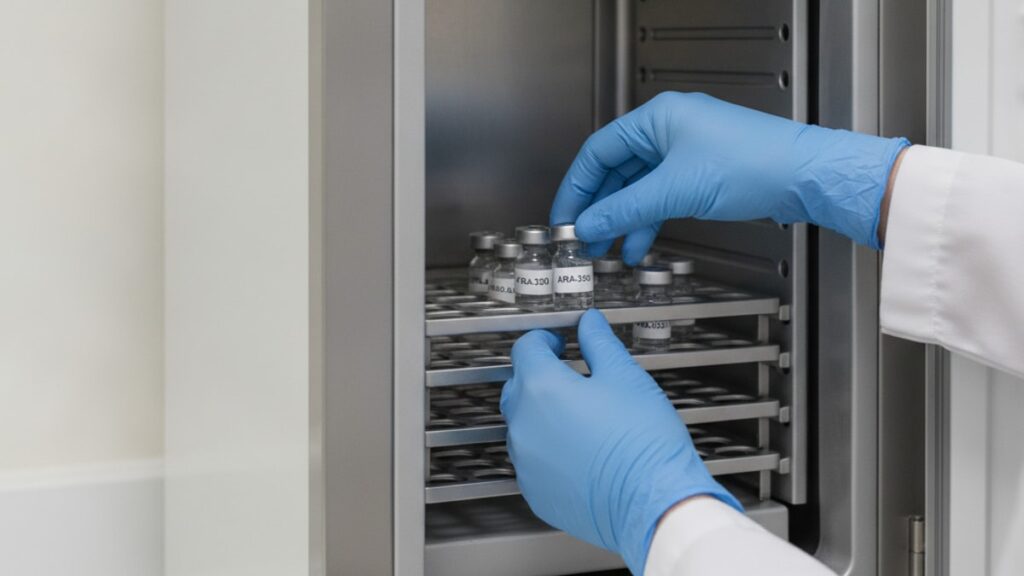
How to Store ARA-290 Long Term — Research Peptide Stability
Most ARA-290 storage failures happen before the peptide is ever used. A vial left at room temperature for three hours during shipping, a reconstituted solution stored at 10°C instead of 4°C, or a single accidental freeze after mixing with bacteriostatic water. Each of these destroys peptide integrity in ways no visual inspection can detect. The molecule doesn't change color, develop sediment, or show obvious degradation, but its biological activity drops to near-zero.
Our team has worked with hundreds of research labs handling sensitive peptides like ARA-290. The gap between a stable, usable peptide and a degraded compound comes down to three things: temperature precision, container integrity, and timing.
How do you store ARA-290 long term without losing potency?
Store ARA-290 long term at −20°C in lyophilized (freeze-dried) form, where it remains stable for 12–24 months. Once reconstituted with bacteriostatic water, refrigerate the solution at 2–8°C and use within 28–30 days. Any temperature above 8°C or below −80°C (causing ice crystal formation in liquid) causes irreversible peptide denaturation.
The distinction between lyophilized storage and reconstituted storage isn't a recommendation. It's the structural requirement of the peptide itself. ARA-290, a synthetic analog of erythropoietin, contains 11 amino acids arranged in a specific tertiary structure. That structure is what binds to tissue-protective receptors. Temperature excursions disrupt hydrogen bonds holding the peptide in its active conformation, and once those bonds break, they don't reform. This article covers the exact storage protocols for both forms, the mechanisms behind peptide degradation, what temperature ranges matter and why, and what mistakes most researchers make that negate stability entirely.
Step 1: Verify Storage Temperature Before Accepting Delivery
The first failure point for long-term ARA-290 storage happens during transit. Not in your lab. Peptides shipped without cold-chain logistics experience temperature fluctuations that compromise stability before you ever open the package. ARA-290 in lyophilized form can tolerate short-term ambient exposure (up to 25°C for 24–48 hours), but anything beyond that begins measurable degradation.
When Real Peptides ships research peptides, we use insulated gel packs rated to maintain 2–8°C for 48 hours under standard conditions. Upon delivery, check the package immediately. If the gel pack is fully liquefied and warm to the touch, document it and contact the supplier before opening the vial. Most reputable suppliers will replace compromised shipments at no cost.
Once received, transfer lyophilized ARA-290 directly to a −20°C freezer. Standard home or lab freezers maintain this temperature reliably, but chest freezers provide more stable conditions than upright models because they experience fewer temperature swings during door openings. If your facility uses ultra-low temperature freezers (−80°C), that's acceptable for lyophilized peptides. But never store reconstituted ARA-290 below −20°C, as ice crystal formation physically shears peptide bonds.
Label every vial with the receipt date and lot number. Peptide degradation is time-dependent even under optimal conditions. A vial stored at −20°C for 18 months has lower activity than one stored for 6 months, even if both were handled identically.
Step 2: Reconstitute With Bacteriostatic Water Under Sterile Conditions
Reconstitution is the transition point where long-term stability changes completely. Lyophilized ARA-290 stored at −20°C remains stable for 12–24 months. Once mixed with bacteriostatic water, that window compresses to 28–30 days at 2–8°C. And stability drops sharply if the solution is kept at room temperature for more than a few hours.
Use bacteriostatic water, not sterile water. Bacteriostatic water contains 0.9% benzyl alcohol, which prevents bacterial growth in multi-dose vials. Sterile water lacks this preservative, so any contamination during drawing will proliferate rapidly. If you're preparing a single-use dose and discarding the remainder, sterile water is acceptable. But for any vial accessed more than once, bacteriostatic water is non-negotiable.
Reconstitute slowly. Add bacteriostatic water to the vial by directing the stream against the glass wall, not directly onto the lyophilized peptide cake. Let the liquid dissolve the powder passively. Do not shake or vortex the vial. Agitation introduces shear forces that can disrupt peptide structure. Gently swirl the vial in a circular motion until the powder is fully dissolved, then refrigerate immediately.
The reconstituted solution should be clear and colorless. Any cloudiness, visible particles, or discoloration indicates contamination or degradation. Discard the vial. Do not attempt to use it. Store ara-290 long term by keeping reconstituted vials in the coldest, most stable section of your refrigerator (typically the back of the middle shelf, away from the door).
Step 3: Minimize Freeze-Thaw Cycles and Temperature Excursions
Every time a peptide solution experiences a freeze-thaw cycle, a percentage of the molecules denature irreversibly. The exact loss depends on the peptide's structure and the severity of the freeze, but for ARA-290, a single freeze-thaw cycle can reduce biological activity by 20–40%. Three cycles can render the peptide nearly inactive.
This is why reconstituted ARA-290 should never be stored in a freezer. Researchers sometimes assume freezing extends shelf life. It doesn't. Freezing causes water to form ice crystals, which expand and physically disrupt peptide structure. When the solution thaws, those peptides don't refold correctly. The result is a solution that looks identical but has lost most of its receptor-binding capacity.
Temperature excursions above 8°C are equally damaging. Peptides are stable within a narrow thermal range because their tertiary structure depends on weak hydrogen bonds and hydrophobic interactions. At temperatures above 10°C, these bonds begin to break, and the peptide unfolds. Once unfolded, it aggregates with other denatured peptides, forming insoluble clumps. This process is irreversible. Refrigerating the solution again won't restore activity.
Use aliquoting to reduce exposure. If you're working with a multi-week protocol, divide the reconstituted solution into single-use aliquots immediately after mixing. Store each aliquot separately in the refrigerator. This way, you only remove one aliquot at a time, and the remaining doses stay cold continuously. Small cryovials (1–2 mL capacity) work well for this purpose.
ARA-290 Storage: Temperature Comparison
| Storage Form | Optimal Temperature | Maximum Stability Duration | Temperature Tolerance | Freeze-Thaw Risk | Professional Assessment |
|---|---|---|---|---|---|
| Lyophilized (unopened) | −20°C | 12–24 months | Can tolerate 25°C for 24–48 hours during shipping | None. Dry powder stable | Industry standard for long-term peptide storage; maximizes shelf life and minimizes degradation |
| Reconstituted (bacteriostatic water) | 2–8°C | 28–30 days | Any excursion above 8°C accelerates degradation; even 10°C shortens usable window | High. A single freeze reduces activity 20–40% | Requires strict refrigeration; most labs lose potency here due to inconsistent temp control |
| Reconstituted (room temp) | Not recommended | Hours to days | Peptide denatures within 4–8 hours at 20°C or higher | N/A. Liquid at room temp | Worst-case scenario; used only for immediate dosing within minutes of reconstitution |
| Ultra-low temp (−80°C) | Acceptable for lyophilized only | 24+ months | Stable indefinitely in dry form | Never freeze liquid. Causes irreversible aggregation | Common in institutional labs; overkill for most research but doesn't harm lyophilized peptides |
Key Takeaways
- Store ARA-290 long term at −20°C in lyophilized form for 12–24 months of maximum stability.
- Once reconstituted with bacteriostatic water, refrigerate at 2–8°C and use within 28–30 days. Never freeze the liquid solution.
- A single freeze-thaw cycle after reconstitution can reduce peptide activity by 20–40%, and three cycles render it nearly inactive.
- Temperature excursions above 8°C cause irreversible peptide denaturation through hydrogen bond disruption and aggregation.
- Aliquot reconstituted solutions into single-use vials to minimize repeated removal from refrigeration and reduce contamination risk.
- Bacteriostatic water (0.9% benzyl alcohol) prevents bacterial growth in multi-dose vials; sterile water is acceptable only for single-use applications.
What If: ARA-290 Storage Scenarios
What If the Lyophilized Vial Was Left at Room Temperature for 24 Hours?
If the vial is still sealed and the peptide is in lyophilized form, it's likely still usable. Store ara-290 long term at −20°C as soon as you discover the lapse. Lyophilized peptides tolerate short-term ambient exposure better than reconstituted solutions because there's no water present to facilitate degradation reactions. Activity loss after 24 hours at room temperature is typically 5–10%. Measurable but not catastrophic. Document the incident and use that vial for non-critical applications if precision dosing matters.
What If I Accidentally Froze a Reconstituted Vial?
Discard it. A frozen reconstituted peptide solution has undergone ice crystal formation, which physically disrupts the peptide's tertiary structure. Even if you thaw it gently, a significant portion of the peptides will have aggregated into inactive forms. There's no way to reverse this damage, and using a degraded peptide introduces uncontrolled variables into your research. The cost of replacing the vial is far lower than the cost of compromised data.
What If the Refrigerator Temperature Fluctuated Between 2°C and 12°C Overnight?
You've lost some potency, but the peptide isn't necessarily ruined. If the excursion was brief (under 8 hours) and didn't exceed 12°C, you can continue using the vial with the understanding that its effective concentration is now lower than labeled. For quantitative work, consider this vial compromised. For exploratory or preliminary studies, it's still usable. The exact activity loss depends on how long the temperature stayed above 8°C. Peptides degrade exponentially faster as temperature rises.
What If I Need to Transport Reconstituted ARA-290 Between Labs?
Use a validated cold-chain container. Medical specimen transport bags with gel packs rated for 2–8°C work well for trips under 6 hours. For longer transport, use an active cooling system (a portable refrigerator or a phase-change material designed for biologics transport). Never rely on standard ice packs. They're often too cold and can freeze the vial. Store ara-290 long term by maintaining the 2–8°C range continuously, even during transport.
The Unforgiving Truth About Peptide Storage
Here's the honest answer: most peptide degradation in research labs isn't the result of negligence. It's the result of underestimating how fragile these molecules are. Researchers trained in small-molecule chemistry often assume peptides behave like stable organic compounds. They don't. ARA-290 is a biological macromolecule held together by weak non-covalent forces, and those forces break easily.
The storage protocol isn't a suggestion. It's a description of what the peptide's structure requires to remain intact. If you store ara-290 long term at 10°C instead of 4°C because 'it's still cold,' you'll lose activity. If you reconstitute it with sterile water instead of bacteriostatic water and access the vial four times over two weeks, you'll introduce contamination. If you freeze it once 'just to see,' you'll denature it.
The mechanism isn't complex. It's just unforgiving. Peptides don't have a 'close enough' range. They have a stable range and a degraded range, and the transition between those two states happens fast. That's why peptide suppliers like Real Peptides emphasize cold-chain handling at every step. Because once a peptide degrades, no amount of careful handling afterward will restore it.
The biggest mistake we see isn't dramatic. It's assuming that because the peptide looks fine, it is fine. Clear, colorless solutions can be completely inactive. The only way to know for certain is to handle it correctly from the moment it arrives.
Long-term stability for ARA-290 isn't just about where you store it. It's about every temperature transition from synthesis to use. A peptide that ships cold, arrives cold, gets refrigerated immediately, reconstitutes under sterile conditions, and stays at 2–8°C until use will retain full activity for 28–30 days. A peptide that experiences even one uncontrolled temperature excursion won't. The difference between those two outcomes is procedural discipline, not luck.
Frequently Asked Questions
How long does lyophilized ARA-290 remain stable at −20°C?▼
Lyophilized ARA-290 stored at −20°C remains stable for 12–24 months under optimal conditions. Stability duration depends on manufacturing quality, packaging integrity, and whether the vial has been opened. Once the seal is broken, even in lyophilized form, exposure to moisture and oxygen begins gradual degradation. For maximum shelf life, keep vials sealed until you’re ready to reconstitute, and always store them in the coldest, most stable section of your freezer.
Can I store reconstituted ARA-290 at room temperature for a few hours?▼
Reconstituted ARA-290 should not be stored at room temperature for more than 1–2 hours. At 20–25°C, peptide degradation accelerates rapidly due to increased molecular motion and hydrolysis. If you must keep a dose out briefly for immediate use, that’s acceptable — but returning a vial to room temperature repeatedly over days will significantly reduce potency. Always refrigerate reconstituted peptides immediately after drawing your dose.
What’s the difference between storing ARA-290 in bacteriostatic water versus sterile water?▼
Bacteriostatic water contains 0.9% benzyl alcohol, which prevents bacterial growth in multi-dose vials accessed over several weeks. Sterile water lacks this preservative, so contamination introduced during needle access can proliferate. If you’re using the entire vial in a single dose, sterile water is fine. For any vial you’ll access more than once, bacteriostatic water is required to maintain sterility throughout the 28–30 day usable window.
Does freezing reconstituted ARA-290 extend its shelf life?▼
No — freezing reconstituted ARA-290 destroys it. When water freezes, it forms ice crystals that physically shear peptide bonds and disrupt the molecule’s three-dimensional structure. Upon thawing, the peptides aggregate into inactive clumps. A single freeze-thaw cycle can reduce activity by 20–40%. The proper way to store ara-290 long term is to keep lyophilized powder frozen at −20°C and reconstituted solution refrigerated at 2–8°C — never freeze the liquid form.
What temperature is considered ‘too warm’ for storing reconstituted ARA-290?▼
Anything above 8°C begins accelerating peptide degradation. The optimal storage range is 2–8°C (standard refrigerator temperature). At 10°C, you’ll start losing activity measurably within days. At 15°C or higher, degradation happens within hours. Standard refrigerators should maintain 4°C in their coldest sections — use a refrigerator thermometer to verify, as many consumer units fluctuate more than their settings indicate.
How do I know if my ARA-290 has degraded?▼
Degraded peptides often look identical to active ones — clear, colorless, no visible particles. The only reliable indicator is cloudiness or visible precipitate, which signals severe degradation or contamination. For less obvious degradation, you’d need lab testing (HPLC or mass spectrometry) to confirm. This is why correct storage protocol matters so much — you can’t visually detect most stability failures, so prevention is the only practical quality control measure for research labs.
Can ARA-290 be stored alongside other peptides in the same freezer?▼
Yes, as long as each peptide is sealed in its own vial and clearly labeled. Cross-contamination isn’t a risk for sealed lyophilized peptides. However, avoid storing reconstituted peptides in the same refrigerator section as unsealed biological samples or food, as this increases contamination risk if any vial leaks. Dedicated peptide storage in a lab-grade refrigerator is ideal, but a clean home refrigerator with stable temperature control works for small-scale research.
What happens if I miss the 28-day window for reconstituted ARA-290?▼
Activity gradually declines after 28–30 days even under perfect refrigeration. By day 40–45, you’ve likely lost 30–50% potency. By day 60, the peptide is mostly inactive. If you’re beyond the 30-day mark and the solution still looks clear, you can use it for non-quantitative exploratory work, but don’t rely on it for dose-dependent studies. The 28–30 day window isn’t arbitrary — it’s based on measured degradation rates for similar peptides in bacteriostatic water at 2–8°C.
Should I aliquot reconstituted ARA-290 into smaller vials?▼
Yes, if you’re using it over multiple weeks. Aliquoting into single-use vials (1–2 mL capacity) minimizes the number of times the main stock solution is removed from refrigeration and reduces contamination risk from repeated needle access. Each aliquot should be used within one dosing session and then discarded. This approach extends the usable life of your remaining stock by keeping it cold and sealed continuously.
Is it safe to order ARA-290 during summer months when shipping temperatures are higher?▼
Reputable suppliers use insulated packaging and cold packs rated to maintain 2–8°C for 48 hours regardless of external temperature. If you’re concerned, request delivery on a Monday or Tuesday to avoid weekend delays, and arrange to receive the package immediately upon arrival. Some suppliers offer temperature-monitored shipping with data loggers that record the entire transit temperature profile — if stability is critical for your work, that option is worth the added cost.











