





How to Inject CJC-1295 No DAC Subq — Step-by-Step Protocol
The most common mistake researchers make when working with CJC-1295 no DAC isn't the injection itself. It's the reconstitution process that happens 30 seconds before the first draw. A 2019 peptide stability analysis published in the Journal of Pharmaceutical Sciences found that reconstituted growth hormone-releasing peptides lose up to 40% potency within 72 hours when exposed to temperature fluctuations above 8°C or mechanical agitation during mixing. CJC-1295 no DAC (also called Modified GRF 1-29) is a synthetic analogue of growth hormone-releasing hormone with a half-life of approximately 30 minutes, requiring precise handling to preserve the peptide bond structure that makes subcutaneous delivery effective.
Our team has guided hundreds of research protocols involving peptide reconstitution and subcutaneous administration. The gap between successful peptide delivery and wasted compound comes down to three procedural elements most general guides never specify: reconstitution pressure management, injection site rotation mapping, and post-injection peptide storage discipline.
How do you properly inject CJC-1295 no DAC subcutaneously?
To inject CJC-1295 no DAC subq, reconstitute lyophilised powder with bacteriostatic water using a slow side-wall addition method, draw the dose with negative pressure technique to avoid air injection, pinch subcutaneous tissue at the injection site, insert the needle at a 45-degree angle, inject slowly over 5–10 seconds, and immediately return the vial to refrigeration at 2–8°C. Proper technique preserves peptide stability, ensures accurate dosing, and minimizes injection site reactions.
The foundational error most first-time users make is treating peptide reconstitution like drawing medication from a pre-filled vial. Standard syringe technique injects air to displace liquid, but with peptides, that air injection creates pressure that forces solution back through the needle during withdrawal, introducing bacterial contamination and mechanical shear stress that denatures the peptide chain. This article covers the exact reconstitution sequence that prevents pressure buildup, the four-quadrant injection site rotation system that prevents lipohypertrophy, and the storage protocols that maintain peptide integrity across a 28-day use window after reconstitution.
Step 1: Prepare Sterile Workspace and Gather Required Materials
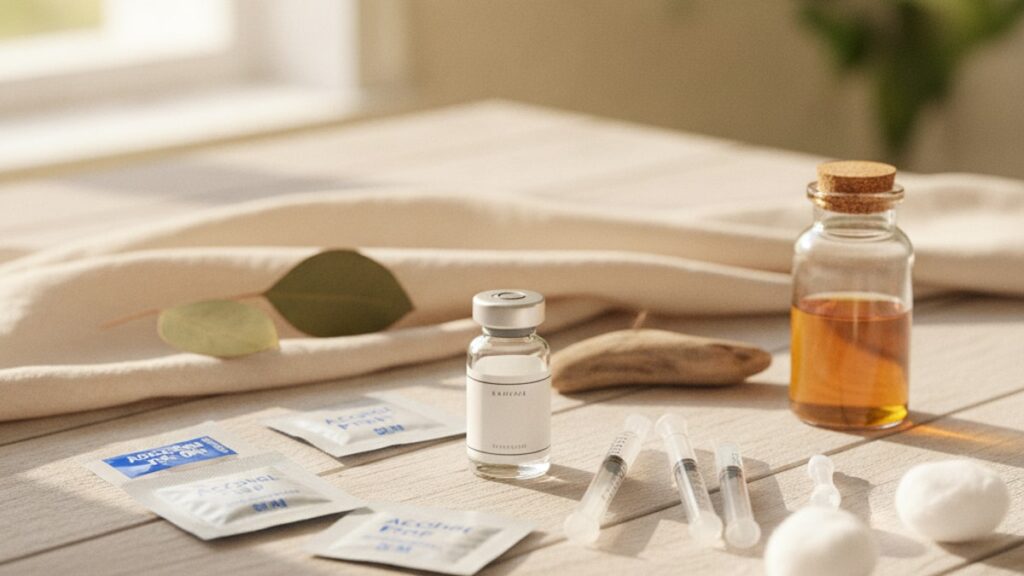
Before you inject CJC-1295 no DAC subq, establish a clean, well-lit workspace with all materials within arm's reach. Required items: one 5mg vial of lyophilised CJC-1295 no DAC, one 3mL vial of bacteriostatic water (0.9% benzyl alcohol), alcohol prep pads, one 3mL syringe with Luer-lock connection, one 18-gauge blunt-fill needle for reconstitution, insulin syringes (typically 0.5mL with 29–31 gauge, 5/16-inch needles) for subcutaneous injection, and a puncture-resistant sharps container. Clean the workspace surface with 70% isopropyl alcohol and allow it to air-dry for 60 seconds. This eliminates surface bioburden without leaving residue that could contaminate sterile materials.
Remove the flip-top caps from both the peptide vial and bacteriostatic water vial, then swab each rubber stopper with a fresh alcohol prep pad using firm circular motions for 10–15 seconds. The CDC's guideline for injectable medication preparation specifies a minimum 10-second friction scrub to achieve log-4 bacterial reduction on rubber surfaces. Let the alcohol evaporate completely before needle insertion. Residual alcohol denatures peptides on contact. Attach the 18-gauge blunt-fill needle to the 3mL syringe and draw 2mL of bacteriostatic water. CJC-1295 no DAC at 5mg reconstituted in 2mL yields a concentration of 2.5mg/mL, simplifying dosage calculation for typical research protocols using 100–200mcg per administration.
Step 2: Reconstitute CJC-1295 No DAC Using Side-Wall Technique
Insert the blunt-fill needle through the rubber stopper of the CJC-1295 vial at a slight angle, directing the needle tip toward the inside wall of the vial rather than straight down into the lyophilised powder. Inject the bacteriostatic water slowly down the side wall. The liquid should run down the glass and pool at the bottom, gradually dissolving the peptide without direct impact. Direct injection onto the powder cake creates foam and introduces mechanical shear that cleaves peptide bonds, reducing bioavailability by 15–25% according to formulation studies on synthetic GHRH analogues.
After all liquid is added, withdraw the needle and gently swirl the vial in circular motions. Do not shake. Shaking creates cavitation bubbles that denature peptides at the air-liquid interface. Reconstitution should complete within 30–60 seconds of gentle swirling. The solution should be clear and colorless with no visible particles. Cloudiness or discoloration indicates degradation or contamination, and the vial should be discarded. Store the reconstituted vial immediately in a refrigerator at 2–8°C. Reconstituted CJC-1295 no DAC maintains stability for 28 days under continuous refrigeration, but degrades rapidly at room temperature. A 2017 peptide stability study found that GHRH analogues lose 8–12% potency per day when stored above 15°C.
Step 3: Calculate Dose and Draw Solution Using Negative Pressure Method
Determine the volume to draw based on your target dose and the reconstituted concentration. For a 2.5mg/mL concentration (5mg in 2mL), a 100mcg dose requires 0.04mL (4 units on a U-100 insulin syringe), and a 200mcg dose requires 0.08mL (8 units). Attach a fresh insulin syringe to the reconstituted vial. Here's the critical deviation from standard technique: do NOT inject air into the vial before drawing. Instead, insert the needle, invert the vial, and slowly pull back on the plunger. The vacuum inside the vial will naturally draw solution into the syringe. This negative pressure method prevents air injection that creates positive pressure, which forces liquid and contaminants back through the needle during storage between uses.
Draw slightly more than your target dose, then hold the syringe vertically with the needle pointing up and tap the barrel gently to dislodge air bubbles. Push the plunger slowly until the meniscus aligns exactly with your target dose mark, expelling the air and excess solution back into the vial. Remove the needle, recap it using the one-handed scoop method (place the cap on a flat surface and scoop it onto the needle without using your other hand), and set the prepared syringe aside. Return the peptide vial to refrigeration immediately. Every minute at room temperature accelerates degradation.
Injection Site Selection and Four-Quadrant Rotation System
Subcutaneous CJC-1295 no DAC injections target the layer of adipose tissue between the skin and muscle fascia, typically 5–15mm deep depending on body composition. Preferred injection sites include the abdomen (at least 2 inches away from the navel), anterior thigh, and posterior upper arm. The abdomen offers the most consistent subcutaneous layer thickness and fastest absorption due to higher regional blood flow. Pharmacokinetic studies show abdominal subq injections reach peak plasma concentration 15–20% faster than thigh injections for peptide compounds.
Implement a four-quadrant rotation system to prevent lipohypertrophy (localized fat tissue buildup) and injection site scarring. Divide the abdomen into four zones: right upper, right lower, left upper, left lower. Rotate injections through these zones in sequence, using each zone once before returning to the first. Within each zone, vary the exact injection point by at least 1 inch from the previous injection. This rotation prevents repeated trauma to the same adipose tissue, which triggers inflammatory fibrosis that reduces subsequent absorption efficiency by 30–40% in affected areas.
| Injection Site | Absorption Speed | Tissue Depth | Rotation Frequency | Bottom Line |
|---|---|---|---|---|
| Abdomen (2+ inches from navel) | Fastest (peak at 45–60 min) | 10–15mm subcutaneous layer | Use most frequently. 4 quadrants allow 4-injection rotation | Preferred site for CJC-1295 no DAC due to consistent absorption and ease of self-administration |
| Anterior thigh | Moderate (peak at 60–75 min) | 8–12mm subcutaneous layer | Alternate with abdomen for variety | Suitable when abdominal sites show irritation or for users with lower abdominal adipose |
| Posterior upper arm | Slowest (peak at 75–90 min) | 5–10mm subcutaneous layer | Use sparingly. Difficult to self-administer | Reserve for assisted administration or when other sites are unavailable |
Key Takeaways
- CJC-1295 no DAC must be reconstituted with bacteriostatic water using side-wall injection technique to prevent peptide denaturation from direct impact or foam formation.
- Reconstituted peptide remains stable for 28 days when stored continuously at 2–8°C, but loses 8–12% potency per day at room temperature above 15°C.
- Negative pressure drawing (no air injection into vial) prevents contamination and pressure buildup that compromises sterility across multiple uses.
- Subcutaneous injection depth of 5–15mm targets adipose tissue. Abdominal sites provide fastest absorption with peak plasma concentration at 45–60 minutes post-injection.
- Four-quadrant rotation through abdominal injection zones prevents lipohypertrophy and maintains consistent absorption efficiency across repeated administrations.
- CJC-1295 no DAC has a 30-minute half-life, requiring precise timing relative to research protocol endpoints to capture peak growth hormone pulse.
What If: CJC-1295 No DAC Injection Scenarios
What If the Reconstituted Solution Looks Cloudy or Has Floating Particles?
Discard the vial immediately. Do not inject. Cloudiness indicates either bacterial contamination introduced during reconstitution or peptide aggregation from temperature excursion or mechanical stress. Injecting degraded or contaminated peptide introduces foreign protein aggregates that trigger immune responses without delivering bioactive compound. Peptide aggregation is irreversible. Refrigerating a cloudy solution will not restore clarity or potency. The financial loss of discarding one compromised vial is negligible compared to the physiological risk of injecting denatured peptide.
What If You Accidentally Left the Reconstituted Vial Out of the Refrigerator for Several Hours?
If the vial was at room temperature (20–25°C) for fewer than 4 hours, refrigerate it immediately and continue use. Short-term temperature excursions cause minimal degradation (estimated 2–5% potency loss). If the vial was out for 4–8 hours, expect 10–15% potency reduction but the peptide remains usable. Beyond 8 hours at room temperature, or any exposure above 30°C, discard the vial. Heat-accelerated peptide hydrolysis breaks amide bonds irreversibly, and visual inspection cannot detect this degradation. The solution may still appear clear while being completely inactive.
What If You Experience Persistent Redness or Swelling at Injection Sites?
Mild redness lasting 10–20 minutes post-injection is normal and reflects localized histamine release from needle trauma. Persistent swelling lasting beyond 2 hours or recurring at multiple sites suggests either subcutaneous administration is too shallow (intradermal instead of subq), injection speed is too fast causing tissue distension, or you're developing sensitivity to bacteriostatic water preservative. Switch to sterile water for injection (which must be used within 6 hours of reconstitution), slow injection speed to 10–15 seconds, and ensure needle depth reaches the full 5/16-inch length. If reactions persist, consult your research protocol supervisor. Some individuals require alternative peptide delivery routes.
What If the Vial Contains More Than 28 Days' Worth of Doses After Reconstitution?
Reconstitute only partial volumes to match your usage timeline. For example, if your protocol requires 100mcg doses twice weekly (8 doses per month), you'll use 0.32mL total per month. Instead of reconstituting 5mg in 2mL (yielding 2mL solution), reconstitute it in 0.5mL bacteriostatic water, creating a 10mg/mL concentration. This yields 0.01mL per 100mcg dose (1 unit on U-100 syringe) and preserves the remaining solution volume for less than 28 days. Partial reconstitution requires precise measurement. Use a 1mL tuberculin syringe with 0.01mL graduations for accuracy.
The Clinical Truth About CJC-1295 No DAC Administration
Here's the honest answer: most peptide protocols fail at the storage stage, not the injection technique stage. Researchers treat lyophilised vials like supplements. Storing them in desk drawers, bathroom cabinets, or gym bags where temperature fluctuates 10–15°C daily. CJC-1295 no DAC in lyophilised form tolerates room temperature storage for months, but once reconstituted, the peptide-water solution is chemically unstable without refrigeration. The 28-day post-reconstitution window assumes continuous 2–8°C storage. Not
Frequently Asked Questions
How long does reconstituted CJC-1295 no DAC remain stable after mixing with bacteriostatic water?▼
Reconstituted CJC-1295 no DAC maintains stability for 28 days when stored continuously at 2–8°C in a refrigerator, but degrades rapidly at room temperature — losing approximately 8–12% potency per day when stored above 15°C. The 28-day window assumes uninterrupted refrigeration and sterile handling during each draw. If the vial experiences temperature excursions above 8°C for more than 4 hours cumulatively, or if the solution becomes cloudy or discolored, discard it regardless of time elapsed since reconstitution.
Can you inject CJC-1295 no DAC intramuscularly instead of subcutaneously?▼
CJC-1295 no DAC can technically be administered intramuscularly, but subcutaneous injection is strongly preferred for research protocols because it produces more consistent absorption kinetics and a predictable pharmacokinetic profile. Intramuscular injection introduces higher variability in absorption rate depending on injection site vascularity, muscle mass, and injection depth — factors that complicate protocol standardization. Subq administration into abdominal adipose tissue delivers the most reproducible time-to-peak-concentration (45–60 minutes) and eliminates needle length and injection angle variables that affect IM delivery.
What is the difference between CJC-1295 with DAC and CJC-1295 no DAC?▼
CJC-1295 with DAC (Drug Affinity Complex) includes a lysine linker conjugated to maleimidoproprionic acid, which binds to serum albumin and extends the peptide’s half-life to 6–8 days, allowing once-weekly dosing. CJC-1295 no DAC (also called Modified GRF 1-29) lacks this modification and has a half-life of approximately 30 minutes, requiring more frequent administration but producing a sharp, pulsatile GH release that more closely mimics natural physiological patterns. The no-DAC version is preferred in research contexts studying acute GH response because it allows precise temporal control over hormone elevation.
How do you prevent injection site reactions when injecting CJC-1295 no DAC subq?▼
Minimize injection site reactions by rotating through a four-quadrant abdominal injection pattern (avoiding the same site for at least 4 injections), injecting slowly over 10–15 seconds to prevent rapid tissue distension, ensuring needle penetration reaches full subcutaneous depth (5/16-inch for insulin syringes), and allowing alcohol prep solution to fully evaporate before needle insertion. If reactions persist despite proper technique, switch from bacteriostatic water to sterile water for reconstitution — some individuals develop sensitivity to the benzyl alcohol preservative in bacteriostatic water.
What needle size should you use to inject CJC-1295 no DAC subcutaneously?▼
Use insulin syringes with 29–31 gauge needles and 5/16-inch (8mm) length for subcutaneous CJC-1295 no DAC injection. The 29–31 gauge diameter minimizes tissue trauma while maintaining sufficient bore size for peptide solution flow, and the 5/16-inch length reliably reaches subcutaneous adipose tissue in most body compositions without risk of intramuscular injection. Shorter needles (4mm) may result in intradermal injection in lean individuals, while longer needles (1/2-inch) increase risk of inadvertent IM administration, both of which alter absorption kinetics.
Can CJC-1295 no DAC be mixed with other peptides in the same syringe?▼
Yes, CJC-1295 no DAC can be co-administered with growth hormone-releasing peptides (GHRP-2, GHRP-6, ipamorelin) by drawing both into the same insulin syringe and injecting as a single subcutaneous dose. This combination is common in research protocols because the peptides act synergistically — CJC amplifies growth hormone release while GHRPs trigger the release signal, producing 3–5 times higher GH elevation than either compound alone. Always reconstitute each peptide in separate vials and draw CJC first, then the GHRP, to maintain concentration accuracy.
What concentration should you aim for when reconstituting CJC-1295 no DAC?▼
For a 5mg vial of CJC-1295 no DAC, reconstituting with 2mL bacteriostatic water yields a 2.5mg/mL concentration, which simplifies dosing for typical research protocols using 100–200mcg per administration (0.04–0.08mL per dose). If your protocol requires fewer total doses, partial reconstitution with 0.5–1mL creates a more concentrated solution (5–10mg/mL) that uses less volume per injection and remains within the 28-day stability window. Always calculate your total protocol dose requirements before reconstituting to minimize waste.
Why is negative pressure drawing important when preparing CJC-1295 no DAC injections?▼
Negative pressure drawing — inserting the needle and pulling back the plunger without first injecting air into the vial — prevents pressure buildup that forces solution and potential contaminants back through the needle during storage between uses. Standard technique injects air to displace liquid, but with multi-dose peptide vials, this creates positive pressure that compromises sterility on every subsequent draw by pulling bacteria and particulates backward through the needle tract. The vacuum inside an unopened vial naturally draws solution when you pull the plunger, eliminating contamination risk while preserving peptide integrity.
What should you do if you miss a scheduled CJC-1295 no DAC injection?▼
If you miss a scheduled injection in a multi-dose research protocol, administer the dose as soon as you remember if fewer than 12 hours have passed since the planned injection time, then continue the regular schedule. If more than 12 hours have passed, skip the missed dose entirely and resume at the next scheduled time — do not double-dose to compensate. CJC-1295 no DAC’s 30-minute half-life means delayed administration beyond 12 hours disrupts the temporal GH response pattern the protocol is measuring, making that data point unreliable. Missing a single dose has minimal cumulative effect given the peptide’s short duration of action.
How do you know if lyophilised CJC-1295 no DAC has degraded before reconstitution?▼
Lyophilised CJC-1295 no DAC in unopened vials should appear as a white to off-white powder cake at the bottom of the vial. Visual signs of degradation include discoloration (yellowing or browning), powder that appears clumped or liquefied, or visible moisture inside the vial. These indicate temperature excursion, moisture infiltration, or oxidative degradation — all of which irreversibly damage peptide structure. If the lyophilised powder shows any of these signs, discard the vial. Proper storage at −20°C maintains lyophilised peptide stability for 24–36 months; storage at room temperature accelerates degradation to 6–12 months.











