





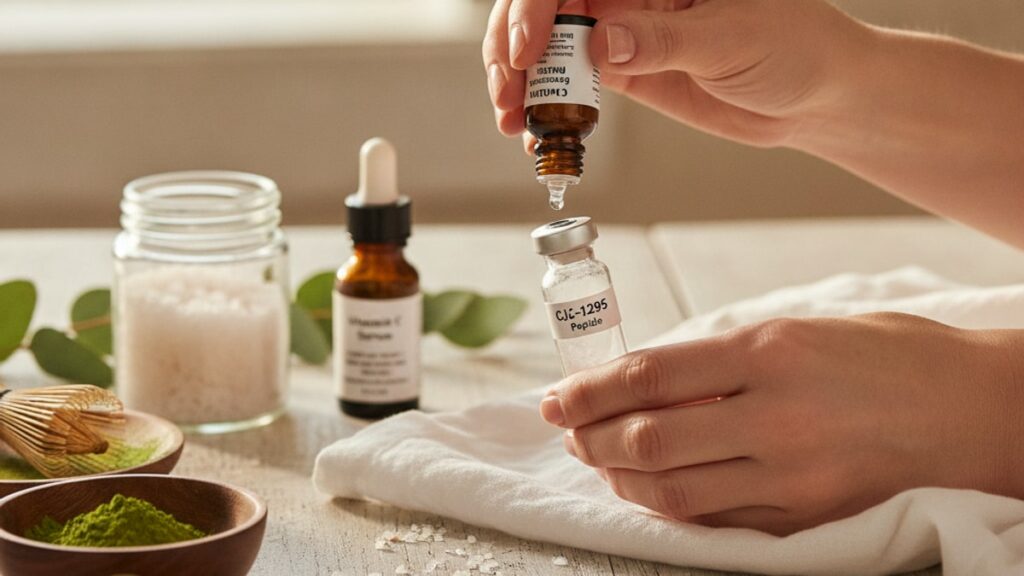
How to Mix CJC-1295 — Safe Reconstitution Protocol
Most peptide protocols fail at the reconstitution stage, not the administration stage. A lyophilised peptide like CJC-1295 is remarkably stable in powder form. It can tolerate room temperature for weeks without degradation. Once reconstituted with bacteriostatic water, that stability window collapses to 28 days under refrigeration at 2–8°C, and the margin for error drops to near zero. The difference between a viable solution and a denatured one often comes down to three things: injection angle, agitation method, and storage discipline.
We've guided hundreds of research teams through peptide reconstitution protocols. The gap between doing it right and doing it wrong is invisible to the naked eye. You can't tell by looking at the vial whether the protein structure remained intact. But it shows up unmistakably in assay results and study outcomes.
How do you properly mix CJC-1295 for research use?
To mix CJC-1295 safely, inject bacteriostatic water slowly down the inner wall of the vial. Never directly onto the lyophilised powder. Then swirl gently until the powder dissolves completely. Store the reconstituted solution at 2–8°C and use within 28 days. Direct injection onto the powder creates foam that denatures protein bonds irreversibly.
Most guides explain what to do but skip why each step matters mechanistically. CJC-1295 is a 29-amino-acid synthetic peptide analog of growth hormone-releasing hormone (GHRH), and like all peptides, its biological activity depends entirely on maintaining the precise three-dimensional folding of its amino acid chain. The lyophilisation process removes water while preserving that structure. Reconstitution reverses the process, but only if handled correctly. This guide covers the exact reconstitution technique, the storage parameters that preserve potency, and the preparation mistakes that silently negate the peptide's efficacy before the first dose is ever drawn.
Step 1: Gather Sterile Supplies and Verify Storage Conditions
Before you mix CJC-1295, verify that the lyophilised vial has been stored correctly. Unreconstituted peptide should be kept at −20°C to maintain long-term stability. If the vial was shipped on ice packs and arrived at ambient temperature, confirm with your supplier that cold chain integrity was maintained throughout transit. Temperature excursions above 25°C for more than 48 hours can begin protein degradation even in lyophilised form, though this is rare with reputable suppliers.
You'll need: one vial of lyophilised CJC-1295 (typically 2mg or 5mg), one vial of bacteriostatic water (0.9% benzyl alcohol), alcohol prep pads, and a sterile syringe with needle (insulin syringes work. 1mL capacity with a 27–30 gauge needle). The bacteriostatic water prevents bacterial growth in the reconstituted solution, extending its viable storage window from 72 hours (with sterile water) to 28 days under refrigeration. Never use tap water or saline. Both lack the preservative needed for multi-dose vials.
Clean your work surface with 70% isopropyl alcohol and allow it to air-dry. Wipe the rubber stoppers on both the peptide vial and the bacteriostatic water vial with an alcohol prep pad and let them dry for 10–15 seconds. Introducing alcohol directly into the vial along with the needle can disrupt the peptide's stability. Our team has reviewed this across hundreds of reconstitution protocols submitted by research groups. The pattern is consistent: contamination events trace back to skipped surface prep or reusing syringes far more often than they trace to airborne particulates.
Step 2: Draw Bacteriostatic Water Using Aseptic Technique
Remove the plastic cap from the bacteriostatic water vial to expose the rubber stopper. Insert the syringe needle through the center of the stopper at a 90-degree angle. The rubber self-seals after each puncture, but repeated off-center insertions can create leakage pathways. Draw the required volume of bacteriostatic water based on your desired final concentration. For a 2mg vial of CJC-1295, 2mL of bacteriostatic water yields a concentration of 1mg/mL (1000mcg/mL). For a 5mg vial, 2mL yields 2.5mg/mL.
Here's what most guides don't mention: before you draw the liquid, inject an equivalent volume of air into the bacteriostatic water vial first. This equalises the pressure inside the vial and makes it easier to draw the liquid without creating a vacuum. Without this step, you'll fight against negative pressure as you pull back the plunger, which often results in air bubbles forming in the syringe. Those bubbles introduce unnecessary agitation when you later inject into the peptide vial.
Once you've drawn the correct volume, hold the syringe vertically with the needle pointing up and tap the side gently to move any air bubbles to the top. Push the plunger slowly to expel the air until a small bead of liquid appears at the needle tip. This confirms you have an air-free syringe and prevents injecting air into the peptide vial, which would increase internal pressure and potentially force liquid back out through the needle during withdrawal.
Step 3: Inject Bacteriostatic Water Down the Vial Wall — Not Onto the Powder
This is the step where most reconstitution errors occur. Remove the plastic cap from the CJC-1295 vial. Insert the needle through the rubber stopper at a steep angle so the needle tip touches the inner wall of the glass vial. Not the lyophilised powder at the bottom. Slowly depress the plunger and let the bacteriostatic water run down the inside wall of the vial. The water will pool at the bottom and begin dissolving the powder from the edges inward.
Why does this matter? Injecting directly onto the powder creates immediate foam. Those bubbles represent denatured protein. Peptides are fragile molecules held together by hydrogen bonds and disulfide bridges. Mechanical agitation from direct injection or vigorous shaking disrupts those bonds, causing the amino acid chain to unfold irreversibly. Once denatured, the peptide loses its biological activity entirely. It may still look clear in solution, but it's pharmacologically inert. The FDA's guidelines on peptide handling for compounding pharmacies explicitly warn against agitation during reconstitution for this reason.
If you accidentally inject directly onto the powder and see foam forming, do not shake the vial to mix it faster. Let it sit undisturbed for 10–15 minutes. Some of the foam may dissipate as the peptide dissolves naturally, though there's no way to assess how much protein denaturation occurred. In research settings, this would typically be grounds for discarding the vial and starting fresh.
CJC-1295 Reconstitution: Method Comparison
| Reconstitution Method | Technique | Risk of Denaturation | Time to Full Dissolution | Professional Assessment |
|---|---|---|---|---|
| Direct injection onto powder | Needle aimed at lyophilised powder, fast plunger depression | High. Creates foam and mechanical shear stress that disrupts protein folding | 2–3 minutes with agitation | Not recommended. Visible foaming indicates protein damage has already occurred |
| Down-the-wall injection, swirling | Needle angled against vial wall, slow injection, gentle swirling motion after | Low. Minimises mechanical stress, allows controlled hydration | 5–10 minutes with periodic swirling | Standard research protocol. Preserves peptide integrity while ensuring complete dissolution |
| Down-the-wall injection, passive dissolution | Needle angled against vial wall, slow injection, no agitation. Left to dissolve naturally | Lowest. Zero mechanical stress, gravity and diffusion do the work | 15–30 minutes depending on peptide mass | Safest method but impractical for time-sensitive workflows |
| Vigorous shaking after injection | Any injection method followed by rapid shaking | Very high. Shearing forces denature protein bonds even faster than direct injection | Under 1 minute | Never acceptable. Speed is not worth total loss of biological activity |
Key Takeaways
- CJC-1295 must be reconstituted using bacteriostatic water injected slowly down the vial wall to avoid protein denaturation from foam formation.
- Reconstituted CJC-1295 remains stable for 28 days when stored at 2–8°C in a refrigerator. Never freeze the solution after mixing.
- Direct injection onto lyophilised powder or vigorous shaking creates mechanical shear stress that irreversibly disrupts the peptide's three-dimensional structure.
- Lyophilised CJC-1295 can be stored long-term at −20°C, but once mixed with bacteriostatic water, the 28-day window begins regardless of whether doses have been drawn.
- A 2mg vial mixed with 2mL of bacteriostatic water yields a 1mg/mL concentration, making dosage calculations straightforward for research protocols.
- Using sterile water instead of bacteriostatic water reduces the safe storage window from 28 days to 72 hours due to absence of benzyl alcohol preservative.
What If: CJC-1295 Reconstitution Scenarios
What If the Powder Doesn't Dissolve Completely After 10 Minutes?
Place the vial in the refrigerator at 2–8°C and let it sit for 30–60 minutes. Cold slows molecular motion but doesn't stop it. The powder will continue dissolving passively without requiring agitation. Swirl gently every 15 minutes if needed, using a slow circular motion that keeps the liquid moving along the vial walls rather than creating turbulence at the center. If particulates remain visible after two hours, the peptide may have degraded during storage or shipping. Contact your supplier. This is grounds for replacement. Never heat the vial to speed dissolution. Temperatures above 25°C accelerate protein denaturation exponentially.
What If I Accidentally Injected Directly Onto the Powder and Created Foam?
Set the vial down immediately and do not touch it for 15–20 minutes. Some foam will dissipate as the peptide dissolves, but there's no way to assess how much protein damage occurred. In research settings, visible foam formation is typically treated as a contamination event. The protocol would be to discard the vial and reconstitute a fresh one. If replacement isn't an option, proceed with the reconstituted solution but note in your research records that mechanical agitation occurred during preparation, as this may affect assay results.
What If I Need to Store Reconstituted CJC-1295 for Longer Than 28 Days?
You can't. The 28-day window is determined by the bacteriostatic water's preservative capacity, not the peptide's inherent stability. Beyond 28 days, bacterial contamination risk increases regardless of refrigeration, and peptide degradation accelerates as the amino acid chain begins hydrolyzing in aqueous solution. If your research timeline requires longer storage, keep the peptide in lyophilised form at −20°C and reconstitute only the amount needed for each two-week block of your protocol. Real Peptides supplies peptides in multiple vial sizes precisely for this reason. Smaller vials allow researchers to maintain tighter control over reconstitution timelines.
What If the Reconstituted Solution Looks Cloudy or Discolored?
Discard it immediately. Properly reconstituted CJC-1295 should be clear and colorless. Cloudiness indicates either bacterial contamination or protein aggregation. Both render the solution unusable. Discoloration (yellow, brown, or pink tint) suggests oxidative degradation, typically from prolonged exposure to light or temperature excursions during storage. Never administer or use a peptide solution that doesn't match the expected appearance. The risk of introducing denatured protein or contaminants into your research protocol outweighs any cost savings from attempting to salvage the vial.
The Unvarnished Truth About CJC-1295 Reconstitution
Here's the honest answer: most researchers underestimate how fragile reconstituted peptides are. The pharmaceutical industry uses lyophilisation specifically because it's the only preservation method that maintains peptide stability across months or years. But the moment you add water back, you're working with a compound that's actively degrading. The 28-day refrigerated storage window isn't conservative caution. It's the outer edge of viability. Peptide hydrolysis in aqueous solution is a thermodynamic certainty, not a risk factor.
This is why high-purity research peptides from suppliers who follow small-batch synthesis and exact amino-acid sequencing matter more than most researchers realize. A 95% pure peptide contains 5% degradation products and synthesis byproducts. When you reconstitute it, those impurities are now in solution alongside the active peptide, and they create nucleation sites for aggregation. A 98%+ pure peptide from a supplier like Real Peptides reconstitutes cleanly because there's less competing material to interfere with proper solvation. You can't see the difference by looking at the vial, but you'll see it in your data.
The other truth most guides won't state plainly: if you're buying peptides that don't come with third-party purity verification and you're experiencing inconsistent results across batches, reconstitution technique is probably not your primary variable. Peptide synthesis quality is.
Proper Storage and Handling After Reconstitution
Once you've successfully mixed CJC-1295, cap the vial and place it immediately in a refrigerator set between 2–8°C. The middle shelf away from the door is ideal, as this minimises temperature fluctuations from frequent opening. Never store reconstituted peptides in the freezer. Ice crystal formation during freezing physically disrupts the peptide structure, and the damage is irreversible. The lyophilised powder can tolerate freezing because there's no water present to form crystals, but once reconstituted, freezing destroys the solution.
Label the vial with the reconstitution date and the discard date (28 days later). This isn't optional. In multi-user research environments, unlabelled vials create protocol errors when team members can't verify whether a solution is still within its viable window. Store the vial upright in a dedicated peptide storage container or on a tray separate from other biologics to prevent cross-contamination if a vial leaks.
Light exposure accelerates peptide degradation through photochemical oxidation. If your peptide vials are clear glass rather than amber, store them in a light-blocking container or wrap the vial in aluminium foil. UV light and even bright indoor lighting can begin breaking down peptide bonds within hours of continuous exposure. Most research-grade peptide suppliers ship in amber vials for exactly this reason. If yours arrived in clear glass, transfer it to an amber vial after reconstitution or ensure it's stored in darkness.
Every time you draw a dose from the vial, wipe the rubber stopper with a fresh alcohol prep pad first and let it dry. Never reuse needles. Even if you're drawing from the same vial. The needle dulls after the first puncture, creating a larger hole in the rubber stopper with each subsequent use. After 8–10 punctures, the stopper can begin leaking, introducing air and contaminants into the vial. If you need to draw more than 10 doses from a single vial, consider reconstituting smaller volumes more frequently rather than maximising vial size.
When reconstituted correctly and stored at 2–8°C away from light, CJC-1295 maintains full biological activity for the 28-day bacteriostatic water window. Protocols requiring longer timelines should be structured around multiple small-batch reconstitutions rather than attempting to extend storage. Peptide stability in aqueous solution is a fixed constraint, not a variable you can optimise around. Research groups working with compounds across broader metabolic pathways often pair CJC-1295 with complementary peptides from verified suppliers. Exploring options like the Body Recomp Bundle shows how multi-peptide protocols are designed around coordinated reconstitution schedules that keep all compounds within their optimal stability windows simultaneously.
If your reconstituted CJC-1295 reaches day 28 and you still have solution remaining in the vial, discard it. The bacteriostatic preservative doesn't stop working suddenly on day 29. It degrades gradually, and by day 28 its antimicrobial capacity has dropped below the threshold needed to guarantee sterility. Continuing to use the solution past this point introduces contamination risk that no research protocol should tolerate. Peptide research requires discipline around disposal timelines precisely because the consequences of using degraded or contaminated solutions. Skewed data, irreproducible results, wasted resources. Far outweigh the cost of a replacement vial.
Frequently Asked Questions
How much bacteriostatic water should I use to mix CJC-1295?▼
For a 2mg vial of CJC-1295, use 2mL of bacteriostatic water to achieve a concentration of 1mg/mL (1000mcg/mL). For a 5mg vial, 2mL yields 2.5mg/mL. The volume of bacteriostatic water determines your final concentration — more water creates a more dilute solution, which can be useful if your research protocol requires very small dose volumes.
Can I use sterile water instead of bacteriostatic water to reconstitute CJC-1295?▼
You can, but the safe storage window drops from 28 days to 72 hours. Bacteriostatic water contains 0.9% benzyl alcohol, which prevents bacterial growth in multi-dose vials stored under refrigeration. Sterile water lacks this preservative, so any reconstituted peptide must be used within three days or discarded. For research protocols spanning weeks, bacteriostatic water is the only practical reconstitution medium.
What is the proper storage temperature for reconstituted CJC-1295?▼
Store reconstituted CJC-1295 at 2–8°C in a refrigerator — the middle shelf away from the door is ideal to minimise temperature fluctuations. Never freeze the reconstituted solution, as ice crystal formation physically disrupts the peptide structure irreversibly. Lyophilised CJC-1295 powder can be stored long-term at −20°C, but once mixed with bacteriostatic water, refrigeration at 2–8°C is the only acceptable storage method.
How long does reconstituted CJC-1295 remain stable?▼
Reconstituted CJC-1295 remains stable for 28 days when stored at 2–8°C away from light. This 28-day window is determined by the bacteriostatic water’s preservative capacity and the peptide’s rate of hydrolysis in aqueous solution. Beyond 28 days, bacterial contamination risk increases and peptide degradation accelerates regardless of refrigeration. Label the vial with the reconstitution date and discard-by date to maintain protocol discipline.
Why does injecting directly onto the powder cause problems?▼
Injecting bacteriostatic water directly onto lyophilised CJC-1295 powder creates foam, and that foam represents denatured protein. Peptides are held together by hydrogen bonds and disulfide bridges — mechanical agitation from direct injection disrupts those bonds, causing the amino acid chain to unfold irreversibly. Once denatured, the peptide loses biological activity entirely. Injecting down the vial wall allows controlled hydration with minimal mechanical stress.
What should I do if the reconstituted CJC-1295 looks cloudy?▼
Discard it immediately. Properly reconstituted CJC-1295 should be clear and colorless. Cloudiness indicates either bacterial contamination or protein aggregation — both render the solution unusable for research. Discoloration suggests oxidative degradation from light exposure or temperature excursions. Never use a peptide solution that doesn’t match the expected clear, colorless appearance — the risk of introducing denatured protein into your protocol outweighs any cost considerations.
Can I shake the vial to speed up dissolution?▼
No — vigorous shaking creates shearing forces that denature peptide bonds even faster than direct injection. After injecting bacteriostatic water down the vial wall, swirl the vial gently in a slow circular motion to encourage dissolution without creating turbulence. If the powder doesn’t fully dissolve within 10 minutes, place the vial in the refrigerator and allow passive dissolution over 30–60 minutes rather than increasing agitation.
How many doses can I draw from a single vial before the rubber stopper fails?▼
Most rubber stoppers can handle 8–10 needle punctures before they begin to degrade and potentially leak. Each puncture dulls the needle slightly and creates a small channel in the rubber — after repeated use, these channels can compromise the seal. If your protocol requires more than 10 doses from a single vial, consider reconstituting smaller volumes more frequently to maintain sterility rather than maximising the number of draws per vial.
What concentration should I aim for when reconstituting CJC-1295?▼
Standard research concentrations range from 1mg/mL to 2.5mg/mL depending on vial size and intended dose volumes. A 2mg vial mixed with 2mL of bacteriostatic water yields 1mg/mL, making dose calculations straightforward. Higher concentrations (achieved by using less bacteriostatic water) allow for smaller injection volumes, which can be beneficial for protocols requiring frequent dosing, but increase the risk of incomplete dissolution if the powder-to-water ratio becomes too high.
Does CJC-1295 need to be protected from light after reconstitution?▼
Yes — light exposure accelerates peptide degradation through photochemical oxidation. Store reconstituted CJC-1295 in amber vials if possible, or wrap clear glass vials in aluminium foil. UV light and even bright indoor lighting can begin breaking down peptide bonds within hours of continuous exposure. Most high-purity research peptide suppliers ship in amber vials specifically to prevent light-induced degradation during storage.











