




Verify Sermorelin Purity — Lab Testing Standards Explained
Most researchers don't verify sermorelin purity before starting experiments. And that oversight can invalidate an entire study. A peptide labeled 98% pure might be 82% pure if the supplier skipped independent third-party testing, meaning your dosing calculations are off by 16% before you even reconstitute the vial. The difference between a reproducible result and a failed trial often comes down to whether the sermorelin in your freezer matches what the certificate of analysis claims.
We've worked with research institutions that discovered mid-protocol that their peptide supplier's purity data was based on in-house testing without external validation. That's not quality control. It's marketing.
How do you verify sermorelin purity before using it in research protocols?
You verify sermorelin purity through third-party analytical testing that includes high-performance liquid chromatography (HPLC) for peptide content, mass spectrometry (MS) to confirm molecular weight and amino acid sequence integrity, and endotoxin testing to rule out bacterial contamination. A legitimate certificate of analysis (CoA) must come from an ISO/IEC 17025-accredited laboratory and include batch-specific data. Not generic template results. Suppliers who can't provide batch-traceable third-party verification are selling peptides you can't use in reproducible research.
Here's what most introductory guides miss: verifying sermorelin purity isn't about finding a single test result that says 'pure'. It's about cross-referencing multiple analytical methods to confirm that the peptide structure, molecular weight, and biological activity all align with published reference standards for sermorelin acetate. A peptide can pass HPLC purity testing but fail mass spec confirmation if synthesis errors introduced truncated sequences or oxidative modifications. This article covers the three core analytical methods required to verify sermorelin purity, how to read a legitimate certificate of analysis, and the red flags that indicate a supplier is cutting corners on quality verification.
The Three Analytical Methods Required to Verify Sermorelin Purity
To verify sermorelin purity with scientific rigor, you need three complementary tests: HPLC (high-performance liquid chromatography) to quantify peptide content, mass spectrometry to confirm molecular weight and sequence integrity, and endotoxin testing to rule out bacterial contamination from synthesis or handling. Each method answers a different question. HPLC tells you how much of the vial is sermorelin versus impurities, mass spec confirms you have the correct 29-amino-acid sequence with the expected 3357.96 Da molecular weight, and endotoxin testing ensures the peptide won't trigger immune responses in cell culture or animal models.
HPLC separates peptides based on hydrophobicity, pushing the sample through a column and measuring absorbance at 214–280 nm. A pure sermorelin sample produces a single dominant peak representing more than 95% of total peptide content, with smaller peaks for synthesis by-products like deletion sequences or acetylated variants. The purity percentage you see on a CoA comes from integrating the area under the main peak and dividing it by total area. But this method can't distinguish between sermorelin and a structurally similar peptide of the same molecular weight. That's where mass spectrometry becomes non-negotiable.
Mass spec ionises the peptide and measures the mass-to-charge ratio, producing a spectrum that definitively confirms molecular weight. Sermorelin acetate has a theoretical molecular weight of 3357.96 Da. If the spectrum shows 3358 ± 1 Da, you've confirmed the correct sequence. If it shows 3200 Da or 3450 Da, you have a truncated or modified peptide that won't replicate published sermorelin mechanisms. Endotoxin testing (typically LAL assay) measures lipopolysaccharides from bacterial contamination, with research-grade peptides requiring <1 EU/mg. At Real Peptides, every batch undergoes all three tests at independent ISO-certified labs before shipping. Because skipping any one of them leaves a verification gap that invalidates downstream research.
How to Read a Certificate of Analysis for Sermorelin
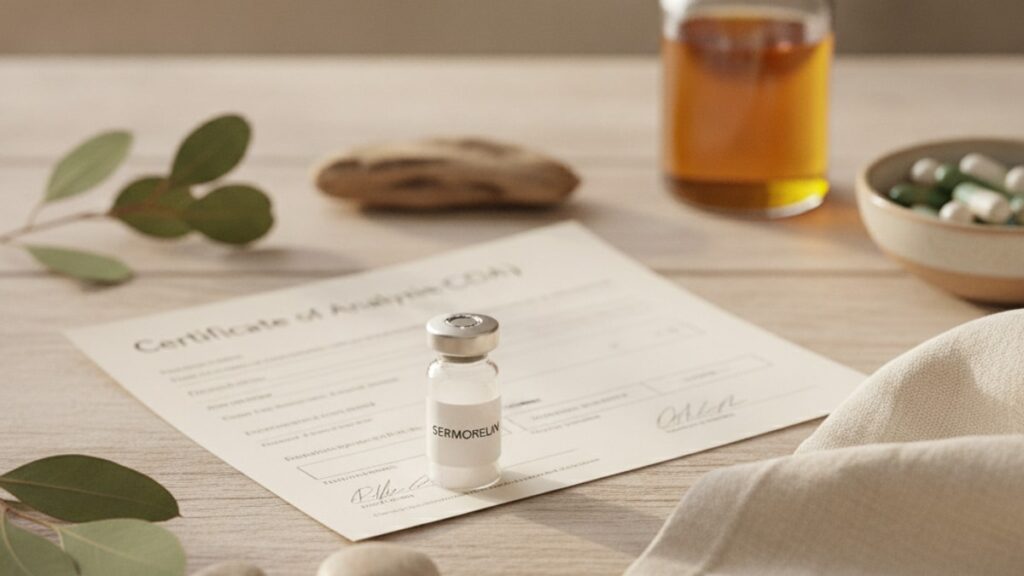
A legitimate certificate of analysis for sermorelin contains six non-negotiable elements: batch number, test date, testing laboratory name and accreditation, HPLC chromatogram with retention time and purity percentage, mass spectrometry data showing molecular weight confirmation, and endotoxin test results with the specific assay method used. If any of these are missing, you're looking at a document designed to look official without providing verifiable data.
The batch number must match the vial label exactly. This ties the CoA to the specific peptide you're using, not a generic result from an earlier synthesis run. Test dates matter because peptides degrade over time, especially if stored incorrectly; a CoA from 18 months ago doesn't tell you what purity the peptide has today. The testing laboratory must be named and ISO/IEC 17025-accredited. 'tested in-house' or 'proprietary lab' are red flags indicating the supplier graded their own work. HPLC data should include the actual chromatogram (the graph showing peaks), not just a purity number. You should be able to see the dominant sermorelin peak and verify that impurity peaks are minimal.
Mass spec confirmation is often listed as 'Expected: 3357.96 Da | Found: 3358.2 Da'. A variance of ±1 Da is acceptable given instrument precision, but discrepancies beyond ±2 Da suggest sequence errors or post-synthesis modifications. Endotoxin results are typically reported as '<0.5 EU/mg' or a specific value. Anything above 1 EU/mg is unsuitable for cell culture or in vivo studies. Suppliers who provide only a purity percentage without supporting chromatograms, mass spec data, or endotoxin levels aren't giving you enough information to verify sermorelin purity. They're giving you marketing copy formatted as a lab report.
What If: Sermorelin Purity Verification Scenarios
What If the Certificate of Analysis Shows 98% Purity but No Mass Spec Data?
Request mass spectrometry confirmation before using the peptide. HPLC purity alone doesn't confirm you have sermorelin. It confirms you have a peptide mixture where one compound represents 98% of total content. That compound could be sermorelin, or it could be a deletion sequence missing two amino acids at the C-terminus that still elutes at a similar retention time. Mass spec is the only method that definitively confirms molecular weight and sequence integrity. If the supplier can't provide it, you're working with unverified material.
What If Two Suppliers Claim 98% Purity but One Costs 40% Less?
Verify where the testing was performed and whether it's batch-specific. Price differences this large often reflect differences in synthesis scale, purification rigor, or testing thoroughness. The lower-cost supplier may be using in-house testing, older synthesis batches, or skipping endotoxin verification. Cross-reference batch numbers on CoAs with vial labels. If they don't match, you're seeing template results, not actual verification data for your peptide.
What If the Peptide Arrives as a Powder but the CoA Lists It as a Solution?
Contact the supplier immediately. This indicates a documentation mismatch that could mean you received the wrong product or an outdated CoA. Sermorelin is typically shipped as lyophilised powder for stability, but some suppliers provide pre-reconstituted solutions for specific research applications. The CoA must match the physical form you received. If it doesn't, the batch number is likely incorrect, which means you have no verified purity data for the actual peptide in your hands.
Verify Sermorelin Purity: Testing Method Comparison
| Testing Method | What It Measures | Standard Acceptance Threshold | Limitation | Professional Assessment |
|---|---|---|---|---|
| HPLC (High-Performance Liquid Chromatography) | Peptide content as % of total material | ≥95% for research grade | Can't distinguish structurally similar peptides of same MW | Essential first-pass purity screen but insufficient alone |
| Mass Spectrometry (MS) | Molecular weight and sequence integrity | 3357.96 Da ±1 Da for sermorelin acetate | Doesn't quantify impurities or peptide concentration | Only definitive method to confirm correct amino acid sequence |
| Endotoxin Testing (LAL Assay) | Bacterial lipopolysaccharide contamination | <1 EU/mg for research use | Doesn't detect non-bacterial contaminants or peptide degradation | Non-negotiable for in vivo or cell culture applications |
| Amino Acid Analysis (AAA) | Confirms amino acid composition and ratios | Matches theoretical sermorelin composition within 10% | Labor-intensive, not provided by most peptide suppliers | Gold standard for sequence verification but rarely included in standard CoAs |
Key Takeaways
- To verify sermorelin purity, you need three tests: HPLC for peptide content (≥95%), mass spectrometry to confirm 3357.96 Da molecular weight, and endotoxin testing below 1 EU/mg.
- A certificate of analysis must include batch-specific data from an ISO/IEC 17025-accredited lab. Template CoAs without chromatograms or mass spec confirmation aren't verifiable.
- HPLC purity percentages alone don't confirm you have sermorelin. Only mass spectrometry definitively verifies the 29-amino-acid sequence and molecular weight.
- Price differences between suppliers often reflect differences in testing rigor. Verify that batch numbers on CoAs match vial labels before assuming equivalent quality.
- Endotoxin contamination above 1 EU/mg invalidates cell culture and animal model studies. This test is non-negotiable for biological research applications.
- Suppliers who can't provide third-party verification or refuse to share raw chromatograms are selling peptides that can't be used in reproducible research.
The Unflinching Truth About Sermorelin Purity Claims
Here's the honest answer: most peptide suppliers in the research market don't verify sermorelin purity the way academic labs or pharmaceutical manufacturers do. They synthesise peptides, run in-house HPLC, print a certificate that says 98%, and ship it. No independent lab. No mass spec confirmation. No batch-to-batch consistency tracking. That's not quality control. It's self-reporting.
The peptide research market operates in a regulatory grey zone where 'research use only' labels exempt suppliers from the same manufacturing and testing standards required for therapeutic-grade compounds. This creates a massive quality variance: one supplier's 95% sermorelin might outperform another supplier's 98% sermorelin because the first used rigorous third-party verification while the second rounded up from an in-house HPLC run. You can't verify sermorelin purity by trusting the label. You verify it by demanding third-party CoAs with batch-traceable data and walking away from suppliers who won't provide them.
Every peptide synthesis produces impurities. Deletion sequences, oxidised residues, acetylated variants, and synthesis by-products that co-elute near the target peptide. A supplier who claims 99% purity without showing you the chromatogram is either lying or using analytical methods so loose they can't detect those impurities. The difference between research that replicates and research that doesn't often comes down to whether you verified sermorelin purity before you started dosing.
Research-grade quality isn't about finding the cheapest peptide. It's about finding peptides with verifiable composition, consistent batch performance, and documentation rigorous enough that another lab could replicate your work. If your institution's research depends on sermorelin mechanism studies, receptor binding assays, or dose-response curves, using peptides you can't verify sermorelin purity for is scientific malpractice. The data won't hold up, the study won't replicate, and you'll have wasted months on experiments built on a foundation of unverified material. That's the unflinching reality most suppliers won't tell you.
Frequently Asked Questions
How do I verify sermorelin purity if I don’t have access to analytical equipment?▼
You verify sermorelin purity by requesting third-party certificates of analysis from ISO/IEC 17025-accredited laboratories before purchasing. The CoA must include HPLC chromatograms, mass spectrometry molecular weight confirmation (3357.96 Da ±1 Da), and endotoxin testing results below 1 EU/mg. Legitimate suppliers provide batch-specific verification data as standard documentation — if a supplier can’t or won’t provide third-party CoAs, you can’t verify sermorelin purity and shouldn’t use the peptide for research.
What is the minimum acceptable purity level for sermorelin in biological research?▼
Research-grade sermorelin should meet or exceed 95% purity by HPLC, with the dominant peak representing sermorelin acetate and impurity peaks totaling less than 5%. Peptides below 90% purity introduce too many confounding variables for reproducible dose-response studies, receptor binding assays, or mechanistic research. Clinical-grade sermorelin used in FDA-regulated studies typically requires ≥98% purity with stricter impurity profiling, but 95% is the minimum threshold for rigorous academic research.
Can I trust a certificate of analysis that only shows HPLC purity without mass spectrometry?▼
No — HPLC alone doesn’t confirm molecular identity, only that a peptide represents a certain percentage of total material. A CoA showing 98% HPLC purity without mass spec confirmation could represent sermorelin, a deletion sequence, or a structurally similar peptide of similar retention time. Mass spectrometry is the only method that definitively verifies the 3357.96 Da molecular weight and correct amino acid sequence. A CoA without mass spec data is incomplete and doesn’t allow you to verify sermorelin purity with scientific confidence.
What does endotoxin testing measure and why does it matter for sermorelin research?▼
Endotoxin testing measures lipopolysaccharides (LPS) from bacterial cell walls, which contaminate peptides during synthesis, lyophilisation, or handling if sterile technique isn’t maintained. Endotoxin levels above 1 EU/mg trigger immune responses in cell culture and animal models, causing inflammatory cytokine release that confounds experimental results. For sermorelin research involving cell signaling, receptor binding, or in vivo growth hormone release, endotoxin contamination invalidates the study by introducing non-peptide biological activity that can’t be separated from sermorelin’s effects.
How often should I verify sermorelin purity if I’m using the same supplier for multiple studies?▼
You should verify sermorelin purity for every new batch, even from the same supplier. Peptide synthesis is a batch process — synthesis conditions, purification efficiency, and contamination risk vary between production runs. A supplier who delivered 97% pure sermorelin in batch A023 might deliver 91% pure sermorelin in batch A024 if purification columns weren’t regenerated properly or if raw materials changed. Batch-to-batch consistency is not guaranteed unless each batch undergoes independent verification. Request and archive CoAs for every batch to maintain experimental traceability.
What should I do if the batch number on my sermorelin vial doesn’t match the certificate of analysis?▼
Contact the supplier immediately and request the correct batch-specific CoA before using the peptide. A mismatched batch number means you have no verified purity data for the actual material in your vial — you could be looking at a different synthesis batch, an older stock with degraded purity, or even a mislabeled product. Using peptides without batch-traceable verification introduces uncontrolled variables that invalidate research reproducibility. If the supplier can’t provide matching documentation, return the peptide and source from a supplier with rigorous batch tracking.
Is in-house testing by the peptide supplier sufficient to verify sermorelin purity?▼
No — in-house testing creates a conflict of interest where the entity synthesizing the peptide is also grading its own quality. Independent third-party testing by ISO/IEC 17025-accredited laboratories provides unbiased verification that meets scientific reproducibility standards. In-house CoAs may use looser acceptance criteria, older reference standards, or uncalibrated instruments that overestimate purity. Research institutions and pharmaceutical labs require third-party verification for this reason — self-reported purity isn’t scientifically defensible.
What is the difference between sermorelin acetate and sermorelin base and does it affect purity verification?▼
Sermorelin acetate is the acetate salt form of the peptide with a molecular weight of 3357.96 Da, while sermorelin base refers to the free peptide without the acetate counterion. Most research and clinical applications use sermorelin acetate because the acetate salt improves solubility and stability. When verifying sermorelin purity, the expected molecular weight on mass spec depends on which form you ordered — sermorelin acetate should show 3357.96 Da, while sermorelin base would show a slightly different molecular weight. Always confirm which form the CoA references to avoid misinterpreting mass spec results.
How long does sermorelin maintain its stated purity after reconstitution?▼
Reconstituted sermorelin in bacteriostatic water maintains stated purity for approximately 28 days when stored at 2–8°C, but degradation begins immediately upon reconstitution due to hydrolysis, oxidation, and aggregation. To verify sermorelin purity over time, you would need to re-test aliquots at intervals using HPLC — most labs don’t do this, which is why reconstituted peptides should be used within the 28-day window and stored in single-use aliquots to minimize freeze-thaw cycles. Lyophilised (powdered) sermorelin stored at −20°C maintains purity for 12–24 months if kept sealed and dry.
What red flags indicate a sermorelin supplier isn’t providing verifiable purity data?▼
Red flags include: CoAs without batch numbers or test dates, ‘tested in-house’ without naming an accredited lab, missing HPLC chromatograms or mass spec data, generic template results that don’t match your vial’s batch number, purity claims above 99% without supporting data, refusal to provide raw analytical data upon request, and endotoxin testing listed as ‘not tested’ or omitted entirely. Any supplier who won’t provide third-party verification from an ISO/IEC 17025-accredited lab is selling peptides you can’t verify sermorelin purity for and shouldn’t use in research that requires reproducibility.











