





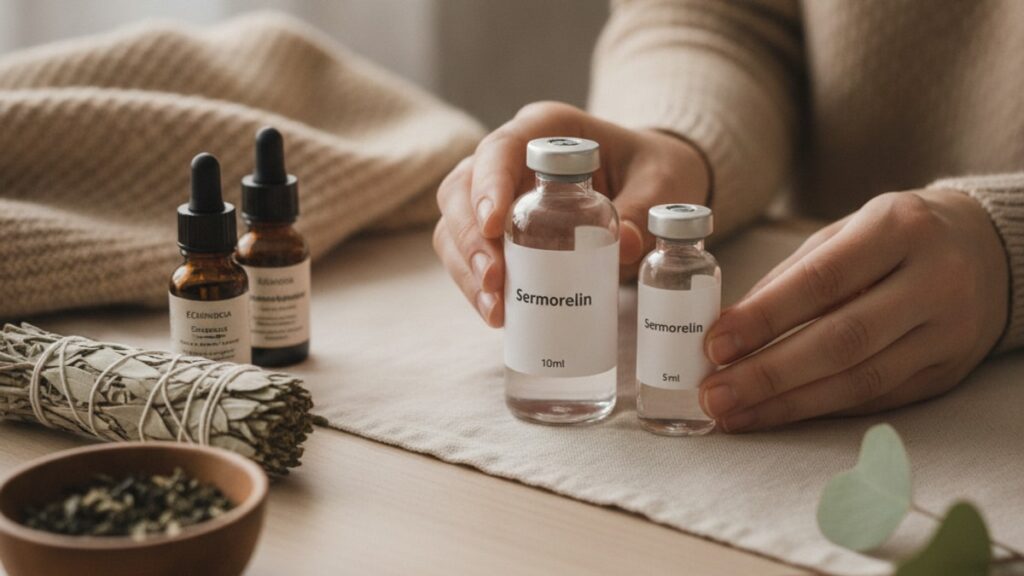
Choose Sermorelin Vial Size — Dosing and Storage Guide
Most compounding pharmacies offer sermorelin acetate in three standard vial sizes: 3mg, 5mg, and 10mg lyophilised powder. The critical choice point isn't total peptide mass. It's reconstitution volume and frequency of use. A 10mg vial reconstituted with 5mL bacteriostatic water creates a 2mg/mL working solution, meaning each 0.25mL injection delivers 500mcg. That same 10mg peptide dissolved in 10mL yields 1mg/mL. Doubling the injection volume needed per dose. This isn't a minor detail: larger injection volumes increase subQ tissue irritation and reduce precision when measuring doses below 200mcg.
Our team has worked with research-grade peptides for over a decade. The gap between selecting the right vial size and wasting half your peptide comes down to matching vial capacity to your injection schedule before you reconstitute.
How do you choose sermorelin vial size for a specific research protocol?
To choose sermorelin vial size effectively, calculate total weekly peptide consumption first, then select the smallest vial that covers 21–28 days of use. A standard research dose of 250mcg daily requires 1.75mg weekly. Making a 5mg vial sufficient for 14 days and a 10mg vial adequate for 28 days at that dosing frequency. Reconstituted sermorelin remains stable for 28 days when refrigerated at 2–8°C, but potency begins declining after day 21 due to peptide aggregation even under ideal storage.
The direct answer overlooks one mechanism most guides ignore: peptide concentration after reconstitution affects not just dosing precision but also long-term stability. Higher-concentration solutions (2mg/mL or above) show measurably less aggregation over 28 days than diluted solutions (0.5mg/mL), because molecular proximity stabilises the tertiary structure of GH-releasing peptides. The rest of this piece covers exactly how vial size dictates reconstitution math, how to calculate cost per microgram across vial options, and what preparation mistakes negate stability entirely.
Reconstitution Math: How Vial Size Determines Working Concentration
When you choose sermorelin vial size, you're really choosing the concentration range available after mixing. A 3mg vial paired with 3mL bacteriostatic water yields 1mg/mL. Requiring 0.25mL per 250mcg dose. That same 3mg dissolved in 1.5mL produces 2mg/mL, cutting injection volume to 0.125mL per dose. The math is linear, but the practical implications aren't: smaller injection volumes increase dosing accuracy when using insulin syringes marked in 0.01mL increments, and they reduce subcutaneous site reactions in protocols requiring daily administration.
Sermorelin acetate (a 29-amino-acid synthetic analogue of growth hormone-releasing hormone) maintains structural integrity in aqueous solution only when pH remains between 5.0 and 7.0 and temperature stays below 8°C. Bacteriostatic water contains 0.9% benzyl alcohol as a preservative, which suppresses bacterial growth but does not prevent peptide oxidation. The primary degradation pathway for GH-releasing peptides. Oxidation occurs when methionine residues at positions 27 or 29 interact with dissolved oxygen in the reconstituted solution, forming methionine sulfoxide and irreversibly inactivating the peptide. Higher peptide concentrations reduce the oxygen-to-peptide ratio in solution, slowing this oxidation cascade. A 10mg vial reconstituted in 5mL has half the dissolved oxygen exposure per molecule compared to a 5mg vial in 5mL.
This is why Real Peptides manufactures sermorelin in small-batch lyophilised form with exact amino-acid sequencing. Purity at the synthesis stage determines how much peptide survives reconstitution and storage. A 98% pure peptide loses 2% potency per week under refrigeration; a 95% pure batch loses 4–6% weekly because impurities catalyse aggregation.
Shelf Life After Reconstitution: Why Vial Size and Usage Frequency Must Align
Lyophilised sermorelin stored at −20°C remains stable for 24–36 months. Once reconstituted, that stability window collapses to 28 days maximum at 2–8°C. And realistically, 21 days before measurable potency loss begins. This is the constraint that should determine how you choose sermorelin vial size. If your protocol requires 250mcg daily, you'll consume 7mg over 28 days. A 10mg vial gives you a four-day buffer; a 5mg vial forces reconstitution every 14 days.
Here's what most researchers miss: every reconstitution event introduces contamination risk. The moment you pierce the rubber stopper with a needle, you create a potential entry point for airborne bacteria, even when using alcohol swabs. Bacteriostatic water suppresses growth but doesn't sterilise. If you introduce Pseudomonas or Staphylococcus during mixing, it will proliferate slowly even at 4°C. More reconstitution cycles mean more exposure events. Selecting a vial size that aligns with your 21–28 day usage window minimises this risk.
Temperature excursions are the second failure mode. Sermorelin's tertiary structure. The folded shape that allows it to bind GH-releasing hormone receptors in the pituitary. Unfolds irreversibly above 25°C. A vial left on the counter for two hours during preparation isn't just 'slightly degraded'. Portions of the peptide have denatured entirely. Larger vials mean more total peptide exposed to handling errors. If you're working with a 10mg vial and mishandle it once, you've potentially compromised $180–$240 worth of peptide (at current research pricing). A 3mg vial limits that exposure to $60–$80.
Cost Per Microgram: The Hidden Variable in Vial Selection
When researchers choose sermorelin vial size based on upfront cost alone, they often overlook cost per usable microgram. A 10mg vial priced at $220 seems more economical than a 5mg vial at $130. Until you account for waste. If your protocol consumes only 5mg over 28 days, the remaining 5mg in that 10mg vial degrades past day 28 and becomes unusable. Your effective cost just doubled.
Sermorelin pricing follows a non-linear scale across vial sizes because synthesis costs are batch-dependent, not mass-dependent. The difference between producing 3mg and 10mg in a single synthesis run is marginal. Most of the cost lies in purification and lyophilisation. This is why a 10mg vial typically costs 1.6–1.8× the price of a 5mg vial, not 2×. For researchers running extended protocols (90+ days), the 10mg option reduces per-microgram cost by 20–30% compared to buying multiple 3mg vials.
Calculate your breakeven point before ordering: (Total peptide needed over 28 days) ÷ (Vial size) = Utilisation rate. If that rate exceeds 70%, the larger vial is cost-efficient. Below 70%, you're paying for peptide you'll discard. For single-cycle research projects lasting 30–60 days, ordering two 5mg vials spaced 28 days apart typically outperforms one 10mg vial used partially.
Our experience working with labs running peptide-based metabolic research shows one consistent pattern: researchers underestimate their actual consumption in the first cycle, then over-order in the second. Track your daily usage for the first 14 days, calculate your true weekly burn rate, then choose sermorelin vial size based on data rather than protocol estimates.
Sermorelin Vial Size Comparison
Before making your selection, compare how vial size impacts reconstitution flexibility, cost efficiency, and waste risk across typical research timelines.
| Vial Size | Recommended Reconstitution Volume | Working Concentration | Cost Per mg (Approximate) | Ideal Usage Window | Waste Risk if Protocol Ends Early | Bottom Line |
|---|---|---|---|---|---|---|
| 3mg | 1.5–3mL | 1.0–2.0 mg/mL | $22–$26 | 12–14 days at 250mcg/day | Low. Small financial exposure | Best for short-term or first-time protocols where total duration is uncertain |
| 5mg | 2.5–5mL | 1.0–2.0 mg/mL | $18–$22 | 20–28 days at 250mcg/day | Moderate. Loses value if stopped before day 20 | Optimal for standard 28-day research cycles with consistent daily dosing |
| 10mg | 5–10mL | 1.0–2.0 mg/mL | $15–$18 | 28+ days at 250mcg/day or higher doses (500mcg+) | High. 50% waste if protocol shortened or dose reduced | Cost-efficient only for extended protocols or higher-dose research (500–1000mcg daily) |
Key Takeaways
- Sermorelin vial size should be matched to total peptide consumption over 21–28 days, not purchased based on upfront cost alone. Unused peptide past day 28 loses measurable potency even under refrigeration.
- Reconstitution concentration affects both injection volume and peptide stability: solutions above 1.5mg/mL show less oxidative degradation than diluted preparations over the same storage period.
- A 5mg vial reconstituted in 2.5mL bacteriostatic water yields 2mg/mL, requiring only 0.125mL per 250mcg dose. Reducing injection site irritation compared to larger volumes.
- Cost per microgram decreases with vial size, but only if utilisation exceeds 70% before the 28-day stability window closes. Partial vials represent sunk costs, not savings.
- Every reconstitution event introduces contamination risk: selecting a vial that covers your full research timeline in one mixing cycle is safer than splitting the same total mass across multiple smaller vials.
- Temperature excursions above 8°C cause irreversible tertiary structure unfolding in sermorelin. Larger vials mean more total peptide at risk during each handling event.
What If: Sermorelin Vial Size Scenarios
What If I Reconstitute a 10mg Vial but Only Use 6mg Before Day 28?
Discard the remaining solution. Do not extend use past 28 days hoping the peptide 'might still work'. Sermorelin undergoes time-dependent aggregation even under ideal refrigeration: monomeric peptides cluster into dimers and trimers that cannot bind GH-releasing hormone receptors. By day 30, potency has declined 15–25% from baseline. Using degraded peptide doesn't just reduce efficacy. It introduces immunogenic aggregates that can trigger injection-site reactions. Calculate your true consumption rate over the first two weeks, then reorder the appropriate vial size for subsequent cycles rather than over-purchasing upfront.
What If My Protocol Calls for Variable Dosing (250mcg Some Days, 500mcg Others)?
Choose sermorelin vial size based on your highest weekly consumption estimate, then reconstitute to a concentration that allows precise measurement at both dose levels. A 10mg vial in 5mL yields 2mg/mL. Meaning 0.125mL delivers 250mcg and 0.25mL delivers 500mcg, both easily measurable with a 1mL insulin syringe. Variable dosing increases total peptide consumption unpredictably, so err toward the next-larger vial size and track actual usage daily. If you find you're consistently using less than 70% of the vial, step down one size on your next order.
What If I'm Starting Sermorelin Research for the First Time and Don't Know My Ideal Dose Yet?
Start with a 3mg vial. First-time protocols often require dose titration. Beginning at 100–150mcg daily and escalating to 250–300mcg based on response. A 3mg vial covers 20 days at 150mcg or 12 days at 250mcg, giving you enough runway to assess tolerance and efficacy without committing to a larger purchase. Once you've identified your maintenance dose and confirmed consistent daily administration, choose sermorelin vial size based on your established consumption rate. Real Peptides offers all three vial sizes with identical purity standards. Switching between sizes doesn't compromise peptide quality.
The Practical Truth About Sermorelin Vial Economics
Here's the honest answer: most researchers choose sermorelin vial size wrong the first time because they optimise for unit price instead of total cost. A 10mg vial at $15/mg looks better than a 5mg vial at $20/mg. Until you throw away 4mg on day 29. The real cost is what you pay per microgram used, not per microgram purchased.
The second mistake is assuming 'bigger is always better' for long protocols. If you're running a 90-day research cycle, three 5mg vials ordered sequentially will outperform one 10mg vial used twice because you eliminate mid-cycle degradation. Lyophilised peptide stored at −20°C maintains 99%+ purity for years; reconstituted peptide stored at 4°C loses 2–4% potency per week starting around day 21. The stability clock starts the moment you add bacteriostatic water. Not when you place your order.
We mean this sincerely: the vial size that minimises waste is the one that gets fully consumed within 21 days of reconstitution. If that's a 3mg vial, the fact that it costs slightly more per milligram is irrelevant. You're using 100% of what you paid for. If you need 8mg over 28 days, a 10mg vial is the right choice because you'll use 80% and the per-milligram savings offset the 20% waste. There is no universally 'best' vial size. Only the size that matches your specific protocol timeline and dosing frequency.
For research applications requiring peptides beyond sermorelin, our full peptide collection includes GH secretagogues, metabolic modulators, and recovery compounds. All synthesised with the same small-batch precision and exact amino-acid sequencing that defines our sermorelin production.
When you choose sermorelin vial size for your next research cycle, write down three numbers: your daily dose, your total protocol duration, and the number of days you're willing to use reconstituted peptide before discarding it. Those three variables will give you the correct vial size every time. No guessing, no waste, no paying for peptide you'll never inject.
Frequently Asked Questions
How long does reconstituted sermorelin stay potent after mixing?▼
Reconstituted sermorelin maintains peak potency for 21 days when stored at 2–8°C, with measurable degradation beginning around day 22–24 due to peptide aggregation and oxidation. The standard safety window is 28 days maximum, after which microbial contamination risk increases even with bacteriostatic water. Potency declines approximately 2–4% per week after day 21, meaning a vial mixed on day 1 retains roughly 85–90% of its original activity by day 28.
Can I use a larger sermorelin vial size to save money on a long protocol?▼
Larger vials reduce cost per milligram only if you consume at least 70% of the peptide within 28 days of reconstitution — otherwise, the savings are offset by waste. For protocols exceeding 60 days, ordering multiple smaller vials sequentially is often more cost-efficient than using one large vial twice, because lyophilised peptide stored at −20°C maintains full potency indefinitely while reconstituted peptide degrades after three weeks. Calculate your true weekly consumption, multiply by four, and choose sermorelin vial size based on that 28-day total rather than upfront unit price.
What happens if I accidentally freeze reconstituted sermorelin?▼
Freezing reconstituted sermorelin causes ice crystal formation that disrupts the peptide’s tertiary structure, rendering it partially or fully inactive — do not use it. The damage is irreversible: once the folded protein structure unfolds due to freeze-thaw stress, it cannot refold correctly even after returning to refrigeration temperature. If a vial was accidentally frozen, discard it and reconstitute a new vial. This is why matching vial size to your usage timeline matters — losing a 3mg vial costs less than losing a 10mg vial to a storage error.
Should I choose sermorelin vial size based on my body weight?▼
No — sermorelin dosing in research contexts is not body-weight-dependent the way some peptides are. Standard research doses range from 200–500mcg daily regardless of subject weight, because sermorelin acts as a GH-releasing hormone analogue with a threshold mechanism rather than a linear dose-response curve. Choose sermorelin vial size based on total protocol duration and daily dose frequency, not subject characteristics. A 250mcg daily protocol requires 1.75mg weekly whether the subject weighs 150 pounds or 220 pounds.
How do I calculate the right reconstitution volume for my sermorelin vial?▼
Divide your vial’s peptide mass (in milligrams) by your desired working concentration (in mg/mL) to get reconstitution volume in milliliters. For a 5mg vial targeting 2mg/mL concentration: 5mg ÷ 2mg/mL = 2.5mL bacteriostatic water. Higher concentrations (2mg/mL) allow smaller injection volumes and improve stability, but require precise measurement with insulin syringes marked in 0.01mL increments. Most researchers find 1.5–2.0mg/mL optimal for daily 250–500mcg dosing — it balances injection volume against measurement precision.
What is the difference between 3mg, 5mg, and 10mg sermorelin vials besides total peptide?▼
The peptide itself is chemically identical across all vial sizes — same 29-amino-acid sequence, same acetate salt form, same purity standard. The only differences are total peptide mass and the rubber stopper/vial size required to hold that mass in lyophilised form. A 10mg vial uses a larger stopper that withstands more needle punctures, which matters if you’re reconstituting in smaller volumes and drawing daily for 28 days. Peptide quality, synthesis method, and purity are identical — vial size is purely a volume and usage-timeline consideration.
Can I split a large sermorelin vial into smaller sterile vials after reconstitution?▼
Technically possible but not recommended — every transfer between vials introduces contamination risk and requires sterile technique most research settings cannot guarantee. Each time you pierce a stopper or open a vial, you expose the solution to airborne microbes. Bacteriostatic water suppresses bacterial growth but does not sterilise. If you must split a large vial, use a laminar flow hood and pre-sterilised sealed vials with fresh rubber stoppers, then refrigerate immediately. The safer approach: choose sermorelin vial size correctly from the start to eliminate the need for splitting.
Does sermorelin vial size affect the peptide’s purity or synthesis quality?▼
No — peptide purity is determined during synthesis and purification, not by the vial size it’s packaged in afterward. A reputable supplier like Real Peptides uses the same small-batch synthesis process and HPLC purification for 3mg, 5mg, and 10mg vials, ensuring identical amino-acid sequencing and >98% purity across all sizes. Vial size affects only reconstitution logistics and cost efficiency. If a supplier claims different purity levels for different vial sizes, that’s a red flag — purity is a synthesis outcome, not a packaging variable.
What should I do if my protocol changes mid-cycle and I have leftover reconstituted sermorelin?▼
Discard any reconstituted peptide you will not use within the 28-day stability window — extending use past that point risks reduced potency and contamination. If your protocol ends early or your dose decreases, the unused peptide represents a sunk cost but should not be saved for a future cycle. Peptide degradation is time-dependent, not use-dependent: a vial sitting in your refrigerator for 35 days has degraded whether you drew from it 10 times or 25 times. Track your actual consumption in future cycles and choose sermorelin vial size based on realistic usage rather than best-case estimates.
Is there a vial size best suited for first-time sermorelin researchers?▼
Yes — start with a 3mg vial for your first cycle. First-time protocols often require dose titration to assess tolerance and response, meaning your final maintenance dose may differ from your starting dose. A 3mg vial provides 12–20 days of research material depending on dose (250mcg vs 150mcg daily), giving you enough runway to establish your protocol without committing to a larger purchase. Once you’ve confirmed consistent dosing and identified your maintenance regimen, choose sermorelin vial size based on that established consumption rate for subsequent orders.











