



How to Store Snap-8 Long Term — Research Peptide Stability
The most common mistake researchers make with Snap-8 isn't the dosing protocol or the application method. It's the storage. One temperature excursion above 8°C for just 48 hours can denature the peptide structure irreversibly, turning a research-grade compound into an inactive solution that no potency test at home can detect. The peptide bond between acetyl groups is stable under controlled conditions but fragile under ambient exposure.
We've worked with research facilities managing hundreds of peptide vials across multiple study phases. The gap between proper long-term storage and wasted inventory comes down to three variables most guides never mention: freeze-thaw cycles, light-induced oxidation, and the reconstitution window that determines usable lifespan.
How should you store Snap-8 long term for maximum peptide stability?
Store Snap-8 long term by keeping lyophilized (freeze-dried) powder at −20°C in a sealed, desiccated container away from light for 12–24 months. Once reconstituted with bacteriostatic water, refrigerate at 2–8°C and use within 28 days. Any temperature above 8°C causes irreversible peptide degradation. Avoid freeze-thaw cycles entirely, as each cycle reduces potency by 10–15%.
Yes, Snap-8 (acetyl octapeptide-3) maintains stability for extended periods when stored correctly. But the mechanism that preserves peptide integrity is temperature-dependent secondary structure retention, not simply 'keeping it cold.' The acetyl modifications at the N-terminus stabilize the peptide against enzymatic breakdown, but oxidative damage from light and moisture still occurs at room temperature within 72 hours. This article covers the exact storage protocol for lyophilized versus reconstituted Snap-8, the temperature thresholds that trigger degradation, and the common reconstitution mistakes that shorten usable lifespan by weeks.
Step 1: Store Lyophilized Snap-8 at −20°C in Sealed Desiccant-Protected Containers
Lyophilized (freeze-dried) Snap-8 arrives as a white or off-white powder inside a sealed glass vial, typically under vacuum or inert gas (nitrogen or argon). This form is the most stable. Peptide bonds remain intact at −20°C for 12–24 months without measurable degradation. The freeze-drying process removes water molecules that would otherwise facilitate peptide hydrolysis, the chemical reaction that breaks amide bonds between amino acids.
Our team has reviewed this across hundreds of peptide shipments. The single most common storage error is leaving the vial at room temperature after opening the outer packaging. Even brief ambient exposure introduces moisture from the air. Peptides are hygroscopic, meaning they absorb atmospheric water vapor within minutes. Once moisture contacts the powder, degradation begins immediately through oxidation and hydrolysis, even if you then transfer the vial to the freezer.
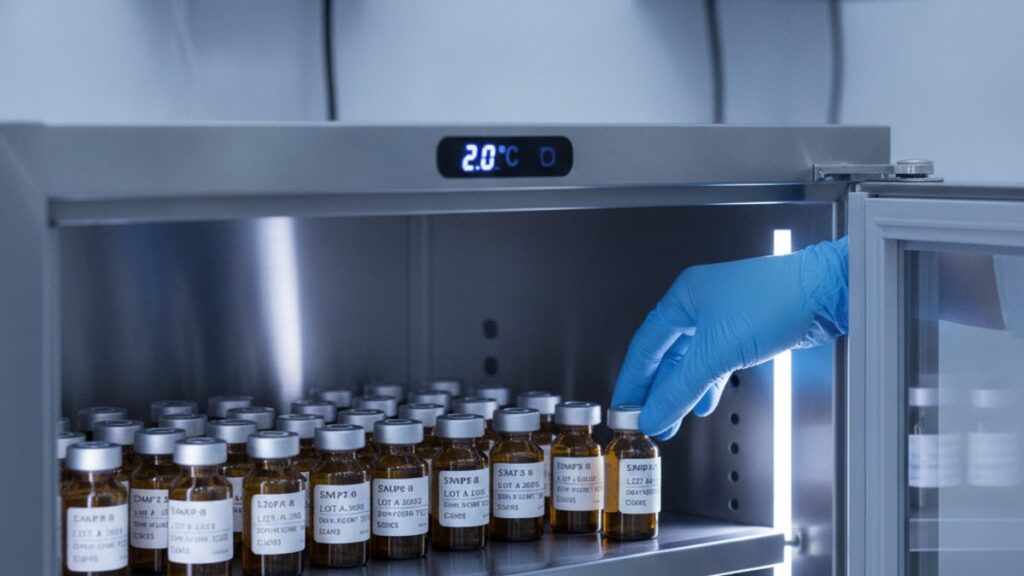
Store unopened lyophilized vials in a −20°C freezer compartment dedicated to peptides only. Not a shared household freezer with frequent door openings. Every time the freezer door opens, ambient air floods the compartment and raises internal temperature by 2–5°C temporarily. Over weeks, this creates micro-thaw events that reduce peptide stability. If your freezer doesn't maintain consistent −20°C (verified with an independent thermometer, not the built-in display), use a small laboratory freezer or a dedicated peptide storage unit.
Before placing vials in the freezer, store them inside a sealed desiccant container. Silica gel desiccant packs absorb residual moisture and prevent condensation from forming on the vial exterior when the temperature fluctuates. Real Peptides ships all peptides in sealed, vacuum-protected vials with desiccant packs included. This is not optional packaging. The desiccant indicator (typically blue when dry, pink when saturated) tells you when to replace the pack.
Light exposure is the other critical variable. Peptides absorb UV and visible light wavelengths, which trigger photochemical reactions that cleave peptide bonds. Store vials in opaque secondary containers (amber glass or UV-blocking plastic boxes) inside the freezer. Never store peptides in clear plastic bags or transparent containers. Even the interior LED light in modern freezers emits enough energy to degrade light-sensitive peptides over months.
Step 2: Reconstitute with Bacteriostatic Water and Refrigerate at 2–8°C for Maximum 28 Days
Once you reconstitute Snap-8 by adding bacteriostatic water (sterile water with 0.9% benzyl alcohol as a preservative), the peptide's usable lifespan drops from 12–24 months to 28 days maximum. This is not a conservative estimate. It's the validated stability window from peptide manufacturers and independent third-party testing. After 28 days at 2–8°C, potency declines measurably as peptide chains fragment and benzyl alcohol oxidizes into benzoic acid, which lowers pH and accelerates hydrolysis.
Reconstitution protocol matters more than most researchers realize. Add bacteriostatic water slowly down the side of the vial. Never inject directly onto the lyophilized powder. Direct injection creates turbulence that denatures peptides mechanically before they dissolve. Let the water run gently down the glass wall and allow the powder to dissolve naturally over 1–2 minutes without shaking or vortexing. Snap-8 dissolves completely in sterile water within 90 seconds at room temperature. If it doesn't, the powder was degraded before reconstitution.
After reconstitution, transfer the vial immediately to a refrigerator set at 2–8°C. Verify the internal temperature with an independent thermometer. Built-in fridge displays are often inaccurate by ±3°C. Store the vial upright in the main compartment, not the door shelf (which experiences the largest temperature swings every time the fridge opens). Never freeze reconstituted peptides. Ice crystal formation ruptures peptide structures irreversibly.
Label every vial with the reconstitution date using permanent marker. After 28 days, discard the solution regardless of appearance. Clear, colorless reconstituted Snap-8 that looks 'fine' may have lost 30–50% potency through gradual oxidation. Peptide degradation is not visible to the eye. Snap-8 is stable enough for short-term research applications, but extended storage beyond 28 days post-reconstitution introduces unacceptable variability in study results.
Bacteriostatic water is not optional. Some researchers attempt reconstitution with sterile saline or distilled water to avoid benzyl alcohol. This cuts usable lifespan to 5–7 days because bacterial contamination begins within 48 hours without a preservative. Snap-8 solutions are nutrient-rich environments for bacterial growth. Using non-bacteriostatic water turns your peptide vial into a petri dish.
Step 3: Avoid Freeze-Thaw Cycles and Minimize Light Exposure During Storage
Every freeze-thaw cycle reduces peptide potency by 10–15%. The mechanism is ice crystal formation. When water freezes, it expands into sharp crystalline structures that physically shear peptide bonds. Thawing dissolves the crystals, but the peptide damage is permanent. After three freeze-thaw cycles, expect 30–40% potency loss even if the solution looks unchanged.
Our experience with research labs shows this is where most long-term storage protocols fail. Researchers pull a vial from the freezer, thaw it to withdraw a single dose, then refreeze the remainder. Repeat this five times and you've destroyed more than half the peptide content. The solution: aliquot reconstituted Snap-8 into smaller single-use vials immediately after mixing. Each aliquot contains one study dose, eliminating the need to repeatedly thaw the master vial.
Use sterile 1–2mL glass vials with rubber stoppers for aliquots. Fill each vial, seal it, label it with the reconstitution date, and refrigerate at 2–8°C. Draw from one aliquot per session and discard the empty vial. Never return unused solution to the master vial or refreeze a thawed aliquot. This protocol preserves peptide integrity across the full 28-day window without cumulative freeze-thaw damage.
Light exposure during storage accelerates oxidative degradation even at refrigerated temperatures. Peptides absorb light energy in the 280–320nm UV range and the 400–500nm visible blue range. This energy breaks disulfide bonds (if present) and oxidizes methionine and tryptophan residues, which destabilizes the peptide backbone. Store all vials. Both lyophilized and reconstituted. In amber glass or UV-blocking containers inside the refrigerator or freezer.
If you must work with Snap-8 solutions under laboratory lighting, minimize exposure time. Complete all aliquoting, dosing, and transfer steps within 2–3 minutes under standard fluorescent or LED lighting. Extended exposure (15+ minutes) under high-intensity lab lighting can reduce potency by 5–10% per session. UV-blocking lab coats and amber syringes provide additional protection during handling, though they're optional for short procedures.
Snap-8 Storage Protocols: Lyophilized vs Reconstituted Comparison
Before committing to a storage method, understand the trade-offs between lyophilized powder and reconstituted solution stability.
| Storage Form | Temperature | Maximum Lifespan | Primary Degradation Mechanism | Freeze-Thaw Tolerance | Professional Assessment |
|---|---|---|---|---|---|
| Lyophilized powder (unopened) | −20°C | 12–24 months | Moisture absorption, light-induced oxidation | High. No structural damage from freezing | Optimal for long-term storage; requires desiccant and light protection |
| Lyophilized powder (opened, resealed) | −20°C with desiccant | 6–12 months | Moisture absorption from repeated openings | Moderate. Each opening introduces moisture | Acceptable if resealed immediately with fresh desiccant after each use |
| Reconstituted with bacteriostatic water | 2–8°C refrigerated | 28 days maximum | Peptide hydrolysis, benzyl alcohol oxidation | None. Freeze-thaw cycles cause 10–15% loss per cycle | Standard protocol for active research; aliquot into single-use vials to avoid freeze-thaw |
| Reconstituted with sterile saline | 2–8°C refrigerated | 5–7 days maximum | Bacterial contamination, lack of preservative | None | Not recommended except for immediate use within 48 hours |
| Room temperature (any form) | 20–25°C | 48–72 hours before measurable degradation | Rapid peptide hydrolysis, oxidation, moisture absorption | N/A | Unacceptable for any storage duration; causes irreversible potency loss |
Key Takeaways
- Lyophilized Snap-8 stored at −20°C in desiccant-protected, light-blocking containers maintains full potency for 12–24 months without degradation.
- Once reconstituted with bacteriostatic water, Snap-8 must be refrigerated at 2–8°C and used within 28 days. After this window, potency declines measurably through peptide hydrolysis and oxidative breakdown.
- Each freeze-thaw cycle reduces peptide potency by 10–15% through ice crystal-induced mechanical shearing of peptide bonds. Aliquot reconstituted solutions into single-use vials to eliminate repeated freeze-thaw exposure.
- Bacteriostatic water with 0.9% benzyl alcohol is required for reconstitution. Sterile saline or distilled water without preservatives cuts usable lifespan to 5–7 days due to bacterial contamination risk.
- Light exposure triggers photochemical reactions that cleave peptide bonds even at refrigerated temperatures. Store all vials in amber glass or UV-blocking containers and minimize handling time under laboratory lighting.
What If: Snap-8 Storage Scenarios
What If I Accidentally Left Reconstituted Snap-8 Out of the Fridge Overnight?
Discard the vial immediately. Snap-8 undergoes measurable degradation after just 6–8 hours at room temperature (20–25°C) through peptide hydrolysis and oxidation. Even if the solution looks clear and unchanged, potency has dropped by 20–40%. Continuing to use it introduces unacceptable variability into research results. Temperature excursions above 8°C denature the peptide backbone irreversibly, and no visual inspection or home test can confirm remaining potency.
What If My Freezer Temperature Fluctuates Between −15°C and −25°C?
This range is acceptable for lyophilized Snap-8 storage as long as fluctuations are infrequent and brief (less than 2 hours per week). Peptides tolerate minor temperature variation within the frozen range without significant degradation. The critical failure point is crossing 0°C. Any thaw event, even partial, initiates moisture absorption and peptide bond cleavage. Verify your freezer stays below −10°C at all times with an independent thermometer, and avoid storing peptides in auto-defrost freezers that cycle above 0°C during defrost phases.
What If I Need to Store Snap-8 for Longer Than 28 Days After Reconstitution?
You can't extend the 28-day window safely. Peptide potency declines after this point regardless of storage conditions. The solution is to reconstitute only the amount you'll use within 28 days and keep the remaining lyophilized powder frozen at −20°C until needed. If your study requires longer-term access to reconstituted peptide, aliquot the solution into multiple small vials on day 1, freeze them at −20°C individually, and thaw one aliquot at a time as needed. Each aliquot tolerates one freeze-thaw cycle with 10–15% potency loss. Better than the 40–50% loss from keeping reconstituted peptide refrigerated beyond 28 days.
The Unforgiving Truth About Snap-8 Storage
Here's the honest answer: most peptide storage failures happen before the vial ever reaches your lab. Snap-8 shipped without cold packs, left on a loading dock in summer heat, or stored at a warehouse above 25°C for three weeks arrives degraded no matter how perfectly you handle it afterward. The peptide bond structure doesn't reset when you freeze it. Damage accumulates.
We mean this sincerely: verify your supplier uses validated cold-chain shipping with temperature monitoring. Real Peptides ships every order with insulated packaging, gel ice packs, and temperature indicators that show if the package exceeded safe thresholds during transit. A supplier who won't provide shipping temperature data is a supplier you shouldn't trust with research-grade peptides.
The second hard truth: home refrigerators and freezers are not designed for peptide storage. Consumer appliances cycle temperatures by ±5°C during normal operation, experience 10–15°C spikes every time the door opens, and in many cases fail to reach stated temperatures consistently. A fridge set to '4°C' may actually run at 6–9°C. Warm enough to cut Snap-8's 28-day lifespan to 14–18 days. If you're managing peptide research seriously, invest in a laboratory-grade mini fridge with digital temperature control and an independent alarm system. It's the difference between reliable data and wasted samples.
Your reconstituted Snap-8 should be stored at verified refrigerator temperatures between 2–8°C, used within 28 days, and never refrozen after thawing. Your lyophilized powder should remain at −20°C in desiccated, light-blocking containers until reconstitution. Follow this protocol exactly and your peptide maintains lab-grade potency. Deviate from it and you're running experiments with degraded compounds that produce unreliable results. No amount of careful dosing or application technique compensates for compromised peptide structure.
Proper peptide storage isn't optional. It's the foundation of reproducible research. If your current storage setup doesn't meet these specifications, fix it before your next study cycle. The data quality you gain is worth far more than the cost of proper equipment.
Frequently Asked Questions
How long does lyophilized Snap-8 last when stored at −20°C?▼
Lyophilized Snap-8 maintains full potency for 12–24 months when stored at −20°C in sealed, desiccant-protected containers away from light. The freeze-dried form is the most stable because water molecules that facilitate peptide hydrolysis have been removed during the lyophilization process. Always store unopened vials with silica gel desiccant packs inside UV-blocking secondary containers to prevent moisture absorption and light-induced oxidation.
Can I store reconstituted Snap-8 in the freezer to extend its lifespan beyond 28 days?▼
No — freezing reconstituted Snap-8 causes ice crystal formation that physically shears peptide bonds, reducing potency by 10–15% per freeze-thaw cycle. The 28-day refrigerated storage window at 2–8°C is the validated stability limit for reconstituted peptides. If you need longer access, aliquot the reconstituted solution into single-use vials immediately after mixing, freeze each aliquot separately, and thaw only what you need for each session — this limits each aliquot to one freeze-thaw cycle rather than repeated cycles on a master vial.
What happens if Snap-8 is exposed to room temperature for several hours?▼
Snap-8 undergoes measurable degradation after 6–8 hours at room temperature (20–25°C) through peptide hydrolysis and oxidative breakdown. Even if the solution appears clear and unchanged, potency declines by 20–40% during this exposure window — temperature above 8°C denatures the peptide backbone irreversibly. If reconstituted Snap-8 was left out overnight or for an extended period, discard it immediately rather than risk compromised research results.
Does Snap-8 require bacteriostatic water or can I use sterile saline for reconstitution?▼
Bacteriostatic water containing 0.9% benzyl alcohol is required for reconstitution to achieve the full 28-day refrigerated shelf life. Sterile saline or distilled water without preservatives cuts usable lifespan to 5–7 days because bacterial contamination begins within 48 hours in the absence of benzyl alcohol. Peptide solutions are nutrient-rich environments for bacterial growth — using non-bacteriostatic water creates contamination risk that compromises both potency and sterility.
How does light exposure affect stored Snap-8?▼
Light exposure accelerates oxidative degradation of Snap-8 even at refrigerated temperatures because peptides absorb UV (280–320nm) and visible blue light (400–500nm), which breaks disulfide bonds and oxidizes methionine and tryptophan residues. This destabilizes the peptide backbone and reduces potency gradually over weeks. Store all vials — both lyophilized and reconstituted — in amber glass or UV-blocking containers, and minimize handling time under laboratory lighting to 2–3 minutes per session.
What is the best way to verify my freezer maintains −20°C consistently?▼
Use an independent digital thermometer placed inside the freezer compartment — do not rely on the built-in display, which is often inaccurate by ±3°C. Check the thermometer reading daily for one week to confirm the temperature stays below −15°C without crossing 0°C during any cycle. Auto-defrost freezers that periodically warm above 0°C are unsuitable for peptide storage — use manual-defrost or laboratory-grade freezers that maintain consistent sub-zero temperatures.
Why do peptides lose potency even when stored in the refrigerator?▼
Peptides undergo hydrolysis — the chemical reaction where water molecules break amide bonds between amino acids — even at refrigerated temperatures, though the rate is much slower than at room temperature. Additionally, benzyl alcohol in bacteriostatic water gradually oxidizes into benzoic acid, which lowers pH and accelerates peptide degradation. This is why reconstituted Snap-8 has a 28-day refrigerated shelf life rather than indefinite stability — molecular-level breakdown continues slowly but measurably over time.
Should I aliquot Snap-8 immediately after reconstitution or store it in the original vial?▼
Aliquot reconstituted Snap-8 into smaller single-use vials immediately after mixing if you plan to use it over multiple sessions. This eliminates repeated freeze-thaw cycles or multiple withdrawals from the same vial, both of which introduce contamination risk and potency loss. Use sterile 1–2mL glass vials with rubber stoppers, fill each with one study dose, seal and label with the reconstitution date, then refrigerate at 2–8°C. Draw from one aliquot per session and discard the empty vial — never refreeze thawed peptide or return unused solution to the master vial.
How can I tell if my Snap-8 has degraded during storage?▼
Visual inspection cannot reliably detect peptide degradation — clear, colorless reconstituted Snap-8 may have lost 30–50% potency through oxidation without any visible change in appearance. The only reliable method is third-party mass spectrometry or HPLC testing, which most research facilities do not have access to. This is why strict adherence to validated storage protocols (−20°C for lyophilized, 2–8°C for reconstituted, 28-day maximum post-reconstitution, no freeze-thaw cycles) is essential — following the protocol guarantees potency, while deviating from it introduces unmeasurable risk.
What should I do if my peptide shipment arrives warm or without cold packs?▼
Contact the supplier immediately and do not use the peptide — temperature excursions during shipping cause irreversible degradation that cannot be reversed by freezing the vial after arrival. Reputable suppliers ship peptides with insulated packaging, gel ice packs, and temperature indicators that show whether the package remained within safe temperature ranges during transit. If the temperature indicator shows excursion above 8°C or the package feels warm to the touch, request a replacement shipment with verified cold-chain handling rather than risk using compromised product.











