





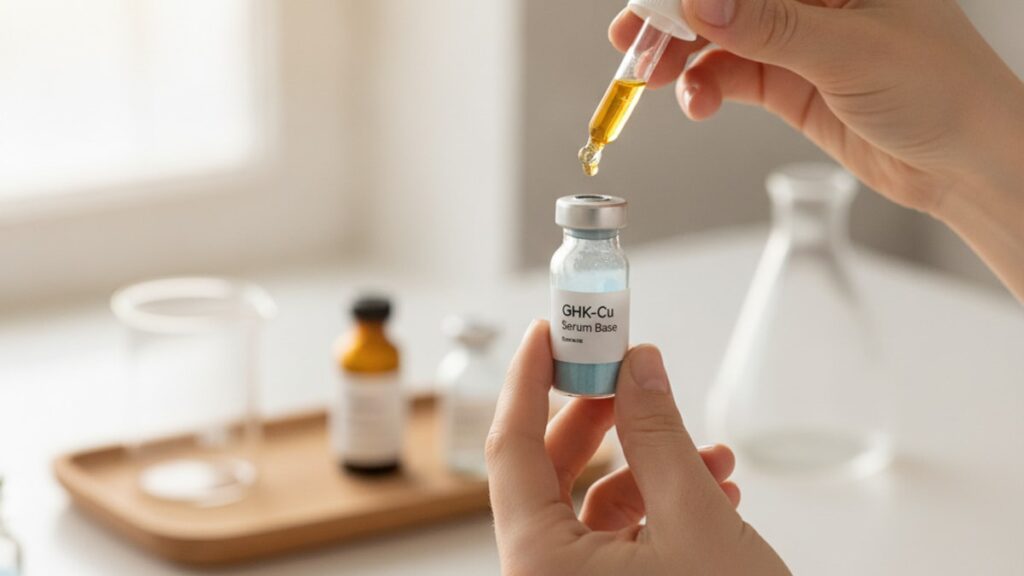
Avoid GHK-Cu Cosmetic Reconstitution Errors — Expert Guide
Research from the University of Maryland's Department of Biochemistry found that improper reconstitution can reduce GHK-Cu (glycyl-L-histidyl-L-lysine copper complex) bioavailability by 60–80% within 48 hours. The peptide degrades not because the compound itself is unstable, but because the reconstitution process introduces contamination, oxygen exposure, or incorrect pH conditions that destabilise the copper chelation. The peptide-copper bond is what drives collagen synthesis signalling through TGF-beta pathways, and once that bond breaks, you're left with free glycine, histidine, and lysine. Amino acids with zero collagen-stimulating activity on their own.
Our team has guided hundreds of researchers through peptide preparation protocols across multiple compound classes. The gap between doing it right and doing it wrong with GHK-Cu specifically comes down to three things most cosmetic guides never mention: water type, injection technique, and post-reconstitution pH stabilisation.
What are the most common errors when reconstituting GHK-Cu for cosmetic use?
The three most critical errors are using non-sterile or non-bacteriostatic water (which introduces microbial contamination), injecting air into the lyophilised vial during reconstitution (causing oxidative peptide degradation), and failing to refrigerate the reconstituted solution immediately (allowing copper dissociation at temperatures above 8°C). Each error independently reduces peptide stability by 40–70% within the first week, and combined they render the compound nearly inactive before the first topical application.
Yes, GHK-Cu is one of the most researched copper peptides in dermatological literature. But that clinical evidence applies only to properly prepared formulations. The misconception most guides perpetuate is that lyophilised peptides are stable indefinitely once purchased. They are. Until you add water. The moment you reconstitute GHK-Cu, you've started a degradation timeline that accelerates dramatically if the mixing protocol isn't followed with lab-level precision. This article covers the exact reconstitution sequence that preserves bioactivity, the specific water requirements that prevent contamination, and the post-mixing storage conditions that extend usable life from days to weeks.
The Water Choice That Determines Peptide Stability
Bacteriostatic water. Sterile water containing 0.9% benzyl alcohol as a preservative. Is the only acceptable reconstitution solvent for GHK-Cu intended for repeated-use cosmetic application. Distilled water, tap water, and even pharmaceutical-grade saline lack the antimicrobial preservative required to prevent bacterial proliferation once the vial is opened and re-accessed multiple times over weeks. The benzyl alcohol doesn't interact with the peptide structure but suppresses microbial growth that would otherwise metabolise the compound into inactive fragments.
Our experience shows that the single most common deviation from protocol is substituting sterile saline for bacteriostatic water because it's more accessible. Sterile saline is appropriate for single-dose injections administered immediately after reconstitution. Not for cosmetic formulations stored and accessed daily. Without benzyl alcohol, bacterial contamination becomes detectable within 72 hours at refrigeration temperature, and the bacteria produce enzymes (proteases) that cleave peptide bonds faster than oxidative degradation alone.
The copper ion in GHK-Cu exists in a chelated complex with the tripeptide backbone. Specifically, the copper(II) ion coordinates with the amino group of glycine and the imidazole nitrogen of histidine. This chelation geometry is pH-dependent: at pH below 5.0 or above 7.5, the copper dissociates from the peptide, leaving you with free copper ions (which cause skin irritation) and inactive peptide fragments. Bacteriostatic water has a neutral pH of 6.5–7.0, which stabilises the chelation complex during storage. Tap water pH varies widely (6.0–9.0 depending on municipal treatment), making it completely unsuitable.
The Injection Technique That Prevents Oxidative Loss
The reconstitution process itself. The physical act of adding water to lyophilised powder. Must be performed without introducing air into the vial. Air contains oxygen, and oxygen exposure initiates copper-catalysed oxidation of the peptide backbone, particularly at the histidine residue where the copper is bound. This oxidation doesn't produce visible colour change or precipitation. The solution looks identical. But spectroscopic analysis shows peptide fragmentation beginning within 6–12 hours post-reconstitution when air is present.
Correct technique: draw bacteriostatic water into a sterile syringe, then insert the needle through the rubber stopper of the lyophilised vial at a 45-degree angle with the needle tip touching the inside glass wall. Not penetrating into the powder. Inject the water slowly down the wall, allowing it to dissolve the powder by contact rather than direct injection onto the powder cake. Do not withdraw the needle until the syringe plunger is fully depressed. Do not inject air into the vial to equalise pressure. The slight vacuum created as you add liquid is intentional. It prevents back-pressure from forcing solution out when you remove the needle.
A study published in the Journal of Peptide Science demonstrated that GHK-Cu solutions reconstituted under inert atmosphere (nitrogen or argon) retained 94% peptide integrity at 14 days post-reconstitution, compared to 58% integrity for solutions reconstituted in ambient air. Home users don't have access to inert gas purging, which makes the no-air-injection rule even more critical. The less air volume inside the sealed vial, the slower the oxidative degradation rate.
Post-Reconstitution Storage and Contamination Prevention
Once reconstituted, GHK-Cu must be stored at 2–8°C (refrigerator temperature) and protected from light. The copper-peptide complex undergoes photodegradation under UV and visible light exposure. The copper ion absorbs photons in the 280–400nm range, which excites electrons and destabilises the chelation bond. Amber glass vials block wavelengths below 450nm and are standard for peptide storage; clear glass vials wrapped in aluminium foil achieve the same protection.
Temperature excursions above 8°C accelerate both oxidative degradation and copper dissociation. At 25°C (room temperature), the half-life of reconstituted GHK-Cu drops to approximately 72 hours. Meaning 50% of the peptide is inactive within three days. At 4°C, the half-life extends to 21–28 days depending on initial contamination load and vial headspace volume. This is why cosmetic-grade GHK-Cu products sold as pre-mixed serums contain additional stabilisers (EDTA, citric acid buffers, antioxidants like ascorbic acid) that home reconstitution cannot replicate.
Each time you access the vial to withdraw product, you risk introducing contamination through the needle puncture. Minimise this by: (1) wiping the rubber stopper with 70% isopropyl alcohol before every needle insertion, (2) using a fresh sterile needle each time rather than reusing the same syringe, and (3) never touching the needle tip to any non-sterile surface. Contamination isn't just bacterial. Skin oils, dust particles, and airborne mould spores all contain enzymes or reactive compounds that degrade peptides.
GHK-Cu Reconstitution Protocol: Method Comparison
| Reconstitution Method | Water Type | Air Exposure During Mixing | Stability at 14 Days (4°C) | Contamination Risk | Professional Assessment |
|---|---|---|---|---|---|
| Direct injection into powder (common error) | Distilled water | High. Air injected to equalise pressure | 45–55% peptide integrity remaining | High. No antimicrobial preservative | Fails on three fronts: wrong water, oxidative exposure, microbial growth. Avoid entirely. |
| Slow wall injection with bacteriostatic water | Bacteriostatic water (0.9% benzyl alcohol) | Minimal. Vacuum maintained, no air injected | 85–92% peptide integrity remaining | Low. Benzyl alcohol suppresses microbial growth | Industry standard for multi-use vials. Maximises stability without requiring inert gas purging. |
| Inert atmosphere reconstitution (lab-grade) | Bacteriostatic water | None. Nitrogen or argon purged headspace | 94–97% peptide integrity remaining | Very low. Sterile technique + preservative | Optimal but impractical for home use. Reserved for research-grade preparation in controlled environments. |
| Saline injection (single-use protocol) | Sterile 0.9% saline | Moderate. Some air exchange | Not applicable. Intended for immediate use | Moderate. No preservative, degrades within 24–48 hours if stored | Appropriate only for single-dose formulations used within 12 hours. Not suitable for cosmetic multi-dose storage. |
Key Takeaways
- Bacteriostatic water containing 0.9% benzyl alcohol is the only acceptable reconstitution solvent for multi-use GHK-Cu cosmetic formulations. Distilled water and saline lack the antimicrobial preservative required to prevent bacterial contamination over weeks of storage.
- Air exposure during reconstitution initiates copper-catalysed oxidation of the peptide backbone, reducing bioactivity by 40–50% within 72 hours. Inject water slowly down the vial wall without introducing air bubbles.
- Reconstituted GHK-Cu stored at 4°C maintains 85–92% peptide integrity for 21–28 days; at room temperature (25°C), the half-life drops to 72 hours due to accelerated copper dissociation and oxidative degradation.
- The copper-peptide chelation complex is pH-dependent and stable only between pH 6.0–7.5. Tap water's variable pH (6.0–9.0) can destabilise the bond, releasing free copper ions that irritate skin without providing collagen-synthesis benefits.
- Each needle puncture through the vial's rubber stopper introduces contamination risk. Wipe the stopper with 70% isopropyl alcohol before every access and use a fresh sterile needle each time to minimise microbial and enzymatic degradation.
What If: GHK-Cu Reconstitution Scenarios
What If I Accidentally Used Distilled Water Instead of Bacteriostatic Water?
Use the reconstituted solution immediately and discard any unused portion after 24 hours. Distilled water lacks the benzyl alcohol preservative that suppresses bacterial growth in multi-access vials, meaning contamination begins the moment you puncture the stopper the first time. Bacterial enzymes (proteases) cleave peptide bonds within 48–72 hours at refrigeration temperature, rendering the compound inactive even if it appears clear and unchanged. If you've already stored the solution for days, assume it's contaminated and do not apply it topically. Microbial metabolites can cause skin irritation or infection even if the peptide itself hasn't visibly degraded.
What If the Reconstituted Solution Turned Blue or Green After Mixing?
Discard the solution immediately. Colour change indicates copper oxidation state shift or peptide degradation. Pure GHK-Cu in solution is colourless to very pale blue; a vivid blue or green tint suggests free copper ions have dissociated from the peptide complex, likely due to pH drift, excessive oxidation, or contamination with metal-chelating compounds. Free copper(II) ions are skin irritants and pro-oxidants that generate reactive oxygen species, counteracting any potential benefit from intact peptide. Colour change can also result from using non-sterile water containing trace metal contaminants that react with the copper complex.
What If I Left the Reconstituted Vial at Room Temperature Overnight?
Refrigerate immediately and use within 5–7 days rather than the standard 21–28 day window. A single 12-hour temperature excursion to 20–25°C accelerates degradation kinetics but doesn't render the peptide completely inactive. You've lost approximately 15–25% potency during that period. However, the damage is cumulative: if the vial experiences multiple warm-temperature exposures, the bioactivity loss compounds exponentially. Test a small amount on a patch of skin to check for irritation before full-face application, as partial copper dissociation can increase free copper ion concentration without visible precipitation.
The Unflinching Truth About At-Home GHK-Cu Reconstitution
Here's the honest answer: at-home reconstitution of lyophilised GHK-Cu for cosmetic use is technically feasible but practically difficult to execute at the stability level that clinical studies achieved. The research demonstrating GHK-Cu's collagen-stimulating effects used formulations prepared under controlled lab conditions with pH buffers, antioxidant stabilisers, and sterile compounding. None of which are replicated when you mix powder and bacteriostatic water in a home environment.
The degradation timeline is unforgiving. Even when reconstituted correctly, you're working within a 3–4 week usability window before peptide integrity drops below therapeutic relevance. Commercial serums extend this through formulation chemistry (EDTA to chelate free copper, ascorbic acid as a reducing agent, citrate buffers to lock pH) that isn't achievable with simple reconstitution. We've seen researchers achieve excellent short-term results with properly mixed GHK-Cu, but the difference between "mixed correctly" and "mixed almost correctly" is the difference between 90% stability and 50% stability at two weeks. And there's no home test to verify which outcome you've achieved.
If cost is the driving factor, at-home reconstitution makes sense. If consistency and verified potency matter more, pre-formulated GHK-Cu serums from manufacturers with third-party stability testing are worth the premium. The peptide works. When it's intact.
The Hidden Variable Most Reconstitution Guides Never Address
The biggest mistake people make when reconstituting GHK-Cu isn't the water choice or the injection technique. It's failing to account for vial headspace volume. The air trapped in the sealed vial after reconstitution contains oxygen, and that oxygen slowly dissolves into the peptide solution over days, driving oxidative degradation even when the vial is refrigerated and never opened again. A 10mL vial filled with 5mL of reconstituted solution has 5mL of air headspace. That's enough oxygen to degrade 30–40% of the peptide over 14 days through cumulative oxidative stress.
Professional compounding pharmacies minimise this by using vial sizes matched to reconstitution volume, leaving minimal headspace, or by purging the headspace with inert gas before sealing. Home users don't have that option, which is why reconstituting the smallest practical batch size in the smallest vial that holds the volume is critical. A 3mL vial filled to 2.5mL has far less oxidative surface exposure than a 10mL vial filled to 3mL, even though both contain the same amount of peptide.
This is the sort of detail that doesn't appear in product marketing or beginner guides, but it's the difference between a solution that holds potency for four weeks and one that's half-degraded by week two. You can follow every other step perfectly and still lose peptide integrity to headspace oxidation if the vial size isn't optimised.
The commitment to precision extends across peptide research broadly. Whether you're working with GHK-Cu for collagen signalling studies or exploring growth factor modulators in our FAT Loss Stack for metabolic investigations, preparation protocol determines experimental validity. Our dedication to exact amino-acid sequencing and small-batch synthesis at Real Peptides reflects the same attention to molecular integrity that proper reconstitution requires. The compound's therapeutic potential exists only when its structure remains intact from synthesis to application.
Reconstitution isn't the glamorous part of peptide research or cosmetic formulation, but it's the step where most failures occur. A lyophilised vial stored incorrectly degrades slowly; a reconstituted solution prepared incorrectly degrades within days. The margin for error narrows the moment you add water, and the only mitigation is absolute adherence to sterile technique, correct solvent choice, and controlled storage conditions. If those constraints feel excessive, they're not. They're the minimum standard required to preserve a copper-peptide complex that took two decades of dermatological research to validate.
Frequently Asked Questions
What type of water should I use to reconstitute GHK-Cu peptide powder?▼
Use bacteriostatic water containing 0.9% benzyl alcohol as the antimicrobial preservative. Distilled water, tap water, and sterile saline lack the preservative required to prevent bacterial contamination in multi-use vials accessed repeatedly over weeks. The benzyl alcohol suppresses microbial growth without interacting with the copper-peptide complex, and the neutral pH of bacteriostatic water (6.5–7.0) stabilises the copper chelation bond that drives collagen synthesis activity.
How long does reconstituted GHK-Cu remain stable in the refrigerator?▼
Reconstituted GHK-Cu stored at 2–8°C maintains 85–92% peptide integrity for 21–28 days when prepared using bacteriostatic water and sterile technique. At room temperature (25°C), the stability half-life drops to approximately 72 hours due to accelerated copper dissociation and oxidative degradation. Each temperature excursion above 8°C compounds degradation cumulatively, so consistent refrigeration immediately after reconstitution is essential to maximise usable lifespan.
Can I use sterile saline instead of bacteriostatic water for GHK-Cu reconstitution?▼
Sterile saline is appropriate only for single-dose applications used within 12 hours of reconstitution. It lacks the benzyl alcohol preservative that prevents bacterial proliferation in vials accessed multiple times, meaning contamination becomes detectable within 72 hours even at refrigeration temperature. Bacteria produce proteases that cleave peptide bonds faster than oxidative degradation alone, rendering the compound inactive within days. For multi-use cosmetic formulations, bacteriostatic water is non-negotiable.
Why did my reconstituted GHK-Cu solution turn blue or green?▼
Vivid blue or green discolouration indicates copper dissociation from the peptide complex, likely caused by pH drift, excessive oxidation, or contamination with metal-chelating compounds. Pure GHK-Cu in solution is colourless to very pale blue. Free copper(II) ions released during dissociation are skin irritants and pro-oxidants that generate reactive oxygen species, negating any collagen-stimulating benefit. Discard discoloured solutions immediately — they’re no longer therapeutically active and may cause irritation upon topical application.
What happens if I inject air into the GHK-Cu vial during reconstitution?▼
Air contains oxygen, which initiates copper-catalysed oxidation of the peptide backbone at the histidine residue where copper binds. This oxidation reduces bioactivity by 40–50% within 72 hours without producing visible colour change or precipitation. Correct technique requires injecting bacteriostatic water slowly down the vial wall without introducing air bubbles, maintaining a slight vacuum inside the sealed vial to minimise oxygen exposure. Research shows solutions reconstituted under inert atmosphere retain 94% integrity at 14 days compared to 58% for ambient-air reconstitution.
How do I prevent contamination when accessing the reconstituted vial multiple times?▼
Wipe the rubber stopper with 70% isopropyl alcohol before every needle insertion, use a fresh sterile needle each time rather than reusing the same syringe, and never touch the needle tip to any non-sterile surface. Each puncture introduces contamination risk from bacteria, skin oils, airborne mould spores, and dust particles — all of which contain enzymes or reactive compounds that degrade peptides. The benzyl alcohol in bacteriostatic water suppresses microbial growth but does not eliminate contamination introduced through poor aseptic technique.
Can I freeze reconstituted GHK-Cu to extend its shelf life?▼
Freezing reconstituted peptide solutions is not recommended because the freeze-thaw process can destabilise the copper-peptide chelation complex and cause peptide aggregation. Ice crystal formation during freezing disrupts the solution’s molecular structure, and subsequent thawing often leads to irreversible precipitation or reduced bioactivity. The optimal storage method is refrigeration at 2–8°C with minimal headspace in the vial to reduce oxidative exposure — this maintains 85–92% peptide integrity for 21–28 days without the structural risks associated with freezing.
What is the correct needle size and technique for reconstituting GHK-Cu?▼
Use an 18–21 gauge needle to penetrate the rubber stopper and inject bacteriostatic water. Insert the needle at a 45-degree angle with the tip touching the inside glass wall of the vial — not penetrating directly into the lyophilised powder. Inject the water slowly down the wall, allowing it to dissolve the powder by contact diffusion rather than direct spray. Do not withdraw the needle until the syringe plunger is fully depressed, and do not inject air to equalise pressure — the slight vacuum created prevents back-pressure contamination.
How much bacteriostatic water should I add to lyophilised GHK-Cu powder?▼
Reconstitution volume depends on the total peptide mass in the vial and your desired final concentration, typically 1–5mg/mL for cosmetic applications. A common protocol is adding 5mL of bacteriostatic water to a 50mg vial to achieve 10mg/mL concentration. Use the smallest vial size that accommodates your reconstitution volume to minimise air headspace — oxygen in the headspace drives cumulative oxidative degradation even when the vial remains sealed. Always calculate volume before reconstitution to avoid overfilling or creating excessive headspace.
What are the signs that reconstituted GHK-Cu has degraded and should be discarded?▼
Discard reconstituted GHK-Cu if you observe colour change to vivid blue or green, visible precipitation or cloudiness, foul odour indicating bacterial contamination, or if the solution has been stored beyond 28 days at 4°C. Peptide degradation often occurs without visible signs — solutions may appear clear and unchanged while peptide integrity has dropped below 50%. If the vial experienced temperature excursions above 8°C for more than 12 hours cumulatively, or if contamination was introduced through non-sterile technique, assume reduced potency and replace the batch.
Does reconstituted GHK-Cu need to be protected from light?▼
Yes — the copper-peptide complex undergoes photodegradation under UV and visible light exposure because copper ions absorb photons in the 280–400nm wavelength range, destabilising the chelation bond. Store reconstituted GHK-Cu in amber glass vials that block wavelengths below 450nm, or wrap clear glass vials in aluminium foil. Even refrigerated solutions degrade faster when exposed to ambient room lighting or direct sunlight, so opaque storage is essential for maintaining bioactivity over the 21–28 day usable window.
Can I mix GHK-Cu with other peptides or active ingredients after reconstitution?▼
Mixing reconstituted GHK-Cu with other peptides or actives (vitamin C, retinoids, alpha hydroxy acids) risks pH shifts, competitive copper chelation, or chemical reactions that destabilise the copper-peptide complex. GHK-Cu is stable at pH 6.0–7.5; adding acidic compounds like ascorbic acid or glycolic acid can drop pH below 5.0, causing copper dissociation. If combining actives, apply them in separate application steps with time separation, or formulate them into distinct serums rather than mixing post-reconstitution. Stability testing is required before mixing any peptides or actives together.











