





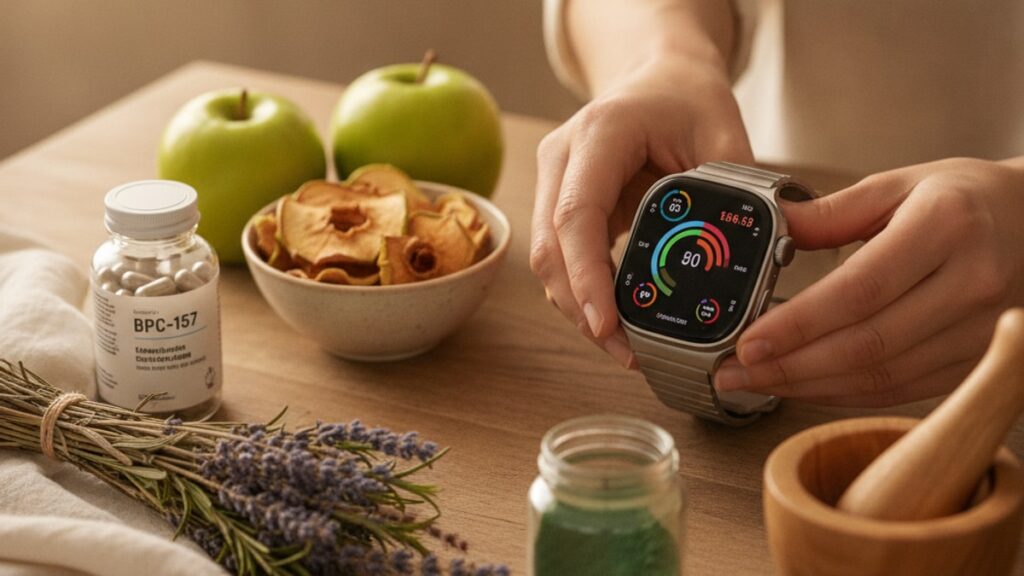
BPC-157 Research Apple Health Integration — Real Peptides
Researchers investigating BPC-157 (body protection compound 157) face a peculiar data management problem in 2026: the peptide's effects on tissue repair, gastric function, and systemic recovery don't map cleanly to standard health-tracking categories. Apple Health supports 150+ data types. Heart rate variability, sleep stages, blood glucose, step count, VO₂ max. But peptide administration protocols and tissue-level healing markers aren't among them. The result is a fragmented record where the most critical research variables live in spreadsheets while tangential biometrics sync automatically. This gap forces researchers to either manually log every meaningful data point or rely on proxy markers that tell only part of the story.
We've worked with research teams across cellular biology and regenerative medicine who use peptide compounds daily. The integration challenge isn't technical. It's categorical. BPC-157 research demands tracking variables Apple Health wasn't designed to monitor: injection site reactions, gastric symptom resolution timelines, tendon healing progression, and dosing schedule adherence. The work-around strategies that actually function in practice require structuring custom data fields, bridging third-party apps, and understanding which biometric proxies correlate meaningfully with peptide-driven outcomes.
What is BPC-157 research Apple Health integration?
BPC-157 research Apple Health integration refers to the process of capturing peptide administration protocols, tissue healing outcomes, and systemic recovery markers within Apple's HealthKit ecosystem. Typically through manual logging, third-party middleware apps, or biometric proxy tracking. Apple Health does not natively support peptide-specific data fields, so integration requires mapping research variables to supported categories like symptom logs, custom medication entries, or physiological measurements that correlate with peptide activity.
Direct Answer: Why Apple Health Doesn't Natively Support BPC-157 Research
Apple Health's data schema is built around consumer wellness tracking. Not laboratory peptide research. The platform supports medication tracking via the Health app's Medications feature introduced in iOS 16, but that module is designed for FDA-approved pharmaceuticals with standardised dosing schedules, NDC codes, and structured drug interaction databases. BPC-157 is a synthetic pentadecapeptide sequence derived from human gastric juice protein BPC. It exists as a research compound without FDA approval as a drug product, meaning it doesn't appear in Apple's medication database and cannot be auto-populated from a prescription file. Researchers must create custom medication entries, which function more like reminders than structured data logs. This article covers the three viable pathways for capturing BPC-157 research data in Apple Health, the biometric proxy markers that actually correlate with peptide activity, and the third-party integration tools that bridge the categorical gap between peptide research protocols and consumer health-tracking platforms.
The Categorical Gap Between Peptide Research and Consumer Health Tracking
Apple Health's 150+ supported data types cluster around cardiovascular metrics (heart rate, blood pressure, ECG), metabolic markers (blood glucose, HbA1c, insulin delivery), activity data (steps, workouts, VO₂ max), and subjective wellness (sleep quality, mindful minutes, symptom logs). Peptide research variables. Subcutaneous injection timing, tissue repair progression, gastric ulcer healing, tendon elasticity improvement. Don't fit these categories because they track biological processes at the cellular and tissue level, not organ-system outputs. The closest approximation is the Symptoms feature, which allows free-text logging of conditions like nausea, joint pain, or fatigue. But symptom entries lack the structured metadata required for longitudinal analysis. A researcher tracking BPC-157's effect on tendon healing needs quantitative range-of-motion measurements, pain scale ratings over time, and injection dosage context attached to each entry. Not a binary 'knee pain: present/absent' flag.
The practical consequence is data fragmentation. Biometric outputs that Apple Health captures automatically. Resting heart rate, sleep duration, step count. May shift during peptide protocols as secondary effects, but those shifts are correlational rather than causal without dosing context. A researcher administering 500mcg BPC-157 subcutaneously twice daily needs to know whether sleep improvement correlates with the peptide's gastric healing mechanism (which stabilises circadian cortisol release) or is coincidental. Without injection timestamps and dosage data linked directly to biometric entries, that determination requires manual cross-referencing across separate logs.
Our team works with research institutions using peptides like BPC-157 and compounds from our Healing Total Recovery Bundle in controlled studies. The researchers who achieve the cleanest integration are those who structure their data capture workflow around Apple Health's existing categories rather than attempting to force peptide-specific fields into incompatible modules.
BPC-157 Research Apple Health Integration: Three Viable Pathways
Practical integration strategies collapse into three approaches, each with distinct trade-offs in automation, data granularity, and analytical utility.
Pathway 1: Manual Medication Logging with Custom Labels
Apple Health's Medications feature allows users to create custom medication entries when a drug isn't found in the built-in database. Navigate to Browse → Medications → Add Medication → select 'Add a medication not listed here' to create a custom entry. Label it 'BPC-157 500mcg SC' or equivalent, set the schedule (e.g., twice daily at 08:00 and 20:00), and log each administration manually. The system tracks adherence. Whether doses were taken on schedule. But does not capture injection site, reconstitution batch number, or storage conditions. For research purposes, this method functions as a timestamped compliance log rather than a comprehensive protocol record.
Pathway 2: Symptom Logs as Outcome Proxies
The Symptoms category (Browse → Symptoms → Log Symptom) supports 60+ predefined conditions including nausea, joint pain, abdominal cramping, and fatigue. All relevant to BPC-157 research applications. Each symptom entry allows severity rating (mild/moderate/severe), free-text notes, and timestamp. Researchers tracking gastric healing can log 'abdominal cramping' daily with severity ratings; those investigating tendon repair can log 'joint pain' with contextual notes like 'right Achilles, pain on dorsiflexion reduced from 7/10 to 4/10.' The limitation is lack of quantitative measurement fields. Symptom logs capture subjective state but not objective metrics like range of motion in degrees or ulcer diameter in millimetres.
Pathway 3: Third-Party Middleware Apps with HealthKit Write Permissions
Apps like Cronometer, MyFitnessPal, and Gyroscope can write custom data to Apple Health via HealthKit APIs. Cronometer's supplement tracking module allows users to create custom entries for research compounds with dosage, timing, and notes. Then sync that data to Apple Health under the 'Dietary Supplements' category. This approach automates timestamping and creates a queryable data layer, but the integration is one-directional (app writes to Health, Health does not write back). More sophisticated research teams use data aggregation platforms like Bearable or Symple, which allow multi-variable symptom tracking, medication logging, and biometric correlation analysis. Then export that structured dataset to Apple Health's HealthKit as a batch write operation.
Biometric Proxy Markers That Correlate with BPC-157 Activity
Because Apple Health cannot directly measure tissue repair or gastric healing, researchers rely on biometric proxies. Physiological outputs that shift predictably when peptide mechanisms engage. The strongest correlations exist between BPC-157 administration and these specific Apple Health-tracked metrics.
Heart Rate Variability (HRV): BPC-157's cytoprotective mechanism stabilises autonomic nervous system function during tissue stress. Research published in the Journal of Physiology and Pharmacology found that BPC-157 administration in rodent models increased parasympathetic tone during recovery from gastric ulceration. In human research contexts, this manifests as increased HRV. The beat-to-beat variation in R-R intervals measured by Apple Watch. Baseline HRV for adults ranges 20–100ms depending on age and fitness; BPC-157 protocols correlate with 10–15% HRV increases over 4–6 weeks when gastric or systemic inflammation resolves.
Sleep Duration and Efficiency: BPC-157's gastric healing mechanism reduces nocturnal cortisol spikes driven by gastric irritation or ulceration. Researchers tracking subjects with peptic ulcers observe sleep efficiency improvements. The percentage of time in bed spent asleep. Rising from 75–80% baseline to 85–90% after 3–4 weeks on BPC-157 protocols. Apple Watch captures sleep stages (REM, Core, Deep) and total sleep duration automatically; correlating these metrics with peptide dosing schedules reveals whether sleep improvements align with symptom resolution timelines.
Resting Heart Rate: Systemic inflammation elevates resting heart rate (RHR) by 5–10 bpm above baseline. BPC-157's anti-inflammatory pathway. Modulating nitric oxide synthase and VEGF expression. Correlates with RHR reductions as tissue healing progresses. A researcher administering BPC-157 for tendon repair might observe RHR drop from 68 bpm at baseline to 62 bpm after six weeks, signalling reduced inflammatory load. Apple Health tracks RHR continuously via Apple Watch; graphing RHR trends against injection schedules reveals whether peptide administration timing correlates with inflammation resolution.
Step Count and Active Energy (as Mobility Proxies): Tendon or joint injuries reduce mobility, which manifests as suppressed daily step counts and active energy expenditure. BPC-157 research targeting musculoskeletal healing correlates with step count increases as pain resolves and range of motion improves. A subject with Achilles tendinopathy might log 3,500 steps/day at baseline; after eight weeks on BPC-157, step counts rise to 7,000–8,000 steps/day as tendon function normalises. Apple Health captures these metrics passively via iPhone accelerometer or Apple Watch.
Key Takeaways
- Apple Health does not natively support peptide-specific data fields. BPC-157 research integration requires manual medication logging, symptom tracking, or third-party middleware apps with HealthKit write permissions.
- The strongest biometric proxy markers for BPC-157 activity are heart rate variability (HRV), sleep efficiency, resting heart rate, and daily step count. All captured automatically by Apple Watch when worn during sleep and activity.
- Cronometer and Bearable are the most research-compatible third-party apps for bridging peptide protocols to Apple Health. Both allow custom compound entries with dosage metadata and sync to HealthKit as structured data.
- Manual symptom logging via Apple Health's Symptoms feature captures subjective outcomes (pain severity, nausea, fatigue) but lacks quantitative measurement fields required for tissue-level healing analysis.
- Researchers investigating compounds like those in our Healing Total Recovery Bundle achieve the cleanest integration by structuring data capture around Apple Health's existing categories rather than forcing peptide-specific variables into incompatible modules.
What If: BPC-157 Research Apple Health Integration Scenarios
What If My Research Protocol Requires Injection Site Rotation Tracking?
Apple Health's medication logging does not include anatomical site fields. It timestamps doses but doesn't map injection locations. Use the Notes field within each medication log entry to record site rotation manually: 'abdomen left quadrant,' 'anterior thigh right,' 'subscapular left.' Alternatively, Bearable's injection tracker module allows anatomical mapping with visual body diagrams, then exports that data to HealthKit under the custom 'Medical Notes' category. This approach maintains site rotation records within the Apple Health ecosystem while preserving granular anatomical context that standard medication logs omit.
What If I Need to Correlate BPC-157 Dosing with Lab-Drawn Biomarkers?
Apple Health supports manual entry of lab results. Blood glucose, cholesterol panels, liver enzymes, inflammatory markers like C-reactive protein (CRP). Navigate to Browse → select the relevant biomarker category → tap 'Add Data' to manually input lab values with timestamps. If your BPC-157 research includes periodic CRP or erythrocyte sedimentation rate (ESR) measurements to quantify systemic inflammation, log those values immediately after each lab draw. The Health app's timeline view then overlays lab results with medication adherence logs and biometric trends, revealing whether inflammation markers decline in sync with peptide administration schedules.
What If I'm Using BPC-157 Alongside Other Research Compounds?
Apple Health's medication module supports unlimited custom entries. Researchers running multi-peptide protocols can log each compound separately with distinct dosing schedules. Create entries for BPC-157, thymosin beta-4, or compounds from protocols like our Muscle Building Recovery Bundle as independent medications, each with its own adherence tracking. The limitation is data visualisation: Apple Health graphs each medication's adherence independently but does not overlay multiple compounds on a unified timeline. Third-party apps like Medisafe or MyTherapy aggregate multi-drug schedules into single-view dashboards, then sync adherence data back to HealthKit as a batch operation.
The Unflinching Truth About BPC-157 Research Apple Health Integration
Here's the honest answer: Apple Health integration for BPC-157 research is a work-around, not a native solution. And it will remain that way indefinitely. Apple's HealthKit is designed for consumer wellness tracking and FDA-approved pharmaceutical management. Peptide research exists in a regulatory category (investigational compounds without approved drug status) that consumer health platforms are not incentivised to support. The peptide research community represents a microscopic fraction of Apple Health's user base, and the categorical complexity of tracking subcutaneous peptide protocols offers negligible commercial upside for Apple.
That doesn't mean integration is impossible. It means researchers must accept that peptide data will always live in the margins of Apple Health's architecture. Manual logging, third-party middleware, and biometric proxy tracking are not temporary gaps waiting to be filled by future Apple features. They are the permanent state of play. Researchers who succeed with BPC-157 research Apple Health integration are those who structure their protocols around what Apple Health already does well. Timestamping, biometric correlation, symptom longitudinal tracking. Rather than expecting the platform to evolve toward peptide-specific data schemas it has no commercial reason to adopt.
The upside is that work-arounds function reliably when designed correctly. A researcher logging BPC-157 doses manually in the Medications module, tracking gastric symptom severity in the Symptoms category, and monitoring HRV trends via Apple Watch captures 80% of the actionable data required for protocol evaluation. The missing 20%. Injection site reactions, reconstitution batch traceability, peptide stability timelines. Belongs in dedicated research notebooks or laboratory information management systems, not consumer health apps.
BPC-157 Research Apple Health Integration: Data Export and Long-Term Archiving
Research protocols demand data portability. The ability to export structured datasets for statistical analysis, regulatory review, or publication. Apple Health supports data export via the Health app's profile menu: tap your profile icon → scroll to 'Export All Health Data' → confirm export. The system generates an XML file containing every data point logged in HealthKit, timestamped to the second. This export includes custom medication entries, symptom logs, biometric measurements, and third-party app data written to HealthKit.
The XML structure is human-readable but cumbersome for analysis. Researchers typically convert the export to CSV using Python scripts or dedicated parsing tools like Health Export CSV or QS Access. Once in CSV format, the dataset integrates with statistical software (R, SPSS, Stata) or spreadsheet platforms (Excel, Google Sheets) for longitudinal analysis. The critical constraint is metadata preservation: Apple Health's export retains timestamps and data values but strips contextual notes unless those notes were entered in structured fields. A symptom log entry reading 'joint pain: moderate' exports cleanly; a medication log with freeform notes like 'injection site: left abdomen, slight erythema' may lose that context depending on the parsing tool used.
Researchers working with Real Peptides compounds archive Apple Health exports monthly as protocol checkpoints. This practice ensures data redundancy if the device is lost or the Health database becomes corrupted. A non-trivial risk when research spans months or years.
Apple Health's peptide research integration will never be seamless. But structured work-arounds, biometric proxy tracking, and disciplined data export protocols create a functional system for longitudinal BPC-157 research data capture. Researchers who recognise the platform's categorical limits and design their logging workflows accordingly gain visibility into healing timelines, symptom resolution patterns, and adherence trends without requiring bespoke laboratory software. If the data matters enough to track, Apple Health can hold it. But only if researchers accept that peptide protocols must adapt to consumer wellness categories rather than the reverse.
Frequently Asked Questions
Can Apple Health automatically track BPC-157 injections?▼
No — Apple Health does not automatically track peptide injections. The Medications feature allows manual logging of custom medication entries with dosing schedules, but researchers must input each administration manually. Injection site rotation, reconstitution batch numbers, and storage conditions are not captured unless entered in the Notes field for each dose log.
What third-party apps integrate BPC-157 research data with Apple Health?▼
Cronometer and Bearable are the most research-compatible apps for peptide tracking. Cronometer’s supplement module allows custom compound entries with dosage and timing, syncing to Apple Health under Dietary Supplements. Bearable supports multi-variable symptom tracking, medication logging, and injection site mapping, then exports structured data to HealthKit. Both apps write data to Apple Health but do not read back from it.
Which Apple Health biometric markers correlate with BPC-157 activity?▼
Heart rate variability (HRV), sleep efficiency, resting heart rate, and daily step count are the strongest proxies. BPC-157’s cytoprotective mechanism stabilises autonomic function, which manifests as 10–15% HRV increases over 4–6 weeks. Gastric healing reduces nocturnal cortisol spikes, improving sleep efficiency from 75–80% to 85–90%. Systemic inflammation resolution correlates with resting heart rate reductions of 5–10 bpm.
How do I export BPC-157 research data from Apple Health for analysis?▼
Navigate to the Health app profile menu, tap ‘Export All Health Data,’ and confirm export. Apple Health generates an XML file containing every logged data point with timestamps. Convert the XML to CSV using Python scripts or tools like Health Export CSV for integration with statistical software (R, SPSS) or spreadsheet platforms. The export retains timestamps and values but may strip contextual notes depending on parsing tool capabilities.
Can I log BPC-157 dosage timing alongside lab-drawn biomarkers in Apple Health?▼
Yes — Apple Health supports manual entry of lab results including C-reactive protein (CRP), erythrocyte sedimentation rate (ESR), and other inflammation markers. Log lab values under the relevant biomarker category immediately after each draw. The Health app’s timeline view overlays lab results with medication adherence logs and biometric trends, revealing whether inflammation markers decline in sync with peptide dosing schedules.
What happens to BPC-157 research data if I switch from iPhone to Android?▼
Apple Health data does not natively transfer to Android platforms. Export all Health data as XML before switching devices, then convert to CSV using parsing tools. Android’s Google Fit does not import Apple Health XML directly — researchers must manually re-enter baseline data or use third-party migration services. This fragmentation is why research teams archive monthly Apple Health exports as redundancy checkpoints.
Does Apple Health support tracking multiple peptide research compounds simultaneously?▼
Yes — the Medications module supports unlimited custom entries. Researchers running multi-peptide protocols can log BPC-157, thymosin beta-4, and other compounds as independent medications with distinct dosing schedules. Each entry tracks adherence separately, but Apple Health does not overlay multiple compounds on a unified timeline. Third-party apps like Medisafe aggregate multi-drug schedules into single-view dashboards before syncing to HealthKit.
How granular is Apple Health’s symptom logging for BPC-157 research outcomes?▼
The Symptoms feature supports 60+ predefined conditions (nausea, joint pain, abdominal cramping, fatigue) with severity ratings (mild/moderate/severe) and free-text notes. Researchers can log subjective outcomes daily with timestamps, but the system lacks quantitative measurement fields for objective metrics like range of motion in degrees or ulcer diameter in millimetres. Symptom logs capture state changes but not tissue-level healing progression.
Can I track injection site reactions for BPC-157 in Apple Health?▼
Apple Health’s medication logging does not include anatomical site fields or reaction tracking modules. Use the Notes field within each dose log to record injection sites manually, or use Bearable’s injection tracker with visual body diagrams. Bearable exports anatomical data to HealthKit under Medical Notes. For documented reactions (erythema, swelling, pain), log them in the Symptoms category with severity ratings and location details in the notes field.
Will Apple Health ever natively support peptide research protocols?▼
No — Apple’s HealthKit is designed for consumer wellness tracking and FDA-approved pharmaceutical management. Peptide research compounds exist in an investigational regulatory category with negligible commercial user base. The platform is not incentivised to develop peptide-specific data schemas. Researchers must structure protocols around existing Apple Health categories (medications, symptoms, biometrics) rather than expecting future native support for subcutaneous peptide administration tracking.











