


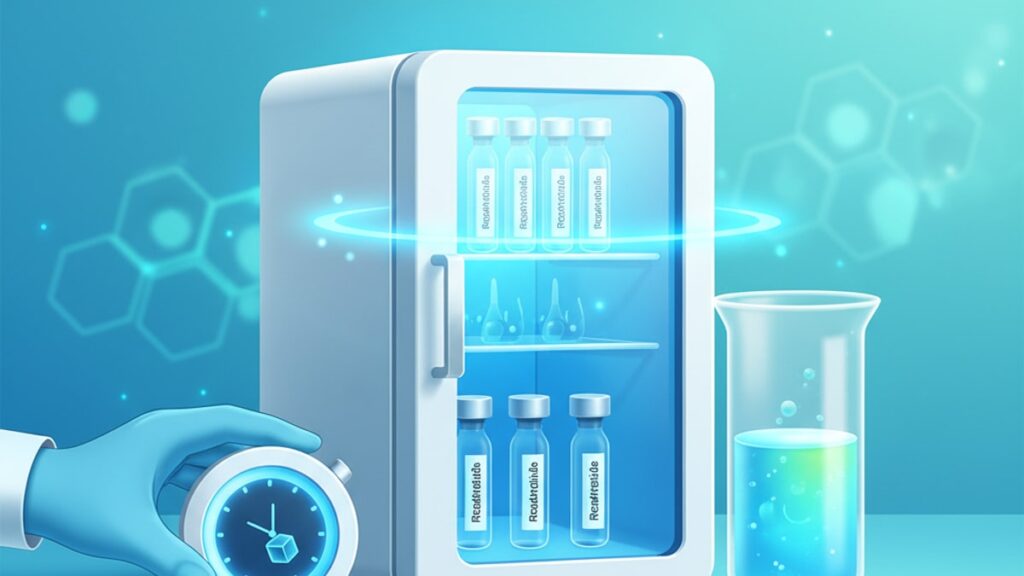
You've made a significant investment in your research by sourcing a high-purity compound like Retatrutide. It arrives as a delicate, chalky white disc of lyophilized powder at the bottom of a vial—a picture of potential and precision. But here's the unvarnished truth our team has seen play out time and again: all that potential, all that painstaking synthesis for exact amino-acid sequencing, can be undone by one simple mistake. Improper storage.
It’s a question we get constantly, and for good reason. Understanding the stability of these molecules isn't just a trivial detail; it's the bedrock of reproducible, valid scientific outcomes. So, let’s get right to it and answer the central question: how long does retatrutide last in the fridge? The answer, as with most things in advanced biological research, is nuanced. It's not one number, but two, and the difference between them is absolutely critical.
The Two States of Peptide Life: Lyophilized vs. Liquid
Before we can talk about timelines, we have to be crystal clear about what form of Retatrutide we're discussing. A peptide exists in two fundamentally different states in a lab setting, and their stability profiles are worlds apart. Confusing them is a recipe for catastrophic failure in your experiments. We mean this sincerely: getting this right is non-negotiable.
First, you have the lyophilized state. This is the freeze-dried powder you receive from us at Real Peptides. The process, called lyophilization, removes water from the peptide under deep vacuum and freezing temperatures. This creates a remarkably stable, almost inert puck of material that is highly resistant to degradation. Think of it as suspended animation for the molecule. In this form, it's built for the long haul, provided you keep it in the right environment. Its primary enemies are moisture and heat, which is why we ship it sealed and recommend immediate, proper storage upon arrival.
Then, you have the reconstituted state. This is what happens after you add a solvent—typically Bacteriostatic Water—to the lyophilized powder, bringing it into a liquid solution for your research protocol. The moment you add that liquid, a countdown timer starts. The peptide is now 'awake' and active, but it's also far more vulnerable. It's exposed to potential microbial contamination, oxidation, and the inherent chemical instability of being in a solution. This is where storage protocols become relentlessly demanding.
So, How Long Does Retatrutide Actually Last in the Fridge?
Alright, let's put some numbers to this. These are the timelines our team recommends based on extensive experience and established biochemical principles. Sticking to them is your best bet for ensuring your Retatrutide maintains its specified purity and efficacy throughout your study.
For Unreconstituted (Lyophilized) Retatrutide:
When it's still in its powdered form, Retatrutide is quite resilient. If you store the sealed vial in a standard refrigerator (around 2°C to 8°C or 36°F to 46°F), you can expect it to remain stable for many months, often up to a year or more. It's an excellent short-to-medium-term storage solution.
But we can do better. For maximum longevity, the gold standard for lyophilized peptides is a freezer set to -20°C (-4°F) or colder. In a deep freeze, protected from light and moisture, the powder can remain viable for several years. This is the protocol we use for our own long-term inventory management. It’s the ultimate way to preserve the integrity of the complex molecular structure you’re relying on.
For Reconstituted (Liquid) Retatrutide:
This is the big one. This is where the clock is ticking loudly.
Once you've reconstituted Retatrutide with bacteriostatic water, its lifespan in the refrigerator (again, 2°C to 8°C) shrinks dramatically. Our professional recommendation is to use the solution within 2 to 4 weeks. Some protocols might suggest you can stretch this to 5 or 6 weeks under absolutely impeccable sterile conditions, but our experience shows that the risk of degradation and microbial growth increases exponentially after the one-month mark. Why take that chance? Your data is too valuable.
That relatively short window is why we constantly advise researchers to only reconstitute the amount of peptide they plan to use in the immediate future. Don't mix a full 10mg vial if your next series of experiments only calls for 2mg. It's far better to leave the rest in its stable, lyophilized state and mix a fresh batch when you need it. This single practice can save you from a world of compromised results.
The Enemies of Peptide Integrity
Knowing the timelines is one thing. Understanding why those timelines exist is what separates the novice from the expert. A peptide's stability isn't just a matter of time; it's a constant battle against environmental assailants. Here are the primary culprits we've identified that can prematurely degrade your Retatrutide.
1. Temperature Fluctuations:
Your fridge isn't a uniformly cold box. The temperature in the door can swing wildly every time you open it. The front of the shelves is also less stable than the back. These cycles of warming and cooling, even by a few degrees, can stress the peptide's structure. We can't stress this enough: store your vials at the back of the main compartment, never in the door. For labs running high-stakes research, a dedicated, calibrated lab refrigerator is a wise investment.
2. Light Exposure:
Peptides are, by their nature, photosensitive. Exposure to UV light from sunlight or even harsh fluorescent lab lighting can initiate photodegradation, breaking the delicate peptide bonds. This is why most research vials are designed to be stored inside a box or are made of amber glass. Keep them in the dark as much as possible.
3. Agitation and Physical Stress:
After reconstituting, your instinct might be to shake the vial to ensure it's fully dissolved. Don't. Vigorous shaking or vortexing can shear the long amino acid chains, a process called mechanical denaturation. It literally tears the molecule apart. The proper technique is to gently swirl the vial or roll it between your palms until the powder dissolves completely. It might take a minute, but it's a critical step in preserving the peptide's intended structure.
4. Contamination:
This is the silent killer. Every time you puncture the vial's septum, you create a potential entry point for airborne bacteria or fungi. This is precisely why choosing the right reconstitution solvent is paramount. Using a solvent without an antimicrobial agent, like sterile water, dramatically shortens the viable lifespan of the reconstituted peptide. This is also why sterile handling—wiping the septum with an alcohol pad, using a new sterile syringe for every draw, and working in a clean environment—is not just a suggestion, it's a requirement for good science.
To make this clearer, let's compare the common solvents. Our team put together this table to simplify your decision-making process.
| Reconstitution Solvent | Ideal Use Case | Typical Refrigerated Shelf Life | Antimicrobial Agent? | Our Professional Notes |
|---|---|---|---|---|
| Bacteriostatic Water | Multi-use vials, standard research | 2-4 weeks | Yes (0.9% Benzyl Alcohol) | This is the standard for most research peptides. The benzyl alcohol actively inhibits microbial growth, providing a crucial safety buffer for vials accessed multiple times. |
| Sterile Water | Single-use protocols only | Less than 24 hours | No | Once opened or reconstituted, it's a breeding ground for bacteria. Only use this if you plan to draw and use the entire vial's contents immediately. |
| 0.6% Acetic Acid | Specific peptides requiring an acidic pH for solubility | Varies (check peptide data sheet) | No | More complex to handle. It can help with hard-to-dissolve peptides but is not a general-purpose choice and lacks antimicrobial properties. Only use when explicitly required. |
As you can see, for a peptide like Retatrutide in a multi-use research setting, Bacteriostatic Water isn't just an option; it's the only professionally responsible choice.
Real Peptides' Protocol for Flawless Storage
Over the years, our team has refined a set of best practices that we consider the gold standard for handling research peptides. Following this protocol will give you the absolute best chance of maintaining the purity and integrity of your compounds from the moment they arrive until the final data point is collected.
- Inspect on Arrival: Before you even think about the fridge, look at the vial. The powder should be a solid, uniform white puck or powder. If you see discoloration or signs that the vacuum seal has been compromised, that's a red flag.
- Log Everything, Immediately: Get a lab notebook or create a spreadsheet. Record the date of arrival, the lot number, and the date you plan to reconstitute. Once you do reconstitute, log that date, the solvent used, and the final concentration. This record-keeping is invaluable for troubleshooting any unexpected results later.
- Freeze for the Future: If you don't plan on using the Retatrutide within the next few months, don't just put it in the fridge. Place the lyophilized powder directly into a -20°C freezer. It's the simplest way to protect your investment for the long term.
- Reconstitute with a Plan: Never reconstitute on a whim. Do it with purpose, mixing only what you need for the next 2-4 weeks of your study. This minimizes waste and ensures every experiment is run with a maximally potent compound.
- Label Like a Pro: Your reconstituted vial needs a new label. It should clearly state the peptide name, the concentration (e.g., 1 mg/mL), the reconstitution date, and a 'use by' date (e.g., 4 weeks from reconstitution). Don't rely on memory. Ever.
- Handle with Aseptic Technique: Always wipe the rubber stopper with a sterile alcohol prep pad before each use. Use a brand-new, sterile syringe and needle for every withdrawal to prevent cross-contamination between vials or experiments. This is fundamental.
What Does Degraded Retatrutide Look Like?
So what happens if things go wrong? How can you tell if your peptide has passed its prime? Sometimes the signs are obvious, but other times they're frustratingly subtle.
Visually, you might see the solution turn cloudy or hazy. You could also notice tiny specks or particulates floating in the liquid that weren't there before. Any change from a perfectly clear solution is a major warning sign that something—either bacterial growth or chemical degradation—has occurred. In that case, the vial must be discarded. There's no saving it, and using it would completely invalidate your research.
More often, though, the degradation is invisible. The solution looks perfectly fine, but the peptide's structure has been compromised. The only way you'll know is when your experimental results become erratic, inconsistent, or just plain null. You'll see a loss of expected biological activity. This is perhaps the most costly outcome because you waste time, resources, and other materials chasing down a variable that turns out to be your degraded peptide. It’s a devastating setback, and it all comes back to that initial question of storage.
It’s why we are so relentless about quality control in our own small-batch synthesis. We ensure that what goes into the vial is of the highest possible purity. Our commitment to excellence extends across our entire catalog, from metabolic research compounds to nootropics like Dihexa and cell-regenerating peptides. We provide the best possible starting material so that with proper handling, your results can be reliable and groundbreaking. You can explore our full collection of peptides to see that this standard applies to everything we produce.
Ultimately, the integrity of your research is a chain of custody. It begins with a reputable supplier dedicated to purity and precision. It continues with meticulous handling and storage practices in the lab. Every link in that chain must be strong. The question of 'how long does retatrutide last in the fridge' is more than a simple query; it's a reflection of a researcher's commitment to excellence. By respecting the delicate nature of these molecules and adhering to strict protocols, you ensure that your hard work is built on a foundation of valid, reproducible science. If you're ready to build your next project on that foundation, we're here to help you Get Started Today.
Frequently Asked Questions
Can I freeze reconstituted Retatrutide?
▼
We strongly advise against this. The freeze-thaw cycle can fracture the peptide’s delicate structure, denaturing it and reducing its efficacy. It’s much safer to store the reconstituted solution in the refrigerator and only mix what you need for a few weeks at a time.
What is the ideal temperature for my research fridge?
▼
The optimal range is between 2°C and 8°C (36°F to 46°F). It’s crucial to use a thermometer to verify the temperature, as the built-in dials on many consumer refrigerators can be inaccurate. A stable temperature is key to peptide preservation.
Does it really matter where in the fridge I store the vial?
▼
Yes, absolutely. You should always store peptide vials in the main body of the refrigerator, preferably towards the back where the temperature is most stable. Never store them in the door, as the temperature fluctuates significantly every time it’s opened.
What’s the main difference between bacteriostatic and sterile water?
▼
Bacteriostatic water contains 0.9% benzyl alcohol, which acts as a preservative to inhibit bacterial growth. Sterile water is simply sterilized water with no preservative, making it suitable only for single, immediate use as it can easily become contaminated.
How can I tell for sure if my peptide has degraded?
▼
Visual signs like cloudiness or particles are definite indicators of degradation, and the vial should be discarded. However, degradation is often invisible. The most reliable sign is a noticeable decrease or inconsistency in expected biological effects during your experiments.
Is it a problem if my lyophilized peptide arrived at room temperature?
▼
No, this is generally not an issue. Lyophilized peptides are stable at room temperature for several days, even weeks, so standard shipping times won’t harm them. However, for long-term storage, you should move them to a refrigerator or freezer immediately upon arrival.
Why shouldn’t I shake the vial to mix the peptide?
▼
Shaking creates a shearing force that can physically break the complex, folded structure of the peptide chain. This is called denaturation and it will render the peptide inactive. Always gently swirl or roll the vial to dissolve the powder.
How long does unreconstituted Retatrutide last at room temperature?
▼
While not recommended for storage, lyophilized Retatrutide is stable for short periods at room temperature, typically a few weeks. This stability allows for safe shipping, but it is not a substitute for proper cold storage for preserving long-term viability.
Can I pre-load syringes with Retatrutide for the week?
▼
Our team does not recommend this practice. Storing peptides in plastic syringes can lead to adherence of the peptide to the plastic over time, which can alter the effective dosage. It’s always best to draw the required amount from the vial immediately before use.
Is Retatrutide sensitive to light?
▼
Yes, like most peptides, Retatrutide is photosensitive. Prolonged exposure to UV light from the sun or even strong indoor lighting can degrade the molecule. Always store the vial in its box or in a dark part of the refrigerator to protect it.
What if the powder in my new vial isn’t a solid puck?
▼
This is usually not a cause for concern. During shipping, the lyophilized puck can sometimes break apart into a fine powder. As long as the vial’s seal is intact and the powder is a uniform white color, its purity and efficacy are not affected.
Does the type of syringe I use matter for reconstitution?
▼
Yes, for accurate measurement, using a U-100 insulin syringe marked in units is standard for many research protocols. Ensure the syringe is sterile and appropriately sized for the volume you intend to draw to maintain accuracy and prevent contamination.
