





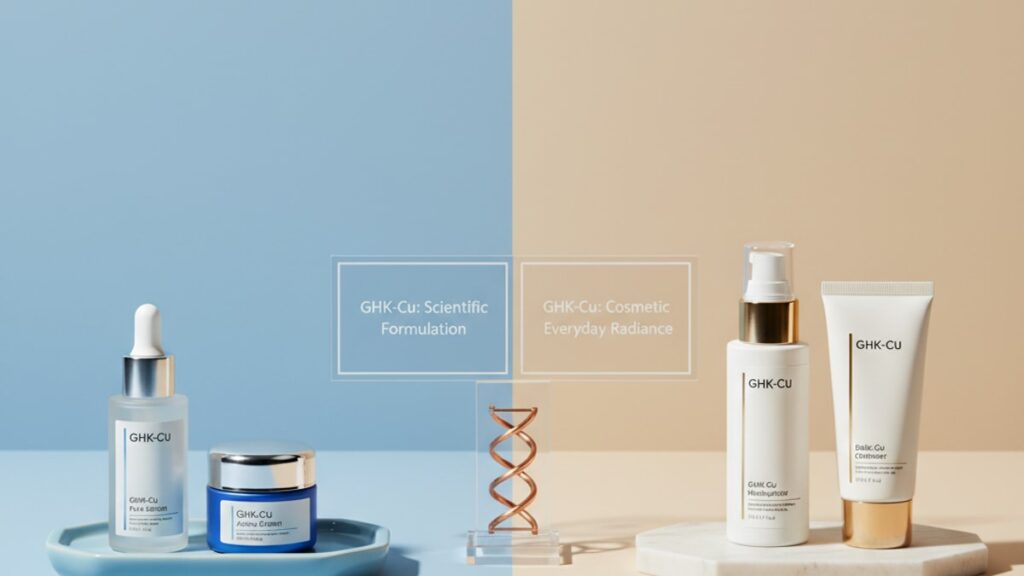
In the burgeoning landscape of peptide research, discerning between compounds can feel like navigating a labyrinth, frankly. You're constantly bombarded with new discoveries, nuanced applications, and subtly different product labels. It's enough to make anyone's head spin, especially when you're striving for impeccable precision in your studies. One such area where clarity is absolutely essential revolves around a peptide we've all come to know for its remarkable potential: GHK-Cu. But here's the kicker: not all GHK-Cu is created equal, and understanding the core differences is critical for any serious researcher in 2026. We're talking specifically about the distinction in GHK-Cu vs GHK-Cu Cosmetic.
Our team at Real Peptides has been at the forefront of peptide synthesis and supply for years, and we've witnessed firsthand the confusion that can arise when researchers aren't fully informed about the specific grades and intended uses of these powerful molecules. This isn't just a matter of semantics; it's a fundamental difference that directly impacts experimental outcomes, safety protocols, and the very integrity of your scientific endeavors. Let's be honest, getting this wrong can derail months of work, costing valuable time and resources. So, what exactly separates GHK-Cu vs GHK-Cu Cosmetic? We're going to break it down, providing an unflinching look at the scientific realities.
Unraveling the Core Identity: What Exactly is GHK-Cu?
Before we dive into the specific differences, let's establish a baseline. GHK-Cu, or Glycyl-L-Histidyl-L-Lysine Copper(II), is a naturally occurring copper complex that’s been extensively studied for its multifaceted biological activities. It's a small, tripeptide molecule that binds strongly to copper ions, forming a complex that plays a significant role in various physiological processes. From tissue regeneration and wound healing to anti-inflammatory responses and antioxidant protection, its potential is genuinely vast. Researchers across diverse fields, from Hair & Skin Research to Longevity Research, are exploring its applications. The scientific community has been captivated by GHK-Cu's ability to modulate gene expression, stimulate collagen and elastin production, and even improve nerve regeneration. It’s a remarkable compound, really.
But this broad utility is precisely where the critical distinction arises in GHK-Cu vs GHK-Cu Cosmetic. The market, both research and commercial, has seen a proliferation of GHK-Cu products. This isn't inherently bad, but it does demand a sharper, more discerning eye from those of us committed to rigorous scientific exploration. Our experience shows that while the underlying peptide sequence is the same, the context and quality parameters surrounding the product vary dramatically. It's not just a fancy label; it's about what’s actually in the vial and what it’s suitable for.
Purity and Formulation: The Demarcation Line for GHK-Cu vs GHK-Cu Cosmetic
When you're conducting research, purity isn't just a preference; it's a non-negotiable requirement. Contaminants, even in trace amounts, can introduce confounding variables that invalidate your results. This is where the primary, often dramatic, distinction between GHK-Cu vs GHK-Cu Cosmetic truly becomes apparent. Think of it this way: you wouldn't use industrial-grade chemicals for a delicate biological assay, would you? The principle holds true here.
Research-Grade GHK-Cu: When we talk about research-grade GHK-Cu, like our own Ghk-cu Copper Peptide, we're referring to a product synthesized under stringent laboratory conditions with an unwavering focus on minimizing impurities. Our team at Real Peptides takes immense pride in our small-batch synthesis and exact amino-acid sequencing, ensuring high-purity, consistent, and lab-reliable peptides. We're talking about purities often exceeding 98%, verified by comprehensive analytical testing, including HPLC and Mass Spectrometry. This meticulous process ensures that what you're studying is indeed GHK-Cu, free from extraneous substances that could skew your data or introduce unexpected biological effects. It's comprehensive. This level of purity is absolutely vital for in vitro and in vivo studies where experimental integrity is paramount. You need to know that any observed effects are attributable to the peptide itself, not some co-contaminant.
Cosmetic-Grade GHK-Cu: Now, let's consider Ghk-cu Cosmetic. This grade is typically produced for topical applications in skincare products. While it still contains the GHK-Cu peptide, the purity specifications are generally less rigorous than those for research-grade compounds. Cosmetic formulations often allow for a higher percentage of impurities, excipients, or stabilizing agents that are acceptable for external, non-invasive use but would be wholly inappropriate for scientific research. These additional components, while benign in a cosmetic cream, could interact with biological systems in unpredictable ways when introduced into a research setting. Honestly, though, this is a critical point often overlooked. We've seen this happen, where researchers inadvertently use cosmetic-grade material and then struggle to replicate results or interpret unexpected findings. It's a common pitfall.
Here's what we've learned: success depends on starting with the right tools. While other solutions might cut corners, our commitment is to provide the purest forms available. Our collective expertise dictates that for robust, publishable research, there's simply no substitute for verified, high-purity GHK-Cu. We can't stress this enough when discussing GHK-Cu vs GHK-Cu Cosmetic.
Intended Use and Application: A Fork in the Road
The intended application is another significant differentiator that helps clarify the GHK-Cu vs GHK-Cu Cosmetic debate. It's not just about what the molecule is, but what it's for.
Research Applications: Research-grade GHK-Cu is designed for precisely what its name implies: scientific research. This includes a vast array of studies such as investigating cellular mechanisms, exploring therapeutic potentials, drug discovery, or understanding complex biological pathways. Researchers might utilize it in cell culture experiments to observe effects on fibroblast proliferation, collagen synthesis, or antioxidant enzyme activity. They might also employ it in animal models to study wound healing rates, hair growth stimulation, or anti-aging effects at a systemic level. The data generated from these studies aims to contribute to the broader scientific knowledge base, potentially leading to new treatments or medical advancements. For these rigorous applications, the consistency and purity we guarantee through our small-batch synthesis are absolutely vital. We encourage all researchers to explore our full range of high-purity research peptides, ensuring they have the right compound for their specific investigative needs.
Cosmetic Applications: Cosmetic-grade GHK-Cu, conversely, is formulated for inclusion in skincare products like serums, creams, and lotions. Its purpose here is to leverage GHK-Cu's known benefits for skin health – reducing fine lines, improving elasticity, evening skin tone, and promoting a youthful appearance. These products are intended for topical application on human skin, without any expectation of systemic absorption or interaction with internal biological systems beyond the dermal layer. The focus is on aesthetic improvement and consumer safety for external use. While the cosmetic industry certainly benefits from GHK-Cu's properties, the testing and regulatory frameworks for cosmetic ingredients differ substantially from those for research compounds or pharmaceuticals. This is a key distinction in the GHK-Cu vs GHK-Cu Cosmetic discussion.
It's important to recognize that the goals of these two applications are fundamentally different. One seeks to expand knowledge and develop novel interventions; the other aims to enhance appearance. This disparity in objectives inherently demands different standards for the raw materials involved. Our team understands these nuances intimately, having supported researchers in both discovery and application for years. We're committed to ensuring you Find the Right Peptide Tools for Your Lab.
The Real Peptides Standard: Why Quality Matters for GHK-Cu vs GHK-Cu Cosmetic
At Real Peptides, our foundational principle is an unwavering commitment to quality and scientific integrity. We understand the grueling road warrior hustle researchers face, the demanding schedules and high expectations. That's why we don't compromise. When you're assessing GHK-Cu vs GHK-Cu Cosmetic, our philosophy is clear: research demands the highest standard. Our Ghk-cu Copper Peptide is produced with the precision and purity that cutting-edge biological research demands. We're not just selling peptides; we're supplying the building blocks for discovery, and that requires a level of trust and consistency that few can match.
We provide detailed Certificates of Analysis (CoA) for all our research compounds, offering transparent verification of purity and identity. This isn't merely a formality; it's a critical component of good research practice. Knowing the exact composition and purity of your GHK-Cu sample eliminates a huge variable from your experiments. While other providers in the broader market might offer a range of grades without clear distinctions, we prioritize clarity and scientific utility. Our rigorous quality control processes, from raw material sourcing to final product testing, are designed to give you peace of mind and, more importantly, accurate, reproducible results. We mean this sincerely: it runs on genuine connections to science.
A Quick Comparison: GHK-Cu vs GHK-Cu Cosmetic
Let's put this into a straightforward comparison. This table summarizes the critical differences, helping you make an informed decision when evaluating GHK-Cu vs GHK-Cu Cosmetic for your specific needs.
| Feature | Research-Grade GHK-Cu (e.g., Real Peptides) | Cosmetic-Grade GHK-Cu (e.g., GHK-Cu Cosmetic) |
|---|---|---|
| Purity | High (typically >98%), verified by HPLC/MS | Lower (often 90-95%), less rigorous testing |
| Formulation | Pure, minimal excipients, lyophilized powder | Often blended with carriers, stabilizers, liquids |
| Intended Use | In vitro & in vivo scientific research | Topical application in skincare products |
| Testing | Comprehensive analytical validation | Generally less stringent, focused on topical safety |
| Cost | Typically higher due to purity & rigor | Generally lower due to production scale & purity tolerance |
| Regulatory | Governed by research standards/guidelines | Governed by cosmetic industry regulations |
| Risk of Data Skew | Very low, controlled variables | Higher, potential for confounding factors |
This table succinctly highlights why the distinction in GHK-Cu vs GHK-Cu Cosmetic is so vital for maintaining the integrity of your studies. It's simple, right? The context completely changes the requirements.
Navigating the Market in 2026: Making Informed Choices
The peptide market in 2026 is robust, offering a plethora of options. It's becoming increasingly challenging to sift through the noise and identify reliable suppliers. Our team at Real Peptides believes in empowering researchers with knowledge. When you're looking for GHK-Cu for your studies, always ask these crucial questions:
- What's the stated purity, and how is it verified? Demand a Certificate of Analysis. We provide ours readily, ensuring transparency.
- What's the intended use of the product? Is it explicitly labeled for research, or is it a cosmetic ingredient?
- What are the storage and handling recommendations? Research-grade peptides often have specific requirements to maintain stability and purity.
- How is the company's quality control implemented? Look for details about synthesis processes, testing protocols, and commitment to consistency. Our small-batch synthesis with exact amino-acid sequencing is a testament to this commitment.
These questions are your armor against ambiguity when you're comparing GHK-Cu vs GHK-Cu Cosmetic. We're dedicated to helping you make the best choices for your invaluable work. We recommend that you Discover Premium Peptides for Research by browsing our extensive catalog. Whether you're investigating a Fat Loss Stack or exploring Energy, Mitochondria & Fatigue Elimination Bundle, our standards remain consistently high.
We understand that research is an investment – an investment of intellect, time, and resources. You deserve to work with materials that match your dedication. That's why we're so passionate about the quality of our offerings, whether it's BPC-157 10mg for regenerative studies or Thymosin Alpha 1 for immune modulation. The difference between GHK-Cu vs GHK-Cu Cosmetic, in a research context, isn't just a minor detail; it's a foundational element of sound scientific practice. Our integrity is reflected in every product we offer. So, when you're embarking on your next groundbreaking study, remember the profound impact that starting with the right, high-purity compound can have. We're here to support your success, every step of the way. It's our privilege to be your partner in discovery.
Frequently Asked Questions
What is the primary difference in purity between GHK-Cu and GHK-Cu Cosmetic?
▼
The core distinction lies in purity levels. Research-grade GHK-Cu, like what we offer, boasts purities typically exceeding 98%, rigorously verified through advanced analytical methods. Cosmetic-grade GHK-Cu generally has lower purity specifications, often acceptable for topical applications but unsuitable for precise scientific studies.
Can I use GHK-Cu Cosmetic for scientific research studies?
▼
We strongly advise against using GHK-Cu Cosmetic for scientific research. Its lower purity and potential inclusion of unlisted excipients can introduce confounding variables, compromising the integrity and reproducibility of your experimental results. Always opt for research-grade GHK-Cu for any scientific investigation.
How does Real Peptides ensure the quality of its GHK-Cu products?
▼
At Real Peptides, our GHK-Cu Copper Peptide is produced through small-batch synthesis with exact amino-acid sequencing, ensuring high purity and consistency. We provide transparent Certificates of Analysis (CoA) for all our research compounds, detailing purity verified by HPLC and Mass Spectrometry, so you know exactly what you’re getting.
Are there different regulatory standards for GHK-Cu vs GHK-Cu Cosmetic?
▼
Absolutely. Research-grade GHK-Cu is produced under stringent laboratory standards relevant to scientific compounds, with a focus on purity for experimental use. GHK-Cu Cosmetic, on the other hand, adheres to regulatory frameworks applicable to cosmetic ingredients, prioritizing topical safety and aesthetic outcomes rather than experimental precision.
What are the typical applications for research-grade GHK-Cu?
▼
Research-grade GHK-Cu is extensively used in various scientific investigations. These include studies on tissue regeneration, wound healing, anti-inflammatory mechanisms, antioxidant effects, collagen and elastin synthesis, and neurological health, both in vitro and in vivo. It’s a versatile compound for discovery.
Why is the distinction between GHK-Cu vs GHK-Cu Cosmetic so important for researchers?
▼
The distinction is paramount because using the wrong grade can lead to inaccurate data, non-reproducible results, and wasted resources. Research demands meticulously controlled variables, and only high-purity, research-grade GHK-Cu provides that reliability. The difference impacts the very foundation of your scientific findings.
Does GHK-Cu Cosmetic contain different active ingredients?
▼
While both contain the GHK-Cu peptide, cosmetic grades might incorporate additional carriers, stabilizers, or inactive ingredients that are not disclosed or relevant for research purposes. These can interfere with sensitive biological assays. Research-grade GHK-Cu is kept as pure as possible to isolate the peptide’s effects.
What analytical tests should accompany research-grade GHK-Cu?
▼
Reputable suppliers of research-grade GHK-Cu should always provide data from High-Performance Liquid Chromatography (HPLC) and Mass Spectrometry (MS). These tests confirm the peptide’s purity, identity, and molecular weight, ensuring its suitability for rigorous scientific study. We make these available for our products.
How can I be sure I’m purchasing genuine research-grade GHK-Cu?
▼
To ensure you’re getting genuine research-grade GHK-Cu, always purchase from established suppliers like Real Peptides who specialize in high-purity compounds. Look for companies that provide comprehensive Certificates of Analysis, transparent quality control processes, and a clear focus on scientific applications, not just cosmetic claims.
Are the costs different for GHK-Cu vs GHK-Cu Cosmetic, and why?
▼
Yes, there’s typically a cost difference. Research-grade GHK-Cu is often more expensive due to the rigorous synthesis processes, higher purity standards, and extensive analytical testing required. Cosmetic-grade GHK-Cu might be produced at a larger scale with less stringent purity requirements, leading to a lower per-unit cost.
What are the potential risks of using cosmetic-grade GHK-Cu in research?
▼
The risks include skewed experimental data, difficulty replicating studies, and potential toxicity or unexpected biological interactions from impurities or unlisted excipients. It could lead to misinterpretations of results and invalid conclusions, ultimately undermining your research efforts.
Do storage requirements differ for GHK-Cu vs GHK-Cu Cosmetic?
▼
Yes, often they do. Research-grade GHK-Cu, typically supplied as a lyophilized powder, often requires specific cool, dry storage conditions to maintain its high purity and stability over time. Cosmetic formulations, being pre-mixed liquids or creams, might have different, often less stringent, storage recommendations for shelf-life.
Can I find information on GHK-Cu’s gene-modulating effects in cosmetic product descriptions?
▼
While GHK-Cu has been studied for its ability to modulate gene expression in scientific literature, you won’t typically find this detailed scientific information in cosmetic product descriptions. Cosmetic claims focus on visible skin benefits, while research-grade applications delve into the underlying molecular mechanisms and pathways.
Where can I learn more about Real Peptides’ commitment to quality for research compounds?
▼
You can learn more about our unwavering commitment to quality by visiting our website at [www.realpeptides.co](https://www.realpeptides.co). We detail our small-batch synthesis, exact amino-acid sequencing, and rigorous quality control processes there. You’ll find transparent information to confidently choose your research materials.











