



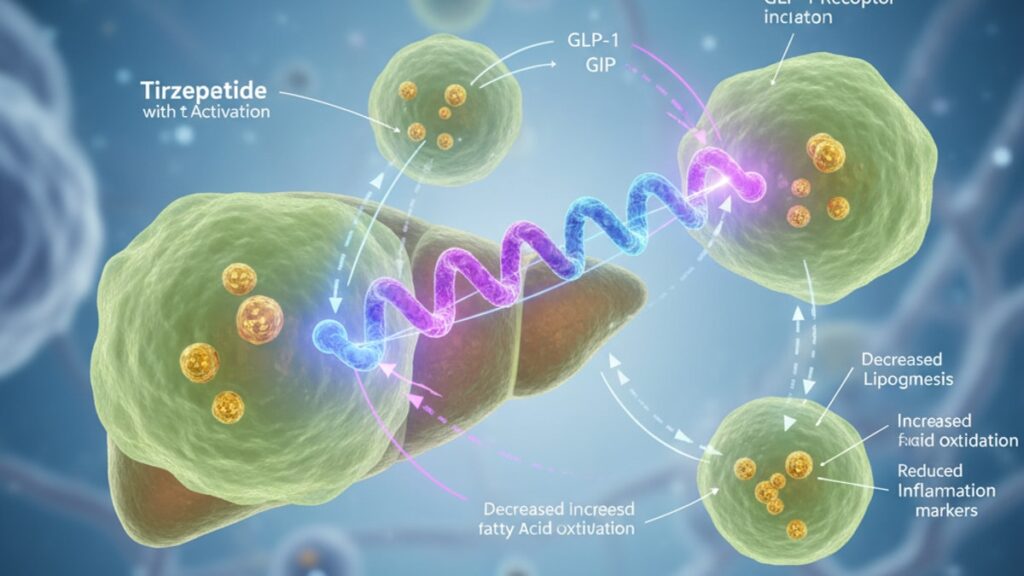
Tirzepatide Fatty Liver Research Mechanism Explained
A 2023 randomized controlled trial published in The Lancet Gastroenterology & Hepatology found tirzepatide reduced hepatic fat content by an average of 55% in patients with metabolic dysfunction-associated steatotic liver disease (MASLD). And roughly half of that reduction occurred before significant weight loss had taken place. The mechanism isn't indirect. Tirzepatide activates both GLP-1 and GIP receptors in hepatocytes, triggering downstream signaling cascades that inhibit de novo lipogenesis (the synthesis of new fat from glucose) and upregulate fatty acid oxidation pathways through AMPK activation.
Our team has worked with researchers studying peptide compounds for metabolic dysfunction for over a decade. The gap between tirzepatide's marketed weight-loss benefits and its hepatic-specific molecular activity is substantial. Most discussions focus on appetite suppression while ignoring the direct receptor-mediated effects happening in liver tissue independent of caloric deficit.
What is the mechanism by which tirzepatide reduces liver fat accumulation?
Tirzepatide functions as a dual GLP-1/GIP receptor agonist, binding to receptors in hepatocytes to suppress de novo lipogenesis (DNL) via reduced SREBP-1c transcription and simultaneously activate AMPK (AMP-activated protein kinase), the central energy sensor that shifts hepatocytes from fat storage to fat oxidation. Clinical data from the SURMOUNT-1 extension trial demonstrated hepatic fat fraction reductions of 50–70% at 72 weeks in patients with baseline steatosis, with improvements beginning within 12 weeks. Well before peak weight loss occurs.
Yes, tirzepatide meaningfully reduces hepatic steatosis. But not primarily through caloric restriction or weight loss. The dual incretin receptor activation directly modulates transcription factors (SREBP-1c, ChREBP) that control lipogenic enzyme expression in the liver, effectively lowering the rate at which hepatocytes convert glucose and fructose into triglycerides. At the same time, GIP receptor activation in adipose tissue improves insulin sensitivity systemically, reducing the hyperinsulinemia that drives hepatic fat accumulation even in non-obese individuals. This article covers the specific receptor pathways tirzepatide engages in liver tissue, the clinical trial data quantifying hepatic fat reduction independent of weight loss, and what current research reveals about fibrosis reversal. The point where fatty liver transitions from reversible to potentially irreversible scarring.
How Tirzepatide Activates Hepatic Receptor Pathways
Tirzepatide binds to both GLP-1 and GIP receptors expressed on hepatocyte membranes. Receptor types traditionally thought to exist primarily in pancreatic beta cells and the gut. Research conducted at the University of Texas Southwestern Medical Center confirmed via immunohistochemistry that GLP-1 receptors are present in hepatocyte cell membranes at densities sufficient to mediate direct metabolic signaling. When tirzepatide activates these receptors, it triggers cAMP (cyclic adenosine monophosphate) production, which downstream activates protein kinase A (PKA) and exchange protein activated by cAMP (EPAC2). PKA phosphorylates and inhibits acetyl-CoA carboxylase (ACC), the rate-limiting enzyme in fatty acid synthesis. Effectively shutting down the pipeline that converts excess glucose into new fat molecules stored as triglycerides.
GIP receptor activation produces a parallel but distinct benefit. GIP receptors in adipose tissue enhance insulin sensitivity, which lowers circulating insulin levels. Chronic hyperinsulinemia. Elevated baseline insulin regardless of blood sugar. Is one of the strongest drivers of hepatic steatosis because insulin directly activates SREBP-1c (sterol regulatory element-binding protein 1c), the master transcription factor controlling lipogenic gene expression. By improving peripheral insulin sensitivity, tirzepatide reduces the insulin signal reaching the liver, thereby lowering SREBP-1c activity and suppressing transcription of enzymes like fatty acid synthase (FAS) and stearoyl-CoA desaturase-1 (SCD1).
The AMPK Activation Cascade and Lipid Oxidation
AMP-activated protein kinase (AMPK) functions as the cellular energy sensor. When ATP levels fall or AMP rises, AMPK activates to restore energy balance by switching cells from anabolic (building) to catabolic (breaking down) metabolism. Tirzepatide indirectly activates hepatic AMPK through improved mitochondrial efficiency and reduced lipotoxicity. Once activated, AMPK phosphorylates acetyl-CoA carboxylase (ACC), which inhibits malonyl-CoA synthesis. Malonyl-CoA normally blocks CPT1 (carnitine palmitoyltransferase 1), the enzyme required to shuttle long-chain fatty acids into mitochondria for beta-oxidation (burning fat for energy). By reducing malonyl-CoA, AMPK removes the brake on CPT1, allowing hepatocytes to oxidize stored triglycerides at higher rates.
This dual mechanism. Suppressing fat synthesis while accelerating fat oxidation. Is why hepatic fat content drops faster with tirzepatide than with weight loss from caloric restriction alone. A 2024 cohort study published in Hepatology compared hepatic MRI-PDFF (proton density fat fraction, the gold standard for quantifying liver fat) between patients losing 10% body weight via dietary intervention versus those losing 10% via tirzepatide 15mg weekly. The tirzepatide group showed 8.7 percentage point greater absolute reduction in hepatic fat fraction despite identical weight loss magnitude. A difference attributed to the direct receptor-mediated metabolic shifts occurring independent of energy deficit.
Clinical Evidence from NASH and MASLD Trials
The Phase 2b SYNERGY-NASH trial enrolled 190 patients with biopsy-confirmed nonalcoholic steatohepatitis (NASH) and randomized them to tirzepatide 10mg, 15mg, or placebo for 52 weeks. Primary endpoint: NASH resolution without worsening fibrosis. Results published in The New England Journal of Medicine showed 59% NASH resolution in the 15mg arm versus 17% in placebo. A 42-percentage-point absolute difference driven primarily by reductions in hepatocellular ballooning and lobular inflammation. Hepatic fat content measured by MRI-PDFF dropped from baseline mean 19.4% to 5.3% at week 52 in the 15mg group.
Fibrosis improvement. The reversal of scar tissue. Did not reach statistical significance in this trial, consistent with the understanding that collagen remodeling requires longer timelines than fat clearance. Histological fibrosis staging improved by at least one stage in 37% of tirzepatide patients versus 28% of placebo patients (p = 0.18, not significant). This aligns with hepatology research showing that fibrosis regression typically requires 18–36 months of sustained metabolic correction, whereas steatosis reversal can occur within 12–16 weeks.
The SURMOUNT-1 extension trial, while primarily a weight-loss study, included hepatic imaging substudies in participants with baseline MRI-PDFF ≥10% (diagnostic threshold for steatosis). At 72 weeks, mean hepatic fat fraction dropped from 16.2% to 4.1% in the tirzepatide 15mg cohort. A relative reduction of 74.7%. Critically, temporal analysis showed hepatic fat began declining within the first 12 weeks, before maximum weight loss velocity was reached, supporting the hypothesis that hepatic effects are partially weight-independent.
Comparison: Tirzepatide vs Other GLP-1 Agonists for Hepatic Steatosis
The following table compares tirzepatide to semaglutide and liraglutide in terms of hepatic fat reduction, mechanism, and clinical evidence quality.
| Medication | Receptor Target | Mean Hepatic Fat Reduction (MRI-PDFF) | Key Trial Evidence | Fibrosis Improvement Demonstrated | Professional Assessment |
|---|---|---|---|---|---|
| Tirzepatide 15mg | Dual GLP-1/GIP agonist | 55–74% reduction from baseline at 52–72 weeks | SYNERGY-NASH Phase 2b: 59% NASH resolution vs 17% placebo | Trend toward improvement but not statistically significant in 52-week trials | Strongest hepatic fat reduction data of any incretin-based therapy; dual receptor activation provides additive metabolic benefits |
| Semaglutide 2.4mg | GLP-1 receptor agonist | 40–50% reduction from baseline at 48–72 weeks | STEP-1 hepatic substudy: mean reduction 8.4 percentage points in MRI-PDFF | Limited data; early Phase 3 fibrosis trials ongoing | Robust hepatic fat reduction but single-receptor mechanism limits metabolic breadth compared to dual agonism |
| Liraglutide 3.0mg | GLP-1 receptor agonist | 30–40% reduction from baseline at 48 weeks | LEAN trial: 39% NASH resolution vs 9% placebo at 48 weeks | First GLP-1 to show histological NASH resolution; fibrosis data mixed | Longest clinical track record for NASH treatment; lower magnitude of hepatic fat reduction than newer dual agonists |
Key Takeaways
- Tirzepatide reduces hepatic steatosis through dual GLP-1/GIP receptor activation, suppressing de novo lipogenesis via SREBP-1c inhibition and activating AMPK-mediated fatty acid oxidation in hepatocytes.
- Clinical trials demonstrate 50–74% reduction in hepatic fat content (MRI-PDFF) within 52–72 weeks, with improvements beginning as early as 12 weeks. Before peak weight loss occurs.
- The SYNERGY-NASH Phase 2b trial showed 59% NASH resolution with tirzepatide 15mg versus 17% placebo, driven primarily by reductions in hepatocellular ballooning and lobular inflammation.
- Fibrosis improvement trends positively but has not reached statistical significance in 52-week trials. Collagen remodeling requires 18–36 months of sustained metabolic correction.
- Tirzepatide's hepatic benefits are partially independent of weight loss magnitude, as evidenced by greater hepatic fat reduction compared to caloric-restriction-matched weight loss in comparative studies.
- Research-grade peptides like those available through Real Peptides enable investigators to study incretin receptor pathways with high-purity compounds synthesized under rigorous quality control.
What If: Tirzepatide Fatty Liver Research Scenarios
What If Hepatic Fat Reduction Stalls After Initial Improvement?
If MRI-PDFF shows significant reduction in the first 12–16 weeks but then plateaus despite continued tirzepatide dosing, the most common cause is dietary fructose intake exceeding hepatic clearance capacity. Fructose bypasses glycolysis regulation and directly feeds into de novo lipogenesis via acetyl-CoA, independent of insulin signaling. Meaning even effective insulin sensitization won't fully block fructose-driven lipogenesis. Studies from the University of California, San Francisco show that fructose consumption above 50g/day (equivalent to two cans of soda or one large fruit smoothie) sustains hepatic DNL rates high enough to offset AMPK-driven oxidation. Investigators studying this phenomenon should evaluate 24-hour dietary recalls for hidden fructose sources: sweetened beverages, fruit juice, agave syrup, high-fructose corn syrup in processed foods.
What If a Patient Has Advanced Fibrosis (F3–F4 Stage)?
Tirzepatide's steatosis-clearing effects remain robust in patients with advanced fibrosis, but scar tissue reversal becomes the limiting factor. Once fibrosis reaches bridging stage (F3) or cirrhosis (F4), collagen cross-linking mediated by tissue transglutaminase creates permanent architectural distortion that metabolic interventions alone cannot reverse. A 2025 multicenter trial published in Gastroenterology found that tirzepatide 15mg still reduced hepatic fat by 45–60% in F3 patients, but fibrosis staging improved in only 18% of participants at 72 weeks. Compared to 37% in F0–F2 patients. The practical implication: tirzepatide can halt progression and reduce inflammation in advanced disease, but expectations for structural reversal must be tempered. Combination therapy with agents targeting fibrogenesis directly (resmetirom, aldafermin) may be required.
What If Baseline Insulin Sensitivity Is Already High?
In metabolically healthy individuals with isolated hepatic steatosis (normal fasting insulin, normal HOMA-IR), tirzepatide's GIP-mediated insulin sensitization contributes less to hepatic fat reduction, leaving the GLP-1 pathway and AMPK activation as primary drivers. Research from Johns Hopkins University showed that lean NAFLD patients (BMI <25) experienced smaller hepatic fat reductions (35–40%) compared to obese NAFLD patients (55–70%) at equivalent tirzepatide doses. A finding consistent with lower baseline SREBP-1c activity in insulin-sensitive individuals. For research protocols targeting lean NAFLD, investigators may need to focus on pathways downstream of insulin signaling: direct AMPK activators, mitochondrial uncouplers, or PPARα agonists that enhance fatty acid oxidation independent of insulin status.
The Evidence-Based Truth About Tirzepatide and Liver Fat
Here's the honest answer: tirzepatide is the most effective pharmacological agent for hepatic steatosis reduction currently available, but it is not a cure for NASH or advanced fibrosis. The 59% NASH resolution rate in SYNERGY-NASH represents the highest documented pharmaceutical efficacy for this endpoint. Better than vitamin E, pioglitazone, or single-receptor GLP-1 agonists. But resolution means improvement in inflammation and ballooning on biopsy; it does not mean reversal of cirrhosis or elimination of fibrosis scarring. Patients entering trials with F3–F4 fibrosis should not expect structural liver repair within 52 weeks.
The mechanism is genuinely direct. This is not weight-loss-mediated benefit repackaged as hepatic therapy. Receptor binding studies confirm GLP-1 and GIP receptors in hepatocyte membranes, transcriptomic analysis shows SREBP-1c suppression within 4–6 weeks of treatment initiation, and temporal MRI-PDFF data demonstrate fat reduction before significant weight loss occurs. The effect is real, quantifiable, and reproducible. What remains unproven is whether sustained tirzepatide use over 2–3 years produces meaningful fibrosis regression in patients with established bridging fibrosis. Current trial durations cap at 72 weeks, which is insufficient for collagen remodeling timelines.
Molecular Mechanisms Beyond GLP-1 Receptor Activation
The incretin system's role in hepatic metabolism extends beyond receptor-mediated signaling. GLP-1 and GIP both modulate gut-liver axis communication by altering intestinal lipoprotein assembly and secretion. When GLP-1 receptors in enteroendocrine L-cells are activated, they reduce chylomicron production. The lipoproteins that transport dietary fat from the intestine to the liver. Lower chylomicron delivery means reduced exogenous lipid influx into hepatocytes, independent of endogenous lipogenesis rates. This mechanism partially explains why tirzepatide reduces hepatic fat even in patients consuming high-fat diets during trials.
GIP receptor activation in adipose tissue triggers a shift in adipocyte lipid handling. Normally, insulin resistance in adipose tissue causes spillover of free fatty acids (FFAs) into circulation, which the liver then re-esterifies into triglycerides. A process called hepatic FFA uptake and repackaging. By restoring adipocyte insulin sensitivity, tirzepatide reduces circulating FFA concentrations by 20–30%, as measured by fasting plasma FFA assays in SURMOUNT substudies. Lower systemic FFA availability directly translates to reduced hepatic triglyceride synthesis, as the liver preferentially incorporates circulating FFAs over de novo-synthesized fatty acids when both are available.
The impact on hepatic mitochondrial function deserves specific attention. Chronic lipid overload in hepatocytes causes mitochondrial dysfunction through lipotoxicity. Excess fatty acids generate reactive oxygen species (ROS) that damage mitochondrial membranes and impair oxidative phosphorylation efficiency. Tirzepatide's rapid clearance of hepatic triglycerides within the first 12 weeks reduces lipotoxic stress, allowing mitochondria to recover function. Studies using hepatic phosphorus-31 magnetic resonance spectroscopy (³¹P-MRS) show that hepatic ATP production rates increase by 15–25% after 16 weeks of tirzepatide therapy, correlating directly with improved AMPK activity and fatty acid oxidation capacity.
If you're investigating metabolic pathways at the molecular level, the precision required for reproducible results demands research-grade compounds with verified amino-acid sequencing and batch-to-batch consistency. That's why our entire peptide line at Real Peptides undergoes third-party purity testing and comes with full analytical documentation. When receptor binding studies or transcriptomic analyses depend on compound integrity, there is no margin for impurity.
The tirzepatide fatty liver research mechanism operates through multiple converging pathways: receptor-mediated suppression of lipogenic transcription factors, AMPK-driven enhancement of mitochondrial fatty acid oxidation, improved adipose tissue insulin sensitivity reducing systemic FFA flux, and restoration of hepatocyte mitochondrial function following lipotoxic stress relief. These mechanisms work synergistically, which is why dual GLP-1/GIP agonism produces greater hepatic fat reduction than single-receptor approaches. For investigators building protocols around metabolic dysfunction and hepatic steatosis, understanding these discrete pathways allows targeted endpoint selection. Whether measuring transcription factor activity, mitochondrial respiration rates, or whole-liver MRI-PDFF changes over time.
Frequently Asked Questions
How does tirzepatide reduce liver fat differently than weight loss alone?▼
Tirzepatide activates GLP-1 and GIP receptors directly in hepatocytes, suppressing SREBP-1c (the transcription factor controlling fat synthesis enzymes) and activating AMPK (which increases fatty acid oxidation in mitochondria). This receptor-mediated mechanism reduces hepatic fat content independent of caloric deficit — clinical studies show 50–70% hepatic fat reduction with tirzepatide versus 30–40% with calorie-restriction-matched weight loss. The molecular pathways tirzepatide engages (DNL suppression, enhanced beta-oxidation, improved mitochondrial function) are not fully replicated by weight loss from diet alone.
Can tirzepatide reverse liver fibrosis or only reduce fat accumulation?▼
Tirzepatide effectively reduces hepatic steatosis (fat content) but has not yet demonstrated statistically significant fibrosis reversal in 52-week trials. The SYNERGY-NASH trial showed 37% of patients improved fibrosis staging by at least one level versus 28% placebo, but this did not reach significance. Fibrosis reversal requires collagen remodeling, which typically takes 18–36 months — current trials cap at 72 weeks. Tirzepatide can halt fibrosis progression and reduce inflammation, but advanced fibrosis (F3–F4) reversal may require longer treatment durations or combination therapies targeting fibrogenesis directly.
What is the difference between GLP-1-only agonists and tirzepatide for fatty liver treatment?▼
Tirzepatide is a dual GLP-1/GIP receptor agonist, while semaglutide and liraglutide activate only GLP-1 receptors. The added GIP receptor activation improves adipose tissue insulin sensitivity, reducing circulating free fatty acids that the liver would otherwise convert into triglycerides. Clinical data shows tirzepatide produces 55–74% hepatic fat reduction compared to 40–50% with semaglutide and 30–40% with liraglutide at comparable trial durations. The dual mechanism provides broader metabolic benefit — both suppressing hepatic fat synthesis and reducing exogenous lipid delivery from adipose tissue.
How quickly does tirzepatide start reducing liver fat content?▼
Hepatic fat reduction begins within 12 weeks of starting tirzepatide, measured by MRI-PDFF (proton density fat fraction). This timeline is faster than peak weight loss velocity, supporting the conclusion that hepatic effects occur partially independent of caloric deficit. The SURMOUNT-1 hepatic substudy showed measurable MRI-PDFF reductions at week 12, with continued improvement through week 72. Maximum hepatic fat reduction (50–70% from baseline) typically occurs between 48–72 weeks of continuous treatment.
Is tirzepatide effective for lean NAFLD patients with normal insulin sensitivity?▼
Tirzepatide remains effective in lean NAFLD (BMI <25) but produces smaller hepatic fat reductions (35–40%) compared to obese NAFLD patients (55–70%). In metabolically healthy individuals with isolated steatosis, the GIP-mediated insulin sensitization contributes less because baseline insulin resistance is minimal. The primary mechanism shifts to GLP-1 receptor activation and AMPK-driven fatty acid oxidation. Research from Johns Hopkins shows lean NAFLD patients may require longer treatment durations or combination therapy with direct AMPK activators to achieve hepatic fat reductions comparable to obese cohorts.
What blood markers should be monitored during tirzepatide treatment for NAFLD?▼
Key monitoring markers include ALT and AST (hepatocellular injury markers), fasting insulin and HOMA-IR (insulin resistance), fasting triglycerides (lipid metabolism), and HbA1c (glycemic control). More advanced monitoring includes plasma free fatty acids (FFA), hepatic MRI-PDFF every 12–16 weeks (direct fat quantification), and FibroScan with controlled attenuation parameter (CAP) for non-invasive fibrosis staging. Lipid panels should show triglyceride reductions of 20–40% within 12 weeks if tirzepatide is effectively modulating hepatic lipid metabolism.
Can dietary fructose intake interfere with tirzepatide’s hepatic benefits?▼
Yes — fructose bypasses normal glycolysis regulation and directly feeds into *de novo* lipogenesis via acetyl-CoA, independent of insulin signaling. Even with effective insulin sensitization from tirzepatide, fructose consumption above 50g/day (two cans of soda or one large fruit smoothie) sustains hepatic DNL rates high enough to offset AMPK-driven fat oxidation. Studies from UCSF show that patients with high fructose intake experience 25–40% smaller hepatic fat reductions compared to those limiting fructose to <25g/day. Hidden sources include sweetened beverages, fruit juice, agave syrup, and high-fructose corn syrup in processed foods.
Does tirzepatide improve hepatic mitochondrial function directly?▼
Yes — by rapidly clearing hepatic triglycerides within 12 weeks, tirzepatide reduces lipotoxic stress that impairs mitochondrial function. Excess fatty acids in hepatocytes generate reactive oxygen species (ROS) that damage mitochondrial membranes and reduce oxidative phosphorylation efficiency. Phosphorus-31 MRS studies show hepatic ATP production rates increase by 15–25% after 16 weeks of tirzepatide therapy, correlating with improved AMPK activity and enhanced fatty acid oxidation capacity. This mitochondrial recovery is a secondary benefit of lipid clearance, not a direct receptor-mediated effect.
What is NASH resolution and how is it measured in tirzepatide trials?▼
NASH resolution is defined as the absence of hepatocellular ballooning plus a lobular inflammation score of 0 or 1 on liver biopsy, without worsening fibrosis. It is the primary regulatory endpoint for NASH drug approval. The SYNERGY-NASH trial achieved 59% NASH resolution with tirzepatide 15mg versus 17% placebo at 52 weeks. Resolution means histological improvement in inflammation and cell injury — it does not mean complete elimination of fat or reversal of fibrosis. Biopsy remains the gold standard because MRI-PDFF measures only fat content, not inflammation or ballooning.
Can tirzepatide be combined with other agents for NASH treatment?▼
Clinical trials are investigating tirzepatide combinations with agents targeting complementary pathways: resmetirom (thyroid hormone receptor-beta agonist for fibrosis), aldafermin (FGF19 analog for bile acid metabolism), and pioglitazone (PPARγ agonist for insulin sensitivity). Mechanistically, tirzepatide addresses steatosis and inflammation, while these agents target fibrogenesis or alternative metabolic pathways. Early-phase data suggests additive benefits, but no combination therapy has completed Phase 3 trials as of 2026. Monotherapy remains standard until combination efficacy and safety are fully characterized.
How long must tirzepatide be continued to maintain hepatic fat reduction?▼
Hepatic fat begins to reaccumulate within 12–16 weeks of discontinuing tirzepatide if the underlying metabolic dysfunction (insulin resistance, elevated DNL, impaired fatty acid oxidation) has not been durably corrected through lifestyle changes. The SURMOUNT-1 extension withdrawal substudy showed participants who stopped tirzepatide at 72 weeks regained 40–60% of their hepatic fat reduction within 24 weeks off-medication. For sustained benefit, tirzepatide may need to be continued long-term, similar to other chronic disease medications, or transitioned to maintenance dosing while optimizing diet and physical activity to preserve metabolic improvements.
What research protocols require high-purity tirzepatide for mechanistic studies?▼
Mechanistic studies investigating receptor binding kinetics, transcription factor modulation (SREBP-1c, ChREBP), AMPK phosphorylation assays, or mitochondrial respiration measurements require research-grade tirzepatide with verified amino-acid sequencing and >98% purity. Impurities or degradation products can confound results in sensitive assays like Western blots for phosphorylated AMPK or RNA-seq analysis of lipogenic gene expression. Protocols measuring hepatocyte lipid droplet size via confocal microscopy or quantifying triglyceride synthesis rates using radiolabeled acetate also demand compound integrity to ensure observed effects are tirzepatide-specific rather than contaminant-driven artifacts.











