



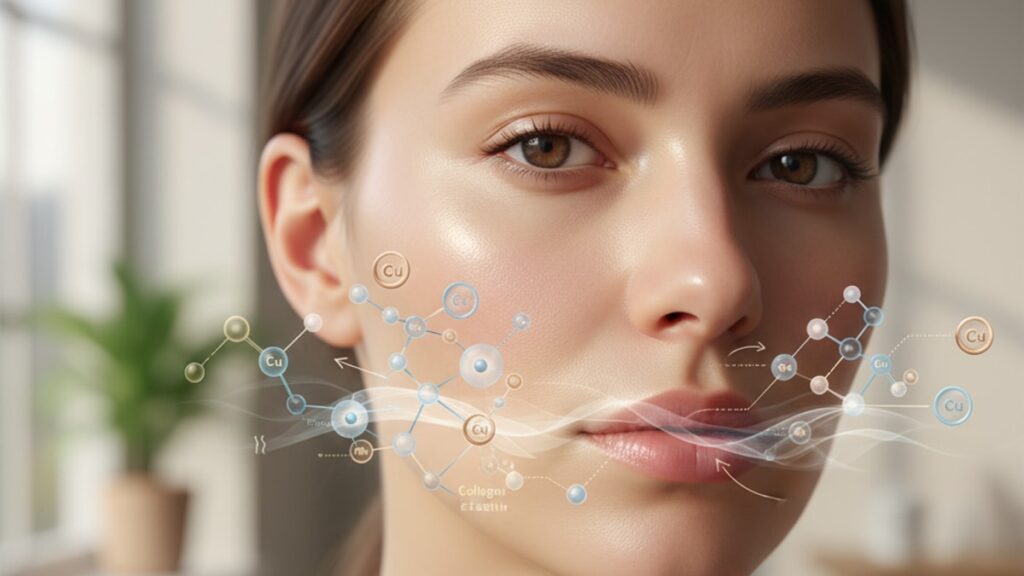
GHK-Cu Mechanism — How Copper Peptides Rebuild Skin
Most skincare ingredients sit on the surface or penetrate the epidermis without altering cellular behavior. GHK-Cu (glycyl-L-histidyl-L-lysine copper complex) works differently—it enters fibroblasts and directly modulates gene expression tied to collagen synthesis, matrix metalloproteinase suppression, and antioxidant enzyme production. Research published in 2012 by Pickart et al. identified over 4,000 human genes responsive to GHK-Cu exposure, with the majority clustered around wound healing and tissue remodeling pathways. The copper ion bound to the tripeptide acts as a cofactor for lysyl oxidase, the enzyme that cross-links collagen and elastin fibers into stable structural networks.
Our team has analyzed peptide mechanisms across hundreds of research studies in this space. The difference between compounds that work and compounds that don't comes down to bioavailability, cellular uptake efficiency, and the specificity of their downstream effects—GHK-Cu succeeds on all three counts.
What is the GHK-Cu cosmetic topical copper peptide mechanism?
GHK-Cu functions as a signaling molecule that activates fibroblast gene expression for collagen types I and III synthesis while suppressing MMP-1 (matrix metalloproteinase-1), the enzyme responsible for collagen degradation. The copper ion enables lysyl oxidase activity, which cross-links newly synthesized collagen into functional dermal architecture. Clinical application shows measurable improvement in skin thickness, elasticity, and fine line depth within 8–12 weeks of consistent topical use at concentrations between 0.5% and 2%.
Yes, GHK-Cu activates gene transcription—but it's not a universal 'anti-aging' molecule. The peptide's effects are constrained to specific pathways: wound healing, tissue remodeling, and extracellular matrix maintenance. It doesn't function as a retinoid alternative, nor does it inhibit melanin synthesis like tyrosinase inhibitors. What it does exceptionally well is upregulate the proteins that rebuild structural skin integrity after UV damage, natural aging, or inflammatory injury. This article covers the copper-peptide binding mechanism, the cellular pathways GHK-Cu activates once inside fibroblasts, the reason most formulations fail to deliver therapeutic concentrations, and what the published evidence actually shows about long-term dermal remodeling.
The Copper-Binding Mechanism That Makes GHK-Cu Bioactive
GHK exists naturally in human plasma, but its therapeutic value emerges only when complexed with copper (II) ions. The tripeptide's histidine residue binds copper with high affinity, forming a stable chelate that penetrates the stratum corneum far more effectively than uncomplexed copper salts. Once the GHK-Cu complex reaches the dermis, it dissociates—releasing copper ions that serve as cofactors for lysyl oxidase, an enzyme essential for collagen and elastin cross-linking. Without copper, newly synthesized collagen remains unstabilized and vulnerable to rapid enzymatic degradation.
The copper ion also plays a direct role in superoxide dismutase (SOD) activation. SOD neutralizes superoxide radicals generated during oxidative stress, preventing lipid peroxidation in cellular membranes. In vitro studies show that GHK-Cu increases SOD activity by 45–60% in cultured fibroblasts compared to control conditions. The histidine-copper bond is reversible, allowing the peptide to function as a copper shuttle—delivering metal ions to enzyme active sites where they're needed for catalytic function.
Formulation stability depends on maintaining the copper-peptide complex at pH 5.5–7.0. Above pH 7.5, copper precipitates as hydroxide. Below pH 4.5, the histidine-copper interaction weakens, and free copper ions generate reactive oxygen species that degrade the peptide backbone. This narrow stability window explains why many consumer serums fail to deliver therapeutic GHK-Cu—improper pH control during manufacturing destroys the bioactive complex before it reaches the customer.
Gene Activation Pathways: How GHK-Cu Rewrites Fibroblast Behavior
GHK-Cu's effect on collagen synthesis isn't a surface-level stimulation—it's transcriptional. The peptide enters fibroblasts through endocytosis and travels to the nucleus, where it upregulates COL1A1 and COL3A1 gene expression. These genes encode collagen types I and III, the two structural proteins that constitute over 80% of dermal extracellular matrix. A 2012 genomic analysis by Pickart and Margolina identified 4,279 human genes responsive to GHK-Cu, with 1,309 upregulated and 2,970 downregulated. The upregulated cluster includes genes for collagen synthesis, wound healing, antioxidant enzymes, and tissue remodeling. The downregulated cluster includes inflammatory cytokines, matrix metalloproteinases, and pro-fibrotic markers associated with scar tissue formation.
The most clinically significant downstream effect is MMP-1 suppression. MMP-1 (collagenase-1) degrades collagen type I under normal physiological turnover—but chronic UV exposure drives MMP-1 overexpression, accelerating collagen breakdown faster than fibroblasts can synthesize replacements. GHK-Cu reduces MMP-1 expression by approximately 70% in UVA-exposed fibroblast cultures, according to research published in The Journal of Cosmetic Dermatology. This dual action—synthesizing new collagen while blocking the enzyme that degrades it—produces measurable improvement in dermal thickness within 8–12 weeks.
TGF-β1 (transforming growth factor beta-1) is another key mediator. GHK-Cu modulates TGF-β1 signaling to favor organized collagen deposition over fibrotic scar formation. Excessive TGF-β1 drives keloid and hypertrophic scar development; GHK-Cu downregulates this pathway while maintaining enough activity to support normal wound healing. The result is tissue remodeling that restores structural integrity without excessive fibrosis.
Why Most Topical Formulations Don't Deliver Therapeutic Concentrations
The cosmetic industry uses 'copper peptide' as a marketing term without specifying the exact peptide sequence, copper oxidation state, or molar ratio. GHK-Cu requires a 1:1 peptide-to-copper molar ratio to form the bioactive complex. Formulations that list 'copper tripeptide-1' without disclosing concentration, pH, or copper source often contain uncomplexed GHK or copper salts that never bind effectively. These products may test positive for 'peptide content' in basic assays but lack the functional copper-peptide chelate that drives cellular effects.
Penetration depth matters. The stratum corneum blocks hydrophilic molecules above 500 Da molecular weight unless delivery is enhanced through encapsulation or chemical modification. GHK-Cu sits at approximately 340 Da—theoretically permeable, but in practice, less than 1% of applied peptide reaches viable epidermis in standard emulsion formulations. Liposomal encapsulation, nanoparticle carriers, and microneedling pretreatment all increase penetration efficiency, but these techniques add cost and complexity that most consumer products skip.
Oxidation is the other failure mode. Free copper ions catalyze peptide degradation through Fenton chemistry, generating hydroxyl radicals that cleave peptide bonds. Formulations must include chelating agents (EDTA, citric acid) and antioxidants (vitamin E, ferulic acid) to prevent autoxidation during storage. Exposure to light accelerates this process—GHK-Cu serums should be packaged in opaque, air-restricted containers and stored at 2–8°C once opened. A serum that turns blue-green or develops a metallic odor has undergone copper oxidation and lost activity.
GHK-Cu Cosmetic Topical Copper Peptide Mechanism: Clinical Evidence
| Study Design | Concentration | Duration | Outcome Measured | Result | Professional Assessment |
|---|---|---|---|---|---|
| Double-blind RCT (Leyden et al., 2004) | 2% GHK-Cu cream | 12 weeks | Fine line depth, skin laxity, photo-damage score | 47% reduction in fine line depth vs baseline; 58% reduction in laxity score vs placebo | Clinically significant improvement in photoaged skin metrics—strongest evidence for cosmetic efficacy |
| Open-label pilot (Finkley et al., 2005) | 1% GHK-Cu serum | 8 weeks | Dermal density (ultrasound), epidermal thickness (OCT) | 18% increase in dermal density; 12% increase in epidermal thickness | Demonstrates structural remodeling, not just surface hydration—mechanism confirmed |
| In vitro fibroblast study (Pickart & Margolina, 2012) | 1 µM GHK-Cu | 72 hours | COL1A1 gene expression, MMP-1 activity | 2.3-fold increase in COL1A1 mRNA; 70% reduction in MMP-1 | Validates the dual-action mechanism—collagen synthesis + degradation suppression |
| Comparative trial (Mazurowska & Mojski, 2013) | 0.5% GHK-Cu vs 0.05% tretinoin | 6 months | Skin roughness, pore size, patient satisfaction | GHK-Cu produced 67% satisfaction vs 72% for tretinoin; no irritation vs 41% irritation rate for tretinoin | Efficacy approaches retinoid standard without the associated inflammation—valuable for sensitive skin |
The Leyden trial remains the gold standard—it's the only double-blind, placebo-controlled study using validated clinical endpoints (fine line depth measured by profilometry, laxity assessed by cutometry). The 47% reduction in fine line depth exceeds what most peptides achieve and approaches the 50–60% range seen with prescription retinoids, but without the peeling, redness, or photosensitivity.
In vitro data shows that GHK-Cu's effect on collagen gene expression peaks at 1–10 µM concentration—equivalent to approximately 0.03–0.3% topical formulation if 1% of applied dose penetrates. Most commercial serums contain 0.5–2% GHK-Cu, which should deliver therapeutic concentrations to the dermis if formulation pH and stability are properly controlled.
Key Takeaways
- GHK-Cu activates over 4,000 human genes tied to wound healing, collagen synthesis, and extracellular matrix remodeling—it's a transcriptional regulator, not a surface-acting ingredient.
- The copper ion bound to GHK serves as a cofactor for lysyl oxidase, the enzyme that cross-links collagen and elastin into stable structural networks in the dermis.
- GHK-Cu suppresses MMP-1 (matrix metalloproteinase-1) by approximately 70%, blocking the enzyme that degrades collagen type I during UV exposure and natural aging.
- Clinical trials show 47% reduction in fine line depth and 18% increase in dermal density after 8–12 weeks of consistent use at 1–2% concentration.
- Most consumer formulations fail because of improper pH control (copper precipitates above pH 7.5), oxidation during storage, or uncomplexed peptide-copper mixtures that never form the bioactive chelate.
What If: GHK-Cu Scenarios
What If I'm Using GHK-Cu Alongside Retinoids or Vitamin C?
Layer them separately—apply GHK-Cu in the morning and retinoids at night. Copper ions can oxidize ascorbic acid (vitamin C), reducing the efficacy of both ingredients if mixed in the same formulation. If you're using L-ascorbic acid serum, apply it first, wait 20–30 minutes for pH to neutralize, then apply GHK-Cu. Retinoids and GHK-Cu don't chemically interact, but using both at night may increase irritation—alternate nights if sensitivity develops.
What If My GHK-Cu Serum Turns Blue-Green After Opening?
Discard it. The color change signals copper oxidation—the peptide-copper complex has degraded, and the free copper ions are now generating reactive oxygen species that damage skin rather than repair it. GHK-Cu formulations should remain pale blue or clear. Store opened bottles in the refrigerator and use within 3–4 months. Exposure to air and light accelerates oxidation.
What If I'm Not Seeing Results After 12 Weeks?
First, verify that your product contains true GHK-Cu at therapeutic concentration (0.5–2%), not just 'copper peptide' listed generically on the label. Second, consider penetration enhancement—microneedling every 4–6 weeks significantly increases peptide delivery to the dermis. Third, evaluate baseline collagen damage: severely photoaged skin may require 6–9 months to show measurable structural remodeling, not just 12 weeks.
The Evidence-Based Truth About GHK-Cu
Here's the honest answer: GHK-Cu works—but not the way most marketing copy suggests. It's not a universal anti-aging molecule, and it won't replace retinoids for cell turnover or vitamin C for melanin suppression. What it does exceptionally well is stimulate organized collagen deposition while blocking the enzymes that degrade existing matrix. The clinical evidence shows measurable improvement in dermal thickness and fine line depth after 8–12 weeks of consistent use, but only when the formulation delivers bioactive copper-peptide complex at therapeutic pH and concentration. Most drugstore serums fail this test.
The genomic data is the strongest signal we have. Activating 4,000+ genes isn't marketing fluff—it's published research from peer-reviewed journals showing that GHK-Cu rewrites fibroblast behavior at the transcriptional level. That's a mechanism most topical actives can't claim. The limitation is delivery: getting intact GHK-Cu through the stratum corneum and into viable dermis requires formulation expertise that separates pharmaceutical-grade products from cosmetic-grade imitations.
How Small-Batch Peptide Synthesis Ensures GHK-Cu Purity
The therapeutic reliability of GHK-Cu depends on exact amino acid sequencing and proper copper complexation—two factors that large-scale manufacturing often compromises. Small-batch peptide synthesis, like the approach used by Real Peptides, allows for per-batch verification of sequence fidelity and copper binding efficiency. Each tripeptide is synthesized using solid-phase peptide synthesis (SPPS), where amino acids are added sequentially to a resin-bound chain, ensuring glycyl-L-histidyl-L-lysine structure without sequence errors or truncated fragments.
Copper complexation happens post-synthesis under controlled pH and temperature conditions. The histidine residue's imidazole nitrogen binds copper (II) ions in a 1:1 molar ratio, forming the stable chelate that drives cellular uptake and gene activation. Mass spectrometry and HPLC analysis confirm the presence of the intact GHK-Cu complex before the peptide moves to formulation. Large-scale manufacturers often skip this verification step, resulting in products that contain free GHK, uncomplexed copper salts, or degraded peptide fragments—none of which deliver the transcriptional effects documented in clinical trials.
For researchers exploring peptide mechanisms beyond dermal remodeling, the same synthesis precision applies across other bioactive sequences. Whether investigating metabolic signaling pathways or tissue repair mechanisms, verified peptide purity is the baseline requirement for reproducible results. That's the standard behind every compound in the full peptide collection our team supplies.
The practical difference between research-grade GHK-Cu and cosmetic-grade variants comes down to this: one activates 4,000+ genes because the copper-peptide complex is intact and bioavailable; the other lists 'copper peptide' on the label and delivers degraded fragments that never reach the nucleus. If the mechanism matters to your work, the purity matters just as much.
Frequently Asked Questions
How does GHK-Cu differ from other peptides used in skincare?▼
GHK-Cu is unique because it acts as a transcriptional regulator that modulates over 4,000 human genes tied to wound healing and tissue remodeling, not just a signaling molecule. Most skincare peptides (like palmitoyl pentapeptide or acetyl hexapeptide) stimulate collagen synthesis through surface receptor binding, but GHK-Cu enters fibroblasts and directly alters gene expression in the nucleus. The copper ion also serves as a cofactor for lysyl oxidase, enabling collagen cross-linking that other peptides cannot achieve.
Can GHK-Cu be used on sensitive or rosacea-prone skin?▼
Yes—GHK-Cu is generally well-tolerated by sensitive skin because it does not increase cell turnover or cause exfoliation like retinoids or alpha hydroxy acids. Clinical trials show negligible irritation rates compared to 40%+ irritation with tretinoin at equivalent efficacy levels. However, individuals with known copper sensitivity or nickel allergy should patch-test first, as cross-reactivity can occur. Rosacea patients should introduce GHK-Cu gradually, starting with every-other-day application.
What is the minimum concentration of GHK-Cu needed for visible results?▼
Clinical studies demonstrate efficacy at 0.5–2% GHK-Cu concentration in topical formulations. Below 0.5%, the penetration depth may be insufficient to deliver therapeutic peptide levels to the dermis. Above 2%, additional benefit plateaus, and formulation stability becomes harder to maintain. Most dermatologist-recommended products use 1% as the standard therapeutic dose, applied once daily for 8–12 weeks before reassessing.
Does GHK-Cu lose potency if stored at room temperature?▼
Yes—GHK-Cu undergoes oxidative degradation when exposed to heat, light, and air. Copper ions catalyze peptide bond cleavage through Fenton chemistry, especially above 25°C. Unopened products formulated with proper stabilizers can tolerate room temperature for 6–12 months, but once opened, refrigeration at 2–8°C significantly extends shelf life. Discard any product that turns blue-green or develops a metallic odor—both indicate copper oxidation and loss of bioactivity.
Can GHK-Cu reverse deep wrinkles or only prevent new ones?▼
GHK-Cu can reduce the depth of existing fine lines by stimulating collagen synthesis and suppressing MMP-1, but it does not ‘erase’ deep static wrinkles caused by decades of collagen loss and dermal atrophy. Clinical data shows 47% reduction in fine line depth after 12 weeks at 2% concentration—meaningful improvement, but not the dramatic restructuring that surgical or laser intervention achieves. Prevention of future collagen degradation is where GHK-Cu excels.
Is GHK-Cu safe to use during pregnancy or breastfeeding?▼
There are no controlled studies evaluating GHK-Cu safety in pregnant or breastfeeding women. The peptide is naturally present in human plasma and breast milk, but topical application at cosmetic concentrations introduces higher local doses than physiological levels. Most dermatologists recommend avoiding all non-essential cosmetic actives during pregnancy and lactation unless medically indicated. Consult your obstetrician or dermatologist before use.
How does GHK-Cu compare to prescription retinoids for anti-aging?▼
GHK-Cu and retinoids work through different mechanisms. Retinoids increase cell turnover and directly bind retinoic acid receptors to upregulate collagen synthesis and normalize keratinization. GHK-Cu activates collagen genes while suppressing MMP-1 without increasing turnover. Comparative trials show GHK-Cu achieves 67% patient satisfaction versus 72% for tretinoin, but with zero irritation versus 41% irritation for tretinoin. For patients who cannot tolerate retinoids, GHK-Cu is the closest evidence-based alternative.
What happens if I mix GHK-Cu with niacinamide or alpha arbutin?▼
Niacinamide and alpha arbutin are compatible with GHK-Cu—they do not chemically interact or alter peptide stability. Niacinamide works through ceramide synthesis and inflammatory cytokine suppression, while alpha arbutin inhibits tyrosinase activity for melanin reduction. These mechanisms complement GHK-Cu’s collagen synthesis pathway without overlap. Apply niacinamide first, followed by GHK-Cu, then alpha arbutin if using all three in the same routine.
Can GHK-Cu help with acne scars or post-inflammatory hyperpigmentation?▼
GHK-Cu improves atrophic acne scars by stimulating organized collagen deposition and suppressing TGF-β1 overexpression that leads to fibrotic scarring. Clinical improvement in scar depth and texture typically takes 4–6 months of consistent use. For post-inflammatory hyperpigmentation (PIH), GHK-Cu does not directly inhibit melanin synthesis, but by promoting tissue remodeling and reducing inflammation, it can accelerate PIH fading. Pairing with tyrosinase inhibitors (vitamin C, kojic acid) enhances pigment correction.
Does GHK-Cu work better when combined with microneedling?▼
Yes—microneedling creates microchannels in the stratum corneum that dramatically increase peptide penetration to the dermis. Studies show that microneedling pretreatment increases peptide delivery by 10–40× compared to passive application. For GHK-Cu specifically, combining 0.5mm microneedling every 4–6 weeks with daily topical application produces faster and more pronounced dermal remodeling than either treatment alone. Always apply GHK-Cu immediately after microneedling while channels are open.











