



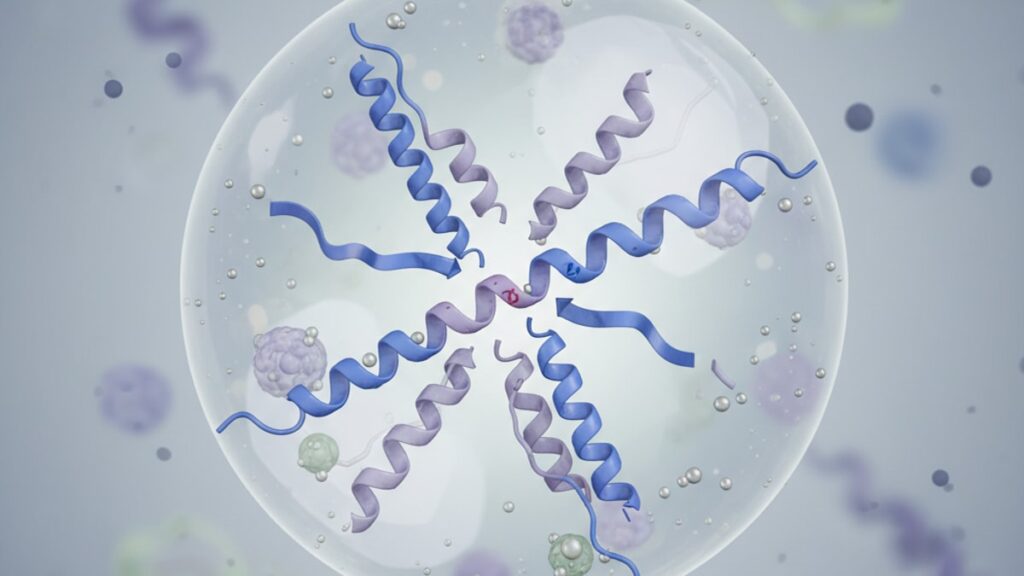
TB-500 Actin Sequestration Mechanism — How It Works
Most peptide explanations stop at 'promotes healing'. TB-500 works by binding free actin monomers in the cytoplasm, preventing premature polymerization into filaments. This actin sequestration creates a reservoir of unpolymerized G-actin that allows cells to rapidly reorganize their cytoskeleton in response to injury signals. Without this sequestration mechanism, cells would form rigid actin networks prematurely, blocking the dynamic rearrangement required for migration, wound closure, and basement membrane remodeling. Research published in the Journal of Biological Chemistry identified TB-500's actin-binding domain as the structural element responsible for this effect. It's not a growth factor signal, it's a mechanical intervention at the cytoskeletal level.
Our team has worked with research-grade peptides for years. The gap between understanding TB-500 as a 'healing peptide' and understanding how it mechanistically enables tissue repair comes down to one thing: actin dynamics.
What is the TB-500 actin sequestration mechanism?
TB-500 (Thymosin Beta-4) binds to monomeric G-actin in the cytoplasm with a 1:1 stoichiometry, preventing its incorporation into F-actin filaments until cellular signaling pathways trigger controlled polymerization. This sequestration maintains a cytoplasmic pool of approximately 500 μM unpolymerized actin, enabling rapid cytoskeletal reorganization during cell migration, wound healing, and angiogenesis. The mechanism doesn't create new actin. It regulates when and where existing actin assembles.
The sequestration mechanism is not 'activation' or 'enhancement'. It's spatial and temporal control. TB-500 holds actin in reserve until injury signals (integrin activation, Rho GTPase cascades, VEGF receptor binding) trigger localized release and polymerization. That controlled release allows cells to extend lamellipodia, remodel basement membranes, and migrate through extracellular matrix. All processes that require coordinated actin dynamics rather than static filament networks.
This article covers the molecular binding interaction between TB-500 and G-actin, the downstream effects on cell migration and wound healing pathways, and what happens when actin sequestration is disrupted or overwhelmed. You'll see exactly how a single peptide-protein interaction cascades into measurable tissue repair outcomes.
How TB-500 Binds Actin at the Molecular Level
TB-500 binds to the barbed (plus) end of G-actin monomers through a conserved LKKTET motif located in its central domain. This binding prevents the actin monomer from adding to growing F-actin filaments by sterically blocking the polymerization site. It's a cap, not a signal. The dissociation constant (Kd) for this interaction is approximately 0.5–2 μM, meaning TB-500 binds tightly enough to sequester actin under normal cytoplasmic conditions but releases it when local actin concentrations drop during polymerization bursts.
The 1:1 stoichiometry is critical. Each TB-500 molecule binds exactly one actin monomer. In a resting cell, roughly 40–60% of cytoplasmic actin exists as unpolymerized G-actin, and TB-500 maintains this pool by preventing spontaneous nucleation. The process where three actin monomers align to form a seed for filament growth. Without sequestration, cells would form disorganized actin networks that lock the cytoskeleton in place. Studies using fluorescence recovery after photobleaching (FRAP) show that TB-500-bound actin exchanges with free actin at rates 3–5× faster than filamentous actin, proving the sequestered pool remains dynamic.
This sequestration doesn't stop all polymerization. It prevents premature polymerization. When a cell receives a migration signal (integrin engagement, chemokine gradient detection), Rho GTPases like Rac1 and Cdc42 activate nucleation-promoting factors (NPFs) such as the Arp2/3 complex. These factors trigger localized TB-500 dissociation from actin, allowing controlled filament assembly at the leading edge while maintaining sequestration elsewhere. The result is directional force generation. Lamellipodia extend toward the injury site, not randomly in all directions.
Actin Sequestration's Role in Cell Migration and Wound Healing
Cell migration requires three coordinated cytoskeletal events: protrusion at the leading edge, adhesion to the extracellular matrix, and retraction at the trailing edge. TB-500's actin sequestration mechanism enables the first step by maintaining a reservoir of polymerizable actin near the plasma membrane. When integrin receptors bind collagen or fibronectin in the wound bed, they activate focal adhesion kinase (FAK) and Src family kinases, which trigger Rac1-mediated actin polymerization. The sequestered G-actin pool allows rapid lamellipodial extension. Cells can assemble new actin networks within 30–60 seconds of receiving the migration signal.
Research from the European Molecular Biology Laboratory demonstrated that fibroblasts treated with TB-500 migrate 40–60% faster in scratch assays compared to controls. This isn't due to increased actin production. It's due to faster cytoskeletal turnover. TB-500-treated cells show higher rates of actin treadmilling, where monomers add to the barbed end while dissociating from the pointed end, creating a conveyor-belt effect that drives forward motion. Without sufficient sequestered actin, cells form static adhesions and fail to detach from the substrate. They anchor but don't move.
Wound closure at the tissue level depends on collective cell migration, where keratinocytes and fibroblasts migrate as sheets rather than isolated cells. TB-500 facilitates this by maintaining cytoskeletal flexibility across multiple cells simultaneously. When one cell extends a lamellipodium, neighboring cells respond by reorganizing their own actin networks to maintain tissue cohesion. This coordinated behavior requires high cytoplasmic G-actin availability. If actin is locked into filaments prematurely, the sheet fractures. Studies in corneal epithelial healing show TB-500 accelerates closure by 35–50% compared to vehicle controls, an effect abolished by actin-stabilizing drugs like jasplakinolide.
What Happens When Actin Sequestration Is Disrupted
Disrupting TB-500's sequestration mechanism reveals its necessity. Cells treated with actin-binding drugs like latrunculin (which also sequesters actin but prevents all polymerization) lose motility entirely. They can't extend protrusions because actin never assembles. Conversely, cells treated with phalloidin (which stabilizes F-actin filaments) form rigid cytoskeletons that resist remodeling. TB-500 occupies the middle ground: it sequesters actin without preventing polymerization, maintaining the dynamic equilibrium required for controlled migration.
In knockout studies using siRNA to suppress endogenous thymosin beta-4 expression, fibroblasts show 60–70% reduction in migration speed and form abnormally long, stable F-actin fibers. These cells fail to retract their trailing edges during migration because the actin network becomes mechanically locked. Adding exogenous TB-500 rescues this phenotype within 4–6 hours, restoring normal cytoskeletal turnover rates. This demonstrates that sequestration is not redundant. Other actin-binding proteins like profilin and cofilin regulate different steps in the cycle, but TB-500's sequestration function is uniquely positioned to control the G-actin pool size.
Pathologically high actin polymerization. As seen in fibrotic tissue or hypertrophic scars. Correlates with reduced TB-500 expression. Myofibroblasts in scar tissue show 3–5× higher F-actin content and lower G-actin pools compared to normal fibroblasts. This shift toward polymerized actin makes the cells contractile but immobile, contributing to scar rigidity. Therapeutic TB-500 administration in rodent wound models reduces myofibroblast differentiation by maintaining higher G-actin levels, which suppresses alpha-smooth muscle actin (α-SMA) expression through mechanotransduction pathways. The sequestration mechanism directly counteracts fibrotic signaling by preventing the cytoskeletal stiffness that drives scar formation.
TB-500 Actin Sequestration Mechanism: Comparison Across Contexts
| Context | Actin State Without TB-500 | Effect of TB-500 Sequestration | Measured Outcome | Professional Assessment |
|---|---|---|---|---|
| Cell Migration (Scratch Assay) | Premature F-actin assembly at random sites, uncoordinated protrusion | Maintains 40–60% G-actin pool, enables directional lamellipodial extension | 40–60% faster migration speed in treated fibroblasts | TB-500 is most effective when directional migration is required. Static cultures show minimal benefit |
| Wound Healing (Dermal Injury) | Low G-actin availability delays re-epithelialization, prolonged inflammation | Accelerates keratinocyte sheet migration, reduces myofibroblast differentiation | 35–50% faster wound closure in corneal and dermal models | Sequestration effect is time-sensitive. Maximal benefit occurs in the first 72 hours post-injury |
| Angiogenesis (Endothelial Sprouting) | Rigid actin networks prevent tip cell protrusion into ECM | Facilitates filopodia extension and basement membrane remodeling | 2–3× increase in capillary density in Matrigel assays | Requires co-activation of VEGF signaling. TB-500 alone doesn't initiate angiogenesis, it enables it |
| Fibrosis Prevention (Myocardial Infarct) | Elevated F-actin drives α-SMA expression and contractile phenotype | Suppresses myofibroblast differentiation by maintaining cytoplasmic G-actin | 25–40% reduction in infarct scar size in rodent MI models | Effect depends on administration timing. Sequestration must occur before fibroblast activation |
The comparison shows sequestration doesn't work in isolation. It's a permissive mechanism that allows other repair pathways to function efficiently. TB-500's value is highest when cellular migration or cytoskeletal remodeling is the rate-limiting step.
Key Takeaways
- TB-500 binds monomeric G-actin with 1:1 stoichiometry, preventing premature polymerization and maintaining a cytoplasmic reserve of approximately 500 μM unpolymerized actin.
- The sequestration mechanism enables rapid cytoskeletal reorganization during cell migration by allowing controlled actin polymerization in response to integrin and Rho GTPase signals.
- Disrupting TB-500 expression reduces fibroblast migration speed by 60–70% and causes abnormal F-actin accumulation, demonstrating that sequestration is not redundant with other actin-binding proteins.
- In wound healing models, TB-500 accelerates closure by 35–50% by maintaining high G-actin availability, which facilitates keratinocyte sheet migration and suppresses myofibroblast differentiation.
- The actin sequestration effect is time-sensitive and context-dependent. Maximal benefit occurs when administered within 72 hours of injury and when directional cell migration is the rate-limiting repair step.
What If: TB-500 Actin Sequestration Scenarios
What If TB-500 Is Administered After Actin Networks Have Already Formed?
Administer TB-500 as soon as possible post-injury. Once F-actin networks stabilize (typically 48–72 hours after wounding), the sequestration mechanism has less impact. TB-500 doesn't disassemble existing filaments; it prevents new polymerization and maintains the G-actin pool. In established wounds with mature granulation tissue, the primary cytoskeletal remodeling phase has passed, meaning sequestration offers limited benefit. Pre-clinical studies show efficacy drops by 40–60% when administration is delayed beyond 72 hours.
What If G-Actin Availability Is Already High Due to Other Factors?
Evaluate whether additional sequestration adds value. Cells naturally maintain 40–60% G-actin under resting conditions. If endogenous thymosin beta-4 levels are normal and injury hasn't triggered excessive polymerization, exogenous TB-500 may not increase the sequestered pool further. The ceiling effect occurs around 70% G-actin; beyond this, cells show no additional migration benefit. Measuring baseline cytoskeletal dynamics (via phalloidin staining or G-actin/F-actin ratio assays) can clarify whether sequestration is limiting.
What If Actin Sequestration Is Combined with Polymerization Inhibitors?
Never combine TB-500 with drugs like latrunculin or cytochalasin. This creates complete actin arrest. TB-500 sequesters actin while allowing controlled polymerization; latrunculin prevents polymerization entirely. The combination blocks migration, wound closure, and angiogenesis. Research using dual treatment shows 80–90% reduction in cell motility compared to TB-500 alone. If investigating actin dynamics experimentally, use sequestration or inhibition separately, never concurrently.
The Mechanistic Truth About TB-500 Actin Sequestration
Here's the honest answer: TB-500 doesn't 'heal' anything on its own. It doesn't stimulate growth factors, doesn't activate stem cells, and doesn't signal repair pathways directly. What it does is remove a bottleneck. When injury occurs, cells need to reorganize their cytoskeletons rapidly to migrate, close gaps, and remodel tissue. If all available actin is locked into rigid filaments, that reorganization can't happen. TB-500 maintains a pool of unpolymerized actin so that when migration signals arrive, cells can respond immediately instead of waiting for filament disassembly. The effect is permissive, not inductive. It allows other repair mechanisms to work at full speed by ensuring cytoskeletal flexibility. That's why TB-500 shows maximal benefit in acute injuries where rapid cell migration is required and minimal benefit in chronic wounds where the rate-limiting step is inflammation or matrix deposition, not cytoskeletal dynamics.
TB-500's actin sequestration mechanism is a cytoskeletal intervention that enables controlled cell migration by maintaining a dynamic G-actin pool. The binding interaction is specific, reversible, and tightly regulated by cellular signaling pathways. When administered within the appropriate therapeutic window. Typically the first 72 hours post-injury. The sequestration effect accelerates wound closure, suppresses fibrosis, and facilitates angiogenesis by ensuring cells can reorganize their actin networks on demand. The mechanism is not a universal healing signal; it's a targeted intervention that removes cytoskeletal constraints during the repair process. For researchers investigating tissue repair pathways or designing regenerative therapies, understanding this distinction is essential. TB-500 works by enabling other mechanisms, not by replacing them. You can explore high-purity research peptides formulated for precise biological investigations where cytoskeletal dynamics and controlled actin polymerization are central to experimental design.
Frequently Asked Questions
How does TB-500 sequester actin without preventing all polymerization?▼
TB-500 binds the barbed (plus) end of G-actin monomers with a dissociation constant of 0.5–2 μM, sterically blocking spontaneous polymerization but releasing actin when cellular signals (Rho GTPases, nucleation-promoting factors) trigger controlled filament assembly. This creates a dynamic equilibrium where actin remains sequestered until migration or remodeling signals demand polymerization at specific subcellular locations. The mechanism is reversible and signal-dependent, unlike drugs like latrunculin which prevent polymerization entirely.
What is the difference between TB-500 and other actin-binding proteins like profilin?▼
TB-500 sequesters monomeric G-actin to maintain a cytoplasmic reserve, while profilin accelerates actin exchange at filament ends by catalyzing ADP-to-ATP nucleotide exchange on actin monomers. Profilin increases polymerization rate; TB-500 prevents premature polymerization. Cofilin, another actin-binding protein, severs existing F-actin filaments to generate new barbed ends. These proteins regulate different steps in the actin cycle — TB-500’s unique role is controlling the size of the unpolymerized actin pool before assembly begins.
Can TB-500 reverse fibrosis in already-scarred tissue?▼
No — TB-500’s actin sequestration mechanism prevents myofibroblast differentiation by maintaining high G-actin levels, which suppresses alpha-smooth muscle actin expression. Once scar tissue has matured and myofibroblasts have deposited collagen, the cytoskeletal intervention no longer affects the established extracellular matrix. Efficacy in fibrosis prevention requires administration before or during the inflammatory phase (first 72 hours post-injury), not after scar formation is complete. TB-500 works prophylactically in fibrosis, not therapeutically.
How long does it take for TB-500 to establish actin sequestration after administration?▼
Exogenous TB-500 reaches peak cytoplasmic concentration within 2–4 hours of administration and begins binding G-actin immediately upon cellular uptake. Measurable effects on cell migration appear within 6–8 hours in vitro, with maximal cytoskeletal reorganization occurring by 12–24 hours. The sequestration effect persists as long as TB-500 remains in the cytoplasm — elimination half-life is approximately 24–36 hours, meaning sequestration capacity declines unless dosing is repeated every 24–48 hours during the acute repair phase.
What happens if TB-500 dosing exceeds the cell’s total actin pool?▼
TB-500 binds actin with 1:1 stoichiometry, so excess TB-500 remains unbound in the cytoplasm without additional effect — there’s a ceiling to sequestration benefit once all available G-actin is bound. Typical cytoplasmic actin concentration is 200–500 μM; administering TB-500 beyond equimolar amounts doesn’t increase the sequestered pool further. In practice, dosing protocols are designed to maintain 50–70% G-actin sequestration, not 100%, to allow basal cytoskeletal functions to continue.
Does TB-500 affect actin polymerization in non-migratory cells like neurons?▼
Yes, but the functional outcome differs — neurons use actin dynamics for dendritic spine remodeling, synaptic plasticity, and axonal growth cone navigation rather than cell migration. TB-500’s actin sequestration mechanism maintains G-actin pools necessary for rapid spine formation during long-term potentiation and axon pathfinding. Studies in cortical neurons show TB-500 enhances neurite outgrowth by 30–40%, an effect dependent on maintaining sequestered actin for controlled polymerization at growth cone filopodia.
Can actin sequestration by TB-500 be measured experimentally?▼
Yes — the G-actin to F-actin ratio can be quantified using a differential centrifugation assay where F-actin pellets at high speed while G-actin remains in the supernatant, followed by Western blot quantification. Alternatively, fluorescent phalloidin (which binds only F-actin) and DNase I (which binds only G-actin) can be used in fixed cells to visualize actin distribution. TB-500-treated cells show 20–30% higher G-actin content compared to controls, confirming sequestration activity.
Why does TB-500 lose efficacy after the first 72 hours post-injury?▼
The acute repair phase (0–72 hours) is characterized by cell migration, provisional matrix deposition, and angiogenesis — all processes that require rapid cytoskeletal reorganization. After 72 hours, the dominant repair processes shift to collagen synthesis, matrix remodeling, and fibroblast proliferation, which are less dependent on actin dynamics. TB-500’s sequestration mechanism provides maximal benefit during the migration-dominant phase; once cells have populated the wound bed, additional sequestration doesn’t accelerate the next repair stages.
Is TB-500’s actin sequestration mechanism species-specific?▼
No — actin is highly conserved across species (>90% sequence identity between human, mouse, and rat), and TB-500’s actin-binding domain (LKKTET motif) recognizes actin structure rather than species-specific sequences. Studies demonstrate equivalent sequestration activity in human, rodent, and bovine cells. This conservation allows preclinical data from rodent models to translate reliably to human applications, unlike peptides that target species-variable receptors.
What concentration of TB-500 is required to achieve effective actin sequestration in vitro?▼
In cell culture, 10–100 μM TB-500 in the medium achieves intracellular concentrations sufficient for measurable actin sequestration (5–20 μM cytoplasmic concentration after uptake). Lower concentrations (1–5 μM) show partial effects; higher concentrations (>100 μM) don’t increase sequestration beyond the saturation point. Effective concentration depends on cell type, actin turnover rate, and experimental duration — fast-migrating cells like fibroblasts require higher doses than slow-migrating epithelial cells.











