



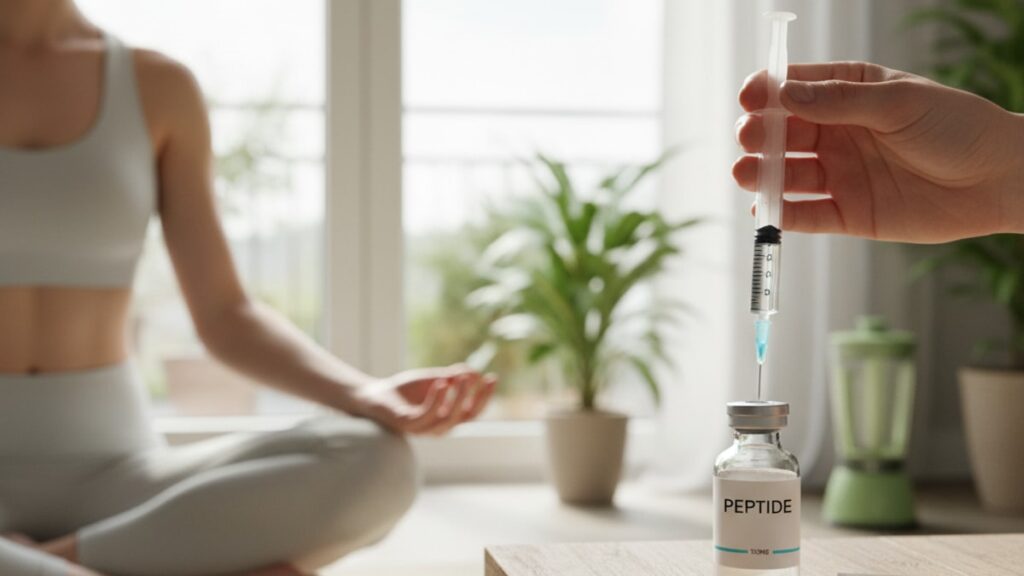
It’s the question our team hears almost daily. It lands in our inboxes, pops up in research forums, and causes a surprising amount of anxiety for seasoned and novice researchers alike: how much BAC water for 10mg peptide?
And let's be honest—it’s a fantastic question. Because the answer isn’t just about making a simple mixture. It’s about precision. It’s about ensuring the validity of your work from the absolute ground floor. Get this step wrong, and every subsequent data point is built on a flawed foundation. Here at Real Peptides, where we obsess over the purity and exact amino-acid sequencing of our products, we see proper reconstitution as the critical handover—from our lab's precision to yours. It’s where the potential of a high-purity peptide becomes reality.
Why This Step Is Absolutely Critical
First, let's quickly cover the 'why.' Peptides are delivered in a lyophilized state—a fancy term for freeze-dried. This process removes water, rendering the delicate protein chains inert and stable for shipping and storage. They are, for all intents and purposes, in a state of suspended animation.
This isn't like mixing a powdered drink. It's a careful, calculated process. The amount of diluent you add directly dictates the final concentration of the solution. An error here has a catastrophic domino effect. Too little water, and your solution is overly concentrated, making it incredibly difficult to measure small, accurate aliquots. Our experience shows that the most common research errors don't happen in complex experimental phases; they happen right here, with a vial and a labware. It's a simple mistake with profound consequences, potentially invalidating weeks or even months of work.
Gearing Up: Your Reconstitution Toolkit
Before you even think about popping the cap off a vial, you need the right tools. Attempting this with the wrong equipment is a recipe for contamination and inaccuracy. We can't stress this enough—start with a clean workspace and the proper gear.
Here’s your non-negotiable checklist:
- Your 10mg Vial of Peptide: The star of the show. At Real Peptides, our vials contain a precise amount of lyophilized powder, often appearing as a small, solid 'puck' or a light dusting at the bottom. The small amount of powder is normal and highly concentrated.
- Bacteriostatic (BAC) Water: This is sterile water containing 0.9% benzyl alcohol, an antimicrobial preservative. This alcohol is the key—it prevents bacteria from growing in the vial after it's been punctured, allowing for multiple, safe withdrawals. Using simple sterile water is only acceptable if you plan to use the entire vial in a single session. For multi-use research protocols, BAC water is the gold standard.
- A 3mL labware with transfer line (for mixing): You need a labware large enough to easily and accurately draw your chosen volume of BAC water. A 3mL or 5mL labware is perfect for this task.
- Alcohol Prep Pads: Sterility is paramount. You'll need these to swab the rubber stoppers on both your peptide vial and the BAC water vial before every puncture.
Having these items ready isn't just about convenience; it's about maintaining a sterile environment and ensuring the integrity of the peptide—a principle we live by during our own small-batch synthesis.
Why Retatrutide is The Most Effective FAT LOSS Peptide
This video provides valuable insights into how much bac water for 10mg peptide, covering key concepts and practical tips that complement the information in this guide. The visual demonstration helps clarify complex topics and gives you a real-world perspective on implementation.
Scenario 1: Adding 1mL of BAC Water
This is the simplest, most direct dilution. It's powerful but requires a steady hand for smaller aliquots.
- The Mix: 10mg of peptide + 1mL of BAC water
- The Resulting Concentration: 10mg per mL
Simple, right? Every 1mL of solution now contains 10mg of peptide. But researchers rarely aliquot in full milligrams. We need to break it down further, usually into micrograms (mcg).
Remember this crucial conversion: 1mg = 1000mcg
So, our 10mg/mL solution is also a 10,000mcg/mL solution.
That can be tough to measure accurately and leaves very little room for error.
Scenario 2: Adding 2mL of BAC Water (Our Team's Recommendation)
This is what we generally recommend as the best starting point. It strikes a perfect balance between concentration and ease of measurement.
- The Mix: 10mg of peptide + 2mL of BAC water
- The Resulting Concentration: 5mg per mL (because you have 10mg spread across 2mL)
Let's do the math again:
- The concentration is 5mg/mL, which is 5,000mcg/mL.
Suddenly, everything becomes much more manageable. The volumes are larger, the tick marks are easier to hit, and the margin for error shrinks dramatically. For the vast majority of research applications, this is the sweet spot.
Scenario 3: Adding 4mL of BAC Water
When would you use an even greater dilution? When your research demands exceptionally small, or 'micro,' aliquots. This approach maximizes measurement accuracy for tiny amounts.
- The Mix: 10mg of peptide + 4mL of BAC water
- The Resulting Concentration: 2.5mg per mL (10mg divided by 4mL)
Breaking it down:
- The concentration is 2.5mg/mL, which is 2,500mcg/mL.
| BAC Water Volume | Final Concentration (mg/mL) | Final Concentration (mcg/mL) | Volume for 250mcg aliquot | Volume for 500mcg aliquot | Volume for 1mg aliquot |
|---|
The Mistakes We See All The Time
Our team has consulted on enough research projects to see where things go wrong. Avoiding these common pitfalls is half the battle.
- The Aggressive Shake: We mentioned it before, but it bears repeating. Shaking is the number one peptide killer. Treat the vial like it's holding a masterpiece. Because it is.
- Using the Wrong Water: Using tap water is an absolute no-go due to bacteria and impurities. Using sterile water is better, but without the bacteriostatic agent, you risk contaminating your vial with every puncture. Stick to BAC water.
- Ignoring Sterility: Forgetting to swab the stoppers is a rookie mistake that can introduce bacteria and ruin your entire vial. Aseptic technique isn't optional.
- Bad Math: Always double-check your calculations. Then check them again. Write it down. Use an online peptide calculator if you're unsure. An error of a single decimal place can mean a 10x calculation errors.
- Improper Storage: Leaving a reconstituted vial on a lab bench is a costly mistake. Peptides are sensitive to heat and light. Refrigeration is mandatory to preserve their chemical structure and efficacy.
For those who are more visual learners, seeing the process can make all the difference. We've found that some of the demonstrations on YouTube channels like MorelliFit are incredibly helpful for visualizing the proper, gentle technique required for reconstitution and handling. Seeing it done correctly can take away all the guesswork.
Ultimately, the question of "how much bac water for 10mg peptide" is less about finding a single correct answer and more about making a deliberate, informed choice. It's about tailoring the concentration of your solution to the specific needs of your research protocol.
This first step sets the tone for your entire project. Precision here translates to reliable data later. We take immense pride in crafting the purest peptides possible; we trust you'll take the same pride in preparing them for your groundbreaking research. If you're ready to build your next project on a foundation of unmatched purity and consistency, we invite you to explore our products. Get Started Today.
And for more practical tips, lab insights, and updates from our team, make sure you're following our page on Facebook. We're always sharing information to help our community achieve better, more consistent results.
Frequently Asked Questions
Can I use sterile water instead of BAC water for my 10mg peptide?
▼
You can, but only if you plan to use the entire 10mg vial in a single session. BAC water contains a preservative that prevents bacterial growth, making it essential for vials that will be punctured multiple times over days or weeks.
What happens if I accidentally shake the peptide vial?
▼
Shaking can damage or denature the delicate amino acid chains that form the peptide. This can significantly reduce its effectiveness or render it completely inactive. Always swirl or roll the vial gently to dissolve the powder.
How long will my reconstituted 10mg peptide last in the fridge?
▼
When reconstituted with BAC water and stored properly in a refrigerator (2-8°C), most peptides remain stable for about 4 to 6 weeks. However, this can vary depending on the specific peptide, so always check the guidelines for the compound you’re working with.
Why did my peptide solution turn cloudy after mixing?
▼
A cloudy solution is a red flag. It can indicate bacterial contamination (from poor sterile technique), a problem with solubility, or that the peptide has degraded. We recommend discarding any solution that isn’t perfectly clear.
Is it okay to preparing aliquots in advance with my peptide aliquots for the week?
▼
Our team strongly advises against this. Peptides are most stable in the glass vial. Storing them in a plastic labware can lead to degradation and potential issues with concentration accuracy as the solution interacts with the plastic and rubber transfer control over time.
Does adding more or less BAC water change the peptide’s overall potency?
▼
No, the total amount of peptide in the vial (10mg) remains the same. Changing the amount of BAC water only changes the solution’s concentration (e.g., mg/mL). You simply adjust the volume you draw to get the same final aliquot.
How do I easily convert milligrams (mg) to micrograms (mcg)?
▼
It’s a simple conversion: 1 milligram (mg) is equal to 1,000 micrograms (mcg). To convert from mg to mcg, you multiply by 1,000. For example, 10mg is 10,000mcg.
Can I mix two different peptides in the same reconstitution vial?
▼
Absolutely not. Mixing different lyophilized peptides in the same vial can cause them to interact in unpredictable ways, potentially degrading both compounds and creating unknown byproducts. Each peptide must be reconstituted in its own separate vial.
What should I do if I still see particles after gently swirling the vial?
▼
With high-purity peptides like those from Real Peptides, this is extremely rare. If particles persist after gentle swirling for a few minutes, do not use the solution. It could indicate a manufacturing or contamination issue, and you should contact your supplier.
Is it normal for the peptide powder to look like a tiny dot or be loose?
▼
Yes, this is completely normal. The lyophilization process can result in the peptide forming a dense, solid ‘puck’ at the bottom of the vial or appearing as a light, almost invisible powder. Both forms contain the correct 10mg amount.
How should I store the BAC water itself?
▼
Unopened BAC water can typically be stored at room temperature. Once opened, it’s best practice to store it in the refrigerator to help maintain the effectiveness of the benzyl alcohol preservative.











