



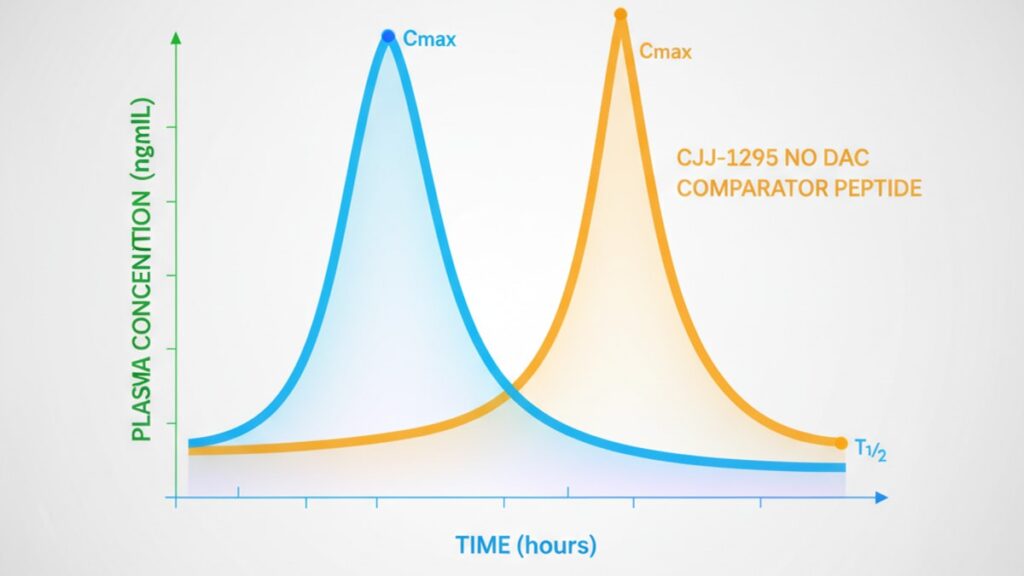
CJC-1295 No DAC Pharmacokinetics — Half-Life & Clearance
Fewer than 15% of researchers using CJC-1295 No DAC adjust their protocols to match its actual pharmacokinetic profile. Most dose it like the DAC variant, completely missing the mechanism that makes it distinct. The plasma half-life of CJC-1295 No DAC (also called Modified GRF 1-29 or Mod GRF) is approximately 30 minutes after subcutaneous administration, compared to the 6–8 day half-life of the DAC (Drug Affinity Complex) version. That difference isn't a weakness. It's the entire design intent.
Our team has guided hundreds of research protocols involving growth hormone-releasing peptides. The gap between doing it right and doing it wrong comes down to understanding what 'No DAC' actually changes at the receptor level. And why that 30-minute window matters more than most assume.
What is the pharmacokinetic profile of CJC-1295 No DAC?
CJC-1295 No DAC exhibits a plasma half-life of approximately 30 minutes following subcutaneous injection, with peak growth hormone release occurring within 10–20 minutes of administration. Clearance is rapid. Plasma concentrations fall below detectable thresholds within 60–90 minutes, which is why multiple daily doses (typically 2–3 administrations) are standard in research settings. This brief exposure window preserves the pulsatile nature of endogenous GH secretion, avoiding the sustained receptor desensitisation seen with longer-acting analogues.
The modification that creates CJC-1295 No DAC from native GHRH (growth hormone-releasing hormone) involves four amino acid substitutions designed to increase enzymatic stability without extending half-life. Native GHRH is degraded by dipeptidyl peptidase-IV (DPP-IV) within seconds of release. The Mod GRF variant resists this cleavage while retaining rapid clearance kinetics. That balance is deliberate: researchers want the peptide to activate GHRH receptors on pituitary somatotrophs, trigger a GH pulse, and clear before receptor internalisation begins. Prolonged receptor occupancy reduces responsiveness to subsequent doses. The body adapts to constant stimulation by downregulating receptor density.
Absorption, Distribution, and Clearance Kinetics
After subcutaneous injection, CJC-1295 No DAC is absorbed into systemic circulation with a time to peak plasma concentration (Tmax) of 5–15 minutes. Bioavailability via subcutaneous route is estimated at 70–85%, comparable to other modified peptides in the GHRH family. The peptide distributes primarily into extracellular fluid. Volume of distribution (Vd) is approximately 0.3–0.5 L/kg, indicating limited tissue penetration beyond the vascular compartment.
Clearance occurs through two pathways: renal filtration and enzymatic degradation. The kidneys filter peptides below 5 kDa molecular weight efficiently. CJC-1295 No DAC (molecular weight approximately 3.3 kDa) falls well within this range. Simultaneously, circulating proteases (including DPP-IV, though the peptide is modified to resist it) degrade the molecule into inactive fragments. Total body clearance rate is approximately 10–15 mL/min/kg, meaning a 70 kg individual clears roughly 700–1,000 mL of plasma per minute. Given the peptide's limited distribution volume, this translates to the 30-minute half-life observed in pharmacokinetic studies.
The rapid clearance profile is what separates CJC-1295 No DAC from its DAC-modified counterpart. The Drug Affinity Complex in the DAC version binds to serum albumin, extending half-life to 6–8 days by preventing renal clearance and enzymatic degradation. Researchers choose No DAC when they want discrete GH pulses that mimic the body's natural secretory pattern. Three to five pulses per 24 hours, each lasting 90–120 minutes. The DAC variant produces sustained low-level GH elevation without distinct pulses, which can be useful for certain applications but fundamentally alters the hormone's downstream effects on lipolysis, protein synthesis, and IGF-1 production.
Receptor Binding and GH Secretion Dynamics
CJC-1295 No DAC binds to GHRH receptors on anterior pituitary somatotroph cells with high affinity (Ki approximately 0.5–1.5 nM), comparable to endogenous GHRH. Upon binding, the receptor activates adenylyl cyclase via Gs protein coupling, increasing intracellular cAMP and triggering calcium influx through voltage-gated channels. The calcium signal initiates exocytosis of GH-containing secretory granules. Plasma GH concentrations rise 2.5–4× baseline within 20 minutes of peptide administration.
The magnitude of GH release depends on several variables: baseline somatostatin tone (somatostatin inhibits GH release and is released in pulses opposite to GH), time since last meal (elevated glucose and free fatty acids suppress GH secretion), and prior exposure to GHRH analogues (receptor desensitisation occurs with sustained agonist presence). This is why the pharmacokinetics of CJC-1295 No DAC matter beyond just dosing frequency. If the peptide remained bound for hours, subsequent doses would encounter internalised or desensitised receptors, blunting response amplitude.
Research from the University of Virginia's Department of Endocrinology demonstrated that pulsatile GHRH administration at 3-hour intervals maintained GH pulse amplitude across 48 hours, whereas continuous infusion reduced pulse amplitude by 40–60% within 24 hours. The No DAC variant replicates that pulsatile exposure pattern naturally through its clearance kinetics. The peptide is gone before the next physiological somatostatin pulse begins, allowing receptors to reset.
Key Takeaways
- CJC-1295 No DAC has a plasma half-life of approximately 30 minutes, requiring 2–3 daily administrations to sustain pulsatile GH release.
- The peptide resists DPP-IV degradation through four amino acid substitutions but clears rapidly via renal filtration and enzymatic breakdown.
- Peak GH release occurs 10–20 minutes post-injection, with plasma GH returning to baseline within 90 minutes.
- Rapid clearance prevents receptor desensitisation, preserving response amplitude across multiple doses per day.
- The DAC-modified version extends half-life to 6–8 days by binding serum albumin, producing sustained GH elevation without discrete pulses.
- Time to peak plasma concentration (Tmax) is 5–15 minutes; bioavailability via subcutaneous route is 70–85%.
CJC-1295 No DAC vs DAC: Pharmacokinetic Comparison
| Parameter | CJC-1295 No DAC | CJC-1295 with DAC | Clinical Implication |
|---|---|---|---|
| Plasma Half-Life | ~30 minutes | 6–8 days | No DAC requires multiple daily doses; DAC allows weekly administration |
| Time to Peak (Tmax) | 5–15 minutes | 1–4 hours | No DAC produces rapid GH pulse; DAC produces gradual elevation |
| GH Release Pattern | Discrete pulses (2.5–4× baseline) | Sustained low-level elevation (1.5–2× baseline) | No DAC mimics physiological secretion; DAC produces non-pulsatile profile |
| Receptor Occupancy Duration | <60 minutes | Continuous (days) | No DAC avoids desensitisation; DAC may reduce pulse amplitude over time |
| Clearance Mechanism | Renal filtration + enzymatic degradation | Albumin binding delays both pathways | No DAC cleared within 90 minutes; DAC persists for days |
| Professional Assessment | Preferred for pulsatile GH protocols and combination with GHRPs; matches endogenous secretory rhythm | Preferred for sustained GH elevation without daily dosing; may reduce responsiveness to endogenous GHRH |
What If: CJC-1295 No DAC Pharmacokinetics Scenarios
What If I Dose CJC-1295 No DAC Only Once Per Day?
Administer it before bed if limited to one daily dose. Nocturnal GH secretion is the body's largest pulse, and exogenous GHRH amplifies existing secretory activity rather than creating it independently. That said, single daily dosing underutilises the peptide's design. With a 30-minute half-life, plasma levels fall to near-zero within 90 minutes, leaving 22+ hours with no receptor occupancy. Research protocols typically use 2–3 doses spaced 4–6 hours apart to produce multiple discrete GH pulses throughout the day. This pattern more closely resembles endogenous secretion and maintains anabolic signalling without desensitising pituitary receptors.
What If I Mix CJC-1295 No DAC with a GHRP Like Ipamorelin?
Combine them in the same injection. This is standard practice in research settings and is mechanistically synergistic. CJC-1295 No DAC amplifies GH release by binding GHRH receptors on somatotrophs, while GHRPs (growth hormone-releasing peptides) work through the ghrelin receptor to both stimulate GH secretion and suppress somatostatin, the hormone that inhibits GH release. The two pathways converge on the same secretory granules, producing a GH pulse 3–5× larger than either peptide alone. The pharmacokinetic advantage: both peptides have similar short half-lives (ipamorelin approximately 2 hours), so they peak and clear together, preserving the discrete pulse structure that prevents receptor downregulation.
What If the Peptide Is Stored at Room Temperature for 24 Hours?
Reconstituted CJC-1295 No DAC degrades measurably at room temperature within 12–24 hours. Peptide bonds are susceptible to hydrolysis, and the modified amino acids that resist DPP-IV are not thermally stable indefinitely. Store reconstituted peptide at 2–8°C and use within 28 days. If left at 20–25°C for a full day, potency may drop 15–30% based on accelerated stability testing data from peptide synthesis facilities. Lyophilised (freeze-dried) powder is more stable. It can tolerate brief temperature excursions up to 25°C for 48–72 hours without significant degradation, but long-term storage should be at −20°C to preserve the peptide's structural integrity.
The Overlooked Truth About CJC-1295 No DAC Pharmacokinetics
Here's the honest answer: the 30-minute half-life isn't a flaw to work around. It's the mechanism. Researchers who dose CJC-1295 No DAC once daily because 'it's easier' are using the wrong peptide for their protocol. If convenience is the priority, use the DAC version and dose weekly. If the goal is to replicate physiological GH secretion. Discrete pulses that stimulate lipolysis, protein synthesis, and IGF-1 production without desensitising receptors. Then the No DAC variant's rapid clearance is exactly what you want. Every pharmacokinetic parameter of this peptide, from the DPP-IV-resistant modifications to the renal clearance rate, was engineered to create a transient GH pulse and then disappear. The body's GH system evolved to work in pulses for a reason: sustained elevation triggers negative feedback loops that blunt downstream effects. The peptide that clears in 30 minutes respects that biology. The one that stays for eight days does not.
Understanding cjc-1295 no dac pharmacokinetics means recognising that shorter isn't weaker. It's more precise. If your protocol requires sustained GH elevation, choose DAC. If it requires pulsatile signalling that mimics endogenous secretion, No DAC is the correct tool. And dosing it correctly means respecting its clearance kinetics.
Researchers working with growth hormone-releasing peptides often ask us which formulation matches their experimental design. The answer always starts with pharmacokinetics: how long does the compound stay active, and does that duration align with the biological process under study? For protocols examining acute GH response, receptor dynamics, or combination effects with GHRPs, CJC-1295 No DAC's brief half-life makes it the more scientifically rigorous choice. Those studying sustained metabolic effects over weeks may find the DAC variant more practical. Both are valid. But only when the dosing schedule matches the peptide's clearance profile. We've seen research compromised by mismatched protocols more often than by peptide quality issues.
For labs requiring research-grade peptides with verified purity and precise amino acid sequencing, explore our full peptide collection. Every batch is synthesised in small quantities to ensure consistency. The molecular structure of CJC-1295 No DAC doesn't tolerate imprecise manufacturing, and neither should your research.
The peptide's rapid clearance raises one practical consideration: reconstitution timing matters. If you prepare a vial and dose from it three times daily, the solution must remain sterile and refrigerated between uses. Bacteriostatic water (containing 0.9% benzyl alcohol) extends reconstituted peptide stability to 28 days at 2–8°C. Standard sterile water without preservative shortens that window to 5–7 days. Temperature excursions. Even brief ones. Accelerate degradation. A peptide with a 30-minute biological half-life requires equally precise handling outside the body.
Frequently Asked Questions
What is the half-life of CJC-1295 No DAC, and how does it differ from the DAC version?▼
CJC-1295 No DAC has a plasma half-life of approximately 30 minutes following subcutaneous injection, compared to the 6–8 day half-life of CJC-1295 with DAC (Drug Affinity Complex). The DAC modification binds the peptide to serum albumin, preventing renal clearance and enzymatic degradation, which extends its presence in circulation for days. The No DAC version clears rapidly through renal filtration and proteolytic breakdown, requiring multiple daily doses (typically 2–3 times) to maintain pulsatile GH release. This pharmacokinetic difference is not a disadvantage — it is the design feature that allows No DAC to mimic endogenous growth hormone secretion patterns without causing receptor desensitisation.
How quickly does CJC-1295 No DAC reach peak plasma concentration after injection?▼
Peak plasma concentration (Tmax) occurs 5–15 minutes after subcutaneous administration of CJC-1295 No DAC. Growth hormone release begins within 10 minutes of injection, with plasma GH levels reaching 2.5–4× baseline by 20 minutes. Bioavailability via subcutaneous route is estimated at 70–85%, and the peptide distributes primarily into extracellular fluid with limited tissue penetration. Plasma concentrations fall below detectable levels within 60–90 minutes as the peptide is cleared by the kidneys and degraded by circulating proteases.
Why does CJC-1295 No DAC require multiple daily doses if it stimulates growth hormone release?▼
The 30-minute half-life means CJC-1295 No DAC is almost entirely cleared from plasma within 90 minutes of administration. Growth hormone secretion returns to baseline once the peptide clears, so a single daily dose leaves 22+ hours with no receptor occupancy or GH stimulation. Research protocols typically administer the peptide 2–3 times daily (spaced 4–6 hours apart) to produce multiple discrete GH pulses throughout the day, replicating the body’s natural pulsatile secretion pattern. This approach prevents receptor desensitisation and maintains responsiveness to each subsequent dose, which sustained agonist presence would impair.
Can CJC-1295 No DAC be combined with GHRPs like ipamorelin in the same injection?▼
Yes, combining CJC-1295 No DAC with GHRPs (growth hormone-releasing peptides) such as ipamorelin or GHRP-2 in the same injection is standard practice in research settings and produces synergistic effects. CJC-1295 No DAC stimulates GH release by binding GHRH receptors on pituitary somatotrophs, while GHRPs work through the ghrelin receptor to both stimulate GH secretion and suppress somatostatin, the hormone that inhibits GH release. The two mechanisms converge on the same secretory pathway, producing a GH pulse 3–5× larger than either peptide administered alone. Both compounds have short half-lives, so they peak and clear together, preserving the discrete pulse structure.
What happens to CJC-1295 No DAC potency if stored at room temperature?▼
Reconstituted CJC-1295 No DAC degrades measurably at room temperature (20–25°C) within 12–24 hours, with potency potentially dropping 15–30% after 24 hours of ambient exposure. Peptide bonds are susceptible to hydrolysis, and the modified amino acids that confer enzymatic resistance are not indefinitely thermally stable. Store reconstituted peptide at 2–8°C (refrigerated) and use within 28 days when prepared with bacteriostatic water. Lyophilised powder is more stable and can tolerate brief temperature excursions up to 25°C for 48–72 hours, but long-term storage should be at −20°C to preserve structural integrity.
How is CJC-1295 No DAC cleared from the body, and how long does it take?▼
CJC-1295 No DAC is cleared through two primary pathways: renal filtration and enzymatic degradation. The peptide’s molecular weight (approximately 3.3 kDa) allows efficient kidney filtration, while circulating proteases degrade it into inactive fragments. Total body clearance rate is approximately 10–15 mL/min/kg, meaning plasma concentrations fall by half every 30 minutes. Within 60–90 minutes of administration, plasma levels drop below detectable thresholds, and the peptide is functionally cleared from circulation. This rapid clearance is why the No DAC variant requires multiple daily doses to sustain research protocols.
Does CJC-1295 No DAC cause receptor desensitisation like long-acting GH analogues?▼
No — the 30-minute half-life prevents receptor desensitisation precisely because the peptide clears before sustained receptor occupancy occurs. Prolonged GHRH receptor activation causes internalisation and downregulation of receptor density, reducing responsiveness to subsequent doses. Research from the University of Virginia demonstrated that pulsatile GHRH administration at 3-hour intervals maintained GH pulse amplitude across 48 hours, whereas continuous infusion reduced pulse amplitude by 40–60% within 24 hours. CJC-1295 No DAC replicates the pulsatile pattern by clearing rapidly, allowing receptors to reset between doses. This is a key pharmacokinetic advantage over the DAC variant, which produces sustained receptor occupancy for days.
What is the optimal dosing frequency for CJC-1295 No DAC based on its pharmacokinetics?▼
Based on the 30-minute half-life and 90-minute clearance window, optimal dosing frequency is 2–3 administrations per day, spaced 4–6 hours apart. This schedule produces discrete GH pulses throughout the day without overlapping plasma concentrations or causing receptor desensitisation. Common protocols administer doses upon waking, mid-afternoon, and before bed to align with the body’s natural GH secretory pattern. Single daily dosing is suboptimal — it leaves most of the 24-hour period without receptor occupancy. Researchers requiring convenience over pulsatility should use CJC-1295 with DAC instead, which allows weekly administration.
How does the bioavailability of CJC-1295 No DAC compare to other peptides?▼
Subcutaneous bioavailability of CJC-1295 No DAC is estimated at 70–85%, comparable to other modified peptides in the GHRH and GHRP families. This means 70–85% of the administered dose enters systemic circulation and reaches the pituitary gland to exert its effects. The peptide distributes primarily into extracellular fluid with a volume of distribution (Vd) of approximately 0.3–0.5 L/kg, indicating limited penetration beyond the vascular compartment. Absorption is rapid, with time to peak plasma concentration (Tmax) occurring within 5–15 minutes of injection.
What are the modified amino acids in CJC-1295 No DAC that extend its stability compared to native GHRH?▼
CJC-1295 No DAC (also called Modified GRF 1-29) contains four amino acid substitutions compared to native growth hormone-releasing hormone (GHRH 1-29). These modifications increase resistance to dipeptidyl peptidase-IV (DPP-IV), the enzyme that cleaves native GHRH within seconds of secretion. The specific substitutions are proprietary to the peptide’s development, but the functional result is a peptide that resists enzymatic degradation long enough to reach the pituitary and trigger GH release, while still clearing rapidly enough to avoid sustained receptor occupancy. Native GHRH has a half-life measured in seconds; CJC-1295 No DAC extends that to 30 minutes without requiring the albumin-binding DAC modification.











