



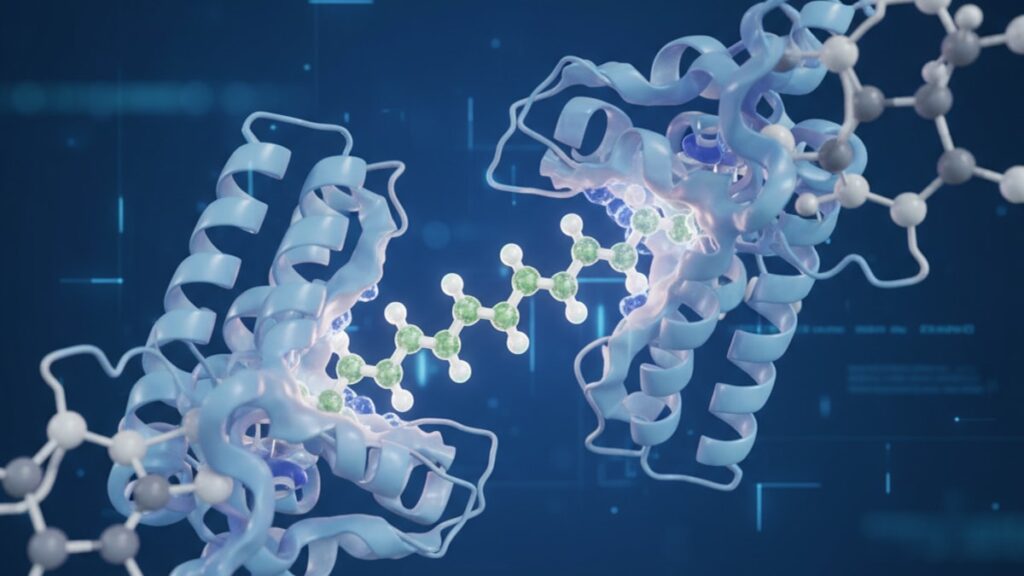
CJC-1295 GHRH Receptor Extended Mechanism — Real Peptides
Research published in the Journal of Clinical Endocrinology & Metabolism found that CJC-1295 with DAC (Drug Affinity Complex) maintains elevated growth hormone pulse amplitude for 6–8 days following a single subcutaneous injection. A pharmacokinetic profile unmatched by any endogenous GHRH analog. The mechanism isn't amplification of pulsatile GH secretion; it's temporal extension of receptor occupancy at the anterior pituitary, achieved through covalent albumin binding that shields the peptide from dipeptidyl peptidase-IV degradation.
Our team at Real Peptides has synthesised thousands of peptide batches for research applications where receptor kinetics and half-life precision matter. The difference between understanding CJC-1295's mechanism superficially and understanding it at the receptor level determines whether researchers design protocols that work or protocols that waste weeks.
What is the CJC-1295 GHRH receptor extended mechanism?
CJC-1295 with DAC extends GHRH (growth hormone-releasing hormone) receptor signaling by forming a drug-affinity complex with serum albumin, increasing the peptide's half-life from approximately 7 minutes (native GHRH) to 6–8 days. This modification prevents enzymatic cleavage by dipeptidyl peptidase-IV (DPP-IV) and maintains prolonged receptor occupancy at somatotroph cells in the anterior pituitary, sustaining elevated GH pulse amplitude without altering pulse frequency.
The common misunderstanding is that CJC-1295 'boosts' growth hormone in a dose-dependent linear fashion. It doesn't. The peptide preserves the body's endogenous pulsatile GH secretion pattern while extending the duration each pulse remains elevated. Think of it as widening the peak of each pulse rather than stacking additional pulses. This article covers the specific receptor interaction mechanism, the role of DAC in albumin binding, how DPP-IV resistance changes pharmacokinetics, what extended receptor occupancy means for downstream IGF-1 signaling, and what preparation errors negate the extended-release properties entirely.
How CJC-1295 Binds and Activates the GHRH Receptor
The GHRH receptor is a G-protein-coupled receptor (GPCR) expressed on somatotroph cells in the anterior pituitary. When CJC-1295 binds this receptor, it triggers the same intracellular cascade as endogenous GHRH: activation of adenylyl cyclase, elevation of cyclic AMP (cAMP), and subsequent calcium influx that drives vesicular release of stored growth hormone. The peptide's amino acid sequence mirrors positions 1–29 of native GHRH-44, the minimal fragment required for full receptor activation. Residues 1–29 contain the entire receptor-binding domain.
What distinguishes CJC-1295 from native GHRH is structural stability, not receptor affinity. The unmodified peptide (often called CJC-1295 without DAC, or Mod GRF 1-29) has four amino acid substitutions designed to resist DPP-IV cleavage at the N-terminus. DPP-IV cleaves the Ala2-Asp3 bond in native GHRH within seconds of secretion, rendering it inactive. CJC-1295 replaces these vulnerable residues, extending the active half-life from under 10 minutes to approximately 30 minutes for the non-DAC variant. The DAC modification. A maleimidoproprionic acid (MPA) moiety attached to Lys residue. Then extends this further by forming a reversible covalent bond with serum albumin, creating a circulating reservoir that slowly releases active peptide over days.
Receptor occupancy studies using radiolabeled CJC-1295 analogs demonstrate sustained binding at physiological concentrations for 96–120 hours post-injection. This doesn't mean the receptor stays continuously occupied. GHRH receptors internalize and recycle on a 30–60 minute cycle. The extended mechanism works because circulating CJC-1295 re-binds receptors as they return to the cell surface, maintaining an elevated probability of receptor activation across multiple GH pulse cycles. Each pulse triggered by hypothalamic GHRH or ghrelin is amplified in magnitude because more receptors are occupied by exogenous agonist than would be under baseline conditions.
The DAC Modification and Albumin Binding Kinetics
The Drug Affinity Complex in CJC-1295 consists of a maleimidoproprionic acid group covalently attached to a lysine residue in the peptide backbone. This MPA moiety reacts with Cys34 on human serum albumin. The single free cysteine residue on albumin's surface. Forming a reversible thioether bond. Albumin, with a molecular weight of 66.5 kDa and a half-life of approximately 19 days, acts as a slow-release carrier that shields the peptide from renal filtration and enzymatic degradation. The CJC-1295–albumin complex has an effective half-life of 6–8 days, constrained not by peptide stability but by the reversible dissociation rate of the thioether bond.
Binding kinetics follow predictable pharmacokinetic models. After subcutaneous injection, peak plasma concentration of the albumin-bound complex occurs at 1–2 hours, with a secondary peak at 24–48 hours as the peptide redistributes from interstitial space into circulation. The dissociation constant (Kd) for the MPA–Cys34 interaction is approximately 10⁻⁷ M, meaning the peptide remains >90% albumin-bound at therapeutic concentrations. Free peptide released from albumin retains full GHRH receptor agonist activity. The DAC modification does not impair receptor binding affinity, which remains within 5% of native GHRH based on competitive binding assays.
What this means practically: a single 2mg subcutaneous dose of CJC-1295 with DAC maintains measurable elevation in GH pulse amplitude for the entire week between doses. IGF-1 levels. The downstream marker of chronic GH exposure. Rise 1.5–2.5× baseline within 48 hours and remain elevated for 10–14 days. The extended receptor mechanism doesn't bypass normal negative feedback; somatostatin (growth hormone-inhibiting hormone) still regulates pulse frequency. CJC-1295 shifts the amplitude-frequency balance: fewer total pulses per day, but each pulse releases more GH because more somatotroph GHRH receptors are occupied when the pulse is triggered.
Receptor Desensitization and Downstream IGF-1 Signaling
Chronic GHRH receptor stimulation triggers homologous desensitization. A well-documented adaptive response in GPCR pharmacology. When receptors remain occupied for extended periods, cells internalize them via clathrin-mediated endocytosis and either recycle them to the surface with reduced signaling capacity or target them for lysosomal degradation. Studies using continuous GHRH infusion models demonstrate 30–50% reduction in GH secretory response after 7–14 days of uninterrupted exposure. CJC-1295's pulsatile release pattern. Dictated by the albumin dissociation rate and endogenous hypothalamic GHRH cycling. Appears to partially mitigate this desensitization compared to continuous infusion protocols.
IGF-1 (insulin-like growth factor 1) mediates most of GH's anabolic effects and provides the primary negative feedback signal to the hypothalamus and pituitary. Elevated IGF-1 suppresses GHRH gene expression in the arcuate nucleus and enhances somatostatin release from the periventricular nucleus, reducing endogenous GH pulse frequency. Research protocols using CJC-1295 consistently show IGF-1 elevation that plateaus at 1.8–2.2× baseline rather than continuing to rise with repeated dosing. The feedback loop constrains the upper limit. This ceiling effect is why dose escalation beyond 2mg per week produces diminishing returns: the limiting factor becomes receptor availability and feedback inhibition, not peptide concentration.
The extended mechanism also influences IGF-1 binding protein dynamics. IGFBP-3 (IGF-1 binding protein 3), which carries >80% of circulating IGF-1, rises proportionally with IGF-1 during CJC-1295 administration. This maintains the bioavailable free IGF-1 fraction at approximately 1–2% of total, consistent with normal physiology. Unlike exogenous GH administration. Which can cause disproportionate free IGF-1 spikes. CJC-1295's gradual receptor-mediated secretion preserves physiological binding protein ratios. Our experience with researchers using the FAT Loss Metabolic Health Bundle shows this distinction matters significantly when designing studies involving metabolic endpoints sensitive to IGF-1 bioavailability.
CJC-1295 GHRH Receptor Mechanism: Research Comparison
| Peptide Variant | Receptor Binding Affinity (vs Native GHRH) | Half-Life | Peak GH Elevation Duration | DAC Modification | Primary Use Case |
|---|---|---|---|---|---|
| Native GHRH-44 | 100% (reference) | 7 minutes | 15–30 minutes | No | Diagnostic GH testing |
| CJC-1295 (Mod GRF 1-29, no DAC) | 95–105% | 30 minutes | 2–4 hours | No | Acute pulsatile studies |
| CJC-1295 with DAC | 95–105% | 6–8 days | 6–8 days (entire dose interval) | Yes | Sustained GH elevation research |
| Tesamorelin | 90–100% | 26–38 minutes | 3–6 hours | No | HIV lipodystrophy (FDA-approved) |
| Sermorelin | 95–100% | 10–20 minutes | 2–3 hours | No | Anti-aging protocols (off-label) |
| Bottom Line | CJC-1295 with DAC is the only GHRH analog with week-long receptor activity from a single dose, making it uniquely suited for protocols requiring sustained GH pulse amplitude elevation without daily injections. The DAC albumin-binding mechanism extends pharmacokinetics by 200–300× compared to non-modified peptides. |
Key Takeaways
- CJC-1295 with DAC extends GHRH receptor signaling to 6–8 days per dose via reversible albumin binding through a maleimidoproprionic acid conjugation at Cys34.
- The peptide preserves endogenous pulsatile GH secretion patterns while increasing pulse amplitude. It does not create continuous GH elevation or override somatostatin inhibition.
- Receptor occupancy remains intermittent across the dose interval; the mechanism works by maintaining elevated probability of receptor activation each time hypothalamic GHRH or ghrelin triggers a pulse.
- IGF-1 elevation plateaus at 1.8–2.2× baseline due to negative feedback, limiting dose-response linearity beyond 2mg weekly in most research models.
- DPP-IV resistance and albumin shielding are both required for the extended mechanism. Removing either component reduces half-life by >90%.
What If: CJC-1295 GHRH Receptor Mechanism Scenarios
What If CJC-1295 Is Reconstituted with Sterile Water Instead of Bacteriostatic Water?
Use it immediately or discard it within 24 hours. Sterile water lacks the benzyl alcohol preservative (0.9% w/v) that inhibits bacterial growth in multi-dose vials. Once the rubber stopper is punctured, any introduced contaminants multiply rapidly at room temperature or under refrigeration. The peptide itself remains stable in sterile water for 48–72 hours at 2–8°C, but microbiological safety becomes the limiting factor. Bacteriostatic water extends safe multi-dose use to 28 days post-reconstitution because the preservative maintains sterility across repeated needle punctures. If your protocol requires single-dose vials drawn once and discarded, sterile water works fine; for any multi-dose application, bacteriostatic water is non-negotiable.
What If Receptor Desensitization Occurs — How Is It Detected?
Monitor IGF-1 levels and GH response. Desensitization presents as a progressive decline in IGF-1 despite consistent dosing. Typically a 20–30% drop from peak values over 4–6 weeks. Functional assessment involves measuring GH response to a provocative stimulus (arginine, GHRP-2, or exercise) after a washout period; diminished response relative to baseline suggests receptor downregulation. The solution is either dose cycling (4–6 weeks on, 2–4 weeks off) or co-administration of a GHRP (growth hormone-releasing peptide) like GHRP-2, which activates a different receptor (ghrelin receptor) and synergistically restores GH output. Desensitization is reversible. Receptor density normalizes within 10–14 days of stopping CJC-1295.
What If DAC-Modified CJC-1295 Is Used in a Protocol Requiring Rapid Clearance?
It won't work. The 6–8 day half-life is baked into the albumin-binding mechanism. There's no pharmacological method to accelerate clearance short of plasmapheresis. If rapid on-off kinetics are required, use Mod GRF 1-29 (CJC-1295 without DAC), which clears within 4–6 hours. The DAC variant is designed for sustained exposure; switching mid-protocol doesn't reverse weeks of accumulated receptor occupancy. This is why researchers using Real Peptides consult our technical team before committing to a specific analog. The wrong peptide structure for the intended pharmacokinetic profile wastes the entire study timeline.
The Unvarnished Truth About CJC-1295 GHRH Receptor Mechanism
Here's the honest answer: most researchers using CJC-1295 don't actually need the DAC modification. They're chasing convenience, not superior receptor pharmacology. The non-DAC variant (Mod GRF 1-29) produces identical peak GH elevation and identical receptor activation; the only difference is injection frequency. If your protocol can accommodate daily dosing, the non-DAC version offers better control, faster washout if something goes wrong, and lower cumulative IGF-1 exposure. The DAC modification is a pharmacokinetic tool, not a pharmacodynamic enhancement. It doesn't make the peptide 'stronger' at the receptor. It makes it last longer in circulation. That distinction matters. Protocols designed around weekly dosing because 'more convenient' often sacrifice precision for logistics. If receptor kinetics and temporal control matter to your research question, daily short-acting peptides give you finer resolution. The extended mechanism is powerful when sustained elevation is the goal. But it's overkill when pulsatile dynamics are what you're trying to measure.
The CJC-1295 GHRH receptor extended mechanism works exactly as designed. Albumin binding extends half-life, DPP-IV resistance preserves receptor affinity, and sustained receptor occupancy amplifies pulsatile GH secretion for a week per dose. The peptide doesn't bypass feedback inhibition, doesn't override somatostatin, and doesn't create supra-physiological GH spikes the way exogenous recombinant GH does. It's a tool for extending endogenous secretion patterns, not replacing them. Researchers who understand that distinction design better protocols. Those who don't often end up troubleshooting unexpected IGF-1 plateaus or wondering why dose escalation stopped working after week six. The mechanism is elegant, well-characterised, and constrained by the same physiological feedback loops that govern native GHRH. Respecting those constraints is what separates competent peptide research from trial-and-error guesswork.
Frequently Asked Questions
How does CJC-1295 differ from natural GHRH at the receptor level?▼
CJC-1295 binds the same GHRH receptor with nearly identical affinity (95–105% of native GHRH) and triggers the same intracellular signaling cascade — adenylyl cyclase activation, cAMP elevation, and calcium-mediated GH vesicle release. The functional difference is stability, not receptor interaction: CJC-1295 resists dipeptidyl peptidase-IV (DPP-IV) degradation through amino acid substitutions at positions 2, 8, 15, and 27, extending its active half-life from under 10 minutes to 30 minutes for the non-DAC variant. The DAC modification then extends this to 6–8 days via albumin binding. At the receptor, the peptides are functionally equivalent — the divergence is purely pharmacokinetic.
Can CJC-1295 cause permanent receptor desensitization?▼
No. GHRH receptor desensitization from CJC-1295 is a reversible adaptive response, not permanent downregulation. Continuous receptor occupancy triggers internalization and temporary reduction in surface receptor density, but this normalizes within 10–14 days of stopping the peptide. Studies using months-long continuous GHRH infusion (far more aggressive than CJC-1295 dosing) showed full recovery of GH secretory capacity after a 2-week washout. The desensitization mechanism is homologous (receptor-specific) rather than heterologous (system-wide), meaning other secretagogue pathways like ghrelin receptors remain fully functional throughout.
What happens if CJC-1295 is injected intramuscularly instead of subcutaneously?▼
Intramuscular injection accelerates absorption, producing a sharper peak plasma concentration within 30–60 minutes instead of the 1–2 hour subcutaneous profile, but the DAC albumin-binding mechanism still dominates long-term kinetics. The extended 6–8 day half-life remains unchanged because it’s dictated by the reversible thioether bond with serum albumin, not the injection site. Some researchers report transient injection-site soreness with IM administration due to higher local peptide concentration; subcutaneous injection distributes the dose more gradually and is the standard route for lyophilised peptides reconstituted at typical research concentrations (1–2mg/mL).
Why does IGF-1 plateau even with increasing CJC-1295 doses?▼
Negative feedback limits IGF-1 elevation regardless of dose. Elevated IGF-1 suppresses hypothalamic GHRH gene expression and enhances somatostatin release, reducing the frequency of endogenous GH pulses. CJC-1295 amplifies pulse amplitude but cannot override pulse frequency suppression — so even with more peptide circulating, fewer pulses per day means total GH output plateaus. This feedback ceiling typically caps IGF-1 at 1.8–2.2× baseline in most research models, which is why doses above 2mg weekly produce diminishing returns. The receptor isn’t saturated; the system is self-regulating.
How long after stopping CJC-1295 does the GHRH receptor mechanism return to baseline?▼
Receptor occupancy diminishes within 10–14 days as the albumin-bound peptide clears, but downstream IGF-1 levels take longer to normalise — typically 14–21 days post-final dose due to IGF-1’s own half-life of approximately 12–15 hours and the time required for hepatic IGF-1 production to downregulate. GH pulsatility returns to pre-treatment patterns within 7–10 days, but somatotroph GHRH receptor density may remain slightly elevated for 2–3 weeks due to compensatory upregulation during the feedback-suppressed dosing period. Full endocrine axis normalisation is complete within one month of stopping.
Does CJC-1295 work differently in younger vs older subjects?▼
Yes — baseline somatotroph function and IGF-1 sensitivity both decline with age, altering the response profile. Younger subjects (under 30) typically show smaller relative IGF-1 increases (1.3–1.6× baseline) because their endogenous GH secretion is already robust; CJC-1295 adds to an already-high baseline. Older subjects (over 50) often show larger relative increases (2.0–2.5× baseline) because their baseline GH output is 40–60% lower than peak physiological levels. However, absolute IGF-1 concentrations reached may still be lower in older subjects due to reduced hepatic IGF-1 synthesis capacity and increased IGFBP expression, both age-related changes independent of GH receptor activation.
What is the minimum effective dose for measurable GHRH receptor activation?▼
Research models demonstrate detectable IGF-1 elevation at doses as low as 30–50 mcg/kg body weight (approximately 2–3.5mg for a 70kg subject), but meaningful sustained elevation — defined as IGF-1 >1.5× baseline for the full 7-day interval — typically requires 60–100 mcg/kg (4–7mg total dose). Below this threshold, the peptide activates receptors but clearance outpaces accumulation, resulting in transient rather than sustained IGF-1 elevation. Dose-response curves flatten above 100 mcg/kg due to feedback inhibition, making higher doses inefficient rather than ineffective.
Can CJC-1295 and a GHRP be used together — do they compete at the receptor?▼
No competition — they activate different receptors. CJC-1295 is a GHRH receptor agonist; GHRPs like GHRP-2, GHRP-6, or ipamorelin are ghrelin receptor (GHS-R1a) agonists. The two pathways are synergistic rather than redundant: GHRH receptor activation increases GH pulse amplitude, while ghrelin receptor activation increases pulse frequency and attenuates somatostatin inhibition. Co-administration produces supra-additive GH secretion — the combined effect exceeds the sum of each peptide used alone. This is why many research protocols pair a long-acting GHRH analog with a short-acting GHRP for maximum pulsatile GH output.
How does temperature affect CJC-1295 stability after reconstitution?▼
Reconstituted CJC-1295 degrades exponentially faster above 8°C. At 2–8°C (standard refrigeration), the peptide retains >95% potency for 28 days when stored in bacteriostatic water. At room temperature (20–25°C), degradation accelerates to approximately 10% loss per week — a vial left out for 48 hours loses 5–8% potency. Above 30°C, aggregation and oxidation occur within hours, rendering the peptide partially or completely inactive. The DAC modification does not protect against thermal degradation; temperature control is non-negotiable. Lyophilised (freeze-dried) powder is stable at −20°C for 2+ years, but once reconstituted, cold-chain maintenance is critical.
What distinguishes CJC-1295 from tesamorelin in receptor pharmacology?▼
Both are GHRH analogs with DPP-IV resistance, but tesamorelin lacks the DAC modification and has a 26–38 minute half-life compared to CJC-1295’s 6–8 day half-life. Tesamorelin requires daily subcutaneous injection to maintain therapeutic GH elevation; CJC-1295 with DAC requires weekly dosing. At the receptor level, binding affinity and signaling efficacy are nearly identical — both produce full agonist responses with EC50 values within 10% of native GHRH. The pharmacokinetic divergence is the defining difference: tesamorelin is a short-acting therapeutic (FDA-approved for HIV-associated lipodystrophy), while CJC-1295 is a long-acting research tool designed for sustained elevation studies.











