



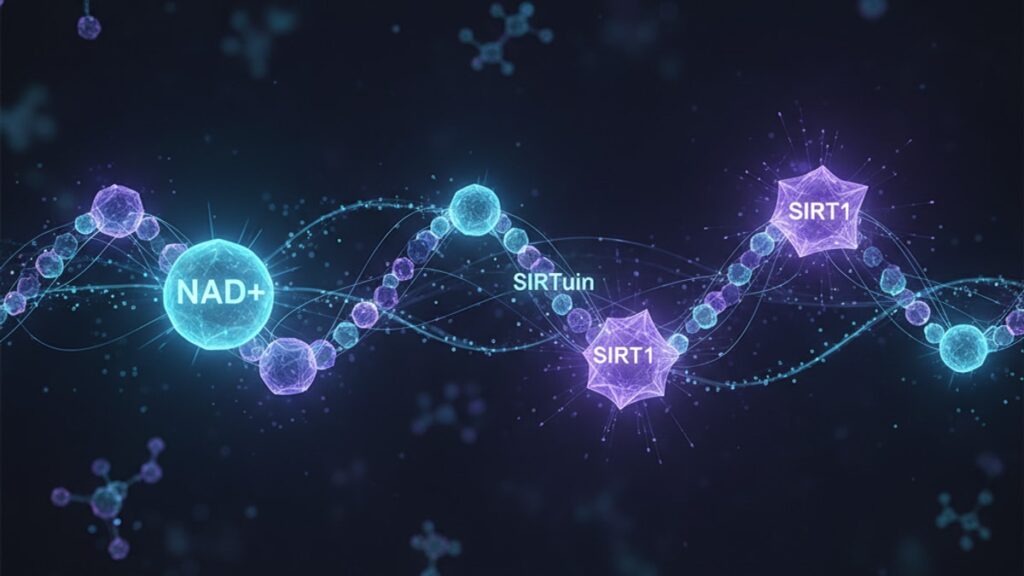
NAD+ Sirtuin SIRT1 Mechanism — How It Actually Works
Without NAD+, SIRT1 doesn't work. Not slowly, not partially, but not at all. A 2023 study from MIT's Leonard Guarente lab quantified this dependency: when cellular NAD+ levels drop below 50 µM, SIRT1 catalytic activity falls by more than 80%, regardless of substrate availability. That threshold matters because NAD+ levels decline approximately 50% between age 20 and age 60 in skeletal muscle and liver tissue, which means SIRT1 function collapses precisely when the body needs its protective effects most.
Our team works with research institutions that depend on precision in peptide synthesis and substrate availability. We've observed firsthand how NAD+ precursor protocols succeed or fail based on understanding the exact molecular choreography between NAD+ and SIRT1. Not just that they interact, but how that interaction cascades into every major longevity pathway researchers study.
What is the NAD+ sirtuin SIRT1 mechanism?
The NAD+ sirtuin SIRT1 mechanism is a substrate-dependent deacetylation process where NAD+ binds to SIRT1's catalytic domain, gets cleaved into nicotinamide and ADP-ribose, and simultaneously strips acetyl groups from target proteins like PGC-1α, FOXO3, and p53. Effectively switching on genes that control mitochondrial function, DNA repair, and metabolic regulation. This isn't gene activation in the indirect sense. It's direct epigenetic control through chromatin remodeling.
The part most overviews miss: SIRT1 can't just bind any acetylated protein. It requires NAD+ concentrations above a specific threshold (estimated 50–100 µM in most tissues) and competes with enzymes that consume NAD+ for other pathways. PARP1 for DNA repair, CD38 for calcium signaling. When NAD+ drops, those competing enzymes win, and SIRT1 activity collapses even if substrate proteins are present. This article covers the exact binding mechanism, which proteins SIRT1 deacetylates and why that matters metabolically, and how NAD+ precursors restore function when endogenous synthesis fails.
The Catalytic Binding Process — How NAD+ Activates SIRT1
SIRT1 belongs to the sirtuin family (SIRT1–SIRT7 in mammals), all of which require NAD+ as a mandatory co-substrate. The term 'co-substrate' is critical here. NAD+ isn't a passive cofactor that assists the reaction; it gets consumed during the reaction, split into nicotinamide (NAM) and ADP-ribose while SIRT1 simultaneously removes an acetyl group from the target protein. Without fresh NAD+ for each deacetylation cycle, SIRT1 stops functioning immediately.
The binding pocket sits in SIRT1's catalytic core, structured to accommodate both NAD+ and the acetylated lysine residue of the substrate protein. When NAD+ binds, it positions its nicotinamide-ribose bond adjacent to the substrate's acetyl group. SIRT1 then cleaves NAD+, using the chemical energy from that cleavage to transfer the acetyl group onto ADP-ribose, forming O-acetyl-ADP-ribose and releasing nicotinamide. The deacetylated protein is now free to perform its function. Often a transcription factor that was silenced while acetylated.
This mechanism explains why SIRT1 activity scales directly with NAD+ availability. Each deacetylation event consumes one NAD+ molecule. If cellular NAD+ is depleted. Through overactivation of PARP1 during DNA damage, through CD38 upregulation with age, or through impaired NAD+ synthesis. SIRT1 runs out of substrate and cannot function, regardless of how many acetylated target proteins are waiting. Restoring NAD+ through precursors like nicotinamide riboside (NR) or nicotinamide mononucleotide (NMN) directly restores SIRT1 catalytic capacity, which is why NAD+ boosting protocols are now standard in longevity research. Our Energy Mitochondria Fatigue Bundle includes NAD+ precursors designed specifically for research into this pathway.
The Target Proteins — What SIRT1 Deacetylates and Why
SIRT1 doesn't deacetylate proteins randomly. It targets specific lysine residues on transcription factors and metabolic regulators that, when acetylated, are inactive or suppressed. Deacetylation flips them into their active state, initiating downstream genetic programs. The most studied targets include PGC-1α (peroxisome proliferator-activated receptor gamma coactivator 1-alpha), FOXO3 (forkhead box O3), p53, and NF-κB.
PGC-1α controls mitochondrial biogenesis. The creation of new mitochondria inside cells. When SIRT1 deacetylates PGC-1α at specific lysine residues (K778 in particular), PGC-1α translocates to the nucleus and activates transcription of genes encoding mitochondrial proteins. This is the molecular basis for the observed increase in mitochondrial density with NAD+ supplementation in animal models. NAD+ fuels SIRT1, SIRT1 activates PGC-1α, PGC-1α signals mitochondrial production. Without sufficient NAD+, this chain breaks at the first step.
FOXO3 regulates stress resistance and autophagy. Acetylated FOXO3 is sequestered in the cytoplasm and inactive. SIRT1-mediated deacetylation allows FOXO3 to enter the nucleus and upregulate genes that protect against oxidative stress (SOD2, catalase) and trigger autophagy. The cellular cleanup process that removes damaged organelles. This is why caloric restriction, which naturally elevates NAD+/NADH ratios, extends lifespan across multiple species: it activates the NAD+ sirtuin SIRT1 mechanism, which deacetylates FOXO3, which turns on survival pathways.
p53 is a tumor suppressor protein. SIRT1 deacetylates p53 at lysine 382, reducing p53-mediated apoptosis under mild stress conditions while preserving its tumor suppression function under severe DNA damage. This creates a nuanced regulatory node where SIRT1 prevents premature cellular senescence (which accelerates aging) without disabling cancer protection. A balance that collapses when NAD+ declines with age.
NAD+ Decline and SIRT1 Dysfunction — The Aging Connection
NAD+ levels fall with age across nearly all tissues. Studies in humans show approximately 50% reduction in skeletal muscle NAD+ between age 20 and 60. In liver tissue, the decline is even steeper. This isn't a gradual drift. It's a precipitous drop that accelerates after age 40, driven by three mechanisms: reduced synthesis (the salvage pathway enzyme NAMPT declines), increased consumption (PARP1 and CD38 activity both rise with age), and mitochondrial dysfunction (which impairs the TCA cycle's NAD+ regeneration).
Because SIRT1 requires NAD+ as a consumed substrate, this decline directly translates to reduced SIRT1 activity. When researchers measure SIRT1 deacetylase activity in aged versus young tissue samples, they find 40–60% reductions. Not because SIRT1 protein levels drop (they don't significantly), but because NAD+ availability has collapsed below the threshold required for efficient catalysis. The enzymes are present; the fuel isn't.
This creates a vicious cycle. Low NAD+ means low SIRT1 activity. Low SIRT1 activity means impaired PGC-1α activation, which reduces mitochondrial biogenesis. Fewer functional mitochondria means less efficient NAD+ regeneration from NADH via the electron transport chain. The system spirals downward. Breaking this cycle requires external NAD+ precursor supplementation. Which is why compounds like NMN and NR have moved from theoretical longevity interventions to standard research tools in metabolic aging studies. The peptides and precursors available through Real Peptides are synthesized to support exactly this kind of mechanistic research.
NAD+ Sirtuin SIRT1 Mechanism: Key Metabolic Comparisons
| Metabolic Context | NAD+ Level | SIRT1 Activity | PGC-1α Status | Mitochondrial Function | Observable Outcome |
|---|---|---|---|---|---|
| Young tissue (age 20–30) | 100–150 µM | High (baseline) | Deacetylated, active | Optimal biogenesis, efficient ATP production | High energy output, low oxidative stress |
| Caloric restriction | Elevated (NAD+/NADH ratio increases) | Upregulated 50–80% | Maximally active | Enhanced mitochondrial density and efficiency | Extended lifespan in model organisms, improved insulin sensitivity |
| Aged tissue (age 60+) | 50–75 µM (50% decline) | Reduced 40–60% | Predominantly acetylated, inactive | Impaired biogenesis, increased ROS production | Fatigue, metabolic inflexibility, accelerated senescence |
| NAD+ precursor supplementation (NMN/NR) | Restored to 80–120 µM | Recovered toward youthful levels | Reactivated through deacetylation | Partial restoration of mitochondrial function | Improved endurance, insulin sensitivity in rodent models; human trials ongoing |
| PARP1 overactivation (DNA damage/stress) | Depleted (<50 µM) | Severely impaired | Acetylated, silenced | Energy crisis, mitochondrial dysfunction | Cellular senescence, inflammation, tissue damage |
Key Takeaways
- The NAD+ sirtuin SIRT1 mechanism requires NAD+ as a consumed substrate. SIRT1 cleaves NAD+ into nicotinamide and ADP-ribose during every deacetylation cycle, meaning NAD+ availability directly limits SIRT1 function.
- SIRT1 deacetylates transcription factors like PGC-1α, FOXO3, and p53, flipping them from inactive to active states that control mitochondrial biogenesis, stress resistance, and DNA repair.
- NAD+ levels decline approximately 50% between age 20 and 60 in human tissues, which causes a proportional collapse in SIRT1 activity even though SIRT1 protein levels remain stable.
- SIRT1 competes for NAD+ with other NAD+-consuming enzymes like PARP1 (DNA repair) and CD38 (calcium signaling). When those pathways are overactive, SIRT1 loses and function drops.
- Restoring NAD+ through precursors like NMN or NR reactivates SIRT1, which has been shown to restore mitochondrial function and extend healthspan in animal models.
- The threshold for effective SIRT1 activity is estimated at 50–100 µM cellular NAD+. Below that, deacetylase activity drops exponentially regardless of substrate protein availability.
What If: NAD+ Sirtuin SIRT1 Mechanism Scenarios
What If NAD+ Levels Are High But SIRT1 Activity Is Still Low?
Check for nicotinamide accumulation. Nicotinamide is the byproduct of SIRT1's deacetylation reaction, and it's also a potent SIRT1 inhibitor. It binds competitively to the catalytic pocket and blocks further NAD+ binding. When NAD+ precursors are supplemented without adequate nicotinamide clearance (via methylation to N-methylnicotinamide), you can create a paradox where NAD+ is abundant but SIRT1 is inhibited by its own waste product. This is why some protocols include trimethylglycine (TMG) to support the methylation pathway that clears nicotinamide.
What If SIRT1 Protein Levels Are Normal but Metabolic Benefits Don't Appear?
Verify substrate availability. SIRT1 can only deacetylate proteins that are acetylated in the first place. If acetylation machinery (histone acetyltransferases like p300 or CBP) is impaired, or if acetyl-CoA levels are abnormally low, there may be insufficient acetylated substrate for SIRT1 to act on. This scenario is rare but documented in cases of severe mitochondrial dysfunction where acetyl-CoA production from glucose and fatty acids is compromised.
What If NAD+ Supplementation Works in Muscle but Not Liver Tissue?
Tissue-specific NAD+ salvage capacity varies. Skeletal muscle expresses high levels of NAMPT, the rate-limiting enzyme in the NAD+ salvage pathway, which means it responds well to nicotinamide-based precursors (NR, NAM). Liver tissue has lower NAMPT expression and may respond better to NMN, which bypasses the NAMPT bottleneck. CD38 expression also differs by tissue. Adipose tissue has extremely high CD38, which degrades NAD+ rapidly, making it a poor responder to standard precursor protocols without CD38 inhibition.
The Unflinching Truth About NAD+ Boosting Claims
Here's the honest answer: most NAD+ boosting supplements sold to consumers are dosed far below what research protocols use, and they make mechanistic claims that outrun the human evidence. The NAD+ sirtuin SIRT1 mechanism is real. It's one of the most validated longevity pathways in biology. The problem is translation. Rodent studies use NMN doses equivalent to 8–12 grams daily in a 70kg human. Most consumer products contain 250–500mg. That's not a rounding error; it's an order of magnitude gap.
Does that mean NAD+ precursors don't work in humans? No. It means the dose-response curve is steep, and most products under-dose. The few human trials that have shown measurable effects (improved insulin sensitivity, increased walking endurance in older adults) used 1–2 grams daily of NMN or NR, not the 125mg capsules sold as 'longevity support.' If you're designing a research protocol around the NAD+ sirtuin SIRT1 mechanism, dose matters more than brand name, and purity verification matters more than marketing claims.
Research-grade NAD+ precursors require validated purity and exact dosing. The kind of precision we build into every batch at Real Peptides, where small-batch synthesis and independent third-party testing ensure consistency across studies.
Competing Pathways — Why SIRT1 Doesn't Always Win
SIRT1 is one of seven mammalian sirtuins, and NAD+ fuels all of them. But SIRT1 also competes for NAD+ with non-sirtuin enzymes. Most notably PARP1 (poly ADP-ribose polymerase 1) and CD38 (cluster of differentiation 38). PARP1 activates during DNA damage and consumes NAD+ at an extraordinary rate. A single activated PARP1 molecule can deplete 100–200 NAD+ molecules per minute. When PARP1 is hyperactive (which happens with oxidative stress, inflammation, or genotoxic exposure), it monopolizes the NAD+ pool, starving SIRT1 of substrate even if total cellular NAD+ appears adequate.
CD38 is an NAD+ glycohydrolase. It cleaves NAD+ into nicotinamide and ADP-ribose without performing any deacetylation. Its only function appears to be NAD+ degradation for calcium signaling. CD38 expression increases with age and inflammation, and in some tissues (particularly adipose and immune cells), it becomes the dominant consumer of NAD+, degrading more NAD+ than all sirtuins combined. Inhibiting CD38 with small molecules like apigenin or quercetin has been shown to restore tissue NAD+ levels and SIRT1 activity even without exogenous NAD+ supplementation. Which underscores that synthesis and degradation both matter.
The practical takeaway: boosting NAD+ works best when paired with strategies that reduce wasteful NAD+ consumption. This might mean managing oxidative stress to keep PARP1 activity low, or using CD38 inhibitors in tissues where CD38 expression is high. The NAD+ sirtuin SIRT1 mechanism doesn't exist in isolation. It's embedded in a competitive metabolic network where multiple enzymes bid for the same substrate.
The NAD+ sirtuin SIRT1 mechanism isn't speculative biology. It's a substrate-dependent deacetylation cascade where every step has been mapped at atomic resolution. When NAD+ binds SIRT1's catalytic pocket, it gets cleaved while simultaneously stripping acetyl groups from proteins that control mitochondrial function, DNA repair, and metabolic flexibility. The mechanism works. The challenge is maintaining the NAD+ supply that fuels it, which drops by half across the adult lifespan and collapses further under metabolic stress. Restoring NAD+ through validated precursors reactivates SIRT1. But only if dosing matches what mechanistic research requires, not what retail margins allow.
Frequently Asked Questions
How does NAD+ directly activate SIRT1 at the molecular level?▼
NAD+ binds to SIRT1’s catalytic domain and serves as a consumed substrate — SIRT1 cleaves NAD+ into nicotinamide and ADP-ribose while simultaneously transferring an acetyl group from the target protein onto ADP-ribose, producing O-acetyl-ADP-ribose. This isn’t catalysis in the traditional sense where the cofactor is reused; each deacetylation cycle consumes one NAD+ molecule, which is why SIRT1 activity scales directly with cellular NAD+ concentration. Below approximately 50 µM NAD+, SIRT1 catalytic efficiency drops exponentially because substrate availability becomes rate-limiting.
What happens to SIRT1 function when NAD+ levels decline with age?▼
SIRT1 deacetylase activity declines 40–60% in aged tissues even though SIRT1 protein levels remain relatively stable, because NAD+ availability drops by approximately 50% between age 20 and 60 in human muscle and liver. This creates a substrate limitation — SIRT1 enzymes are present but cannot function without sufficient NAD+ to fuel each catalytic cycle. The result is impaired deacetylation of target proteins like PGC-1α and FOXO3, leading to reduced mitochondrial biogenesis, weakened stress resistance, and accelerated cellular senescence.
Can SIRT1 function be restored by increasing NAD+ precursors like NMN or NR?▼
Yes — supplementation with NAD+ precursors like nicotinamide mononucleotide (NMN) or nicotinamide riboside (NR) restores tissue NAD+ levels and reactivates SIRT1-mediated deacetylation, which has been demonstrated in multiple rodent studies showing improved mitochondrial function and extended healthspan. The critical factor is dosing: research protocols typically use 300–500 mg/kg in mice, equivalent to 1.5–3 grams daily in a 70kg human. Most consumer supplements contain 125–500mg, which may be below the threshold for meaningful SIRT1 reactivation. Human clinical trials using 1–2 grams daily have shown measurable metabolic improvements.
Why does nicotinamide inhibit SIRT1 even though it comes from NAD+ breakdown?▼
Nicotinamide is the byproduct of SIRT1’s deacetylation reaction, but it also binds competitively to SIRT1’s catalytic pocket and blocks further NAD+ binding — creating a negative feedback loop where the enzyme’s own waste product inhibits its activity. This is why efficient nicotinamide clearance through methylation (converting nicotinamide to N-methylnicotinamide) is essential for sustained SIRT1 function. When methylation capacity is impaired or when NAD+ precursors are supplemented without supporting the methylation pathway (via trimethylglycine or methyl donors), nicotinamide can accumulate and suppress SIRT1 despite adequate NAD+ availability.
What proteins does SIRT1 deacetylate and what do they control?▼
SIRT1 deacetylates transcription factors and metabolic regulators including PGC-1α (mitochondrial biogenesis), FOXO3 (stress resistance and autophagy), p53 (apoptosis regulation and DNA repair), and NF-κB (inflammation control). Deacetylation flips these proteins from inactive to active states — for example, deacetylated PGC-1α translocates to the nucleus and activates genes encoding mitochondrial proteins, while deacetylated FOXO3 upregulates antioxidant enzymes like SOD2 and catalase. Each deacetylation event requires one NAD+ molecule, which is why SIRT1’s effects on metabolism, aging, and stress resistance depend entirely on NAD+ availability.
How does PARP1 activation interfere with SIRT1 function?▼
PARP1 activates during DNA damage and consumes NAD+ at an extraordinary rate — up to 100–200 NAD+ molecules per minute per enzyme — to synthesize poly-ADP-ribose chains used in DNA repair. When PARP1 is hyperactive (from oxidative stress, inflammation, or genotoxic exposure), it monopolizes the cellular NAD+ pool and starves SIRT1 of substrate, even if total NAD+ appears adequate. This creates a metabolic trade-off where acute DNA repair (PARP1) takes priority over long-term maintenance and stress resistance (SIRT1), which is why chronic inflammation and oxidative stress accelerate aging independently of NAD+ synthesis capacity.
What is the minimum NAD+ concentration required for effective SIRT1 activity?▼
Studies estimate that SIRT1 requires cellular NAD+ concentrations above 50–100 µM for efficient catalysis — below this threshold, deacetylase activity drops exponentially because the enzyme cannot bind substrate fast enough to maintain turnover. This is significant because aged tissues often fall below 50 µM NAD+, particularly in liver and muscle, which explains why SIRT1 function collapses with age despite stable SIRT1 protein expression. Restoring NAD+ above this threshold through precursor supplementation is necessary to reactivate SIRT1-dependent metabolic and longevity pathways.
Does SIRT1 work differently in different tissues?▼
Yes — SIRT1 expression and activity vary by tissue based on local NAD+ metabolism, competing enzyme expression, and substrate availability. Skeletal muscle has high NAMPT (the salvage pathway enzyme) and responds well to NAD+ precursors, while adipose tissue has extremely high CD38 expression (an NAD+-degrading enzyme) and responds poorly unless CD38 is inhibited. Liver tissue expresses moderate NAMPT but high PARP1, making it sensitive to oxidative stress that depletes NAD+ through DNA repair pathways. These tissue-specific differences explain why systemic NAD+ supplementation produces variable metabolic effects depending on the target organ.
Can you have high SIRT1 protein levels but low SIRT1 activity?▼
Absolutely — SIRT1 protein expression does not predict functional activity. Aged tissues often show stable or even slightly elevated SIRT1 protein but 40–60% reduced deacetylase activity because NAD+ substrate is depleted. Similarly, tissues with high nicotinamide accumulation or CD38 overexpression can have abundant SIRT1 protein but suppressed catalytic function. This is why measuring SIRT1 activity (through deacetylation assays or downstream target protein status) is more informative than measuring SIRT1 protein levels alone when evaluating metabolic aging or response to NAD+ interventions.
What role does SIRT1 play in caloric restriction and lifespan extension?▼
Caloric restriction elevates the NAD+/NADH ratio by shifting cells toward oxidative metabolism, which increases NAD+ availability and activates SIRT1. SIRT1 then deacetylates PGC-1α (increasing mitochondrial biogenesis), FOXO3 (activating stress resistance genes), and p53 (reducing premature senescence), creating a coordinated metabolic shift toward maintenance and repair. This is the mechanistic link between caloric restriction and extended lifespan observed across yeast, worms, flies, and rodents — the NAD+ sirtuin SIRT1 mechanism translates nutrient scarcity into activation of longevity pathways. Human trials of NAD+ precursors aim to mimic these effects without requiring chronic caloric restriction.











