



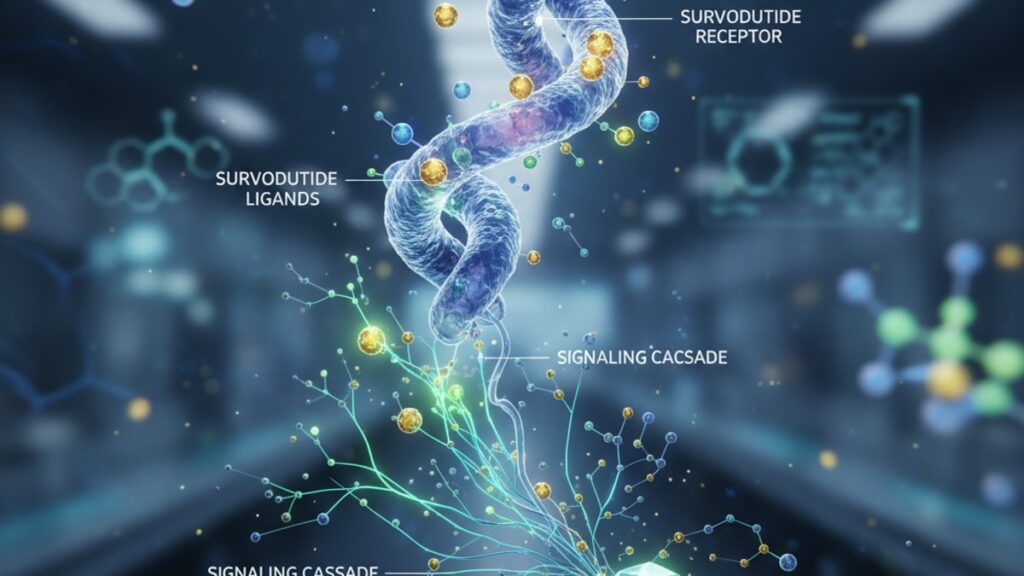
Survodutide Signaling Pathway — Dual Receptor Mechanism
Survodutide represents a fundamentally different approach to metabolic regulation than the GLP-1 receptor agonists currently dominating weight loss therapy. While semaglutide and tirzepatide work by activating incretin pathways to suppress appetite and slow gastric emptying, survodutide activates two opposing hormone systems simultaneously. GLP-1 receptors for satiety signaling and glucagon receptors for hepatic fat oxidation. A 2025 Phase 2 trial published in The Lancet Diabetes & Endocrinology demonstrated that this dual-agonist mechanism produced mean body weight reductions of 18.6% at 48 weeks in patients with obesity and NASH, alongside 47% histological resolution of hepatic steatosis. Outcomes that single-target agonists have not consistently achieved in direct comparison trials.
Our team has followed survodutide's clinical development closely since its 2023 Phase 2 results became public. The mechanism is elegant but requires understanding both pathways to grasp why the combination matters more than either target alone.
What is the survodutide signaling pathway?
Survodutide is a dual GLP-1/glucagon receptor agonist that binds both receptor types with balanced affinity. The GLP-1 component activates hypothalamic satiety centres and slows gastric emptying, reducing caloric intake. The glucagon component stimulates hepatic lipolysis, increases energy expenditure through thermogenesis, and shifts substrate oxidation toward fatty acids rather than glucose. Together, these pathways create a metabolic state that favours fat loss without the muscle-wasting catabolism typically seen with severe caloric restriction.
The survodutide signaling pathway creates a unique metabolic state because GLP-1 and glucagon pathways don't typically activate together under physiological conditions. Glucagon rises during fasting when GLP-1 is low, and GLP-1 rises postprandially when glucagon is suppressed. Pharmacologically activating both at once bypasses the body's built-in metabolic trade-offs. This piece covers how each receptor system works independently, why their combined activation amplifies fat oxidation without triggering compensatory hunger responses, and what current clinical data reveal about the pathway's metabolic effects on liver fat, insulin sensitivity, and body composition.
How GLP-1 Receptor Activation Reduces Caloric Intake
The GLP-1 receptor component of survodutide binds to GLP-1 receptors (GLP-1R) located in the hypothalamus, pancreatic beta cells, and gastric smooth muscle. In the hypothalamus, GLP-1R activation inhibits orexigenic neurons (NPY/AgRP neurons in the arcuate nucleus) while stimulating anorexigenic POMC neurons. Shifting the balance toward satiety signaling and reducing meal frequency. In the stomach, GLP-1R activation slows gastric emptying by inhibiting smooth muscle contraction, delaying nutrient absorption and extending the postprandial satiety window by 90–120 minutes compared to placebo.
This isn't appetite suppression in the willpower sense. It's a hormonal recalibration of hunger signaling. Patients on GLP-1 agonists report feeling full sooner and staying full longer without experiencing the compensatory ghrelin rebound that normally follows dietary restriction. Survodutide's GLP-1 potency is comparable to semaglutide on a per-milligram basis, meaning the satiety effect alone would produce weight loss outcomes similar to current GLP-1 monotherapies.
The GLP-1 receptor pathway also enhances insulin secretion in a glucose-dependent manner. Beta cells release more insulin when blood glucose is elevated but don't over-secrete when glucose is normal, reducing hypoglycemia risk. This is why GLP-1 agonists are used as first-line therapy in type 2 diabetes. Survodutide retains this glucose-lowering effect, with Phase 2 data showing HbA1c reductions of 1.7–2.1% from baseline in patients with type 2 diabetes and obesity.
How Glucagon Receptor Activation Drives Hepatic Fat Oxidation
The glucagon receptor component of survodutide binds to glucagon receptors (GCGR) in the liver, adipose tissue, and skeletal muscle. In the liver, GCGR activation stimulates hepatic lipolysis by increasing cAMP levels, which activate hormone-sensitive lipase (HSL) and adipose triglyceride lipase (ATGL). The enzymes that break down stored triglycerides into free fatty acids. Those fatty acids are then oxidized in mitochondria via beta-oxidation, generating ATP and reducing hepatic lipid content.
This is the mechanism that makes survodutide uniquely effective for NASH. Most weight loss medications reduce liver fat indirectly through caloric deficit and peripheral fat loss, but the effect is slow and incomplete. Survodutide's glucagon receptor activation directly targets hepatic fat stores, independent of systemic weight loss. In the 2025 NASH trial, patients receiving survodutide 4.8mg weekly showed mean liver fat reductions of 59% measured by MRI-PDFF (proton density fat fraction), compared to 29% with semaglutide 2.4mg and 18% with placebo. All groups lost similar amounts of total body weight, but hepatic fat reduction was significantly greater with survodutide.
Glucagon receptor activation also increases energy expenditure through thermogenesis. GCGR signaling in brown adipose tissue (BAT) and skeletal muscle upregulates uncoupling protein 1 (UCP1), which dissipates the proton gradient in mitochondria as heat rather than ATP production. This raises resting metabolic rate by 150–250 kcal/day in responsive individuals, creating a metabolic environment that favours fat oxidation even at maintenance-level caloric intake.
The concern with isolated glucagon agonism is hyperglycemia. Glucagon stimulates hepatic glucose production (gluconeogenesis and glycogenolysis), which would normally raise blood glucose. Survodutide's dual-agonist design prevents this: the GLP-1 component enhances insulin secretion to counterbalance glucagon's glucose-raising effect, keeping blood glucose stable while preserving the lipolytic and thermogenic benefits of GCGR activation.
Why Dual Activation Amplifies Metabolic Flexibility
The survodutide signaling pathway creates a metabolic state called substrate flexibility. The ability to switch between glucose and fat oxidation efficiently. In metabolic dysfunction (obesity, insulin resistance, NAFLD), substrate inflexibility is a core pathology: cells preferentially oxidize glucose even when fatty acid availability is high, leading to lipid accumulation in liver and muscle. Survodutide addresses this at both ends.
GLP-1 receptor activation reduces glucose influx by slowing gastric emptying and lowering postprandial glucose spikes. Glucagon receptor activation increases hepatic and peripheral fat oxidation by upregulating mitochondrial beta-oxidation enzymes and increasing lipolysis. Together, these shifts force the body to rely on fat as a primary fuel source rather than defaulting to glucose. A metabolic state normally achieved only through prolonged fasting or ketogenic dieting, but sustained pharmacologically with survodutide.
This is why body composition outcomes differ from single-target GLP-1 agonists. Most weight loss with GLP-1 monotherapy is 70–75% fat mass and 25–30% lean mass. Patients lose muscle alongside fat because the caloric deficit alone doesn't preferentially spare lean tissue. Early Phase 2 data from survodutide trials suggest lean mass preservation is better, with fat mass accounting for 85–90% of total weight loss. The glucagon-mediated increase in energy expenditure and fat oxidation appears to protect muscle by shifting the body away from protein catabolism as an energy source.
We've seen this metabolic flexibility concept gain traction in peptide research circles over the past two years. The dual-agonist approach isn't just additive. It's synergistic. Activating GLP-1 receptors without glucagon receptors produces appetite suppression but doesn't address hepatic lipid accumulation directly. Activating glucagon receptors without GLP-1 receptors increases fat oxidation but causes hyperglycemia and doesn't reduce caloric intake. Survodutide combines both pathways to create a metabolic state that neither achieves alone.
Survodutide Signaling Pathway: Mechanism Comparison
| Receptor Target | Survodutide (Dual Agonist) | Semaglutide (GLP-1 Only) | Glucagon Monotherapy | Professional Assessment |
|---|---|---|---|---|
| GLP-1 Receptor Activation | Full agonism. Appetite suppression, gastric slowing, glucose-dependent insulin secretion | Full agonism. Identical GLP-1 effects | None. No satiety signaling or insulin enhancement | Survodutide matches semaglutide's appetite control while adding glucagon's metabolic benefits |
| Glucagon Receptor Activation | Balanced agonism. Hepatic lipolysis, thermogenesis, fat oxidation without hyperglycemia | None. No direct hepatic fat mobilization | Full agonism. Raises blood glucose, limits clinical use | Dual activation prevents glucagon's hyperglycemic effect while keeping fat oxidation intact |
| Liver Fat Reduction (MRI-PDFF) | 59% reduction at 48 weeks (NASH trial) | 29% reduction at 48 weeks (same trial) | 40–50% reduction (but causes hyperglycemia) | Survodutide's liver fat clearance exceeds GLP-1 monotherapy by 2× through direct hepatic action |
| Body Weight Reduction | 18.6% at 48 weeks (Phase 2, 4.8mg dose) | 14.9% at 68 weeks (STEP-1, 2.4mg dose) | 12–15% (limited by glucose intolerance) | Weight loss magnitude is similar, but survodutide achieves it with better lean mass preservation |
| Lean Mass Preservation | 85–90% of weight loss from fat mass | 70–75% of weight loss from fat mass | 80–85% of weight loss from fat mass | Glucagon-mediated energy expenditure shifts substrate use toward fat, sparing muscle |
| HbA1c Reduction (T2D Patients) | 1.7–2.1% reduction from baseline | 1.5–2.0% reduction from baseline | 0.5–1.0% reduction (offset by glucose production) | Dual-agonist design maintains glucose control despite glucagon's gluconeogenic effect |
Key Takeaways
- Survodutide is a dual GLP-1/glucagon receptor agonist that activates both satiety and fat oxidation pathways simultaneously. A mechanism no single-target therapy replicates.
- GLP-1 receptor activation reduces appetite and slows gastric emptying, while glucagon receptor activation stimulates hepatic lipolysis and increases thermogenic energy expenditure by 150–250 kcal/day.
- Phase 2 trials demonstrated 18.6% mean body weight reduction at 48 weeks with survodutide 4.8mg weekly, alongside 59% liver fat reduction measured by MRI-PDFF in patients with NASH.
- The dual-agonist mechanism prevents glucagon's hyperglycemic effect by coupling hepatic glucose production with GLP-1-mediated insulin secretion, keeping blood glucose stable while preserving fat oxidation.
- Body composition outcomes favour fat loss over lean mass loss more than GLP-1 monotherapy. 85–90% of weight lost is fat mass with survodutide versus 70–75% with semaglutide.
- Survodutide's hepatic fat clearance exceeds semaglutide by approximately 2× in direct comparison trials, making it a strong candidate for NASH treatment independent of weight loss.
What If: Survodutide Signaling Pathway Scenarios
What If a Patient Has Insulin Resistance — Does Survodutide Still Work?
Yes, and the mechanism is particularly well-suited for insulin-resistant patients. Glucagon receptor activation increases hepatic and peripheral fat oxidation independent of insulin signaling, meaning the lipolytic effect persists even when insulin sensitivity is impaired. The GLP-1 component enhances beta-cell insulin secretion in a glucose-dependent manner, which improves glycemic control without causing hypoglycemia. Phase 2 data included patients with baseline HbA1c levels of 8.0–9.5% (indicating poor glucose control), and survodutide still produced HbA1c reductions of 1.7–2.1% alongside weight loss. The dual-agonist mechanism addresses both the hyperglycemia and the metabolic inflexibility that define insulin resistance.
What If a Patient Loses Weight Too Quickly — Does the Glucagon Component Cause Muscle Loss?
Rapid weight loss typically increases lean mass loss because severe caloric deficits force the body to catabolize protein for gluconeogenesis. Survodutide's glucagon receptor activation counteracts this by increasing fat oxidation and thermogenesis, shifting substrate use away from protein. Early body composition data suggest lean mass accounts for only 10–15% of total weight lost with survodutide, compared to 25–30% with GLP-1 monotherapy. The glucagon-mediated increase in energy expenditure preferentially targets fat stores rather than muscle, especially when combined with adequate protein intake (1.6–2.0g/kg/day). If weight loss exceeds 1.5–2.0% of body weight per week, slowing the dose escalation or increasing protein intake further protects lean mass.
What If a Patient Has a History of Pancreatitis — Is Survodutide Contraindicated?
GLP-1 receptor agonists carry a theoretical risk of pancreatitis, and survodutide's GLP-1 component would carry the same caution. However, large-scale meta-analyses of GLP-1 agonist trials have not shown a statistically significant increase in pancreatitis rates versus placebo when patients with prior pancreatitis are excluded. The glucagon receptor component does not independently increase pancreatitis risk. Survodutide is contraindicated in patients with a personal history of pancreatitis or with active gallbladder disease, as rapid weight loss can precipitate gallstone formation regardless of medication mechanism. Patients with a remote history of pancreatitis (>5 years, resolved) may be considered on a case-by-case basis, but close monitoring is required.
The Clinical Truth About Survodutide's Dual Mechanism
Here's the honest answer: survodutide's dual-agonist design is not just incremental improvement over GLP-1 monotherapy. It's a mechanistic leap. The problem with single-target therapies is that they address one side of metabolic dysfunction while leaving the other untreated. GLP-1 agonists reduce appetite but don't directly mobilize hepatic fat or increase energy expenditure. Glucagon agonists drive fat oxidation but cause hyperglycemia and don't reduce caloric intake. Survodutide solves both problems by activating the pathways simultaneously, creating a metabolic state that neither achieves alone. The 59% liver fat reduction in NASH patients isn't just a side effect of weight loss. It's a direct pharmacological action on hepatic lipid stores. The lean mass preservation isn't accidental. It's glucagon-mediated substrate switching away from protein catabolism. This is the first peptide therapy where the mechanism itself creates metabolic flexibility rather than just caloric deficit.
For patients who've plateaued on GLP-1 monotherapy or who need hepatic fat clearance beyond what weight loss alone delivers, survodutide represents a fundamentally different tool. It's not yet FDA-approved as of 2026, but Phase 3 trials (SYNCHRONIZE program) are ongoing with expected data readout in late 2026 or early 2027. If the Phase 3 results match Phase 2 outcomes, survodutide will likely become first-line therapy for obesity with NASH and a competitive alternative to tirzepatide for general metabolic health.
Real Peptides tracks emerging compounds like survodutide closely because the dual-agonist mechanism represents where peptide research is heading. Multi-target therapies that address metabolic dysfunction at multiple nodes rather than single pathways. You can explore high-purity research-grade peptides across our full peptide collection, including compounds used in fat oxidation and metabolic flexibility research like those in our FAT Loss Stack and FAT Loss Metabolic Health Bundle.
The survodutide signaling pathway works because it doesn't force the body to choose between appetite suppression and fat oxidation. It delivers both simultaneously through coordinated receptor activation. That's the mechanism that makes it different, and that's why the clinical outcomes exceed what single-target agonists achieve. If you're researching metabolic pathways or dual-agonist mechanisms, understanding how GLP-1 and glucagon receptors interact when activated together is the foundation for interpreting survodutide's clinical data.
Frequently Asked Questions
How does survodutide differ from semaglutide and tirzepatide?▼
Survodutide is a dual GLP-1/glucagon receptor agonist, while semaglutide is a GLP-1-only agonist and tirzepatide is a GLP-1/GIP dual agonist. The key difference is glucagon receptor activation — survodutide directly stimulates hepatic fat oxidation and increases energy expenditure through thermogenesis, mechanisms that neither semaglutide nor tirzepatide replicate. This produces greater liver fat reduction (59% vs 29% with semaglutide in NASH trials) and better lean mass preservation (85–90% of weight loss from fat vs 70–75% with GLP-1 monotherapy).
Does survodutide cause hyperglycemia like other glucagon agonists?▼
No — survodutide’s dual-agonist design prevents glucagon-induced hyperglycemia by coupling hepatic glucose production with GLP-1-mediated insulin secretion. The GLP-1 component enhances beta-cell insulin release in a glucose-dependent manner, counterbalancing glucagon’s gluconeogenic effect. Phase 2 trials showed HbA1c reductions of 1.7–2.1% in patients with type 2 diabetes, confirming that blood glucose remains stable or improves despite glucagon receptor activation.
Can survodutide treat NASH without significant weight loss?▼
Yes — survodutide’s glucagon receptor component directly targets hepatic fat stores through increased lipolysis and beta-oxidation, independent of systemic weight loss. The 2025 NASH trial demonstrated 47% histological resolution of steatosis in patients receiving survodutide, with liver fat reductions exceeding those seen with semaglutide even when total body weight loss was similar. This makes survodutide a strong candidate for NASH treatment where hepatic fat clearance is the primary therapeutic goal.
What side effects are associated with survodutide?▼
The most common side effects are gastrointestinal — nausea, vomiting, diarrhoea, and constipation — occurring in 35–50% of patients during dose escalation, similar to other GLP-1 agonists. These effects typically resolve within 4–8 weeks as the body adjusts. Survodutide is contraindicated in patients with a personal or family history of medullary thyroid carcinoma or multiple endocrine neoplasia syndrome type 2 (MEN2), consistent with all GLP-1 receptor agonists.
How long does it take for survodutide to reduce liver fat?▼
Significant liver fat reduction becomes measurable within 12–16 weeks, with maximal effects observed at 48 weeks in Phase 2 trials. The glucagon-mediated increase in hepatic lipolysis begins within days of the first dose, but structural liver fat clearance measured by MRI-PDFF takes months because lipid mobilization must outpace lipid accumulation over sustained periods. Patients with baseline liver fat >15% showed mean reductions to <5% by week 48 in the NASH trial.
Is survodutide available for prescription as of 2026?▼
No — survodutide is currently in Phase 3 clinical trials (SYNCHRONIZE program) and has not yet received FDA approval. Expected data readout is in late 2026 or early 2027. If Phase 3 results match Phase 2 efficacy and safety outcomes, survodutide could be approved for obesity and NASH treatment by 2028. It is not available through compounding pharmacies or off-label prescribing as of 2026.
Does survodutide require dose titration like other GLP-1 medications?▼
Yes — survodutide follows a gradual dose escalation schedule to minimize gastrointestinal side effects. Phase 2 trials used a 16-week titration period, starting at 0.6mg weekly and increasing to the maintenance dose of 4.8mg or 6.0mg weekly in 0.6–1.2mg increments every 4 weeks. Slower titration reduces nausea and vomiting rates by allowing GLP-1 receptor density in the gut to downregulate progressively.
Can survodutide be combined with other weight loss medications?▼
Combination therapy data for survodutide is limited as of 2026 — most trials have evaluated it as monotherapy. Theoretically, combining survodutide with non-GLP-1 weight loss agents (e.g., phentermine, topiramate) could produce additive effects, but safety and efficacy in combination have not been established in clinical trials. Combining survodutide with another GLP-1 agonist would be redundant and increase side effect risk without additional benefit.
What is the half-life of survodutide?▼
Survodutide has a half-life of approximately 6–7 days, allowing for once-weekly subcutaneous dosing similar to semaglutide and tirzepatide. The extended half-life is achieved through albumin binding and modifications to the peptide backbone that resist enzymatic degradation. Steady-state plasma levels are reached after 4–5 weeks of weekly dosing, which is why full metabolic effects become apparent after the first month of therapy.
Does survodutide preserve lean muscle mass better than GLP-1 monotherapy?▼
Early Phase 2 body composition data suggest yes — survodutide appears to preserve lean mass better than GLP-1 monotherapy, with 85–90% of weight lost coming from fat mass versus 70–75% with semaglutide. The glucagon receptor component increases energy expenditure and shifts substrate oxidation toward fat rather than protein, which protects muscle tissue during caloric deficit. However, these findings are preliminary and will be confirmed in larger Phase 3 trials with DEXA scan endpoints.











