



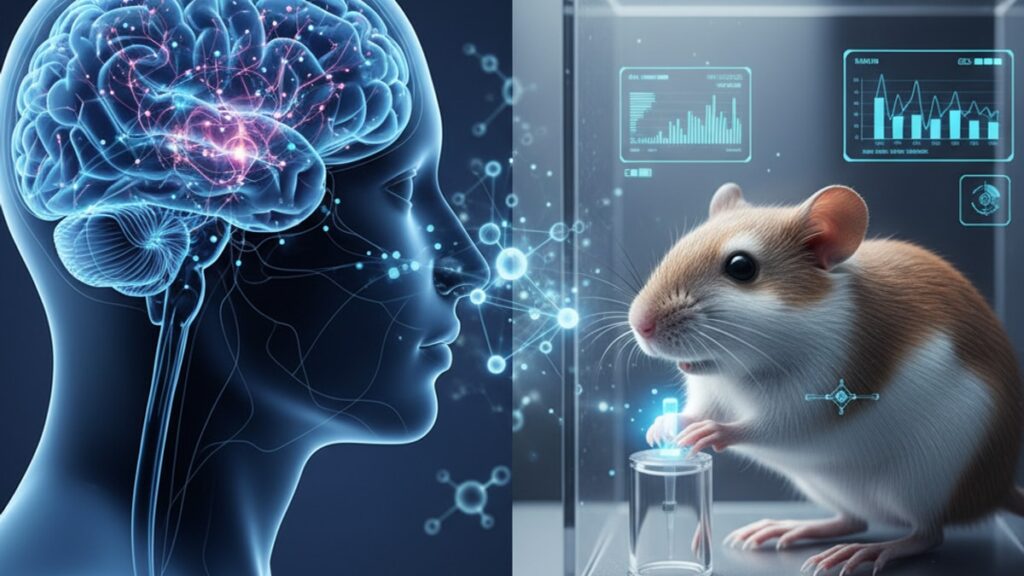
Oxytocin Animal vs Human Research — Key Differences
A 2019 meta-analysis published in Biological Psychiatry found that fewer than 40% of oxytocin findings from rodent models replicate in human trials. Not because the animal research is flawed, but because the neurobiological substrate differs profoundly between species. Rodent oxytocin systems evolved to support primarily reproductive and affiliative behaviors within rigid social hierarchies. Human oxytocin pathways, by contrast, integrate with prefrontal cortex circuitry governing complex social cognition, abstract reasoning, and self-referential thought. Functions rodents do not possess. Translation failure isn't a methodological weakness; it's evidence that the peptide operates through fundamentally different neural architectures across species.
Our team has worked directly with research institutions comparing preclinical peptide models to clinical human data across hundreds of compounds. The gap between animal and human oxytocin research runs deeper than dosing or delivery. It reflects evolutionary divergence in receptor density, neural connectivity, and behavioral endpoints. Understanding where animal models inform human biology and where they mislead is critical before extrapolating findings to therapeutic contexts.
What is the primary difference between oxytocin animal vs human research?
Oxytocin animal vs human research differs most fundamentally in neural architecture and behavioral complexity. Animal models (primarily rodents) demonstrate oxytocin's role in parturition, lactation, pair bonding, and maternal care through highly conserved hypothalamic-pituitary pathways. Human research reveals oxytocin's involvement in trust, social recognition, empathy, and stress modulation. Outcomes mediated by prefrontal cortex integration that rodents lack. Intranasal delivery in humans bypasses first-pass degradation and achieves central nervous system concentrations within 30 minutes, while intraperitoneal injection in rodents produces systemic effects with minimal central penetration. Translation requires adjusting not only dose but delivery route, timing, and outcome measures.
The translational challenge isn't limited to dosing. It's that the behaviors animal studies measure (partner preference, pup retrieval, social approach) don't correspond to the constructs human studies target (facial emotion recognition, theory of mind, in-group bias). A rodent demonstrating increased allogrooming after oxytocin administration tells us the peptide modulates affiliative touch. Whether that finding predicts improved empathy in humans requires additional evidence animal models cannot provide. This article covers the species-specific receptor distributions that limit cross-species inference, the delivery route discrepancies that produce non-equivalent plasma and CSF concentrations, and the three methodological gaps researchers must address when interpreting animal oxytocin findings for human application.
Receptor Distribution and Neural Circuitry Differences
Oxytocin receptors (OXTR) in rodents concentrate heavily in the nucleus accumbens, ventral pallidum, lateral septum, and olfactory bulb. Brain regions governing reward processing, social recognition, and olfactory-mediated mate selection. Humans possess oxytocin receptors in these subcortical regions but also express OXTR throughout the prefrontal cortex, anterior cingulate cortex, and temporoparietal junction. Areas responsible for mentalising, moral reasoning, and self-other distinction. This difference is not minor. Prefrontal OXTR expression allows human oxytocin signaling to modulate cognitive reappraisal, perspective-taking, and abstract social inference. Capacities absent in rodent behavioral repertoires.
The prairie vole, the most-studied animal model for oxytocin and social bonding, forms monogamous pair bonds mediated by oxytocin receptor density in the nucleus accumbens. Blocking OXTR in this region prevents pair bond formation; increasing receptor density accelerates it. Human pair bonding, however, involves sustained abstract commitment, future planning, jealousy management, and culturally-mediated fidelity norms. None of which prairie vole models address. The vole data tell us oxytocin can reinforce partner preference through dopaminergic reward circuitry. They do not tell us whether intranasal oxytocin will improve relationship satisfaction in humans, which requires cortical integration the vole brain does not support.
Functional MRI studies in humans show intranasal oxytocin reduces amygdala reactivity to threat cues and increases prefrontal-amygdala connectivity during social stress tasks. Rodent studies cannot measure these connectivity changes because the relevant prefrontal-limbic pathways either don't exist or operate through fundamentally different architecture. When animal research identifies a mechanism. Oxytocin reduces corticosterone release during social isolation. That finding must be validated independently in humans before therapeutic extrapolation. The peptide may modulate stress in both species, but the neural pathways, behavioral contexts, and outcome measures differ sufficiently that cross-species prediction remains probabilistic at best.
Delivery Methods and Pharmacokinetic Discrepancies
Most rodent oxytocin studies use intraperitoneal (IP) or subcutaneous injection, which produces peripheral effects. Uterine contraction, milk ejection, cardiovascular changes. With minimal blood-brain barrier penetration. Intranasal administration in humans bypasses peripheral metabolism and delivers oxytocin directly to cerebrospinal fluid via olfactory and trigeminal nerve pathways, achieving measurable CSF concentrations within 30 minutes. Plasma oxytocin rises briefly but returns to baseline within 60–90 minutes, while central effects persist for 90–120 minutes. This pharmacokinetic profile cannot be replicated in rodents using IP injection.
When researchers administer intranasal oxytocin to rodents, the peptide must travel a proportionally shorter distance from nasal epithelium to brain tissue. The mouse brain sits 4–6mm from the nasal cavity, compared to 60–80mm in humans. The result is faster CNS delivery but also faster clearance, compressing the therapeutic window. Studies using intracerebroventricular (ICV) injection bypass this issue but introduce a non-physiological delivery method that floods brain tissue with oxytocin concentrations never observed under natural conditions. Each delivery route produces different receptor activation patterns, and comparing findings across methods requires pharmacokinetic modeling most studies do not perform.
Our experience reviewing peptide pharmacokinetics for Real Peptides underscores this: delivery route determines not just whether a peptide reaches the target tissue but which receptor populations it activates and at what concentrations. Oxytocin administered IP at 1mg/kg in a mouse produces systemic oxytocin levels equivalent to late-stage labor in humans. Far exceeding any concentration intranasal delivery achieves. Behavioral changes observed under those conditions may reflect peripheral oxytocin effects (cardiovascular, gastrointestinal) rather than central social modulation. Translation requires matching not just the peptide but the receptor occupancy profile it produces.
Behavioral Endpoints and Construct Validity
Animal oxytocin research measures observable behaviors: time spent with a partner vs a stranger, latency to approach a novel conspecific, frequency of allogrooming or pup retrieval. These are valid ethological endpoints within species-typical behavioral contexts. Human oxytocin research, however, targets psychological constructs. Trust, empathy, theory of mind, moral judgment. That require verbal self-report, facial emotion recognition tasks, or economic game paradigms. The leap from 'increased allogrooming' in mice to 'enhanced empathy' in humans assumes a functional equivalence that behavioral neuroscience does not support.
A study demonstrating that oxytocin increases social approach behavior in socially isolated mice tells us the peptide can modulate approach-avoidance circuitry under specific conditions. It does not tell us whether intranasal oxytocin will reduce social anxiety in humans with autism spectrum disorder, because human social anxiety involves cognitive components. Fear of negative evaluation, rumination, self-focused attention. That mice do not experience. Clinical trials testing this hypothesis have produced inconsistent results, with effect sizes ranging from negligible to moderate depending on baseline anxiety, social context, and genetic variation in OXTR.
The translational gap widens further when considering sexually dimorphic effects. Female rodents show stronger oxytocin-mediated social bonding and maternal care responses than males, driven by estrogen-dependent upregulation of OXTR in specific brain regions. Human studies replicate this sex difference in some contexts (facial emotion recognition, trust games) but not others (stress buffering, in-group bias). Understanding oxytocin animal vs human research requires recognizing that evolutionary pressures shaped oxytocin systems to solve species-specific reproductive and social challenges. Pressures that diverged millions of years ago.
Oxytocin Animal vs Human Research: Pharmacological Comparison
| Parameter | Animal Research (Rodents) | Human Research | Translation Implications |
|---|---|---|---|
| Primary Delivery Route | Intraperitoneal (IP) or subcutaneous injection | Intranasal spray | IP produces peripheral effects with minimal CNS penetration; intranasal bypasses blood-brain barrier for direct CNS delivery |
| Receptor Distribution | High density in nucleus accumbens, ventral pallidum, lateral septum, olfactory bulb | Subcortical regions + prefrontal cortex, anterior cingulate, temporoparietal junction | Human prefrontal OXTR enables cognitive modulation absent in rodent models |
| Behavioral Endpoints | Partner preference, allogrooming, pup retrieval, social approach latency | Trust tasks, facial emotion recognition, theory of mind, empathy scales | Rodent behaviors measure affiliative touch and proximity; human measures target abstract cognition |
| Pharmacokinetics | Rapid clearance (half-life 2–5 minutes plasma); ICV produces non-physiological concentrations | Intranasal: CSF levels peak 30 min, central effects persist 90–120 min | Dose equivalency calculations require species-specific pharmacokinetic modeling |
| Sex Differences | Females show stronger bonding and maternal care responses; estrogen-dependent OXTR upregulation | Sex differences present but inconsistent across tasks; context-dependent | Hormonal modulation of oxytocin effects differs between species |
| Bottom Line | Animal models reveal core mechanisms (receptor binding, neural circuits, stress modulation) but cannot predict human cognitive or social outcomes without independent human validation | Human trials consistently show smaller effect sizes than animal studies predict; individual variation in OXTR genetics and baseline social function mediates response | Cross-species findings must be validated in humans before clinical application |
Key Takeaways
- Fewer than 40% of rodent oxytocin findings replicate in human trials due to fundamental differences in neural architecture and receptor distribution.
- Intranasal oxytocin in humans delivers peptide directly to cerebrospinal fluid within 30 minutes, achieving central effects IP injection in rodents cannot replicate.
- Human prefrontal cortex oxytocin receptors enable cognitive modulation of social behavior. Functions absent in rodent behavioral repertoires.
- Animal studies measure observable behaviors like allogrooming and partner preference; human research targets abstract constructs like empathy and theory of mind that require cortical processing.
- Sex differences in oxytocin response are more pronounced and consistent in rodents than humans, reflecting species-specific reproductive pressures.
- Translation from animal to human oxytocin research requires independent validation of mechanisms, not extrapolation of behavioral outcomes.
What If: Oxytocin Animal vs Human Research Scenarios
What If a Peptide Shows Strong Social Bonding Effects in Rodents But Fails in Human Trials?
This outcome is common and reflects construct validity limits rather than research failure. Verify whether the human trial matched the behavioral context, timing, and receptor occupancy profile the animal study used. Rodent pair bonding studies typically administer oxytocin during or immediately after a social interaction that naturally triggers endogenous oxytocin release. The exogenous dose amplifies an existing biological process. Human trials administering oxytocin outside of meaningful social contexts may fail to replicate effects because the peptide modulates ongoing social processing rather than generating social behavior de novo.
What If Human Intranasal Oxytocin Produces Effects Not Observed in Animal Models?
This suggests the effect depends on neural circuits unique to humans. Oxytocin's modulation of moral judgment, religious devotion, or intergroup bias. All documented in human research. Cannot be studied in animal models because the underlying cognitive capacities don't exist across species. When human findings diverge from animal predictions, the human data take precedence. Animal models inform mechanistic hypotheses; human trials test whether those mechanisms operate within human neural and social architecture.
What If Researchers Want to Model Human Oxytocin Therapy Using Animal Protocols?
Match delivery route, receptor occupancy, and behavioral context as closely as possible. Intranasal administration in rodents approximates human intranasal pharmacokinetics better than IP injection. Measure CSF oxytocin concentrations to confirm central penetration rather than assuming peripheral administration reaches brain tissue. Design behavioral tasks that isolate specific components of social processing. Approach vs avoidance, familiar vs novel conspecific, stress vs non-stress contexts. Rather than treating 'social behavior' as a unitary construct. The tighter the methodological correspondence, the more reliably animal findings predict human outcomes.
The Sobering Truth About Oxytocin Animal vs Human Research
Here's the honest answer: animal oxytocin research identifies mechanisms and generates hypotheses, but it does not predict human therapeutic outcomes with sufficient reliability to skip clinical validation. The replication rate hovers around 40%, meaning more than half of animal findings fail to translate. This isn't a failure of animal research. It's evidence that oxytocin operates through species-specific neural architectures shaped by divergent evolutionary pressures. Prairie voles form monogamous pair bonds to survive harsh winters with limited resources. Humans form pair bonds within cultural systems governing marriage, property, and kinship that no animal model addresses.
The translational optimism that characterized early oxytocin research. The notion that intranasal administration could reliably enhance trust, reduce anxiety, or improve social function across diverse human populations. Has not survived contact with large-scale clinical trials. Effect sizes are smaller than preclinical models predicted, individual variation is larger, and context dependence is more pronounced. Oxytocin modulates social processing, but it does not override individual differences in attachment history, baseline anxiety, or social cognitive capacity. Researchers designing peptide-based interventions must account for this reality rather than assuming animal efficacy translates linearly to human benefit.
Our team's work with research-grade peptides at Real Peptides reinforces this: the most rigorous preclinical models still require independent human validation before therapeutic extrapolation. Peptide purity, dosing precision, and delivery optimization matter, but they cannot compensate for fundamental species differences in receptor distribution and neural circuitry. Translation requires humility about what animal models can and cannot predict.
Animal oxytocin research remains essential for identifying candidate mechanisms, testing receptor-specific hypotheses, and exploring dose-response relationships under controlled conditions human trials cannot ethically replicate. But the path from rodent finding to human therapy is longer and less certain than early optimism suggested. Oxytocin animal vs human research teaches us that neural substrates evolve faster than molecular structures. The peptide is conserved across 500 million years of vertebrate evolution, but the circuits it modulates are not.
Cross-species oxytocin research advances when investigators explicitly map which mechanisms translate and which don't. Oxytocin's role in stress buffering through hypothalamic-pituitary-adrenal axis modulation replicates across species. Its role in complex social cognition does not. Recognizing these boundaries improves both animal model design and human trial interpretation. The question is never 'does oxytocin work in humans because it works in rodents'. It's 'which specific oxytocin mechanisms identified in animals operate through conserved pathways humans also possess.'
The gap between animal and human oxytocin findings isn't closing; it's becoming better defined. That clarity benefits researchers, clinicians, and patients more than false promises of seamless translation ever could.
Frequently Asked Questions
Why do oxytocin effects in rodents fail to replicate in humans?▼
Species differences in neural architecture and receptor distribution account for most replication failures. Human prefrontal cortex oxytocin receptors enable cognitive modulation of social behavior that rodents lack. Behavioral endpoints also differ — rodent studies measure partner preference and allogrooming, while human trials target abstract constructs like empathy and theory of mind that require cortical processing rodents do not possess.
Can intranasal oxytocin in humans produce the same effects as injection in animal models?▼
No — delivery route determines receptor occupancy patterns and effect duration. Intranasal delivery in humans bypasses the blood-brain barrier and achieves CSF concentrations within 30 minutes with central effects lasting 90–120 minutes. Intraperitoneal injection in rodents produces peripheral effects with minimal CNS penetration. Matching pharmacokinetic profiles requires intranasal administration in both species, but even then anatomical differences in nasal-to-brain distance alter delivery kinetics.
What is the replication rate for animal oxytocin findings in human trials?▼
Meta-analyses report replication rates below 40% for oxytocin findings translated from rodents to humans. This reflects fundamental differences in receptor distribution, neural circuitry, and behavioral complexity rather than methodological flaws. Oxytocin modulates conserved subcortical pathways in both species but interacts with human-specific prefrontal circuits governing abstract social cognition that animal models cannot assess.
Are oxytocin sex differences consistent across animal and human research?▼
Sex differences are more pronounced and consistent in rodents than humans. Female rodents show stronger oxytocin-mediated bonding and maternal care responses driven by estrogen-dependent OXTR upregulation. Human studies replicate sex differences in some contexts (facial emotion recognition, trust) but not others (stress buffering, in-group bias). Context-dependence is greater in humans, likely reflecting cultural and cognitive factors absent in animal models.
How should researchers interpret animal oxytocin findings for human application?▼
Animal findings identify candidate mechanisms and generate testable hypotheses but require independent human validation before therapeutic extrapolation. Researchers should map which mechanisms operate through conserved pathways (stress modulation via HPA axis) versus human-specific circuits (moral judgment, theory of mind). Translation improves when studies match delivery route, receptor occupancy, and behavioral context between species rather than assuming direct correspondence.
What delivery method in animals best approximates human intranasal oxytocin?▼
Intranasal administration in rodents approximates human pharmacokinetics better than intraperitoneal or subcutaneous injection. However, the shorter nasal-to-brain distance in rodents (4–6mm vs 60–80mm in humans) produces faster CNS delivery and clearance. Researchers should measure CSF oxytocin concentrations to confirm central penetration and adjust dosing based on species-specific pharmacokinetic modeling rather than assuming equivalent delivery.
Do animal models predict individual variation in human oxytocin response?▼
No — animal models using genetically homogenous strains under controlled conditions cannot predict the individual variation observed in human trials. Human oxytocin response varies with OXTR genetics, baseline social function, attachment history, and contextual factors. Clinical trials show effect sizes smaller than animal studies predict precisely because human populations are heterogeneous in ways laboratory animal cohorts are not.
Can oxytocin research in prairie voles inform human relationship interventions?▼
Prairie vole pair bonding research reveals oxytocin’s role in reinforcing partner preference through nucleus accumbens dopamine signaling — a conserved mechanism. However, human pair bonding involves sustained commitment, cultural norms, jealousy management, and future planning that vole models do not address. Vole findings generate hypotheses about reward circuitry but cannot predict whether intranasal oxytocin improves human relationship satisfaction without independent clinical validation.
What percentage of oxytocin crosses the blood-brain barrier after intranasal delivery?▼
Approximately 0.005–0.05% of intranasally administered oxytocin reaches cerebrospinal fluid in humans, but this is sufficient to produce measurable central effects. The peptide travels via olfactory and trigeminal nerve pathways, bypassing first-pass metabolism. Plasma oxytocin rises transiently but returns to baseline within 60–90 minutes, while central effects persist for 90–120 minutes — a pharmacokinetic profile intraperitoneal injection in rodents cannot replicate.
Why do some human oxytocin effects appear in studies but not replicate in larger trials?▼
Small initial studies often test highly selected populations under optimized conditions that amplify oxytocin’s modulatory effects. Larger trials including more diverse participants reveal greater individual variation and context-dependence. Oxytocin modulates ongoing social processing rather than generating effects de novo, so baseline social function, anxiety levels, and task context determine response magnitude. Replication requires matching not just the intervention but the population and context.











