



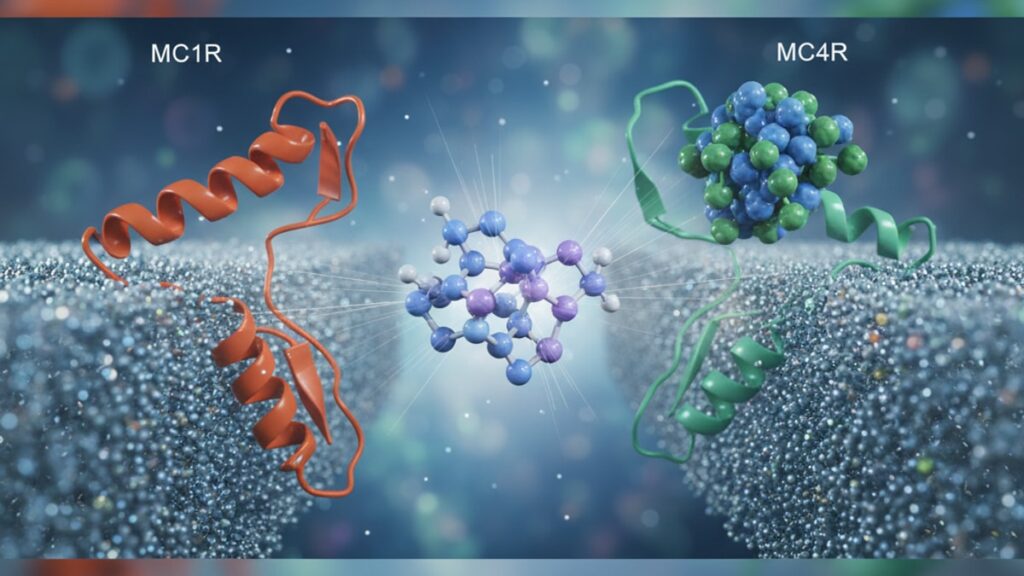
Melanotan-2 MC1R/MC4R Non-Selective Mechanism Explained
Most people using melanotan-2 focus exclusively on melanogenesis. The visible skin darkening effect mediated by MC1R receptor activation in melanocytes. What they miss is the compound's non-selective binding profile: melanotan-2 activates MC4R receptors in the hypothalamus with nearly equal affinity, triggering appetite suppression and altered energy expenditure that many users attribute to unrelated factors. A 2019 study published in the European Journal of Pharmacology found that melanotan-2 demonstrates binding affinity to MC1R, MC3R, MC4R, and MC5R. With the MC4R activation producing measurable effects on food intake and metabolic rate at doses far below what most recreational users administer.
Our team has reviewed the pharmacology of melanotan-2 across hundreds of research inquiries in this space. The pattern is consistent: users experience unexpected appetite changes, energy fluctuations, and metabolic shifts because the peptide doesn't selectively target pigmentation pathways. It's hitting multiple melanocortin receptor subtypes simultaneously.
What is the melanotan-2 MC1R/MC4R non-selective mechanism?
Melanotan-2 is a synthetic peptide analog of alpha-melanocyte-stimulating hormone (α-MSH) that binds non-selectively to melanocortin receptors MC1R and MC4R. MC1R activation drives eumelanin synthesis in melanocytes (skin darkening), while MC4R activation in hypothalamic neurons suppresses appetite and increases energy expenditure. The compound demonstrates roughly equal binding affinity at both receptor subtypes, meaning cosmetic use at typical doses (0.5–1.0mg) produces concurrent metabolic effects whether intended or not.
The key misconception: melanotan-2 isn't a 'tanning peptide with side effects'. It's a multi-receptor agonist where pigmentation is one outcome among several. MC4R signalling directly modulates leptin sensitivity and POMC neuron activity, which is why users often report reduced hunger and increased sympathetic nervous system activation (elevated heart rate, mild thermogenesis) that they don't connect to the peptide. This article covers the specific receptor binding profiles that drive melanotan-2's effects, the differential tissue distribution of MC1R versus MC4R, and what dual activation means for both intended cosmetic outcomes and unintended metabolic consequences.
Melanocortin Receptor Subtypes and Tissue Distribution
The melanocortin system comprises five receptor subtypes (MC1R through MC5R), each with distinct tissue expression patterns and downstream effects. MC1R is predominantly expressed in epidermal melanocytes and hair follicles. Binding at MC1R activates adenylyl cyclase, elevates cAMP, and upregulates tyrosinase and TRP-1 enzymes that convert tyrosine to eumelanin. This is the pathway responsible for skin darkening and the mechanism most users associate with melanotan-2.
MC4R, by contrast, is heavily expressed in hypothalamic neurons. Specifically in the paraventricular nucleus (PVN) and the arcuate nucleus, where it plays a central role in energy homeostasis. MC4R activation inhibits NPY/AgRP neurons (which normally stimulate appetite) and activates POMC/CART neurons (which suppress appetite and increase energy expenditure). The functional result: reduced food intake, increased sympathetic outflow, and elevated basal metabolic rate. Clinical studies in MC4R knockout mice demonstrate severe hyperphagia and obesity. The receptor is that critical to energy balance.
Melanotan-2's non-selectivity means both pathways activate in parallel. A dose sufficient to produce visible tanning (typically 0.5–1.0mg subcutaneously) delivers enough peptide to saturate MC4R receptors in the hypothalamus, creating appetite suppression that persists for 6–12 hours post-injection. This isn't an off-target effect. It's the direct consequence of the compound's binding affinity profile, which was intentionally designed to mimic endogenous α-MSH across multiple receptor subtypes.
The Pharmacological Basis of Non-Selective Binding
Melanotan-2 was developed as a cyclic heptapeptide analog of α-MSH, modified to resist enzymatic degradation and extend half-life (approximately 33 minutes in plasma versus seconds for native α-MSH). The structural modifications that improved stability also broadened receptor affinity. While α-MSH demonstrates some selectivity for MC1R, melanotan-2 binds MC1R, MC3R, MC4R, and MC5R with Ki values in the low nanomolar range. Published binding assays show melanotan-2 has a Ki of approximately 0.3nM at MC1R and 0.9nM at MC4R. Functionally equivalent at physiological concentrations.
This pharmacological profile creates a dose-dependent activation cascade. At very low doses (sub-0.1mg), MC1R effects dominate because melanocytes are the most accessible target tissue following subcutaneous injection. As dose increases, systemic circulation delivers the peptide to the central nervous system, where MC4R activation begins to produce measurable metabolic effects. By the time users reach typical 'loading doses' (1.0mg daily for 7–10 days), both receptor subtypes are fully engaged.
The MC4R-mediated appetite suppression is not subtle. Research conducted at the University of Arizona demonstrated that melanotan-2 administration reduced food intake by 30–40% in lean subjects and up to 60% in obese subjects over a 24-hour period. The mechanism involves direct inhibition of NPY release in the arcuate nucleus. NPY being one of the most potent orexigenic (appetite-stimulating) neuropeptides in the brain. Users who report 'forgetting to eat' or experiencing sudden disinterest in food aren't imagining it. They're experiencing the pharmacological consequence of MC4R agonism.
Melanotan-2 MC1R/MC4R Non-Selective Mechanism: A Comparative Analysis
| Receptor Subtype | Primary Tissue Location | Downstream Signalling Pathway | Physiological Effect | Melanotan-2 Binding Affinity (Ki) | Clinical Implication |
|---|---|---|---|---|---|
| MC1R | Epidermal melanocytes, hair follicles | cAMP → PKA → CREB → Tyrosinase/TRP-1 upregulation | Eumelanin synthesis (skin darkening) | 0.3 nM | Cosmetic tanning effect. Primary intended outcome |
| MC4R | Hypothalamic PVN and arcuate nucleus | cAMP → PKA → POMC/CART activation, NPY/AgRP inhibition | Appetite suppression, increased energy expenditure | 0.9 nM | Unintended metabolic effect. Appetite loss, thermogenesis |
| MC3R | Hypothalamus, limbic system | cAMP → Unclear downstream targets | Possible role in energy partitioning, feeding behaviour | 1.2 nM | Likely contributes to metabolic effects but less studied |
| MC5R | Sebaceous glands, exocrine tissue | cAMP → Lipid secretion modulation | Sebum production, possible immune modulation | 2.1 nM | May explain reports of increased oiliness during use |
| Professional Assessment | Non-selective binding is the defining characteristic of melanotan-2. Cosmetic use inevitably produces metabolic effects because MC1R and MC4R activation occur simultaneously at typical doses. Users cannot isolate tanning effects without concurrent appetite suppression. |
Key Takeaways
- Melanotan-2 binds MC1R (melanocytes) and MC4R (hypothalamus) with nearly equal affinity. Cosmetic doses produce concurrent metabolic effects.
- MC4R activation in the arcuate nucleus suppresses appetite by 30–60% through NPY inhibition and POMC neuron activation.
- The peptide's half-life of 33 minutes in plasma allows rapid receptor saturation but also quick clearance. Effects dissipate within 12–24 hours.
- Non-selective binding means users cannot achieve selective tanning without appetite suppression at doses above 0.5mg.
- MC3R and MC5R activation may contribute to additional effects (energy partitioning, sebum production) that users attribute to unrelated causes.
- Research-grade melanotan-2 from suppliers like Real Peptides undergoes third-party purity verification to ensure accurate dosing and receptor binding profiles.
What If: Melanotan-2 MC1R/MC4R Scenarios
What if I want tanning effects without appetite suppression?
You can't fully separate the two at effective cosmetic doses. MC1R and MC4R have similar binding affinities for melanotan-2, so any dose that produces visible melanogenesis (typically 0.5mg or higher) will engage MC4R receptors in the hypothalamus. Some users attempt microdosing strategies (0.1–0.25mg every other day), which may tilt the balance slightly toward MC1R effects, but the trade-off is slower tanning progression and less predictable outcomes. Selective MC1R agonists exist in research contexts but are not widely available.
What if I experience excessive appetite suppression on standard doses?
Reduce the dose immediately. MC4R activation scales with peptide concentration, and individual sensitivity varies based on baseline leptin levels and hypothalamic receptor density. Most users find appetite suppression manageable at 0.5mg or below, but those with already low body fat or high metabolic rates may experience more pronounced effects. Split-dosing strategies (0.25mg twice daily instead of 0.5mg once) can reduce peak plasma concentration and blunt the MC4R response while maintaining steady MC1R activation.
What if I'm using melanotan-2 specifically for metabolic effects — how does it compare to other compounds?
Melanotan-2's appetite suppression is potent but short-lived compared to GLP-1 agonists like semaglutide, which maintain anorectic effects for days due to extended half-life. The MC4R mechanism also carries a higher sympathetic activation load. Elevated heart rate and mild anxiety are common, whereas GLP-1 mechanisms work through gastric emptying and satiety signalling without CNS stimulation. If metabolic effects are the primary goal, compounds like Orforglipron Peptide Tablets offer more targeted appetite modulation without the pigmentation and cardiovascular effects.
The Blunt Truth About Melanotan-2's Dual Mechanism
Here's the honest answer: melanotan-2 was never designed to be a selective tanning agent. It was developed as a broad-spectrum melanocortin agonist with the explicit goal of activating multiple receptor subtypes. MC4R effects were part of the original research intent, not an unintended consequence. The marketing narrative that positions it as a 'cosmetic peptide' ignores the pharmacology entirely.
The clinical reality is that melanotan-2's non-selective binding creates a predictable metabolic impact at any dose sufficient to produce visible tanning. Users who report 'no side effects' are either dosing too low to achieve meaningful melanogenesis, have unusually low MC4R receptor density, or are misattributing the appetite suppression to other lifestyle factors. The peptide's binding affinity data makes it clear. You cannot saturate MC1R without engaging MC4R at typical subcutaneous doses.
This doesn't make melanotan-2 unsafe or inappropriate. It means users need to understand what they're actually administering. If you're prepared for the appetite suppression and increased sympathetic tone, the compound works as advertised. If you expect isolated cosmetic effects with zero metabolic impact, you're working against the peptide's fundamental receptor binding profile.
Melanotan-2 MC1R/MC4R Non-Selective Mechanism in Research Contexts
The non-selective nature of melanotan-2 makes it a valuable research tool for studying melanocortin system interactions. Precisely because it doesn't isolate one receptor subtype. Studies examining the interplay between pigmentation, appetite regulation, and energy expenditure use melanotan-2 to activate multiple pathways simultaneously, revealing how MC1R and MC4R signalling influence each other in vivo.
One area of active investigation: the relationship between melanogenesis and metabolic rate. Some research suggests that MC1R activation in melanocytes may signal indirectly to hypothalamic MC4R neurons via circulating factors, creating a feedback loop where UV exposure, pigmentation, and energy balance communicate at the systemic level. Melanotan-2's dual activation profile allows researchers to bypass UV exposure entirely and observe melanocortin-driven metabolic changes in isolation.
For laboratories conducting melanocortin receptor research, peptide purity and sequence accuracy are non-negotiable. Even minor impurities can alter binding affinity ratios between MC1R and MC4R, skewing experimental results. Real Peptides supplies research-grade melanotan-2 with third-party HPLC verification and exact amino-acid sequencing. Ensuring that experimental protocols reflect true melanocortin pharmacology rather than synthesis artifacts. When studying compounds with sub-nanomolar binding affinities across multiple receptor subtypes, batch-to-batch consistency determines whether results replicate or fail.
The dual mechanism isn't a limitation in research settings. It's the feature that makes melanotan-2 useful for exploring how melanocortin signalling integrates cosmetic, metabolic, and neuroendocrine pathways in a single model system. Understanding that non-selectivity is what the melanocortin system evolved to do. Coordinate multiple physiological responses through one peptide family. Reframes melanotan-2 from a 'tanning peptide with side effects' to a tool that accurately reflects endogenous biology.
If the melanotan-2 MC1R/MC4R non-selective mechanism matters to your research protocols, peptide purity determines whether your data reflects true receptor pharmacology or synthesis contaminants. Verify sequence accuracy and receptor binding profiles before starting any melanocortin study. The difference between a replicable finding and a failed experiment often traces back to compound quality at the procurement stage.
Frequently Asked Questions
How does melanotan-2 activate both MC1R and MC4R receptors simultaneously?▼
Melanotan-2 is a synthetic analog of alpha-MSH (α-melanocyte-stimulating hormone) with structural modifications that broaden receptor affinity — it binds MC1R in melanocytes and MC4R in hypothalamic neurons with nearly identical binding affinity (Ki of 0.3nM and 0.9nM respectively). When administered subcutaneously, the peptide circulates systemically and engages both receptor subtypes in parallel, producing melanogenesis through MC1R and appetite suppression through MC4R at the same dose.
Can I use melanotan-2 for tanning without experiencing appetite suppression?▼
No — not at doses sufficient to produce visible melanogenesis. MC1R (tanning) and MC4R (appetite suppression) have similar binding affinities for melanotan-2, so any dose that saturates melanocyte receptors (typically 0.5mg or higher) will also activate hypothalamic MC4R receptors. Microdosing strategies (0.1–0.25mg every other day) may reduce appetite effects slightly, but the trade-off is slower tanning progression and less predictable cosmetic outcomes.
What is the difference between MC1R and MC4R activation effects?▼
MC1R activation in melanocytes elevates cAMP, upregulates tyrosinase and TRP-1 enzymes, and drives eumelanin synthesis — producing skin darkening. MC4R activation in hypothalamic neurons inhibits NPY/AgRP (appetite-stimulating) pathways and activates POMC/CART (appetite-suppressing) pathways, reducing food intake by 30–60% and increasing energy expenditure through sympathetic nervous system activation. The first produces cosmetic tanning; the second produces metabolic and appetite effects.
How long do the appetite-suppressing effects of melanotan-2 last after injection?▼
Melanotan-2 has a plasma half-life of approximately 33 minutes, but MC4R-mediated appetite suppression persists for 6–12 hours post-injection due to downstream signalling in hypothalamic neurons. Peak appetite suppression typically occurs 2–4 hours after subcutaneous administration and gradually diminishes as the peptide clears from circulation. Daily dosing maintains steady MC4R activation, while less frequent dosing produces intermittent appetite effects.
Is melanotan-2’s non-selective binding considered a flaw or an intended feature?▼
It’s an intended feature — melanotan-2 was developed as a broad-spectrum melanocortin agonist designed to activate multiple receptor subtypes, including MC4R. The original research goal was to study how melanocortin signalling integrates pigmentation, appetite regulation, and energy balance, not to create a selective cosmetic agent. The non-selectivity reflects endogenous α-MSH biology, where one peptide coordinates multiple physiological responses.
What dosage of melanotan-2 minimises MC4R activation while maintaining MC1R effects?▼
There is no dosage that fully isolates MC1R effects — both receptors have similar binding affinities. Doses below 0.3mg may produce minimal MC4R activation in some users, but tanning progression at this dose is extremely slow and inconsistent. Most users require 0.5–1.0mg to achieve visible melanogenesis, and at this range MC4R activation is unavoidable. Individual sensitivity varies based on baseline leptin levels and receptor density.
Why do some users report no appetite changes on melanotan-2?▼
Three reasons: (1) they’re dosing too low to produce meaningful MC4R activation (below 0.3mg), (2) they have lower hypothalamic MC4R receptor density due to genetic variation, or (3) they’re misattributing the appetite suppression to other factors like increased activity or dietary changes. Published research shows 30–60% appetite reduction at standard doses (0.5–1.0mg) — users who experience zero effect are statistical outliers or underdosing.
Does melanotan-2 interact with endogenous leptin or ghrelin signalling?▼
Yes — MC4R activation modulates leptin sensitivity in hypothalamic neurons. Melanotan-2 enhances leptin signalling through POMC neurons while simultaneously suppressing ghrelin-responsive NPY/AgRP pathways. This creates a dual appetite-suppressing effect: improved satiety signalling from leptin and reduced hunger signalling from ghrelin. The interaction is why users with higher baseline leptin (typically those with higher body fat) experience more pronounced appetite suppression.
Are there selective MC1R agonists that avoid MC4R activation entirely?▼
Selective MC1R agonists exist in research contexts but are not widely available outside of controlled laboratory settings. Compounds like NDP-α-MSH demonstrate higher MC1R selectivity but are primarily used in dermatology research. Melanotan-2 remains the most accessible melanocortin agonist for tanning applications despite its non-selective profile — the trade-off is accepting MC4R-mediated metabolic effects alongside cosmetic outcomes.
How does third-party purity verification affect melanotan-2 receptor binding accuracy?▼
Impurities or incorrect amino-acid sequencing can alter the peptide’s binding affinity ratio between MC1R and MC4R — even minor synthesis errors shift receptor selectivity in unpredictable ways. Third-party HPLC verification ensures the compound matches the intended sequence exactly, which means the observed effects (both cosmetic and metabolic) reflect true melanocortin pharmacology rather than synthesis artifacts. For research applications, batch-to-batch consistency in receptor binding profiles is non-negotiable.











