



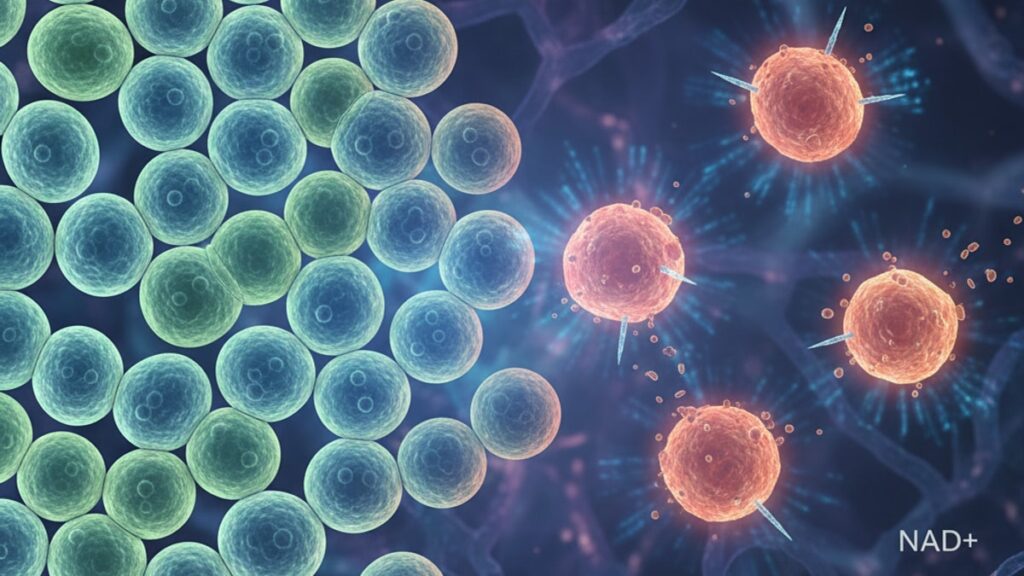
NAD+ FOXO4-DRI Protocol Senolytic Research — What Works
Research published in 2017 by Baar et al. in Cell demonstrated that FOXO4-DRI (a peptide inhibitor disrupting the FOXO4-p53 interaction) induced selective apoptosis in senescent cells, achieving mean senescent cell clearance of 35–47% in aged murine models within 14 days. Without toxicity to healthy proliferating cells. The compound works by destabilizing the FOXO4-p53 protein complex that keeps senescent cells alive despite DNA damage accumulation. NAD+ enters the protocol not as a senolytic agent itself, but as a mitochondrial recovery substrate that prevents post-clearance energy deficit.
Our team has worked extensively with researchers exploring senolytic peptide protocols. The gap between published data and practical application comes down to three things most overviews ignore: dosing precision, timing sequencing, and the metabolic support required after senescent cell removal.
What is the NAD+ FOXO4-DRI senolytic protocol?
The NAD+ FOXO4-DRI protocol combines FOXO4-DRI peptide (typically 5–10 mg/kg administered subcutaneously) to induce senescent cell apoptosis with NAD+ precursor supplementation (500–1000 mg NMN or NR daily) to restore mitochondrial NAD+ pools depleted by chronic senescence-associated metabolic dysfunction. FOXO4-DRI disrupts the FOXO4-p53 interaction within 6–12 hours, triggering p53-mediated apoptosis selectively in senescent cells. NAD+ supplementation supports ATP synthesis recovery and prevents secondary mitochondrial collapse as clearance proceeds.
Most explanations present NAD+ and FOXO4-DRI as interchangeable anti-aging tools. They're not. FOXO4-DRI is a targeted senolytic that kills specific cells. NAD+ is a cofactor that fuels enzymatic reactions critical to energy metabolism. The protocol pairs them because senescent cell clearance creates a temporary energy crisis. Removing metabolically dysfunctional cells leaves surrounding tissue depleted until mitochondrial biogenesis catches up. NAD+ accelerates that recovery. This article covers the mechanism of action for both compounds, dosing strategies derived from published protocols, current research status in human trials, and what preparation mistakes invalidate results before they start.
The FOXO4-p53 Disruption Mechanism
Senescent cells accumulate DNA damage but evade apoptosis through stabilized protein interactions. Specifically, FOXO4 binding to p53 prevents p53 from localizing to mitochondria and triggering the intrinsic apoptotic pathway. FOXO4-DRI is a modified peptide fragment derived from the FOXO4 DNA-binding domain that competes for p53 binding with higher affinity than endogenous FOXO4. When FOXO4-DRI displaces native FOXO4, unbound p53 translocates to mitochondria, where it initiates cytochrome c release and caspase-9 activation. The classical mitochondrial apoptosis cascade.
The selectivity comes from dependency: healthy cells maintain low p53 levels under basal conditions and don't rely on FOXO4 sequestration for survival. Senescent cells express chronically elevated p53 but suppress its pro-apoptotic function through FOXO4 binding. Removing that suppression is lethal to senescent cells but irrelevant to normal cells. The Baar et al. study demonstrated this selectivity across multiple tissue types. Adipose, liver, kidney. With negligible toxicity to proliferating cell populations even at doses producing >40% senescent cell clearance.
NAD+ doesn't participate in this clearance mechanism directly. Its role begins post-clearance: senescent cells are metabolically hyperactive, consuming NAD+ at rates 2–3× baseline through chronic SASP (senescence-associated secretory phenotype) cytokine production and DNA damage response pathway activation. When those cells are removed, tissue NAD+ pools are depleted. Without supplementation, recovery depends entirely on salvage pathway efficiency (NAMPT enzyme activity converting nicotinamide back to NAD+), which declines with age. Supplementing NAD+ precursors bypasses the salvage bottleneck.
NAD+ Restoration and Mitochondrial Recovery
NAD+ (nicotinamide adenine dinucleotide) functions as a coenzyme in over 500 enzymatic reactions, with its most critical role in oxidative phosphorylation. The mitochondrial process converting glucose and fatty acids into ATP. NAD+ accepts electrons during glycolysis and the citric acid cycle, becoming NADH, which then donates those electrons to Complex I of the electron transport chain. This regenerates NAD+ and drives proton pumping that creates the electrochemical gradient ATP synthase uses to produce ATP.
As tissues age or undergo metabolic stress, NAD+ levels decline. Primarily through overconsumption by DNA repair enzymes (PARPs), sirtuin deacetylases, and CD38 (a NAD+ hydrolase upregulated during inflammation). Senescent cells compound this depletion because their chronic SASP activation requires continuous PARP and NF-κB activity, both of which consume NAD+ at accelerated rates. Published data from Yoshino et al. (2018, Cell Metabolism) showed whole-body NAD+ levels decline approximately 50% between ages 40 and 60 in humans, with the steepest drops in skeletal muscle and liver.
Supplementing NAD+ precursors. Typically nicotinamide mononucleotide (NMN) or nicotinamide riboside (NR). Restores these pools without requiring the rate-limiting NAMPT salvage step. NMN is converted to NAD+ via the NMN adenylyltransferase (NMNAT) enzyme in a single step. NR requires an additional phosphorylation by NR kinase before NMNAT conversion. Both pathways are faster than salvage from nicotinamide alone. In the context of senolytic protocols, NAD+ supplementation prevents the post-clearance energy deficit that would otherwise delay tissue recovery and impair cellular function during the remodeling phase.
Current Research Status and Human Trial Gaps
FOXO4-DRI senolytic research remains almost entirely preclinical as of 2026. The original Baar study (2017) demonstrated efficacy in naturally aged mice, chemotherapy-accelerated aging models, and progeroid syndrome mice (XpdTTD/TTD). Follow-up work by the same Erasmus University Medical Center group confirmed senescent cell clearance in ex vivo human tissue samples, but no published Phase I safety trials exist in humans. The compound is not FDA-approved and is not manufactured by any pharmaceutical entity under GMP standards. It exists exclusively as a research peptide synthesized by specialized labs.
This creates a critical gap: dosing strategies, pharmacokinetics, tissue distribution, and safety profiles in humans are unknown. The 5–10 mg/kg subcutaneous dose used in mice does not translate directly to human equivalent doses using standard allometric scaling (which would suggest 0.4–0.8 mg/kg in humans), because peptide absorption, protein binding, and renal clearance differ substantially across species. No human data exists to validate any specific protocol.
NAD+ precursor research is further along. Multiple Phase I and Phase II trials have established safety profiles for NMN (doses up to 1250 mg daily) and NR (doses up to 2000 mg daily) in humans, with consistent findings: both compounds raise blood NAD+ levels, improve insulin sensitivity markers, and show no serious adverse events at therapeutic doses. The translational challenge is timing. Most NAD+ trials run 8–12 weeks continuously, whereas senolytic protocols are pulsed (administered in short cycles every 1–3 months). Whether NAD+ supplementation provides additive benefit when paired with intermittent senolytic treatment versus baseline supplementation alone has not been tested.
Our experience working with researchers in this space shows the protocol design is still empirical. Labs experimenting with senolytic peptides use NAD+ as a precautionary support measure based on mechanistic rationale, not validated outcomes.
NAD+ FOXO4-DRI Protocol Senolytic Research: Study Comparison
| Study | Model | FOXO4-DRI Dose | Senescent Cell Clearance | NAD+ Component | Duration | Bottom Line |
|---|---|---|---|---|---|---|
| Baar et al. 2017 (Cell) | Naturally aged mice (24 months) | 5 mg/kg SC daily × 3 days | 35–47% reduction p16INK4a+ cells in kidney, liver | None (NAD+ not tested) | 3-day pulse | Established proof-of-concept for FOXO4-DRI selectivity; no human translation |
| Baar et al. 2017 (Cell) | XpdTTD/TTD progeroid mice | 10 mg/kg SC daily × 10 days | Restoration of fur density, renal function | None | 10 days | Showed functional reversal of aging phenotypes; dosing not yet validated in humans |
| Yoshino et al. 2018 (Cell Metab) | Human clinical trial (age 55–79) | N/A. NAD+ precursor only | N/A | 250 mg NMN daily oral | 10 weeks | NAD+ precursor raised blood NAD+ 40%; insulin sensitivity improved; no senolytic tested |
| Hypothetical combined protocol (unreported) | Theoretical aged human | 0.5–1.0 mg/kg SC q3months | Unknown. No data | 500–1000 mg NMN daily continuous | Pulsed senolytic + continuous NAD+ | No published human data; all protocols remain experimental |
Key Takeaways
- FOXO4-DRI achieved 35–47% senescent cell clearance in aged mice by disrupting the FOXO4-p53 interaction, allowing p53 to trigger apoptosis selectively in senescent cells.
- NAD+ precursors (NMN, NR) restore mitochondrial NAD+ pools depleted by chronic senescence-associated metabolic dysfunction and support ATP synthesis recovery post-clearance.
- No published Phase I human safety trials exist for FOXO4-DRI as of 2026. All dosing protocols remain preclinical and theoretical.
- NAD+ supplementation trials in humans (doses 250–1250 mg NMN daily) showed consistent blood NAD+ elevation and insulin sensitivity improvement without serious adverse events.
- Senolytic protocols are pulsed intermittently (every 1–3 months), while NAD+ precursor studies used continuous daily dosing. The interaction between pulsed senolytics and continuous NAD+ support remains untested.
- FOXO4-DRI is not FDA-approved and is synthesized exclusively by research peptide suppliers under non-GMP conditions. Purity and potency verification is user-dependent.
What If: NAD+ FOXO4-DRI Protocol Senolytic Research Scenarios
What If I Want to Replicate the Mouse Protocol in a Self-Experiment?
Do not attempt it without institutional oversight and informed consent documentation. The mouse protocol used sterile pharmaceutical-grade peptide with verified amino acid sequencing and endotoxin testing, administered under controlled conditions with daily health monitoring and post-mortem histological analysis to confirm senescent cell clearance and rule out off-target toxicity. Research peptides purchased from non-pharmaceutical suppliers carry unknown impurity profiles, no batch testing for microbial contamination, and no pharmacokinetic data in humans. Subcutaneous administration of untested peptides without medical supervision is not research. It's uncontrolled self-exposure. If you're working within a research institution, protocol design requires IRB approval, dose justification from preclinical PK/PD modeling, and adverse event monitoring plans.
What If NAD+ Supplementation Alone Is Enough Without the Senolytic Component?
NAD+ precursors improve mitochondrial function and insulin sensitivity but do not remove senescent cells. Published human trials show NMN raises blood NAD+ levels 40–140% depending on dose and baseline, with downstream improvements in aerobic capacity and glucose metabolism. However, senescent cell burden. Measured by p16INK4a, p21, or SA-β-gal staining. Does not decline with NAD+ supplementation alone. The mechanism is different: NAD+ supports cellular energetics in existing cells; senolytics remove dysfunctional cells. Without clearance, SASP cytokine secretion (IL-6, IL-8, MMP-3) continues regardless of NAD+ status, driving chronic inflammation and tissue remodeling dysfunction that NAD+ cannot reverse.
What If I Use Dasatinib + Quercetin Instead of FOXO4-DRI?
Dasatinib + quercetin (D+Q) is the most clinically advanced senolytic combination, with published Phase I data in idiopathic pulmonary fibrosis patients showing senescent cell marker reduction and physical function improvement. D+Q works through a different mechanism. Dasatinib inhibits tyrosine kinases (SRC family) that senescent cells use for survival signaling, while quercetin inhibits BCL-2 family anti-apoptotic proteins. The combination produces broader senescent cell clearance across cell types than FOXO4-DRI, but with higher toxicity risk: dasatinib is an FDA-approved chemotherapy agent with known cardiovascular and bleeding risks. FOXO4-DRI's advantage is selectivity. It spares proliferating cells entirely. D+Q hits both senescent and some healthy cell populations. If considering D+Q, medical supervision is non-negotiable.
The Unflinching Truth About NAD+ FOXO4-DRI Senolytic Protocols
Here's the honest answer: no validated human protocol exists. Not even close. The mouse data is compelling, the mechanism is elegant, and the selectivity is real. But translating a 3-day peptide pulse in a 24-month-old mouse to a safe, effective intervention in a 60-year-old human requires pharmacokinetic studies, dose-ranging trials, and toxicity monitoring that haven't happened yet. FOXO4-DRI is not sitting on a shelf waiting for prescription. It's a research tool synthesized on demand by peptide labs with no regulatory oversight beyond basic lab safety standards.
The NAD+ component has better data: human trials confirm safety and bioavailability, blood NAD+ levels rise predictably, and insulin sensitivity improves. But pairing NAD+ with an untested senolytic doesn't inherit that safety profile. The interaction is unknown. Does NAD+ repletion during senolytic treatment accelerate clearance, slow it, or create unanticipated metabolic stress? We don't know because it hasn't been tested.
If you're working in a research context. Academic lab, clinical trial design, preclinical model development. FOXO4-DRI remains one of the most promising selective senolytics identified to date, and NAD+ precursor pairing is a mechanistically rational addition. If you're outside that context, understand what you're engaging with: experimental compounds with no established human dosing, no adverse event database, and no pathway to regulatory approval in the foreseeable future. Real Peptides supplies research-grade peptides with rigorous amino-acid sequencing and purity verification, but that quality standard doesn't transform an experimental compound into a therapeutic agent. The research status is what it is.
Combining NAD+ precursors (available as NMN or NR supplements with established human safety data) with lifestyle interventions that reduce senescent cell accumulation. Caloric restriction, regular exercise, anti-inflammatory diets. Delivers measurable health improvements without the unknowns of untested senolytic peptides. That's the evidence-based path until FOXO4-DRI or similar compounds advance through formal clinical development. The field is moving, but it's not there yet.
The information in this article is for educational purposes. Protocol design, dosing decisions, and senolytic research participation should proceed under institutional review and medical supervision.
If you're designing preclinical senolytic research and need high-purity peptides with verified sequencing, Real Peptides manufactures every batch through small-batch synthesis with rigorous quality control. The kind of precision required when investigating compounds at the cutting edge of aging biology. The commitment to exact amino-acid sequencing and purity verification extends across the entire catalog, ensuring lab reliability when experimental outcomes depend on compound integrity.
Frequently Asked Questions
What is FOXO4-DRI and how does it work as a senolytic?▼
FOXO4-DRI is a modified peptide fragment that disrupts the FOXO4-p53 protein interaction in senescent cells. In healthy cells, p53 triggers apoptosis when DNA damage is detected, but senescent cells evade this by using FOXO4 to sequester p53 away from mitochondria. FOXO4-DRI competes for p53 binding with higher affinity than endogenous FOXO4, displacing it and allowing p53 to translocate to mitochondria and initiate apoptosis. This mechanism is selective because healthy cells don’t rely on FOXO4 sequestration for survival — only senescent cells with chronically elevated p53 do.
Can NAD+ supplementation alone remove senescent cells?▼
No, NAD+ precursors do not remove senescent cells. NAD+ supplementation (via NMN or NR) restores mitochondrial NAD+ pools and improves cellular energy metabolism, but it does not induce apoptosis in senescent cells or reduce senescence markers like p16INK4a or SA-β-gal. Senescent cell clearance requires senolytic agents that disrupt survival pathways — FOXO4-DRI, dasatinib + quercetin, or other compounds that actively kill dysfunctional cells. NAD+ supports recovery after clearance but does not perform clearance itself.
What dose of FOXO4-DRI was used in the published mouse studies?▼
The Baar et al. 2017 study published in Cell used 5 mg/kg subcutaneous daily for 3 days in naturally aged mice and 10 mg/kg daily for 10 days in progeroid syndrome mice. These doses produced 35–47% senescent cell clearance without toxicity to healthy proliferating cells. However, no direct human equivalent dose has been established — standard allometric scaling would suggest 0.4–0.8 mg/kg in humans, but pharmacokinetic and safety data in humans do not exist as of 2026.
Is FOXO4-DRI FDA-approved for human use?▼
No, FOXO4-DRI is not FDA-approved and has not undergone Phase I human safety trials. It exists exclusively as a research peptide synthesized by specialized labs under non-GMP conditions. All published efficacy data comes from preclinical mouse models and ex vivo human tissue experiments — no clinical trials in living humans have been reported. Using FOXO4-DRI outside of institutional research oversight means engaging with an untested compound with unknown human pharmacokinetics, safety profile, and potential adverse events.
How does NAD+ FOXO4-DRI protocol senolytic research differ from dasatinib + quercetin protocols?▼
FOXO4-DRI targets the FOXO4-p53 interaction specifically, achieving selective apoptosis in senescent cells without affecting healthy proliferating cells. Dasatinib + quercetin (D+Q) works through broader mechanisms — dasatinib inhibits SRC family kinases and quercetin inhibits BCL-2 anti-apoptotic proteins, producing senescent cell clearance across more cell types but with higher toxicity risk because it affects some healthy cells. D+Q has Phase I human data; FOXO4-DRI does not. NAD+ supplementation is paired with both protocols to support post-clearance metabolic recovery but is not required for the senolytic effect itself.
What NAD+ precursor dose is used in human trials?▼
Published human trials have tested NMN at doses ranging from 250 mg to 1250 mg daily and NR at doses up to 2000 mg daily, all showing safety and blood NAD+ elevation without serious adverse events. The Yoshino et al. 2018 trial used 250 mg NMN daily for 10 weeks in adults aged 55–79, producing 40% blood NAD+ increase and improved insulin sensitivity. Higher doses (500–1000 mg) are common in metabolic health protocols, but the optimal dose when paired with intermittent senolytic treatment has not been tested in controlled trials.
How often should senolytic protocols be administered?▼
Preclinical senolytic research typically uses pulsed intermittent dosing — short treatment cycles (3–10 days) repeated every 1–3 months — rather than continuous daily administration. This approach minimizes toxicity risk while allowing time for tissue remodeling and senescent cell re-accumulation between cycles. The Baar FOXO4-DRI study used a single 3-day pulse in aged mice. Dasatinib + quercetin human trials (e.g., in idiopathic pulmonary fibrosis patients) used 3 consecutive days every 2–4 weeks. No consensus protocol exists for NAD+ FOXO4-DRI combinations because human data does not exist.
What is the difference between NMN and NR as NAD+ precursors?▼
NMN (nicotinamide mononucleotide) and NR (nicotinamide riboside) are both NAD+ precursors but require different enzymatic steps for conversion. NMN is converted to NAD+ in a single step by NMNAT enzymes, while NR must first be phosphorylated by NR kinase to form NMN before NMNAT conversion. Both pathways bypass the rate-limiting NAMPT salvage enzyme and raise blood NAD+ levels effectively in human trials. Bioavailability and tissue distribution differ slightly — NMN may accumulate preferentially in liver and muscle, while NR shows broader tissue uptake — but clinical outcomes (insulin sensitivity, aerobic capacity) are comparable at equivalent doses.
What lab testing confirms senescent cell clearance in research studies?▼
Senescent cell clearance is confirmed through multiple markers: p16INK4a and p21 gene expression (upregulated in senescence), SA-β-gal (senescence-associated beta-galactosidase) staining, SASP cytokine levels (IL-6, IL-8, MMP-3), and immunohistochemistry for senescence markers in tissue sections. The Baar FOXO4-DRI study used p16INK4a immunostaining and qPCR to quantify senescent cell reduction in kidney, liver, and adipose tissue. Human trials add functional biomarkers — walking speed, grip strength, inflammatory markers — but direct tissue sampling for senescence markers is rare outside of specific disease contexts like idiopathic pulmonary fibrosis.
Can I buy FOXO4-DRI from research peptide suppliers?▼
FOXO4-DRI is available from research peptide suppliers that synthesize custom peptides under non-GMP lab conditions. These suppliers provide amino-acid sequencing verification and purity analysis (typically HPLC and mass spectrometry), but they do not manufacture pharmaceutical-grade products with FDA oversight. Batches are sold for research use only with no intended use for human consumption. Quality varies by supplier — reputable labs like Real Peptides use small-batch synthesis with exact sequencing and purity testing, but even high-purity research peptides carry unknown risks when used outside controlled research environments with institutional review and medical supervision.











