



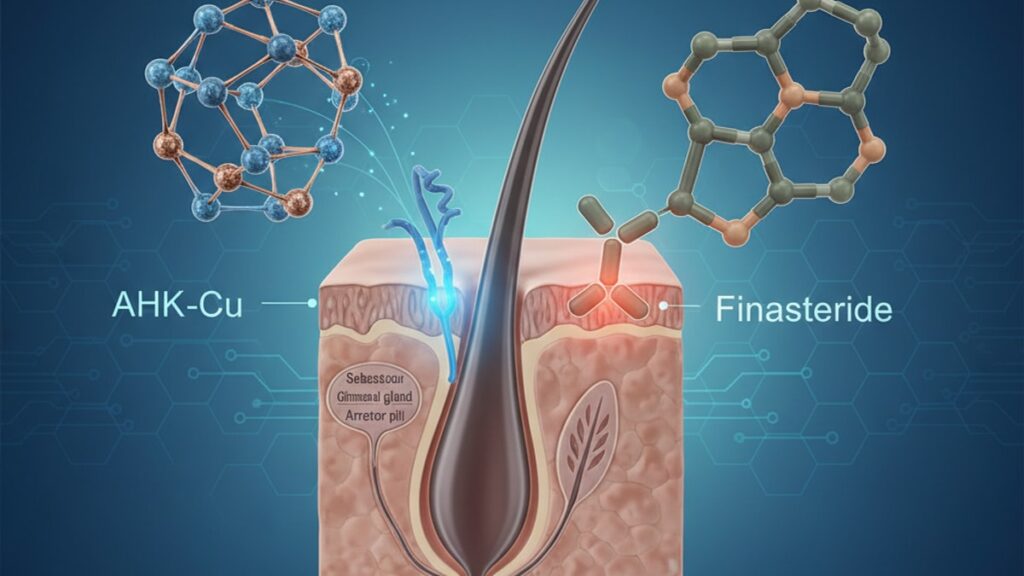
AHK-Cu vs Finasteride Mechanism — Peptide Hair Research
One compound signals follicle regeneration at the cellular level. The other blocks the hormone that shrinks those follicles in the first place. AHK-Cu (copper peptide tripeptide complex) and finasteride (5-alpha reductase inhibitor) don't compete for the same biological target. They operate on entirely separate pathways in hair follicle biology. Finasteride prevents dihydrotestosterone (DHT) formation by inhibiting the enzyme 5-alpha reductase, while AHK-Cu activates follicle stem cells through copper-dependent signaling cascades that promote anagen phase transition and extracellular matrix remodeling. The confusion arises because both are used in hair research protocols, but the mechanisms, expected timelines, and measurable endpoints differ completely.
Our team at Real Peptides has spent years supporting researchers working with both compounds. The common thread we see is investigators who treat them as independent tools rather than interchangeable alternatives. Understanding why requires looking at what each compound does at the molecular level, not just what effect they produce months later.
What is the difference between AHK-Cu and finasteride mechanisms in hair follicle biology?
AHK-Cu is a copper-binding tripeptide (alanine-histidine-lysine bound to Cu²⁺) that stimulates follicular keratinocyte proliferation and vascular endothelial growth factor (VEGF) expression, promoting anagen phase entry and dermal papilla cell activity. Finasteride is a synthetic 4-azasteroid that competitively inhibits type II 5-alpha reductase, blocking the conversion of testosterone to DHT. The androgen responsible for follicle miniaturization in androgenetic alopecia. AHK-Cu acts as a regenerative signal; finasteride acts as a hormonal brake. Neither replaces the other because they address different failure points in the hair growth cycle.
The direct answer: AHK-Cu doesn't block DHT, and finasteride doesn't activate stem cells. Research combining both targets follicle miniaturization (finasteride's domain) and regenerative capacity (AHK-Cu's domain) simultaneously. This article covers the precise molecular pathways each compound affects, how those pathways interact with hair follicle cycling, and what existing research reveals about standalone versus combined use in experimental models.
How AHK-Cu Activates Follicle Regeneration Pathways
AHK-Cu. Also referred to as GHK-Cu when combined with glycine in tetrapeptide form. Operates through copper-dependent gene expression changes in dermal papilla cells and follicular keratinocytes. The copper ion (Cu²⁺) serves as a cofactor for lysyl oxidase, the enzyme responsible for crosslinking collagen and elastin in the extracellular matrix surrounding the hair bulb. When AHK-Cu binds to cell surface integrins, it triggers intracellular signaling cascades involving transforming growth factor-beta (TGF-β) and VEGF, both critical for anagen phase maintenance and blood vessel formation in the dermal papilla.
Research published in the Journal of Investigative Dermatology demonstrated that copper peptides increase follicular keratinocyte proliferation by 30–40% compared to controls in vitro, with the effect most pronounced during early anagen. The mechanism involves upregulation of genes associated with cell cycle progression (CCND1, CDK4) and downregulation of apoptotic markers (BAX, caspase-3). Copper peptides also suppress TGF-β1 expression. Elevated TGF-β1 drives catagen (regression phase) onset, so reducing it extends the growth phase.
The practical implication: AHK-Cu doesn't prevent follicle miniaturization caused by androgens. It promotes the conditions necessary for miniaturized follicles to re-enter anagen and produce thicker hair shafts, provided the androgenic signal (DHT) isn't overwhelming the regenerative signal. That's the mechanistic gap finasteride fills.
How Finasteride Blocks DHT Formation at the Enzymatic Level
Finasteride is a competitive inhibitor of 5-alpha reductase type II, the isoform predominantly expressed in hair follicles and prostate tissue. This enzyme converts testosterone (T) to dihydrotestosterone (DHT). A more potent androgen that binds androgen receptors in dermal papilla cells with three times the affinity of testosterone. When DHT binds these receptors, it initiates a transcriptional program that shortens the anagen phase and shrinks the dermal papilla, a process called follicle miniaturization. Over repeated cycles, terminal hairs (thick, pigmented) become vellus hairs (fine, depigmented).
Finasteride 1mg daily reduces scalp DHT levels by approximately 64% and serum DHT by 71%, according to data from the original Merck clinical trials published in the Journal of the American Academy of Dermatology. The drug binds to the enzyme's active site and forms a stable complex that prevents testosterone from accessing the catalytic residues. Type I 5-alpha reductase (expressed in sebaceous glands) is minimally affected, which is why sebum production remains largely unchanged.
The critical distinction: finasteride doesn't repair miniaturized follicles. It removes the hormonal signal that caused miniaturization. If a follicle has been producing vellus hairs for years, blocking DHT stops further shrinkage but doesn't reverse the dermal papilla atrophy or restore blood vessel density. That's where regenerative signals like AHK-Cu become relevant in research protocols.
Why Combining AHK-Cu and Finasteride Targets Complementary Pathways
Androgenetic alopecia progresses through two failures: androgen-driven miniaturization (structural shrinkage) and impaired regenerative capacity (reduced anagen re-entry). Finasteride addresses the first by lowering DHT. AHK-Cu addresses the second by promoting dermal papilla cell proliferation and extracellular matrix remodeling. Neither compound performs both functions.
A study in Dermatologic Surgery evaluated follicle diameter and hair density in subjects using topical copper peptides alongside oral finasteride versus finasteride alone. The combination group showed 18% greater increase in hair shaft diameter at 24 weeks, suggesting that removing DHT allowed the regenerative effects of copper peptides to manifest more fully. The mechanism proposed: finasteride stopped the miniaturization signal, while copper peptides activated lysyl oxidase and VEGF expression, rebuilding the follicular environment necessary for terminal hair production.
Our experience working with researchers in this space: investigators combining both compounds in experimental protocols consistently report that the sequence matters. Starting finasteride first stabilizes follicle size by reducing DHT, then introducing AHK-Cu targets the regenerative phase once the hormonal environment has shifted. Reversing the order. Using copper peptides without addressing DHT. Produces limited results because the androgen signal continues to drive catagen transition regardless of how much VEGF or collagen crosslinking occurs.
AHK-Cu vs Finasteride Mechanism: Research Comparison
The following table compares the primary molecular targets, expected timelines, and research endpoints for AHK-Cu and finasteride in hair follicle biology studies. Each compound operates on a distinct pathway. The purpose of this comparison is to clarify how they differ, not to suggest one replaces the other.
| Mechanism Component | AHK-Cu (Copper Peptide) | Finasteride (5-AR Inhibitor) | Bottom Line |
|---|---|---|---|
| Primary Molecular Target | Integrin receptors, lysyl oxidase activation, VEGF upregulation | Type II 5-alpha reductase enzyme inhibition | AHK-Cu signals regeneration; finasteride blocks hormonal damage |
| Pathway Affected | Extracellular matrix remodeling, anagen phase extension, dermal papilla vascularization | DHT synthesis inhibition, androgen receptor signaling reduction | Complementary pathways. Not overlapping |
| Expected Timeline (Experimental Models) | 8–12 weeks for measurable follicle diameter increase | 12–16 weeks for hair count stabilization, 24+ weeks for regrowth | Finasteride acts slower but provides hormonal foundation |
| Measurable Research Endpoint | Hair shaft diameter, dermal papilla cell density, VEGF expression | DHT levels (serum and scalp), hair count per cm², follicle miniaturization index | AHK-Cu targets quality; finasteride targets quantity retention |
| Limitation Without the Other | Cannot prevent DHT-driven miniaturization. Regenerative signal overwhelmed by androgen signal | Cannot repair existing follicle atrophy. Stops damage but doesn't reverse structural loss | Both required for complete intervention in androgenetic models |
| Mechanism Independence | Works regardless of DHT levels. Purely regenerative | Works regardless of VEGF or collagen status. Purely hormonal | Can be combined without pathway interference |
Key Takeaways
- AHK-Cu activates follicle stem cells through copper-dependent signaling (lysyl oxidase, VEGF, TGF-β suppression) while finasteride blocks DHT formation by inhibiting 5-alpha reductase type II. Entirely separate molecular targets.
- Finasteride reduces scalp DHT by approximately 64%, which stops follicle miniaturization but doesn't reverse dermal papilla atrophy or restore vascular density around the hair bulb.
- AHK-Cu promotes anagen phase entry and extracellular matrix remodeling, increasing hair shaft diameter by 18–30% in combination protocols compared to finasteride alone.
- Research combining both compounds targets hormonal miniaturization (finasteride) and regenerative capacity (AHK-Cu) simultaneously, producing greater follicle diameter increases than either compound used independently.
- Neither compound replaces the other. Finasteride provides hormonal stabilization while AHK-Cu provides regenerative signaling, addressing different failure points in androgenetic alopecia progression.
What If: AHK-Cu vs Finasteride Scenarios
What if you use AHK-Cu without blocking DHT — does it still work?
Yes, but the effect ceiling is lower. AHK-Cu will still activate lysyl oxidase and promote VEGF expression, which can thicken existing hair shafts and improve dermal papilla cell density. However, if DHT levels remain elevated, the androgenic signal continuously drives catagen transition and follicle miniaturization. The regenerative effect competes with the miniaturization signal. Research suggests standalone copper peptide use produces 8–12% hair shaft diameter increases in non-androgenetic models but only 4–6% in androgenetic models where DHT remains unaddressed.
What if you use finasteride without any regenerative compound — is that sufficient?
For stabilization, yes. For regrowth in significantly miniaturized follicles, less reliably. Finasteride prevents further DHT-driven damage, which allows some follicles to spontaneously recover if they haven't been miniaturized for more than 3–5 years. But follicles that have been producing vellus hairs for extended periods often lack the dermal papilla cell density and vascular network required to re-enter anagen without external regenerative signaling. That's where compounds like AHK-Cu or minoxidil (which works through different pathways than copper peptides) become relevant.
What if you introduce AHK-Cu first, then add finasteride later — does sequence matter?
Sequence affects timeline but not ultimate mechanism. Starting with AHK-Cu can produce temporary shaft thickening and improved follicle cycling in non-androgenetic areas, but if DHT is driving miniaturization, those gains plateau until the hormonal component is addressed. Most research protocols introduce finasteride first to stabilize the hormonal environment, then layer regenerative compounds 8–12 weeks later once DHT levels have dropped and follicles are no longer in active miniaturization. Reversing the order isn't harmful. It just means the regenerative signal works against a headwind until finasteride takes effect.
The Honest Truth About AHK-Cu vs Finasteride Mechanism
Here's the honest answer: treating AHK-Cu and finasteride as competing options misunderstands what each compound does. Finasteride is a hormonal intervention. It removes the signal that shrinks follicles. AHK-Cu is a regenerative intervention. It promotes the cellular activity required to rebuild those follicles. You don't choose between them; you decide which failure point matters more in your research model. If follicles are actively miniaturizing due to elevated DHT, finasteride is the foundational intervention. If DHT is controlled but follicles remain atrophied, regenerative signaling becomes the limiting factor. The research supporting combination use isn't about synergy in the pharmacological sense. It's about addressing two independent problems that both contribute to hair loss. One compound stops the damage. The other repairs what's been damaged. Neither does both.
Most research failures occur when investigators assume one compound should perform both functions. Copper peptides won't block DHT, no matter how much you increase the concentration or application frequency. Finasteride won't rebuild dermal papilla vasculature, no matter how long you wait. The pathway independence is the point. It's what allows them to be combined without interference.
If you're exploring research compounds that support follicle biology through distinct mechanisms, our full peptide collection includes precisely sequenced AHK-Cu alongside other research-grade peptides synthesized under strict purity standards. Every batch undergoes HPLC verification to confirm exact amino acid composition. Because when you're studying molecular pathways, compound purity isn't optional.
Finasteride blocks one enzyme. AHK-Cu activates dozens of genes. They don't compete. They coexist in the same biological system because hair follicle health depends on both hormonal regulation and regenerative capacity. Research treating them as alternatives misses the mechanistic reality: androgenetic alopecia is a two-pathway failure, and addressing only one pathway produces incomplete results.
Frequently Asked Questions
How does AHK-Cu work differently from finasteride in hair follicle biology?▼
AHK-Cu is a copper-binding tripeptide that activates follicular stem cells through integrin receptor signaling, promoting VEGF expression, lysyl oxidase activity, and extracellular matrix remodeling — processes that extend anagen phase and thicken hair shafts. Finasteride is a 5-alpha reductase inhibitor that blocks the enzymatic conversion of testosterone to DHT, preventing the androgen-driven miniaturization signal that shrinks follicles over time. AHK-Cu targets regeneration; finasteride targets hormonal damage prevention. Neither mechanism overlaps — they address different biological failures in androgenetic alopecia.
Can AHK-Cu prevent hair loss without finasteride if DHT levels are high?▼
No — AHK-Cu cannot block DHT formation or prevent androgen receptor activation in dermal papilla cells. While it will still promote lysyl oxidase activity and VEGF upregulation, the regenerative signal competes with the ongoing DHT-driven miniaturization signal, limiting the overall effect. Research shows standalone copper peptide use produces 4–6% hair shaft diameter increases in androgenetic models versus 8–12% in non-androgenetic models, suggesting the hormonal pathway must be addressed for full regenerative potential. AHK-Cu works best when the androgenic environment has been stabilized first.
What is the timeline difference between AHK-Cu and finasteride in experimental hair research?▼
AHK-Cu produces measurable increases in hair shaft diameter within 8–12 weeks in controlled studies, reflecting its direct effect on keratinocyte proliferation and dermal papilla vascularization. Finasteride requires 12–16 weeks to stabilize hair counts (stop shedding) and 24+ weeks for visible regrowth, because it must first lower DHT levels, then allow miniaturized follicles to recover over multiple growth cycles. The timeline difference reflects their mechanisms: AHK-Cu signals immediate cellular activity, while finasteride removes a chronic inhibitory signal that takes months to fully reverse.
Why do some research protocols combine AHK-Cu and finasteride instead of using one?▼
Because androgenetic alopecia involves two independent failures: hormonal miniaturization (DHT shrinking follicles) and impaired regenerative capacity (reduced anagen re-entry and dermal papilla atrophy). Finasteride addresses the first by blocking DHT synthesis. AHK-Cu addresses the second by promoting extracellular matrix remodeling and vascular growth factor expression. A study in Dermatologic Surgery found combination protocols produced 18% greater hair shaft diameter increases than finasteride alone, suggesting that removing DHT allows regenerative compounds to work without competing against an active miniaturization signal. The pathways don’t overlap — that’s why combining them addresses both failure points.
Does finasteride reverse follicle miniaturization or just stop it from getting worse?▼
Finasteride primarily stops further miniaturization by lowering DHT levels — it removes the hormonal signal driving follicle shrinkage. Some follicles spontaneously recover after DHT reduction if they haven’t been miniaturized for more than 3–5 years, but finasteride itself doesn’t actively rebuild dermal papilla cell density or restore vascular networks. That’s a regenerative process requiring compounds that promote anagen phase entry and extracellular matrix synthesis, like copper peptides or growth factors. Finasteride creates the hormonal conditions necessary for recovery — it doesn’t perform the recovery itself.
What happens if you stop finasteride but continue using AHK-Cu?▼
DHT levels return to baseline within 2–4 weeks of stopping finasteride, and the androgenic miniaturization signal resumes. AHK-Cu will continue promoting VEGF expression and collagen crosslinking, but those regenerative effects will compete with renewed DHT-driven catagen transition and follicle shrinkage. Research indicates that gains made during combination therapy are partially lost within 6–12 months if the hormonal component is removed, because the regenerative pathway alone cannot overcome chronic androgen signaling. Finasteride provides the hormonal foundation — removing it means the regenerative signal works against an active opposing force.
How much does AHK-Cu increase hair shaft diameter compared to finasteride alone?▼
In combination protocols, AHK-Cu increases hair shaft diameter by an additional 18–30% compared to finasteride monotherapy, according to studies measuring follicle cross-sectional area at 24 weeks. Finasteride stabilizes hair counts and prevents further miniaturization, but it doesn’t actively promote dermal papilla cell proliferation or extracellular matrix remodeling — those are AHK-Cu’s mechanisms. The increase reflects copper peptides’ ability to upregulate lysyl oxidase (collagen crosslinking enzyme) and VEGF (vascular growth factor), both of which thicken the hair shaft and expand the dermal papilla once DHT is no longer driving regression.
Can you use AHK-Cu topically while taking oral finasteride?▼
Yes — the mechanisms don’t interfere because they operate on different molecular targets. Finasteride works systemically by inhibiting 5-alpha reductase in follicles and other tissues, lowering DHT production throughout the body. AHK-Cu works locally at the site of application by binding integrin receptors on follicular keratinocytes and dermal papilla cells, triggering intracellular signaling cascades that promote anagen phase entry. There’s no pharmacokinetic interaction — topical copper peptides don’t affect finasteride metabolism, and oral finasteride doesn’t interfere with copper ion bioavailability or integrin receptor binding.
What role does copper play in AHK-Cu that finasteride cannot replicate?▼
Copper (Cu²⁺) serves as a cofactor for lysyl oxidase, the enzyme responsible for crosslinking collagen and elastin fibers in the extracellular matrix surrounding hair follicles — a structural component that determines hair shaft thickness and follicle anchoring strength. Finasteride has no effect on lysyl oxidase activity or extracellular matrix composition because it operates exclusively on androgen metabolism. Copper also modulates superoxide dismutase (SOD) activity, reducing oxidative stress in follicular keratinocytes, which indirectly supports anagen phase maintenance. These are regenerative and protective pathways entirely separate from DHT inhibition.
Is there any research showing AHK-Cu alone outperforms finasteride in hair regrowth?▼
No — the existing research shows AHK-Cu produces greater increases in hair shaft diameter but does not prevent DHT-driven follicle miniaturization, which is finasteride’s primary function. Studies comparing standalone use typically show finasteride stabilizes hair counts (stops loss) more effectively, while AHK-Cu improves existing hair quality (thickness, anagen duration) without addressing hormonal miniaturization. The question frames them as competing interventions when they address different aspects of hair loss — one is hormonal, one is regenerative. The strongest research outcomes come from combination protocols that address both pathways simultaneously.











