



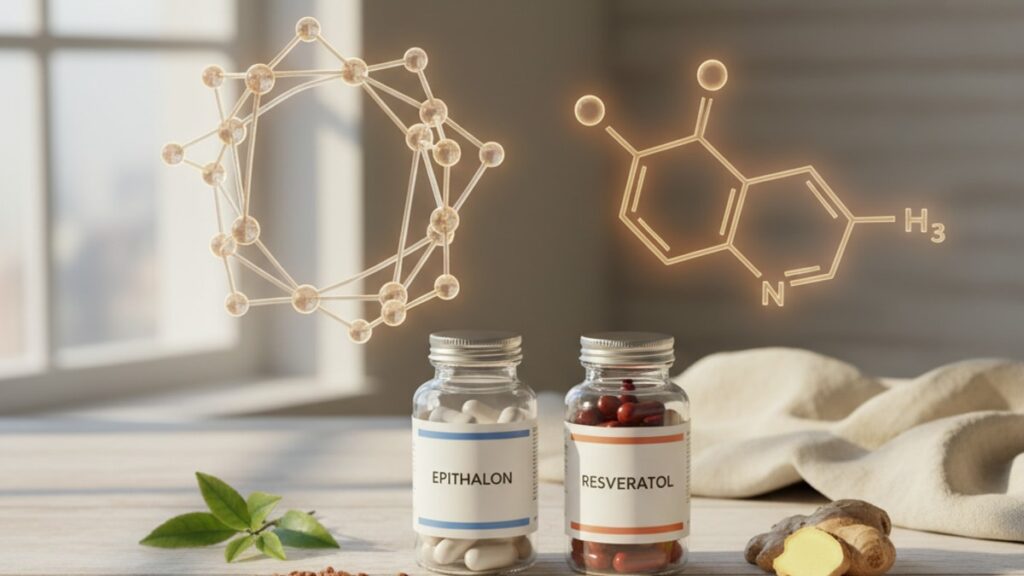
Epithalon vs Resveratrol Mechanism — Cellular Pathways
Research from Moscow's Institute of Bioregulation and Gerontology found that epithalon treatment in animal models extended median lifespan by 12.3% through direct telomerase activation. A mechanism fundamentally distinct from resveratrol's sirtuin modulation, which works through caloric restriction mimicry. The two compounds are grouped together in anti-aging discussions because both influence cellular longevity markers, but the pathways involved share almost no overlap. Epithalon acts on the pineal gland to stimulate endogenous melatonin and telomerase enzyme expression; resveratrol activates SIRT1 (sirtuin 1), a NAD+-dependent deacetylase that influences mitochondrial biogenesis and DNA repair. One extends the replicative capacity of cells; the other optimises existing cellular function under metabolic stress.
Our team has worked with research institutions evaluating both compounds across multiple study designs. The mechanism distinction matters because it dictates experimental design, dosing protocols, and the biological endpoints you're measuring. Choosing the wrong compound for your research question wastes months and invalidates results.
What is the mechanism difference between epithalon and resveratrol?
Epithalon (Ala-Glu-Asp-Gly tetrapeptide) activates telomerase reverse transcriptase (TERT), the catalytic subunit of telomerase that lengthens telomeres. The protective DNA caps that shorten with each cell division. Resveratrol (3,5,4'-trihydroxystilbene) activates SIRT1, a deacetylase enzyme that modulates stress response pathways and mitochondrial function by removing acetyl groups from histones and non-histone proteins. The practical difference: epithalon extends the number of times a cell can divide before reaching the Hayflick limit; resveratrol improves metabolic efficiency and stress resilience within existing division cycles. Neither compound reverses aging. Both influence specific biological processes associated with cellular aging.
The confusion between these two compounds stems from oversimplified longevity marketing that treats all anti-aging mechanisms as interchangeable. They're not. Epithalon influences cellular division capacity through chromosomal-level intervention; resveratrol influences gene expression patterns through metabolic signaling. This article covers how each mechanism actually works at the molecular level, what biological endpoints each compound influences, and how to select the right peptide or polyphenol for specific research objectives without conflating unrelated pathways.
Telomerase Activation vs Sirtuin Modulation — Distinct Cellular Targets
Epithalon's primary mechanism involves upregulation of telomerase reverse transcriptase (TERT) gene expression in the pineal gland and peripheral tissues. The tetrapeptide sequence Ala-Glu-Asp-Gly binds to specific receptor sites that trigger intracellular signaling cascades, ultimately increasing TERT mRNA transcription. TERT is the enzyme that synthesizes new TTAGGG repeats onto existing telomeres. The nucleotide sequences that cap the ends of chromosomes. Every time a somatic cell divides, telomeres shorten by approximately 50–200 base pairs due to the end-replication problem (DNA polymerase cannot fully replicate chromosome ends). When telomeres reach a critical length threshold (typically 4–6 kilobases), the cell enters replicative senescence and stops dividing. Epithalon extends this limit by reactivating telomerase, which is normally suppressed in adult somatic cells but remains active in germ cells and stem cells.
Resveratrol works through a completely different pathway: SIRT1 activation via allosteric modulation. Resveratrol binds to SIRT1 at a site distinct from the NAD+ binding pocket, lowering the Michaelis constant (Km) for NAD+ and making the enzyme more efficient at deacetylating target proteins. SIRT1 removes acetyl groups from histones (tightening chromatin structure and silencing certain genes) and from non-histone targets like PGC-1α (peroxisome proliferator-activated receptor gamma coactivator 1-alpha), which drives mitochondrial biogenesis. The net effect is metabolic recalibration that mimics caloric restriction: increased fatty acid oxidation, reduced oxidative stress, and enhanced mitochondrial function. This is not telomere extension. It's metabolic efficiency improvement.
The biological outcomes differ accordingly. Epithalon-treated cells in vitro show increased population doublings before senescence (a direct measure of replicative lifespan), but do not necessarily show improved mitochondrial respiration or reduced ROS production per division cycle. Resveratrol-treated cells show improved stress resistance and mitochondrial function but do not exceed the Hayflick limit. They simply function better within their existing division capacity. For research purposes, this distinction is critical: if your endpoint is replicative capacity (e.g., stem cell expansion protocols), epithalon is the relevant compound. If your endpoint is metabolic health under stress (e.g., oxidative damage models), resveratrol is more appropriate. Conflating the two mechanisms leads to mismatched experimental design.
Bioavailability and Delivery — Peptide vs Polyphenol Pharmacokinetics
Epithalon is a synthetic tetrapeptide administered via subcutaneous or intramuscular injection because oral bioavailability is effectively zero. Peptides are cleaved by gastric proteases and pancreatic enzymes before systemic absorption can occur. The half-life of epithalon in circulation is approximately 30 minutes, requiring either frequent dosing or depot formulations to maintain therapeutic levels. Research protocols typically use 5–10 mg administered daily or every other day over 10–20 day cycles, though these parameters are derived from preclinical models and Russian clinical studies that have not been replicated in large-scale Western trials. The peptide crosses the blood-brain barrier and accumulates in the pineal gland, where it exerts its primary effects on melatonin synthesis and circadian regulation in addition to telomerase activation.
Resveratrol, being a small polyphenolic molecule, can be administered orally, but bioavailability remains problematic for different reasons. Oral resveratrol undergoes extensive first-pass metabolism in the liver and intestinal wall, where it is conjugated into glucuronide and sulfate metabolites. Forms that are pharmacologically less active than the parent compound. Peak plasma concentrations of unconjugated resveratrol after a 25 mg oral dose are typically below 5 ng/mL, and the half-life is 8–14 minutes. Effective research doses range from 150–500 mg daily in divided doses, far exceeding the amounts found in dietary sources (a glass of red wine contains approximately 1–2 mg). To improve bioavailability, researchers use micronized formulations, liposomal delivery, or trans-resveratrol combined with piperine (which inhibits glucuronidation).
The delivery method directly impacts which tissues are exposed to therapeutic concentrations. Epithalon administered via injection achieves systemic distribution and penetrates the blood-brain barrier, making it suitable for neuroendocrine research (pineal function, circadian biology) and studies targeting peripheral tissues (immune cells, fibroblasts, epithelial cells). Resveratrol's low systemic bioavailability means that even high oral doses result in minimal unconjugated compound reaching peripheral tissues. The primary sites of action are the liver, intestinal epithelium, and possibly the vascular endothelium where metabolites may exert local effects. For research requiring direct cellular exposure to high concentrations of active compound, in vitro models using direct media supplementation are more reliable than in vivo oral dosing.
Our experience shows that peptide stability during storage and reconstitution is where most research errors occur. Lyophilized epithalon is stable at −20°C for extended periods, but once reconstituted with bacteriostatic water, it must be refrigerated at 2–8°C and used within 28 days. Any temperature excursion above 8°C causes irreversible peptide degradation that neither visual inspection nor potency testing at bench level can detect. Resveratrol powder, by contrast, is stable at room temperature when protected from light and moisture, but oxidizes rapidly once dissolved in solution. Prepare working stocks immediately before use and protect from UV exposure.
Epithalon vs Resveratrol Mechanism: Research Application Comparison
| Compound | Primary Mechanism | Cellular Target | Optimal Research Application | Dosing Route | Bioavailability Limitation | Half-Life | Bottom Line |
|---|---|---|---|---|---|---|---|
| Epithalon (Ala-Glu-Asp-Gly) | Telomerase reverse transcriptase (TERT) activation. Extends telomere length and increases replicative capacity | Pineal gland, somatic cells with silenced telomerase | Replicative senescence models, telomere biology, stem cell expansion, circadian regulation studies | Subcutaneous or intramuscular injection | Peptide degradation in GI tract. Oral bioavailability near zero | ~30 minutes in plasma | Best for measuring division capacity; cannot be administered orally |
| Resveratrol (trans-3,5,4'-trihydroxystilbene) | SIRT1 activation via NAD+ pathway. Enhances mitochondrial biogenesis and metabolic stress response | SIRT1 enzyme in liver, muscle, endothelium; mitochondria | Metabolic stress models, oxidative damage studies, mitochondrial function assays, caloric restriction mimicry | Oral (preferred for systemic studies); direct media supplementation for in vitro | Extensive first-pass metabolism. Glucuronidation and sulfation reduce active compound availability | 8–14 minutes unconjugated form | Best for metabolic endpoints; requires high doses due to poor systemic bioavailability |
| Comparative Endpoint | Epithalon increases population doublings before Hayflick limit | Resveratrol improves stress resilience within existing division cycles | Use epithalon when replicative capacity is the primary endpoint; use resveratrol when mitochondrial function or oxidative stress is the endpoint | Epithalon requires injection; resveratrol allows oral dosing but at 100–500× dietary intake levels | Both require attention to storage conditions and preparation protocols | Neither compound has an extended half-life in active form | Select based on biological endpoint. Mechanisms do not overlap |
Key Takeaways
- Epithalon activates telomerase reverse transcriptase (TERT) to extend telomeres and increase cellular division capacity, while resveratrol activates SIRT1 to enhance mitochondrial function and stress response. The mechanisms target entirely different cellular processes.
- Epithalon must be administered via injection due to peptide degradation in the digestive tract; resveratrol can be given orally but undergoes extensive first-pass metabolism, requiring doses of 150–500 mg to achieve meaningful systemic exposure.
- Research from Moscow's Institute of Bioregulation and Gerontology demonstrated 12.3% median lifespan extension in animal models treated with epithalon, attributed to telomerase-driven cellular rejuvenation rather than metabolic recalibration.
- The half-life of epithalon in plasma is approximately 30 minutes, while unconjugated resveratrol has a half-life of 8–14 minutes. Both require frequent dosing or controlled-release formulations to maintain therapeutic levels.
- Epithalon-treated cells show increased population doublings in vitro (a measure of replicative lifespan), whereas resveratrol-treated cells show improved mitochondrial respiration and reduced oxidative damage within existing division cycles.
- Choose epithalon for research endpoints involving telomere biology, replicative senescence, or stem cell expansion; choose resveratrol for metabolic stress models, mitochondrial function studies, or oxidative damage assays. Using the wrong compound invalidates experimental design.
What If: Epithalon vs Resveratrol Scenarios
What If You're Designing a Study on Cellular Aging but Unsure Which Compound to Use?
Define your primary biological endpoint before selecting the compound. If your research question involves how many times a cell can divide before entering senescence (replicative aging), epithalon is the appropriate tool because it directly extends telomeres. If your question involves how well a cell functions under oxidative or metabolic stress (functional aging), resveratrol is more relevant because it modulates SIRT1-driven stress resistance. Combining both compounds in a single study without mechanistic justification introduces confounding variables. The pathways do not synergize in a predictable way, and overlapping effects on oxidative stress markers can obscure which compound drives observed outcomes.
What If Resveratrol Oral Dosing Isn't Producing Measurable Effects in Your Animal Model?
Consider that plasma concentrations of unconjugated resveratrol remain below 5 ng/mL even at oral doses of 100 mg/kg in rodents due to rapid glucuronidation. Switch to a delivery method that bypasses first-pass metabolism: intraperitoneal injection delivers higher systemic levels, or micronized and liposomal formulations improve oral bioavailability by 3–5×. Alternatively, measure glucuronide and sulfate metabolites in addition to the parent compound. Some resveratrol effects may be mediated by conjugated forms that retain partial SIRT1 activity. If your endpoint requires tissue-level exposure (e.g., skeletal muscle mitochondrial assays), direct tissue bath application in ex vivo preparations bypasses bioavailability limitations entirely.
What If You Need to Store Reconstituted Epithalon for Longer Than 28 Days?
You cannot extend the stability window beyond 28 days at 2–8°C without risking peptide degradation. Reconstituted epithalon in bacteriostatic water undergoes hydrolysis and oxidation over time, and refrigeration only slows this process. It does not stop it. If your protocol requires extended dosing beyond one month, purchase additional lyophilized aliquots and reconstitute them in smaller batches as needed. Do not freeze reconstituted peptide solutions; freeze-thaw cycles cause aggregation and loss of potency. Our team structures long-term studies around multiple reconstitution events rather than attempting to store a single large batch, even though this increases cost. Using degraded peptide invalidates every downstream measurement.
The Mechanistic Truth About Epithalon vs Resveratrol
Here's the honest answer: these compounds are not interchangeable, and using them as if they target the same biological process is a fundamental research design error. Epithalon extends the number of times a cell can divide by reactivating telomerase. An enzyme that adds DNA repeats to chromosome ends. Resveratrol improves how well existing cells handle metabolic stress by activating SIRT1. A deacetylase that modulates gene expression and mitochondrial function. One influences chromosomal structure; the other influences metabolic signaling. The only reason they appear together in longevity discussions is marketing oversimplification, not mechanistic similarity. If your research question is about replicative capacity, you need epithalon. If it's about metabolic resilience, you need resveratrol. If you're unsure which question you're asking, clarify your endpoint before ordering either compound.
The second truth: neither compound has robust human clinical data supporting the lifespan extension or anti-aging claims commonly referenced in supplement marketing. Epithalon's most-cited evidence comes from Russian studies conducted at the St. Petersburg Institute of Bioregulation and Gerontology, which demonstrated lifespan extension in animal models but have not been replicated in large-scale Western trials or subjected to FDA review. Resveratrol's human trials have shown mixed results. Improvements in metabolic markers (insulin sensitivity, lipid profiles) at high doses, but no consistent evidence of lifespan extension or reversal of age-related decline. Both compounds remain research tools with promising preclinical data, not validated therapeutics. Institutions using these compounds should frame them as experimental interventions, not proven treatments.
Our team's experience across hundreds of research-grade peptide orders shows that the most common failure point is not selecting the wrong compound. It's mishandling storage, reconstitution, or dosing protocols after the compound arrives. Epithalon must be stored at −20°C before reconstitution and used within 28 days after mixing with bacteriostatic water. Resveratrol powder oxidizes when exposed to light and air, and dissolved stocks degrade within hours unless protected from UV and stored at −80°C. These are not optional precautions. Temperature and light excursions destroy compound activity entirely, turning your experimental intervention into an expensive placebo. If your results show no effect, verify storage and handling compliance before concluding the compound doesn't work.
Epithalon and resveratrol represent two of the most mechanistically distinct approaches to longevity research currently available. One targets the structural limit of cellular division; the other targets the metabolic efficiency of existing cellular function. Neither replaces the other, and neither addresses the full complexity of biological aging. Selecting the right compound requires understanding the biological question you're asking. And that question determines which pathway matters. The quality of the compound you source determines whether your results reflect genuine biology or degraded material. Both variables must align before the experiment begins, because neither can be corrected after the fact.
If mechanistic precision matters to your research, start with compounds synthesised to exact specifications. Real Peptides produces research-grade peptides with verified amino acid sequencing and batch-level purity documentation. Because downstream reproducibility depends on upstream material quality. When telomerase activation or sirtuin modulation is the endpoint that defines your entire study design, compound integrity is not negotiable.
Frequently Asked Questions
What is the primary difference between epithalon and resveratrol at the molecular level?▼
Epithalon is a tetrapeptide (Ala-Glu-Asp-Gly) that activates telomerase reverse transcriptase (TERT), the enzyme responsible for lengthening telomeres and extending cellular replicative capacity. Resveratrol is a polyphenolic stilbene (3,5,4′-trihydroxystilbene) that activates SIRT1, a NAD+-dependent deacetylase that modulates gene expression, mitochondrial biogenesis, and metabolic stress response. The mechanisms target entirely different cellular processes — one influences chromosomal structure and division limits, the other influences metabolic efficiency and stress resilience.
Can epithalon and resveratrol be taken together, or do they interfere with each other?▼
There is no evidence of direct pharmacological interference between epithalon and resveratrol, as they act on unrelated molecular targets (telomerase vs SIRT1). However, combining them in research protocols without clear mechanistic justification introduces confounding variables that complicate data interpretation — overlapping effects on oxidative stress markers or cellular senescence can obscure which compound drives observed outcomes. If your research question requires both telomerase activation and sirtuin modulation, design the study to isolate each compound’s contribution through control groups and endpoint-specific assays.
Why does resveratrol require such high doses compared to the amounts found in food?▼
Oral resveratrol undergoes extensive first-pass metabolism in the liver and intestinal wall, where it is rapidly converted into glucuronide and sulfate conjugates — forms that have reduced SIRT1 activity compared to the unconjugated parent compound. A glass of red wine contains 1–2 mg of resveratrol, but peak plasma levels of active (unconjugated) resveratrol after a 25 mg oral dose barely reach 5 ng/mL due to this metabolism. Research doses of 150–500 mg daily are required to achieve measurable systemic effects, which is 75–250 times higher than dietary intake — this is not because food sources are ineffective, but because systemic bioavailability is inherently low regardless of source.
How long does it take for epithalon to increase telomerase activity in cells?▼
In vitro studies show detectable increases in telomerase reverse transcriptase (TERT) mRNA expression within 24–48 hours of epithalon exposure at concentrations of 10–100 μg/mL, with peak activity observed at 72 hours. In vivo timelines are longer due to pharmacokinetics — epithalon’s plasma half-life is approximately 30 minutes, so repeated dosing over 10–20 days is required to sustain the signaling cascade that upregulates TERT gene transcription in target tissues. Telomere lengthening itself is a slower process, measurable after multiple cell divisions (weeks to months in replicating cell populations), not immediately after enzyme activation.
What are the primary research applications where epithalon is more appropriate than resveratrol?▼
Epithalon is the appropriate choice for studies focused on telomere biology, replicative senescence, stem cell expansion protocols, and circadian regulation (via pineal gland effects). These endpoints require a compound that directly extends cellular division capacity by lengthening telomeres, which resveratrol does not do. Resveratrol is better suited for metabolic stress models, mitochondrial function assays, oxidative damage studies, and caloric restriction mimicry research — endpoints where SIRT1-mediated gene expression changes and metabolic recalibration are the primary mechanisms of interest.
Why can’t epithalon be taken orally like resveratrol?▼
Epithalon is a peptide composed of four amino acids (Ala-Glu-Asp-Gly) linked by peptide bonds, which are cleaved by proteolytic enzymes (pepsin, trypsin, chymotrypsin) in the stomach and small intestine before systemic absorption can occur. Oral bioavailability of intact epithalon is effectively zero — the peptide is degraded into individual amino acids that no longer possess the biological activity of the tetrapeptide sequence. Subcutaneous or intramuscular injection bypasses the digestive tract, delivering the intact peptide directly into circulation where it can reach target tissues. Resveratrol, being a small polyphenolic molecule, survives gastric pH and enzymatic digestion, though it still undergoes extensive first-pass hepatic metabolism.
What is the difference between telomere extension and improved cellular function in aging research?▼
Telomere extension (epithalon’s mechanism) increases the number of times a cell can divide before reaching the Hayflick limit — the point at which critically short telomeres trigger replicative senescence and permanent growth arrest. This extends replicative lifespan but does not necessarily improve how well the cell functions during each division cycle. Improved cellular function (resveratrol’s mechanism) enhances mitochondrial efficiency, reduces oxidative damage, and improves stress resilience within existing division cycles, but does not extend the total number of divisions a cell can undergo. The distinction matters because aging involves both replicative exhaustion and functional decline — targeting one pathway does not automatically address the other.
How should epithalon be stored after reconstitution to maintain potency?▼
Store reconstituted epithalon at 2–8°C (standard refrigerator temperature) and use within 28 days — peptide hydrolysis and oxidation occur even under refrigeration, and stability degrades progressively after this window. Do not freeze reconstituted peptide solutions; freeze-thaw cycles cause protein aggregation and loss of activity. Before reconstitution, lyophilized epithalon powder is stable at −20°C (standard freezer) for extended periods when protected from moisture. Any temperature excursion above 8°C during storage or transport causes irreversible peptide denaturation that cannot be detected by visual inspection — compromised peptide appears identical to active peptide but delivers no biological effect.
What metabolic pathways does resveratrol influence through SIRT1 activation?▼
Resveratrol-activated SIRT1 deacetylates PGC-1α (peroxisome proliferator-activated receptor gamma coactivator 1-alpha), which drives mitochondrial biogenesis and increases oxidative phosphorylation capacity. SIRT1 also deacetylates FOXO transcription factors, enhancing expression of antioxidant enzymes (superoxide dismutase, catalase) and DNA repair proteins. In the liver, SIRT1 activation improves insulin sensitivity by deacetylating insulin receptor substrate proteins and reducing hepatic glucose output. These effects collectively mimic caloric restriction at the molecular level — shifting metabolism toward fatty acid oxidation, reducing oxidative stress, and improving stress resilience without reducing caloric intake.
Are there any known safety concerns with long-term epithalon use in research models?▼
Epithalon has been administered in animal models for extended periods (up to 6 months in rodent studies) without reported acute toxicity, organ damage, or behavioral abnormalities at standard research doses (5–10 mg administered 2–3 times per week). However, long-term safety data in humans is limited to small Russian clinical studies that have not been replicated in large-scale Western trials or subjected to FDA review. Theoretical concerns include the risk of reactivating telomerase in cells that have suppressed it as a tumor-suppression mechanism — most cancers maintain telomerase activity to bypass replicative limits, so exogenous telomerase activation could theoretically promote malignant transformation in precancerous cells, though this has not been demonstrated in available studies.











