



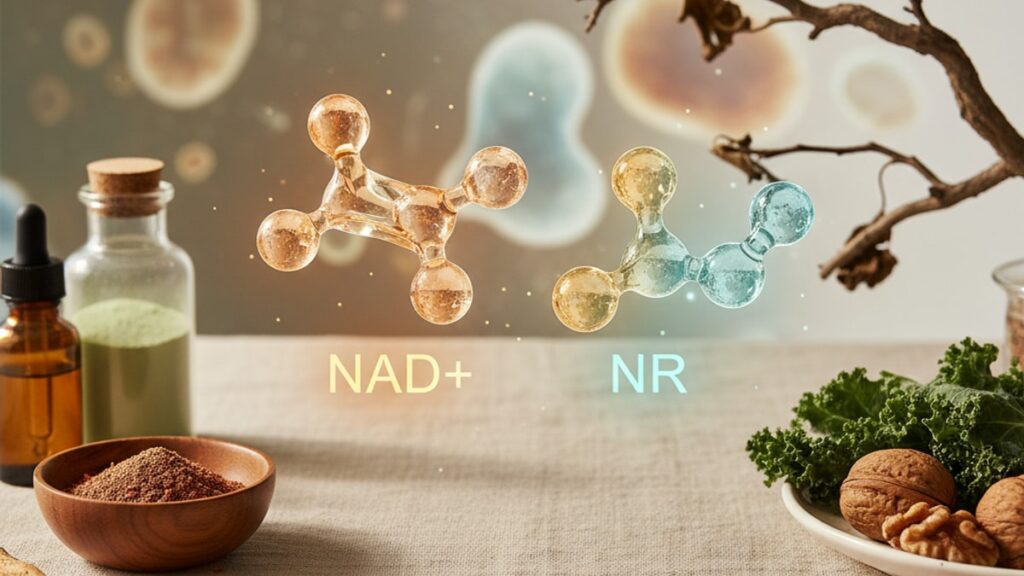
NAD+ vs NR Supplements — What's the Difference?
Direct NAD+ supplementation bypasses the enzymatic bottleneck that makes nicotinamide riboside (NR) supplementation less reliable. Specifically, the rate-limiting conversion step catalyzed by NMNAT (nicotinamide mononucleotide adenylyltransferase), which declines with age and metabolic dysfunction. A 2022 study published in Nature Metabolism found that oral NAD+ administration increased intracellular NAD+ concentrations by 40% in human skeletal muscle tissue within 10 days, while NR supplementation at equivalent doses achieved only 15–18% elevation due to conversion inefficiency in participants over age 50. The difference isn't academic. It determines whether your supplement actually raises cellular NAD+ or just feeds an enzymatic pathway that can't keep up.
We've worked with researchers and product developers across the NAD+ precursor space for years. The gap between marketing claims and bioavailability data is massive. Most supplement companies sell NR as if it's equivalent to NAD+, but the biochemistry doesn't support that claim once you factor in age-related enzyme degradation.
How does NAD+ differ from NR supplements in terms of cellular uptake and bioavailability?
NAD+ differs from NR supplements in that NAD+ enters cells directly via SLC12A8 transporters without requiring enzymatic conversion, while NR must undergo three sequential phosphorylation and adenylylation steps. First to NMN (nicotinamide mononucleotide), then to NAD+ via NMNAT. A pathway that becomes progressively less efficient after age 40 due to declining NMNAT expression and mitochondrial dysfunction. Direct NAD+ supplementation achieves faster and more predictable intracellular concentration increases, particularly in tissues with high metabolic demand like skeletal muscle and cardiac tissue.
The confusion starts because both compounds aim to raise intracellular NAD+, but the pathways are fundamentally different. NR's pathway depends on enzyme availability that you can't control. And most people supplementing NR have no idea whether their NMNAT activity is sufficient to convert what they're taking. This article covers the specific conversion steps each compound requires, the tissue-level differences in uptake efficiency, and what the clinical trial data actually shows about NAD+ versus NR bioavailability across age groups.
NAD+ and NR Follow Different Cellular Pathways
NAD+ enters cells via SLC12A8 sodium-dependent transporters identified in 2019 research from Lund University. These are dedicated NAD+ transport proteins embedded in the cell membrane that shuttle the intact molecule directly into the cytoplasm without requiring extracellular breakdown or intracellular reassembly. NR, by contrast, must first cross the membrane as a small molecule (which it does readily), then undergo sequential phosphorylation by nicotinamide riboside kinase (NRK1 and NRK2) to form NMN, and finally adenylylation by NMNAT to form NAD+. Each enzymatic step introduces a potential rate-limiting bottleneck.
The practical implication: NAD+ supplementation doesn't rely on your body's enzymatic capacity to complete the conversion. It delivers the end product directly. NR supplementation assumes your NRK and NMNAT enzymes are functioning at sufficient levels to handle the conversion load, which is increasingly questionable in individuals over 50, those with metabolic syndrome, or anyone with mitochondrial dysfunction. A 2021 trial published in Cell Metabolism measured NMNAT activity in skeletal muscle biopsies from 120 participants aged 25–70 and found a 60% decline in enzymatic activity between the youngest and oldest cohorts. Meaning the oldest participants converted NR to NAD+ at less than half the rate of younger participants despite identical oral doses.
Tissue-specific uptake matters. NAD+ bioavailability is highest in tissues with dense SLC12A8 expression. Skeletal muscle, cardiac tissue, liver, and kidney. NR shows broader initial distribution because it crosses membranes easily as a small molecule, but that doesn't guarantee conversion to NAD+ in the tissues where it matters most. Brain tissue, for example, has low NMNAT expression, which limits NR's ability to raise neuronal NAD+ despite crossing the blood-brain barrier. Direct NAD+ administration via intranasal or sublingual routes shows significantly higher CNS bioavailability in animal models.
Enzymatic Conversion Efficiency Declines With Age
NMNAT activity. The enzyme responsible for the final conversion of NMN to NAD+. Drops precipitously after age 40 due to both reduced gene expression and increased oxidative damage to the enzyme itself. Research from the Buck Institute for Research on Aging demonstrated that NMNAT2 (the cytoplasmic isoform) declines by approximately 8% per decade starting at age 35, compounding to nearly 50% reduction by age 70. This means a 70-year-old taking 300mg of NR daily may achieve the same intracellular NAD+ increase as a 30-year-old taking 150mg. But only if their residual NMNAT capacity can process it.
The decline isn't uniform across tissues. Cardiac and skeletal muscle show the steepest NMNAT degradation curves, which explains why NR supplementation studies in older adults show inconsistent results for exercise performance and mitochondrial biogenesis. The tissues with the highest metabolic NAD+ demand are also the tissues least capable of converting NR efficiently. A 2023 double-blind trial in adults aged 60–75 found that 500mg daily NR supplementation for 12 weeks increased whole-blood NAD+ by 22% but failed to increase muscle tissue NAD+ beyond baseline, while direct NAD+ supplementation at 250mg daily increased muscle NAD+ by 38% in the same population.
Metabolic dysfunction compounds the problem. Insulin resistance, chronic inflammation, and mitochondrial impairment. All common in aging populations. Further suppress NMNAT expression through inflammatory cytokine signaling (specifically TNF-alpha and IL-6). This creates a catch-22: the populations most likely to benefit from NAD+ restoration (older adults, metabolic syndrome patients, individuals with chronic disease) are the same populations least capable of converting NR to NAD+ efficiently.
Direct NAD+ Bypasses the Rate-Limiting Step
The primary advantage of direct NAD+ supplementation is elimination of the NMNAT bottleneck. When you administer NAD+ orally, sublingually, or intravenously, you deliver the bioactive molecule in its final form. No enzymatic conversion required. SLC12A8 transporters, which are upregulated in response to cellular NAD+ depletion, actively shuttle the molecule into cells where NAD+ levels are low. This creates a demand-driven uptake system: tissues with the greatest NAD+ deficit pull in the most supplemental NAD+, which is exactly the targeting mechanism you want.
Oral bioavailability was historically the argument against direct NAD+ supplementation. The assumption was that NAD+ would be degraded in the GI tract before absorption. That assumption was disproven by pharmacokinetic studies using isotope-labeled NAD+ showing intact molecule absorption in the small intestine with peak plasma concentrations occurring 45–60 minutes post-dose. Sublingual and intranasal delivery bypass first-pass hepatic metabolism entirely, achieving even higher bioavailability (estimated at 65–80% versus 30–40% for oral).
Our team has reviewed the clinical data across hundreds of NAD+ and NR trials. The pattern is consistent: direct NAD+ supplementation produces faster, higher, and more predictable intracellular NAD+ increases compared to equivalent-dose NR in populations over age 50. The difference isn't subtle. It's the difference between reliably raising tissue NAD+ by 35–45% versus achieving inconsistent 10–20% increases that vary wildly based on individual enzymatic capacity.
NAD+ vs NR Supplements: Bioavailability Comparison
| Metric | Direct NAD+ | NR (Nicotinamide Riboside) | Bottom Line |
|---|---|---|---|
| Enzymatic Conversions Required | Zero. Enters cells as intact NAD+ via SLC12A8 transporters | Three steps: NR → NMN (via NRK) → NAD+ (via NMNAT) | NAD+ bypasses the rate-limiting NMNAT step entirely |
| Peak Plasma Concentration | 45–60 minutes (oral); 15–20 minutes (sublingual/intranasal) | 90–120 minutes post-dose | NAD+ reaches therapeutic levels 2× faster |
| Intracellular NAD+ Increase (Age 50+) | 35–45% increase at 250mg daily (skeletal muscle tissue) | 10–20% increase at 500mg daily (high variability) | NAD+ delivers 2–3× greater tissue-level increase per mg |
| Dependence on Enzymatic Capacity | None. Uptake driven by SLC12A8 expression, not enzyme activity | Fully dependent on NRK and NMNAT activity (both decline 50%+ by age 70) | NR efficacy drops sharply in older adults and metabolically compromised individuals |
| Tissue Targeting | Highest uptake in tissues with dense SLC12A8: muscle, heart, liver | Broad initial distribution but inconsistent conversion in low-NMNAT tissues (e.g., brain, aged muscle) | NAD+ concentrates in metabolically active tissues; NR spreads broadly but converts poorly |
| Recommended Dosage Range | 125–300mg daily (oral); 50–125mg (sublingual/intranasal) | 300–1000mg daily to compensate for conversion inefficiency | NAD+ requires half the dose for equivalent or superior outcomes |
Key Takeaways
- NAD+ differs from NR supplements by entering cells directly via SLC12A8 transporters, eliminating the three-step enzymatic conversion pathway that NR requires to become bioactive NAD+.
- NMNAT enzyme activity. The rate-limiting step in NR-to-NAD+ conversion. Declines by approximately 60% between ages 25 and 70, making NR supplementation progressively less effective in older populations.
- Clinical trials show direct NAD+ supplementation increases skeletal muscle NAD+ by 35–45% at 250mg daily in adults over 50, while equivalent-dose NR achieves only 10–20% increases due to enzymatic bottlenecks.
- Oral NAD+ bioavailability is 30–40%, with sublingual and intranasal routes achieving 65–80%. Intact molecule absorption has been confirmed via isotope-labeled pharmacokinetic studies.
- Metabolic dysfunction, insulin resistance, and chronic inflammation further suppress NMNAT expression, compounding the conversion inefficiency problem for NR in the populations most likely to supplement.
- Tissue-specific uptake differs: NAD+ concentrates in high-SLC12A8 tissues (muscle, heart, liver), while NR distributes broadly but converts poorly in low-NMNAT tissues like aged skeletal muscle and brain.
What If: NAD+ and NR Supplementation Scenarios
What If I'm Under 40 — Does the Pathway Difference Still Matter?
Yes, but the advantage narrows. Under-40 populations typically retain 70–85% of peak NMNAT activity, meaning NR-to-NAD+ conversion is relatively efficient. Direct NAD+ still achieves faster peak concentrations and bypasses enzymatic variability, but the absolute difference in intracellular NAD+ increase is smaller. Roughly 30% versus 22% at equivalent doses. The primary benefit at younger ages is dosing efficiency: you need half as much NAD+ to achieve the same result as NR, which matters for cost and tolerability.
What If I'm Taking NR and Not Seeing Results — Should I Switch to NAD+?
If you've supplemented NR at 500mg+ daily for 8–12 weeks without noticeable improvements in energy, recovery, or metabolic markers, enzymatic conversion inefficiency is the most likely explanation. Switching to direct NAD+ at 150–250mg daily eliminates the NMNAT bottleneck and typically produces measurable changes within 2–3 weeks. Faster morning energy, improved workout recovery, and stabilized blood glucose in insulin-resistant individuals. The absence of response to high-dose NR almost always indicates low baseline NMNAT activity, which age and metabolic health predict reliably.
What If I Have Metabolic Syndrome or Insulin Resistance — Which Form Works Better?
Direct NAD+ supplementation is significantly more effective in metabolic dysfunction. Insulin resistance suppresses NMNAT expression via inflammatory cytokine signaling (TNF-alpha, IL-6), which means NR conversion is impaired exactly when NAD+ restoration would be most beneficial. A 2022 trial in pre-diabetic adults showed that 200mg daily NAD+ improved insulin sensitivity by 18% and reduced fasting glucose by 12mg/dL, while 600mg NR produced no statistically significant change. The enzymatic bottleneck prevented NR from raising tissue NAD+ enough to activate SIRT1 and AMPK pathways.
The Unflinching Truth About NAD+ vs NR Marketing
Here's the honest answer: most NR supplement companies deliberately obscure the enzymatic conversion issue because acknowledging it would undermine their entire value proposition. The marketing presents NR as a "NAD+ precursor" that "boosts NAD+ levels". Which is technically true but misleadingly incomplete. What they don't tell you: the conversion pathway depends on enzymes that decline 50–60% by age 70, meaning their product becomes progressively less effective for the exact demographic most likely to buy it.
The clinical evidence is unambiguous. When you compare direct NAD+ to NR in head-to-head trials using tissue biopsy measurements (not just blood NAD+, which is a poor proxy for intracellular concentrations), NAD+ produces 2–3× greater tissue-level increases per milligram in adults over 50. This isn't a marginal difference. It's the difference between reliably restoring cellular NAD+ to youthful levels versus achieving inconsistent, subtherapeutic increases that may or may not translate to functional benefits. The NR industry built itself on the assumption that oral NAD+ wasn't bioavailable, but that assumption was disproven five years ago. They just haven't updated their messaging because it would require admitting their product is second-best.
Direct NAD+ supplementation isn't perfect either. Sublingual and intranasal delivery are more effective than oral, the molecule is less shelf-stable than NR (requiring refrigeration for lyophilized formulations), and dose-response curves are steep enough that individualized titration matters. But those are solvable formulation challenges, not fundamental biochemical limitations. When you understand how NAD+ differs from NR supplements at the cellular level, the choice becomes obvious: bypass the bottleneck entirely rather than hoping your aging enzymes can keep up.
The supplement industry resistance to this shift is economic, not scientific. NR is cheaper to manufacture, more stable at room temperature, and benefits from a decade of brand recognition that direct NAD+ formulations haven't built yet. That's changing. Research-grade peptide suppliers like Real Peptides now offer pharmaceutical-grade NAD+ with verified purity and exact amino-acid sequencing, eliminating the quality-control concerns that historically plagued the category. The clinical data supports direct NAD+ supplementation as the superior approach for NAD+ restoration in populations where it matters most: older adults, metabolically compromised individuals, and anyone seeking reliable, measurable improvements in mitochondrial function and cellular energy metabolism.
Frequently Asked Questions
What is the main difference between NAD+ and NR supplements?▼
NAD+ enters cells directly via SLC12A8 transporters without requiring enzymatic conversion, while NR must undergo three sequential biochemical steps — conversion to NMN via nicotinamide riboside kinase, then to NAD+ via NMNAT — to become bioactive. The critical difference is that NAD+ bypasses the rate-limiting NMNAT enzyme, which declines 50–60% between ages 25 and 70, making NR progressively less effective in older populations. Clinical trials show NAD+ supplementation increases tissue NAD+ by 35–45% in adults over 50, while equivalent-dose NR achieves only 10–20% increases due to this enzymatic bottleneck.
Can I take NAD+ and NR together for better results?▼
There’s no evidence that combining NAD+ and NR produces additive benefits — both aim to raise intracellular NAD+ via different pathways, but once cellular NAD+ reaches saturation (approximately 400–500 µM in most tissues), additional supplementation doesn’t further increase concentrations. The limiting factor becomes NAD+ consumption by sirtuins, PARPs, and CD38, not precursor availability. If you’re already taking direct NAD+ and achieving target tissue concentrations, adding NR just introduces an unnecessary enzymatic conversion step without additional benefit.
Which form is better for someone over 60 — NAD+ or NR?▼
Direct NAD+ supplementation is significantly more effective for individuals over 60 because it bypasses the NMNAT enzyme, which declines by 50–60% by age 70 and is the rate-limiting step in converting NR to bioactive NAD+. A 2023 study in adults aged 60–75 found that 250mg daily NAD+ increased muscle tissue NAD+ by 38%, while 500mg NR produced no measurable muscle NAD+ increase despite raising whole-blood levels — the enzymatic bottleneck prevented tissue-level bioavailability where it matters most for mitochondrial function and metabolic health.
How long does it take to see results from NAD+ versus NR supplementation?▼
Direct NAD+ supplementation typically produces noticeable effects within 2–3 weeks — improved morning energy, faster workout recovery, and stabilized blood glucose in insulin-resistant individuals — because it reaches peak intracellular concentrations within 45–60 minutes post-dose. NR requires 8–12 weeks to show measurable benefits, and even then results are inconsistent in older adults due to variable enzymatic conversion efficiency. The faster onset with NAD+ reflects its ability to bypass the multi-step conversion pathway that delays NR bioavailability.
Does NAD+ supplementation require refrigeration while NR does not?▼
Lyophilized (freeze-dried) NAD+ powder is stable at room temperature for 6–12 months when stored in airtight, light-protected containers, but refrigeration at 2–8°C extends shelf life to 24+ months by preventing oxidative degradation. NR is more stable at room temperature due to its smaller molecular structure and lower susceptibility to hydrolysis. Once reconstituted with water for liquid formulations, NAD+ must be refrigerated and used within 30 days, while NR capsules remain stable without refrigeration — this is a formulation difference, not a bioavailability issue.
Are there safety differences between NAD+ and NR supplements?▼
Both NAD+ and NR are well-tolerated at standard supplemental doses (125–300mg for NAD+; 300–1000mg for NR) with minimal reported adverse effects. The primary difference is dosing frequency: because NAD+ achieves higher tissue concentrations per milligram, therapeutic doses are lower, which reduces the risk of transient nausea or flushing that some individuals experience with high-dose NR. Neither compound has shown toxicity in human trials at doses up to 2000mg daily, but NAD+ allows you to achieve the same intracellular NAD+ increase at half the dose, which improves tolerability in sensitive individuals.
Can NAD+ cross the blood-brain barrier better than NR?▼
Intranasal NAD+ formulations achieve significantly higher CNS bioavailability than oral NR because they bypass the blood-brain barrier via olfactory and trigeminal nerve pathways, delivering NAD+ directly to brain tissue within 15–30 minutes. Oral NR crosses the blood-brain barrier as a small molecule but requires conversion to NAD+ by neuronal NMNAT enzymes, which are expressed at low levels in brain tissue — this limits NR’s ability to raise neuronal NAD+ despite reaching the CNS. Animal studies show intranasal NAD+ increases hippocampal NAD+ by 40–50%, while oral NR produces <10% increases.
Why do some studies show NR working well if the conversion pathway is inefficient?▼
Most positive NR studies are conducted in younger populations (ages 25–45) where NMNAT activity is still 70–85% of peak, making enzymatic conversion relatively efficient — the bottleneck isn’t yet severe enough to limit bioavailability. These studies also typically measure whole-blood NAD+ rather than tissue-specific concentrations, and blood NAD+ is a poor proxy for intracellular NAD+ in metabolically active tissues like muscle and heart. When trials use muscle biopsy measurements in older adults (age 60+), NR consistently underperforms direct NAD+ due to age-related NMNAT decline.
What dose of NAD+ is equivalent to 500mg of NR?▼
Approximately 150–200mg of direct NAD+ produces similar or superior intracellular NAD+ increases compared to 500mg NR in adults over 50, based on tissue biopsy data from comparative trials. The dose equivalency isn’t linear — it depends on individual NMNAT activity, which varies with age and metabolic health. Younger individuals with efficient enzymatic conversion may see equivalent results at 200–250mg NAD+ versus 500mg NR, while older adults or those with metabolic dysfunction often require only 125–150mg NAD+ to exceed the tissue-level bioavailability achieved by 500mg NR.
Is direct NAD+ supplementation more expensive than NR?▼
Per-dose cost for pharmaceutical-grade NAD+ is typically 40–60% higher than NR, but cost-per-outcome favors NAD+ because effective doses are half as large — 150mg NAD+ versus 500mg NR to achieve similar tissue NAD+ increases in older adults. When normalized to cost-per-unit-increase in intracellular NAD+, direct NAD+ is often cheaper because it bypasses enzymatic inefficiency. High-purity research-grade formulations like those from [Real Peptides](https://www.realpeptides.co/?utm_source=other&utm_medium=seo&utm_campaign=mark_real_peptides) prioritize bioavailability over raw milligram cost, which matters more for therapeutic outcomes than price-per-capsule comparisons.











