



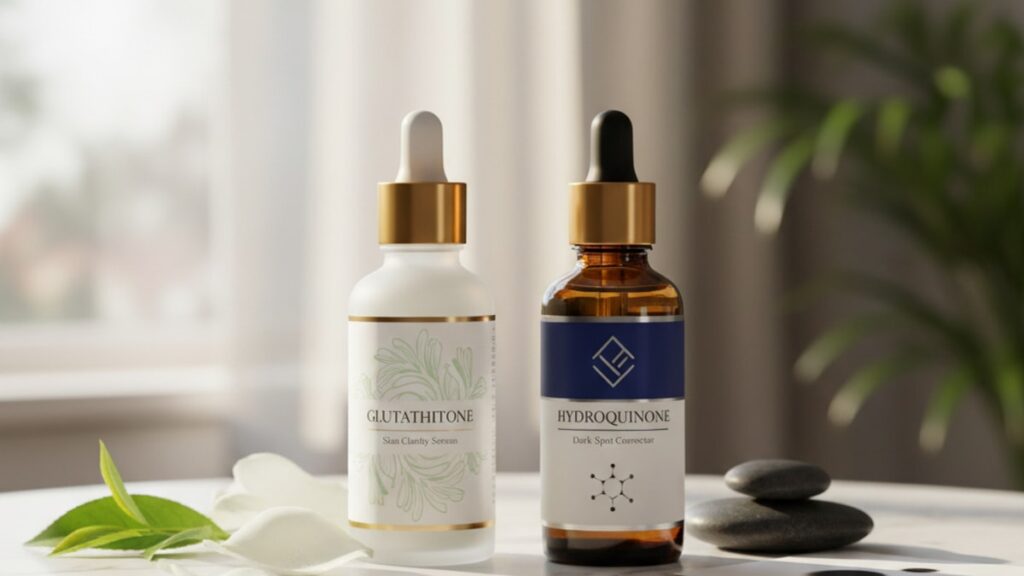
Glutathione vs Hydroquinone — Mechanisms & Applications
The most expensive skincare mistake you can make isn't buying the wrong product. It's assuming two compounds with completely different mechanisms work interchangeably. Glutathione differs from hydroquinone in nearly every measurable way: molecular structure, site of action, safety profile, regulatory status, and the biological pathway each compound influences. Glutathione is a tripeptide (gamma-glutamyl-cysteinyl-glycine) synthesized endogenously in mitochondria and cytoplasm, functioning as the body's master antioxidant. Hydroquinone is a synthetic phenolic compound that inhibits tyrosinase, the enzyme responsible for converting tyrosine into melanin. One works inside cells to neutralize oxidative stress; the other works on the skin's surface to block pigment formation.
We've analyzed the clinical literature on both compounds across dermatology, toxicology, and peptide biochemistry. The confusion between glutathione and hydroquinone stems from marketing claims that position glutathione as a 'natural skin lightener'. A framing that obscures the mechanistic reality and creates unrealistic expectations about how each compound delivers results.
How does glutathione differ from hydroquinone in mechanism and application?
Glutathione differs from hydroquinone in mechanism (intracellular antioxidant vs topical tyrosinase inhibitor), safety profile (endogenous tripeptide vs synthetic phenolic compound with documented toxicity risks), and regulatory status (GRAS supplement vs prescription-restricted in many jurisdictions). Hydroquinone blocks melanin synthesis at concentrations of 2–4% in topical formulations, producing visible depigmentation within 4–8 weeks. Glutathione, administered orally or intravenously, may influence melanin production indirectly through its antioxidant activity, but clinical evidence for skin lightening remains inconsistent compared to hydroquinone's direct enzymatic inhibition.
Most comparisons stop at 'both lighten skin'. But that oversimplifies the pharmacology to the point of distortion. Glutathione's primary role is maintaining the reduced state of cellular thiols, protecting against lipid peroxidation, and recycling other antioxidants like vitamin C and E. Its effect on melanin is secondary and far less predictable than hydroquinone's direct blockade of tyrosinase. This article covers the molecular mechanisms that differentiate these compounds, the clinical evidence for each in dermatological applications, and what the safety data actually shows when you strip away marketing language.
Molecular Structure and Biosynthesis
Glutathione (GSH) is a tripeptide composed of three amino acids: glutamic acid, cysteine, and glycine, linked in that specific sequence through a non-standard peptide bond between the gamma-carboxyl group of glutamate and the amino group of cysteine. This gamma-glutamyl linkage protects glutathione from degradation by most peptidases, allowing it to accumulate at millimolar concentrations inside cells. Higher than nearly any other non-protein thiol. It exists in two forms: reduced glutathione (GSH) and oxidized glutathione disulfide (GSSG). The GSH/GSSG ratio serves as the primary indicator of cellular redox status, with healthy cells maintaining ratios above 100:1. Glutathione is synthesized in two ATP-dependent steps catalyzed by glutamate-cysteine ligase (GCL) and glutathione synthetase, both regulated by the transcription factor Nrf2 in response to oxidative stress.
Hydroquinone (1,4-dihydroxybenzene) is a synthetic aromatic compound with two hydroxyl groups in the para position on a benzene ring. It's not synthesized endogenously in humans and has no natural biological function. It's a xenobiotic compound used exclusively for its tyrosinase inhibitory properties. Hydroquinone is structurally similar to tyrosine, the substrate for melanin synthesis, allowing it to competitively inhibit tyrosinase by mimicking the substrate and binding the enzyme's active site. At therapeutic concentrations (2–4%), hydroquinone also generates reactive oxygen species that cause selective cytotoxicity to melanocytes, reducing pigment cell density over time. This dual mechanism. Enzyme inhibition plus melanocyte suppression. Explains why hydroquinone produces faster and more dramatic depigmentation than most alternatives.
Mechanisms of Action in Pigmentation
Glutathione's proposed effect on skin pigmentation operates through several indirect pathways, none of which involve direct tyrosinase inhibition. First, glutathione can shift melanogenesis from the production of eumelanin (brown-black pigment) toward pheomelanin (yellow-red pigment) by binding to the intermediate dopaquinone and preventing its polymerization into eumelanin precursors. This mechanism was demonstrated in cultured melanocytes but remains difficult to quantify in vivo because pheomelanin is less visible than eumelanin. The skin may contain the same total amount of melanin but appear lighter due to the color shift. Second, glutathione's antioxidant activity may reduce oxidative stress signals that upregulate tyrosinase expression, indirectly lowering melanin production. Third, glutathione is required for the function of glutathione peroxidase, an enzyme that neutralizes hydrogen peroxide. A known stimulator of melanogenesis.
Hydroquinone works through competitive inhibition of tyrosinase, the rate-limiting enzyme in melanin biosynthesis. Tyrosinase catalyzes two critical steps: the hydroxylation of tyrosine to L-DOPA, and the oxidation of L-DOPA to dopaquinone. Hydroquinone's phenolic structure allows it to occupy the enzyme's active site, preventing substrate binding and halting melanin production at the earliest enzymatic step. At higher concentrations, hydroquinone also generates quinone intermediates that are cytotoxic to melanocytes, selectively reducing the number of pigment-producing cells in treated areas. This melanocyte suppression explains why prolonged hydroquinone use can lead to rebound hyperpigmentation after discontinuation. The surviving melanocytes compensate by increasing melanin output once the inhibitor is removed.
Clinical Evidence and Efficacy
The clinical evidence for hydroquinone as a depigmenting agent is extensive and unambiguous. A 2006 meta-analysis published in the Journal of the American Academy of Dermatology reviewed 24 randomized controlled trials and found that hydroquinone 2–4% produced statistically significant reduction in melasma severity scores compared to placebo, with visible improvement noted within 4–8 weeks of twice-daily application. The typical regimen combines hydroquinone with a retinoid (tretinoin) and a corticosteroid (fluocinolone) in a triple-combination formulation, which has been shown to produce superior outcomes compared to any single agent alone. The retinoid increases cell turnover, accelerating the shedding of pigmented keratinocytes, while the corticosteroid reduces inflammation that can trigger post-inflammatory hyperpigmentation.
Glutathione's evidence base for skin lightening is far more contested. A 2016 systematic review published in the International Journal of Dermatology analyzed all available clinical trials on oral and intravenous glutathione for skin lightening and concluded that while some studies reported modest reductions in melanin index measurements, the overall quality of evidence was low due to small sample sizes, lack of placebo controls, and inconsistent dosing protocols. The studies that did show positive results typically used intravenous glutathione at doses of 600–1200 mg administered 1–2 times weekly for 8–12 weeks. A regimen that's impractical for most patients and carries the risks associated with any intravenous therapy, including infection and vein irritation. Oral glutathione bioavailability is limited by first-pass hepatic metabolism, and most ingested glutathione is broken down into constituent amino acids before reaching systemic circulation.
Comparison Table: Glutathione vs Hydroquinone
| Criterion | Glutathione (GSH) | Hydroquinone | Professional Assessment |
|---|---|---|---|
| Molecular Classification | Endogenous tripeptide (gamma-glutamyl-cysteinyl-glycine) | Synthetic phenolic compound (1,4-dihydroxybenzene) | Fundamentally different chemical entities with no structural overlap |
| Primary Mechanism | Antioxidant; shifts eumelanin to pheomelanin; indirectly modulates tyrosinase via oxidative stress reduction | Competitive tyrosinase inhibition; melanocyte cytotoxicity at therapeutic concentrations | Hydroquinone's direct enzymatic action produces faster, more predictable depigmentation |
| Route of Administration | Oral (250–500 mg/day), IV (600–1200 mg weekly), topical (rare, unstable) | Topical cream/gel (2–4% concentration), applied twice daily to affected areas | IV glutathione requires clinical oversight; topical hydroquinone is user-administered |
| Time to Visible Results | 8–12 weeks (inconsistent; some users report no change) | 4–8 weeks with twice-daily application | Hydroquinone's onset is more reliable and clinically documented |
| Safety Profile | GRAS status as supplement; IV administration carries infection/vein risks; minimal dermal toxicity | Dermal irritation common; ochronosis (paradoxical darkening) reported with prolonged use (>6 months); banned or restricted in EU, Japan, Australia | Glutathione has fewer documented dermal risks but lacks long-term IV safety data; hydroquinone's toxicity profile is well-characterized |
| Regulatory Status | Unregulated as supplement in US; not FDA-approved for skin lightening | Prescription-required in US for concentrations >2%; OTC banned in many countries due to toxicity concerns | Regulatory divergence reflects different risk-benefit assessments |
Key Takeaways
- Glutathione differs from hydroquinone in both molecular structure and mechanism: glutathione is an endogenous tripeptide antioxidant; hydroquinone is a synthetic tyrosinase inhibitor with no natural biological role.
- Hydroquinone produces visible depigmentation within 4–8 weeks through direct enzymatic inhibition of melanin synthesis, while glutathione's effect on skin tone is indirect, inconsistent, and requires 8–12 weeks to manifest if it occurs at all.
- The GSH/GSSG ratio inside cells exceeds 100:1 in healthy tissue, maintaining redox homeostasis. This is glutathione's primary function, not pigment regulation.
- Hydroquinone at 2–4% concentration is the gold standard for melasma treatment in dermatology, supported by multiple randomized controlled trials, while glutathione for skin lightening lacks high-quality placebo-controlled evidence.
- Prolonged hydroquinone use beyond six months can cause ochronosis, a paradoxical blue-black pigmentation that is difficult to reverse, which is why dermatologists limit continuous use to 3–4 months followed by a washout period.
- Intravenous glutathione at 600–1200 mg weekly bypasses oral bioavailability limitations but introduces infection risk, vein irritation, and regulatory concerns. It's not approved by FDA for cosmetic indications.
What If: Glutathione and Hydroquinone Scenarios
What If I Use Glutathione and Hydroquinone Together?
Combining glutathione and hydroquinone is theoretically safe from a pharmacological interaction standpoint. They act through different mechanisms and don't compete for the same enzymatic pathways. Glutathione's antioxidant activity might even mitigate some of the oxidative stress induced by hydroquinone's quinone metabolites. However, there's no clinical evidence that combination therapy produces additive or synergistic depigmentation beyond what hydroquinone alone achieves. If you're using topical hydroquinone, adding oral or IV glutathione is unlikely to accelerate results and adds cost without documented benefit. The dermatology literature supports combination therapy that pairs hydroquinone with retinoids and corticosteroids. Not antioxidants.
What If Oral Glutathione Doesn't Work for Skin Lightening?
Most oral glutathione is broken down into glutamate, cysteine, and glycine during first-pass hepatic metabolism, meaning the intact tripeptide never reaches systemic circulation at meaningful concentrations. If oral supplementation at 500 mg/day for 12 weeks produces no visible change in skin tone, switching to IV administration won't necessarily solve the issue. The problem may be that glutathione's indirect effect on melanogenesis is too weak to overcome your baseline melanin production rate. At that point, the evidence-based option is topical hydroquinone under dermatologist supervision, not escalating glutathione dosage. The clinical trials showing modest glutathione effects used IV doses of 1200 mg weekly, which is impractical and expensive for long-term use.
What If I Develop Ochronosis From Hydroquinone?
Ochronosis is a rare but serious adverse effect characterized by blue-black hyperpigmentation in areas of prolonged hydroquinone application, caused by the deposition of ochronotic pigment in the dermis. It occurs most commonly with concentrations above 4%, continuous use beyond six months, or use on darker skin types (Fitzpatrick IV–VI). If ochronosis develops, discontinue hydroquinone immediately. Continued use worsens the pigmentation. Treatment options include Q-switched lasers (Nd:YAG 1064 nm), chemical peels with glycolic or salicylic acid, and topical retinoids to accelerate dermal remodeling, but resolution is slow and incomplete. This is why dermatologists recommend cyclical hydroquinone use: 3–4 months on, 2–3 months off, rather than continuous application.
The Clinical Truth About Glutathione and Hydroquinone
Here's the honest answer: glutathione and hydroquinone are not interchangeable, and positioning glutathione as a 'natural alternative' to hydroquinone sets up unrealistic expectations. The mechanisms are fundamentally different. Hydroquinone blocks the enzyme that makes melanin. Full stop. Glutathione supports general cellular redox balance and may, under specific conditions, shift the type of melanin produced, but it doesn't stop melanin synthesis the way hydroquinone does. The clinical evidence reflects this: hydroquinone is a prescription dermatological agent with decades of controlled trial data, while glutathione for skin lightening is a supplement market phenomenon with inconsistent results and low-quality evidence. If your goal is predictable, measurable depigmentation within 8 weeks, hydroquinone is the evidence-based choice. If your goal is systemic antioxidant support with a possible secondary effect on skin tone, glutathione is worth considering. But expect modest results at best, and understand that oral bioavailability is the limiting factor.
The safety trade-off is real. Hydroquinone works faster but carries dermal toxicity risks that require monitoring. Irritation, post-inflammatory hyperpigmentation, and ochronosis with misuse. Glutathione has minimal dermal toxicity but limited oral bioavailability and no FDA approval for cosmetic indications. The IV route solves the bioavailability issue but introduces infection risk and cost barriers. Neither compound is risk-free, and neither works universally across all skin types and pigmentation patterns. The marketing narrative that glutathione is 'safer' because it's endogenous ignores the fact that exogenous supplementation at pharmacological doses doesn't replicate endogenous synthesis. You're still introducing a compound at concentrations the body wouldn't naturally produce.
Our team has reviewed the peptide biochemistry literature extensively. Glutathione's role in cellular redox homeostasis is uncontested. It's the master antioxidant, critical for detoxification, immune function, and mitochondrial health. Its role in cosmetic skin lightening is far more speculative. If you're interested in glutathione for its antioxidant properties, that's a defensible use case supported by decades of research into oxidative stress and aging. If you're interested in glutathione specifically to lighten skin, understand that you're working with limited evidence and paying for a mechanism that may or may not translate to visible depigmentation in your case. Hydroquinone's mechanism is direct and dose-dependent. Predictable, but not without trade-offs.
Glutathione differs from hydroquinone in nearly every measurable parameter, and the compounds serve different clinical purposes. One is a systemic antioxidant with possible secondary effects on pigmentation; the other is a targeted depigmenting agent with well-documented efficacy and well-documented risks. Choosing between them isn't a matter of 'natural vs synthetic'. It's a matter of understanding what each compound actually does at the molecular level and whether that mechanism aligns with your goals and risk tolerance. If you're working with a dermatologist on melasma or post-inflammatory hyperpigmentation, hydroquinone is the standard of care. If you're exploring peptide-based antioxidant support, glutathione is worth considering for its broader cellular benefits. But don't expect it to replicate hydroquinone's depigmenting effect, because the biochemistry simply doesn't support that expectation.
Frequently Asked Questions
How does glutathione differ from hydroquinone in mechanism of action?▼
Glutathione differs from hydroquinone in that glutathione is an endogenous tripeptide antioxidant that may indirectly influence melanin production by shifting eumelanin synthesis toward pheomelanin and reducing oxidative stress, while hydroquinone is a synthetic tyrosinase inhibitor that directly blocks the enzyme responsible for melanin synthesis. Hydroquinone’s mechanism is enzymatic inhibition at the rate-limiting step of melanogenesis, producing predictable depigmentation, whereas glutathione’s effect on skin tone is secondary to its primary role in cellular redox balance and is far less consistent across individuals.
Can I use glutathione and hydroquinone together for faster skin lightening?▼
Yes, glutathione and hydroquinone can be used together without direct pharmacological interaction, as they work through different mechanisms. However, there is no clinical evidence that combining them produces additive or synergistic depigmentation beyond what hydroquinone alone achieves. The dermatology literature supports combining hydroquinone with retinoids and corticosteroids for enhanced efficacy, not with antioxidants like glutathione.
What is the difference in safety profile between glutathione and hydroquinone?▼
Glutathione has minimal dermal toxicity and is classified as GRAS (Generally Recognized As Safe) when taken orally, though intravenous administration carries risks of infection and vein irritation. Hydroquinone, while highly effective, commonly causes dermal irritation and can lead to ochronosis — a paradoxical blue-black hyperpigmentation — with prolonged use beyond six months or at concentrations above 4%. Hydroquinone is prescription-restricted or banned in many countries due to these toxicity concerns, while glutathione remains unregulated as a supplement in most jurisdictions.
How long does it take to see results from glutathione compared to hydroquinone?▼
Hydroquinone produces visible depigmentation within 4–8 weeks of twice-daily topical application at 2–4% concentration, with results documented in multiple randomized controlled trials. Glutathione, whether taken orally or administered intravenously, requires 8–12 weeks to potentially show modest effects on skin tone, and many users report no visible change at all. The time difference reflects hydroquinone’s direct enzymatic inhibition of melanin synthesis versus glutathione’s indirect and inconsistent influence on pigmentation.
Why is oral glutathione less effective than intravenous for skin lightening?▼
Oral glutathione undergoes extensive first-pass hepatic metabolism, meaning most of the ingested tripeptide is broken down into its constituent amino acids (glutamate, cysteine, glycine) before reaching systemic circulation. Intravenous administration bypasses this metabolic degradation, delivering intact glutathione directly to the bloodstream at concentrations that may influence melanogenesis. However, even IV glutathione at 600–1200 mg weekly shows inconsistent results in clinical trials, and the route introduces infection risk and cost barriers.
Is glutathione FDA-approved for skin lightening like hydroquinone is?▼
No, glutathione is not FDA-approved for any cosmetic indication, including skin lightening — it is sold as a dietary supplement under GRAS status, which does not require FDA pre-market approval for efficacy or safety. Hydroquinone, in contrast, is regulated as a drug and requires prescription for concentrations above 2% in the United States. The regulatory distinction reflects the difference in clinical evidence: hydroquinone has decades of controlled trial data supporting its depigmenting efficacy, while glutathione for skin lightening lacks high-quality placebo-controlled studies.
What happens if I stop using hydroquinone — will the pigmentation return?▼
Yes, pigmentation often returns after discontinuing hydroquinone because the compound does not permanently reduce melanocyte number or tyrosinase expression — it only inhibits melanin synthesis while actively applied. Rebound hyperpigmentation can occur if the treated area is exposed to UV radiation without sun protection, as the melanocytes compensate by increasing melanin production. Dermatologists typically recommend cyclical use of hydroquinone (3–4 months on, 2–3 months off) combined with broad-spectrum sunscreen to minimize rebound and prevent ochronosis.
Can glutathione cause ochronosis like hydroquinone does?▼
No, there are no documented cases of ochronosis caused by glutathione supplementation, as ochronosis is specifically associated with prolonged topical hydroquinone use and results from the deposition of ochronotic pigment in the dermis. Glutathione’s safety profile is distinct from hydroquinone’s — its primary risks are related to intravenous administration (infection, vein irritation) rather than dermal toxicity. However, this does not mean glutathione is universally safe at all doses or routes; long-term IV use lacks comprehensive safety data.
Which is more cost-effective for skin lightening — glutathione or hydroquinone?▼
Hydroquinone is significantly more cost-effective when measured by clinical efficacy per dollar spent. A three-month supply of prescription hydroquinone 4% cream costs approximately 40–80 dollars and produces documented depigmentation within 4–8 weeks. Oral glutathione supplementation at 500 mg/day costs 30–60 dollars per month with inconsistent results, and intravenous glutathione at 1200 mg weekly can cost 100–300 dollars per session with similarly unreliable outcomes. The cost difference reflects the strength of clinical evidence: hydroquinone’s efficacy is proven, glutathione’s is speculative.
What is the biochemical role of glutathione beyond skin lightening?▼
Glutathione’s primary biochemical role is maintaining cellular redox homeostasis by neutralizing reactive oxygen species, recycling other antioxidants (vitamin C, vitamin E), and serving as a cofactor for glutathione peroxidase and glutathione S-transferase enzymes involved in detoxification. It exists in reduced (GSH) and oxidized (GSSG) forms, and the GSH/GSSG ratio is a critical marker of cellular oxidative stress. Healthy cells maintain GSH/GSSG ratios above 100:1. Glutathione’s effect on melanin production is a secondary, indirect consequence of its antioxidant activity — not its primary biological function.











