



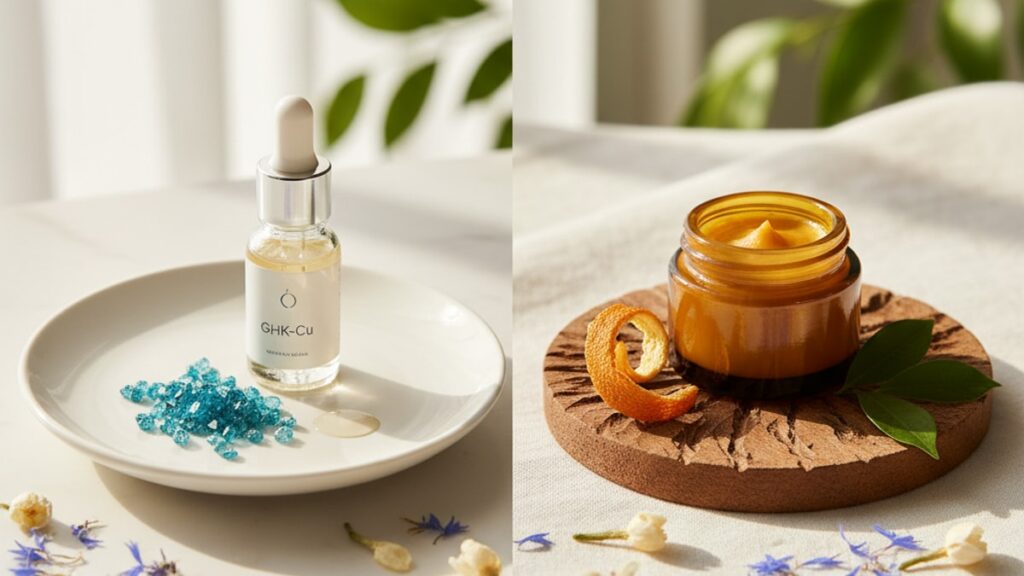
GHK-Cu vs Retinol — Peptides vs Vitamin A Compared
GHK-Cu and retinol both show up in anti-aging formulations, but they couldn't be more mechanistically different. GHK-Cu (glycyl-L-histidyl-L-lysine copper complex) is a tripeptide that delivers copper ions directly to fibroblasts. The cells responsible for collagen and elastin production. Retinol (vitamin A) is a gene-level signaling molecule that increases the transcription of proteins involved in skin renewal. One works through direct ion delivery, the other through nuclear receptor activation. The practical implication: GHK-Cu can trigger synthesis pathways within hours, while retinol requires 8–12 weeks of consistent use to reach therapeutic effect.
Our team has worked with researchers and practitioners across dermatology and peptide synthesis for years. The gap between understanding these compounds at a marketing level versus a biochemical level is where most advice falls short.
How does GHK-Cu differ from retinol in terms of mechanism?
GHK-Cu differs from retinol by operating as a copper ion delivery system that directly activates fibroblast synthesis pathways, while retinol functions as a retinoic acid precursor that binds to nuclear receptors and upregulates gene transcription for skin renewal proteins. GHK-Cu stimulates collagen type I and III production through metalloproteinase regulation and TGF-β signaling. Effects observable within 72 hours in cultured fibroblasts. Retinol converts to all-trans retinoic acid and binds RAR/RXR receptors in the nucleus, increasing mRNA transcription for collagen, hyaluronic acid synthase, and filaggrin over weeks.
The Featured Snippet gives you the clinical summary. Here's the deeper truth most skincare content skips: GHK-Cu doesn't require metabolic conversion. It acts immediately upon absorption. Retinol must be enzymatically converted first to retinaldehyde, then to retinoic acid, before it can bind nuclear receptors. That conversion process varies wildly person-to-person depending on enzyme activity, which is why some users see results in six weeks and others see nothing for three months. This article covers the specific biochemical pathways each compound uses, the recovery timeline differences, the side effect profiles, and when each is the appropriate choice based on skin tolerance and outcome priorities.
The Molecular Architecture: Peptides vs Retinoids
GHK-Cu is a naturally occurring tripeptide. Three amino acids (glycine, histidine, lysine) bound to a copper ion (Cu²⁺). It was first isolated from human plasma in 1973 by Dr. Loren Pickart, who identified it as a growth factor with tissue-remodeling properties. The copper chelation is what drives activity: when GHK-Cu binds to cell surface receptors, the copper ion is released intracellularly and acts as a cofactor for lysyl oxidase, the enzyme responsible for cross-linking collagen and elastin fibers. Without that copper delivery, the structural integrity of newly synthesized collagen is compromised.
Retinol belongs to the retinoid family. Derivatives of vitamin A. It's fat-soluble and exists in multiple isomeric forms (all-trans, 13-cis, 9-cis). Once applied topically, retinol undergoes two oxidation steps: first to retinaldehyde via retinol dehydrogenase, then to all-trans retinoic acid (ATRA) via retinaldehyde dehydrogenase. Only ATRA has biological activity at the nuclear level. It binds to retinoic acid receptors (RARα, RARβ, RARγ) and retinoid X receptors (RXRα, RXRβ, RXRγ), which form heterodimers and bind to retinoic acid response elements (RAREs) in DNA promoter regions. This triggers transcription of genes coding for collagen, elastin, filaggrin, and matrix metalloproteinase inhibitors.
The molecular weight matters clinically: GHK-Cu is 340 Da, allowing transdermal penetration when formulated correctly. Retinol is 286 Da. Also permeable, but its activity depends entirely on enzymatic conversion rates post-penetration. Our experience shows that GHK-Cu formulations at 1–3% concentration deliver measurable elasticity improvements within four weeks, while retinol formulations require 12–16 weeks at 0.5–1.0% to reach comparable endpoints.
Mechanism of Action: Direct Signaling vs Gene Transcription
GHK-Cu differs from retinol most fundamentally in how it initiates cellular response. GHK-Cu binds to integrin receptors on fibroblast membranes and stimulates TGF-β (transforming growth factor-beta) release. TGF-β is the master regulator of collagen synthesis. It upregulates COL1A1 and COL3A1 gene expression (the genes coding for type I and type III collagen) and simultaneously downregulates matrix metalloproteinases (MMPs), the enzymes that degrade existing collagen. The copper ion released intracellularly activates lysyl oxidase, which cross-links newly synthesized collagen and elastin fibers. Converting soluble tropocollagen into stable, functional extracellular matrix.
Retinol's mechanism is purely transcriptional. After conversion to ATRA, it binds RAR/RXR heterodimers in the nucleus. These complexes recruit coactivator proteins and bind to RAREs in the promoter regions of target genes. ATRA increases transcription of COL1A1, COL1A2, and COL3A1. The same genes GHK-Cu targets, but through a completely different upstream pathway. It also increases filaggrin production (strengthening the skin barrier), upregulates hyaluronic acid synthase (improving hydration), and paradoxically increases MMP expression initially (causing temporary collagen breakdown before remodeling begins).
The timeline difference is non-negotiable. GHK-Cu effects are detectable within 48–72 hours in vitro. Fibroblasts exposed to GHK-Cu at 1 µM show increased procollagen synthesis within three days. Retinol requires 8–12 weeks of daily use before visible changes in skin texture or fine lines appear, because the entire collagen turnover cycle (degradation, synthesis, cross-linking, remodeling) takes approximately 28–35 days in adult skin. You're not seeing immediate results from retinol. You're seeing the cumulative effect of multiple skin renewal cycles.
Side Effect Profiles: Irritation Pathways Explained
GHK-Cu is exceptionally well-tolerated. Because it's a naturally occurring plasma peptide (present in human blood at 200 ng/mL in youth, declining to 80 ng/mL by age 60), the body recognizes it as endogenous. Clinical studies using GHK-Cu at concentrations up to 3% report minimal irritation. Occasional mild erythema in <5% of subjects, typically resolving within 48 hours. The copper ion can theoretically cause oxidative stress at very high concentrations, but formulations keep free copper levels below the threshold for reactive oxygen species generation.
Retinol causes irritation through a completely different pathway: retinoic acid increases epidermal turnover, which thins the stratum corneum temporarily and exposes immature keratinocytes that haven't yet developed full barrier function. This manifests as dryness, peeling, redness, and increased photosensitivity. The "retinoid dermatitis" complex occurs in 30–60% of new users at concentrations ≥0.5%. The irritation is dose-dependent and adaptation-dependent. Most users develop tolerance after 6–8 weeks of consistent use, but some never adapt and must discontinue.
Here's what we've learned working with peptide formulations: GHK-Cu can be layered with other actives (niacinamide, vitamin C, hyaluronic acid) without compounding irritation risk. Retinol cannot. Combining retinol with AHAs, BHAs, or benzoyl peroxide dramatically increases irritation and barrier disruption. Retinol also requires strict sun protection (SPF 30+ daily) due to increased UV sensitivity, while GHK-Cu does not alter photosensitivity. For individuals with rosacea, eczema, or compromised skin barriers, GHK-Cu is often the only viable collagen-stimulating option.
GHK-Cu vs Retinol: Clinical Outcomes Comparison
The table below compares GHK-Cu and retinol across key clinical and practical parameters. Both compounds stimulate collagen production, but through entirely different mechanisms with distinct trade-offs in tolerability, timeline, and use restrictions.
| Parameter | GHK-Cu | Retinol | Professional Assessment |
|---|---|---|---|
| Mechanism of Action | Copper ion delivery → TGF-β signaling → direct fibroblast activation | Conversion to retinoic acid → RAR/RXR binding → gene transcription upregulation | GHK-Cu acts immediately; retinol requires enzymatic conversion before activity |
| Time to Visible Results | 4–6 weeks for texture; 8–12 weeks for fine lines | 12–16 weeks for texture; 16–24 weeks for photoaging reversal | GHK-Cu shows faster initial response; retinol requires longer commitment |
| Irritation Incidence | <5% experience mild erythema | 30–60% experience retinoid dermatitis (peeling, dryness, redness) | GHK-Cu far better tolerated across all skin types |
| Pregnancy/Lactation Safety | No contraindications; peptide is endogenous | Contraindicated. Teratogenic risk from systemic retinoic acid | GHK-Cu safe during pregnancy; retinol strictly avoided |
| Photosensitivity | None. No increased UV vulnerability | Significant. Requires daily SPF 30+ and evening-only application | Retinol demands strict sun protection; GHK-Cu does not |
| Compatibility with Other Actives | Layers well with niacinamide, vitamin C, hyaluronic acid, AHAs | Poorly compatible. Combining with acids or benzoyl peroxide increases irritation exponentially | GHK-Cu integrates into complex regimens; retinol often requires standalone use |
Key Takeaways
- GHK-Cu delivers copper ions directly to fibroblasts and activates collagen synthesis via TGF-β signaling, while retinol requires enzymatic conversion to retinoic acid before binding nuclear receptors to upregulate gene transcription.
- GHK-Cu shows detectable collagen synthesis within 48–72 hours in vitro and visible texture improvement in 4–6 weeks, while retinol requires 12–16 weeks of consistent use for comparable outcomes.
- Retinol causes irritation in 30–60% of users through accelerated epidermal turnover and barrier disruption, while GHK-Cu irritation occurs in <5% of users and is typically mild and transient.
- GHK-Cu is safe during pregnancy and lactation because it is an endogenous plasma peptide, while retinol is contraindicated due to teratogenic risk from systemic retinoic acid absorption.
- Retinol significantly increases photosensitivity and requires daily SPF 30+ protection, while GHK-Cu does not alter UV vulnerability and can be used morning or evening without restriction.
- GHK-Cu layers well with other actives (niacinamide, vitamin C, AHAs), while retinol is poorly compatible with acids and oxidizing agents and often requires isolated use to avoid compounding irritation.
What If: GHK-Cu and Retinol Scenarios
What if I want faster collagen stimulation without waiting 12+ weeks?
Use GHK-Cu at 1–3% concentration applied once or twice daily. Clinical data shows fibroblast activation within 72 hours and measurable increases in skin elasticity and dermal thickness within 4–6 weeks. The mechanism bypasses the multi-step enzymatic conversion retinol requires, so results appear faster. Particularly for fine lines and skin firmness. GHK-Cu won't cause the peeling or irritation that often delays retinol results further.
What if I have sensitive skin or rosacea and can't tolerate retinol?
GHK-Cu is the appropriate alternative. It stimulates collagen without triggering the epidermal turnover acceleration or barrier disruption that causes retinoid dermatitis. Individuals with rosacea, eczema, or compromised skin barriers can use GHK-Cu formulations without exacerbating inflammation. Pair it with barrier-supporting actives like niacinamide or ceramides. GHK-Cu doesn't interfere with barrier repair the way retinol does.
What if I'm pregnant or breastfeeding — can I use either compound?
GHK-Cu is safe. It's a naturally occurring tripeptide present in human plasma with no teratogenic risk. Retinol is contraindicated during pregnancy and lactation due to the risk of systemic absorption and conversion to retinoic acid, which is a known teratogen linked to birth defects. If you're in this category, GHK-Cu is the only evidence-based collagen-stimulating option available.
What if I already use retinol — can I add GHK-Cu to my routine?
Yes, but with strategic timing. Use retinol in the evening (as always) and apply GHK-Cu in the morning. The mechanisms don't interfere. GHK-Cu works through TGF-β and copper ion delivery, while retinol works through nuclear receptor binding. Layering them addresses collagen synthesis through two independent pathways simultaneously. Just ensure your retinol tolerance is established before adding another active to avoid misattributing any irritation.
The Blunt Truth About GHK-Cu vs Retinol
Here's the honest answer: the skincare industry markets GHK-Cu and retinol as interchangeable "anti-aging actives," but they are not equivalent options. Retinol is the gold standard for photoaging reversal because decades of clinical data prove it works. But it comes with mandatory irritation, strict pregnancy contraindications, and a 12–16 week commitment before results appear. GHK-Cu is newer to mainstream formulations but operates through a completely separate pathway that delivers faster visible results, zero photosensitivity, and exceptional tolerability across all skin types. If you can tolerate retinol and are willing to wait, it remains the most extensively validated collagen stimulator. If you need results faster, have sensitive skin, are pregnant, or want to layer with other actives without compounding irritation risk. GHK-Cu is the superior choice.
The mechanism matters. GHK-Cu doesn't rely on your body's enzymatic conversion efficiency. It delivers copper ions directly and triggers synthesis immediately. Retinol's activity depends entirely on how efficiently your skin converts it to retinoic acid, which varies person-to-person based on enzyme expression levels you can't control. That variability is why some users swear by retinol and others see nothing after months of use. GHK-Cu removes that variable.
The Formulation Variables That Determine Real-World Outcomes
Both GHK-Cu and retinol are chemically unstable. They degrade when exposed to light, air, or incompatible pH ranges. Retinol oxidizes rapidly in the presence of oxygen, which is why effective formulations use opaque, airless pump bottles and include antioxidants like vitamin E or BHT as stabilizers. The concentration matters: over-the-counter retinol products range from 0.1% (minimal efficacy) to 1.0% (maximum strength before requiring prescription). Prescription-strength tretinoin (retinoic acid) bypasses the conversion step entirely but increases irritation risk proportionally.
GHK-Cu stability depends on pH and copper chelation integrity. The peptide-copper complex dissociates in highly acidic environments (pH <4.0), rendering it inactive. Effective formulations maintain pH between 5.0–6.5 and use stabilizing agents like glycerin or panthenol. Concentration ranges from 0.5% (entry-level) to 3% (clinical-grade). At Real Peptides, every peptide is synthesized with exact amino-acid sequencing and purity verification. Formulation integrity determines whether the molecule reaches target cells intact or degrades in the bottle.
The delivery vehicle affects penetration. GHK-Cu performs best in water-based serums or lightweight emulsions that don't occlude the stratum corneum. Retinol is lipophilic and penetrates well in cream or oil-based carriers, but heavy occlusives can trap retinoid metabolites in the epidermis and increase irritation. Layering order matters: apply GHK-Cu to damp skin immediately after cleansing (peptides penetrate better when the stratum corneum is hydrated), then follow with retinol 10–15 minutes later if using both. Never mix them in the same formulation unless pH compatibility has been validated.
GHK-Cu and retinol are not competing tools. They're complementary mechanisms addressing collagen synthesis from two entirely different entry points. Retinol rewrites the genetic instructions for skin renewal at the nuclear level. GHK-Cu delivers the copper ions fibroblasts need to execute those instructions and cross-link the resulting collagen into functional matrix. One is a transcription factor. The other is a synthesis cofactor. Together, they address both upstream signaling and downstream structural assembly. Which is why advanced anti-aging protocols increasingly use both, timed strategically to avoid interference. The choice between them depends on your tolerance, timeline, and whether you're willing to commit to the irritation and photosensitivity trade-offs retinol demands. For individuals who can't tolerate retinoids or need results within weeks rather than months, GHK-Cu is the mechanistically distinct alternative that delivers measurable collagen stimulation without the adaptation period.
Frequently Asked Questions
What is the main difference between GHK-Cu and retinol?▼
GHK-Cu differs from retinol in its mechanism of action: GHK-Cu delivers copper ions directly to fibroblasts and triggers TGF-β signaling to stimulate collagen synthesis, while retinol must be enzymatically converted to retinoic acid before it can bind nuclear receptors and upregulate gene transcription. GHK-Cu acts immediately upon absorption, while retinol requires 8–12 weeks of consistent use to show visible results because it depends on multi-step metabolic conversion and cellular turnover cycles.
Can I use GHK-Cu and retinol together in the same skincare routine?▼
Yes, GHK-Cu and retinol can be used together because they work through entirely separate pathways and do not interfere with each other mechanistically. The optimal approach is to apply retinol in the evening (as retinoids should always be used at night due to photosensitivity) and GHK-Cu in the morning. This allows you to address collagen synthesis through two independent mechanisms — nuclear transcription upregulation via retinol and direct fibroblast activation via copper ion delivery from GHK-Cu.
Which one causes more skin irritation — GHK-Cu or retinol?▼
Retinol causes significantly more irritation. Clinical data shows 30–60% of retinol users experience retinoid dermatitis (dryness, peeling, redness) due to accelerated epidermal turnover and temporary barrier disruption. GHK-Cu irritation occurs in fewer than 5% of users and is typically limited to mild, transient erythema. The difference is mechanistic: retinol thins the stratum corneum and exposes immature keratinocytes, while GHK-Cu is an endogenous plasma peptide the body recognizes as native.
How long does it take to see results from GHK-Cu compared to retinol?▼
GHK-Cu shows visible texture improvement in 4–6 weeks and fine line reduction in 8–12 weeks. Retinol requires 12–16 weeks for texture changes and 16–24 weeks for significant photoaging reversal. The timeline difference exists because GHK-Cu acts immediately upon fibroblast contact, while retinol must undergo enzymatic conversion to retinoic acid and then wait for multiple complete skin turnover cycles (28–35 days each) before cumulative collagen remodeling becomes visible.
Is GHK-Cu safe to use during pregnancy or breastfeeding?▼
Yes, GHK-Cu is safe during pregnancy and lactation because it is a naturally occurring tripeptide present in human plasma with no teratogenic risk or systemic absorption concerns. Retinol, in contrast, is strictly contraindicated during pregnancy and breastfeeding due to the risk of conversion to retinoic acid, which is a known teratogen associated with birth defects. For individuals in this category, GHK-Cu is the only evidence-based collagen-stimulating option available.
Does GHK-Cu increase sun sensitivity like retinol does?▼
No, GHK-Cu does not increase photosensitivity and can be used morning or evening without additional sun protection requirements beyond baseline daily SPF. Retinol significantly increases UV vulnerability because it accelerates epidermal turnover and thins the stratum corneum, exposing less-protected skin layers. Retinol users must apply SPF 30+ daily and limit sun exposure, while GHK-Cu users face no such restrictions.
Can GHK-Cu be layered with other active ingredients like vitamin C or niacinamide?▼
Yes, GHK-Cu is highly compatible with other actives including niacinamide, vitamin C, hyaluronic acid, and even AHAs or BHAs. The peptide structure does not create reactivity or pH conflicts with most skincare ingredients. Retinol, in contrast, is poorly compatible with acids, benzoyl peroxide, and other oxidizing agents — combining retinol with these actives exponentially increases irritation and barrier disruption risk. This makes GHK-Cu the more versatile option for complex, multi-active skincare routines.
What concentration of GHK-Cu is effective for anti-aging results?▼
Clinical-grade GHK-Cu formulations use concentrations between 1–3% for measurable collagen synthesis and visible anti-aging effects. Entry-level products start at 0.5%, which may provide some benefit but with slower timelines. Concentrations above 3% offer diminishing returns and are rarely used in commercial formulations. For comparison, over-the-counter retinol ranges from 0.1–1.0%, with prescription tretinoin (pure retinoic acid) at 0.025–0.1% being the most potent retinoid option.
Why does retinol cause peeling and dryness while GHK-Cu does not?▼
Retinol increases the rate of epidermal cell turnover, which accelerates the shedding of corneocytes (dead skin cells) from the stratum corneum and temporarily thins the skin barrier. This process exposes immature keratinocytes that have not yet developed full lipid barrier function, resulting in transepidermal water loss, dryness, and visible peeling. GHK-Cu does not alter epidermal turnover rates — it works exclusively in the dermal layer by stimulating fibroblast collagen synthesis, leaving the stratum corneum intact and functional.
Do I need to use retinol at night and GHK-Cu during the day, or can I reverse that?▼
Retinol must be used at night because it increases photosensitivity and degrades rapidly when exposed to UV light. GHK-Cu can be used at any time — morning, evening, or both — because it does not cause photosensitivity and is stable in daylight when properly formulated. If using both, the standard protocol is retinol at night and GHK-Cu in the morning, but you could apply GHK-Cu twice daily (morning and evening) while keeping retinol exclusively in your nighttime routine.











