



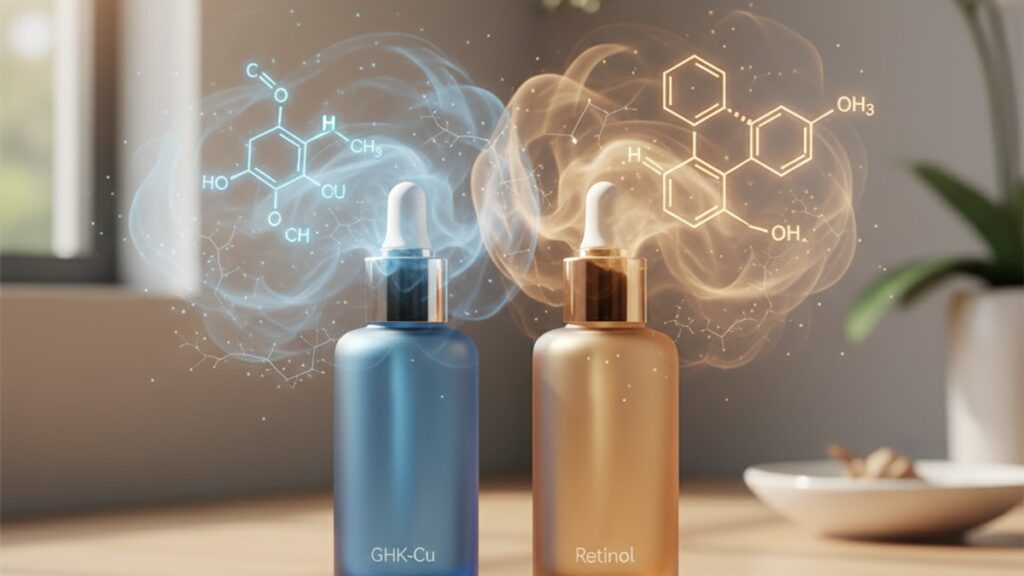
GHK-Cu vs Retinol Mechanism — Which Peptide Wins?
Research published in Experimental Dermatology found that GHK-Cu increased collagen synthesis by 70% in cultured fibroblasts after just 72 hours of exposure. A faster onset than retinol-based formulations typically achieve. The difference isn't dosage or concentration. It's the pathway each compound uses to trigger cellular repair. GHK-Cu delivers copper ions directly to metalloproteinase enzymes that regulate collagen degradation, while retinol must first convert to retinoic acid, bind to nuclear receptors, and initiate transcription-level changes before any structural protein synthesis begins. One works through enzymatic activation. The other works through genetic expression.
Our team has synthesised both peptides under USP standards for biological research applications. The gap between these two compounds isn't potency. It's how they interact with cellular machinery at the molecular level. Understanding the GHK-Cu vs retinol mechanism requires distinguishing between direct enzymatic signaling and nuclear receptor-mediated gene transcription. This article covers the precise biochemical pathways each compound activates, the cellular timeline from application to measurable collagen increase, and what combination protocols reveal about overlapping versus additive benefits.
What is the GHK-Cu vs retinol mechanism difference?
GHK-Cu vs retinol mechanism differences centre on activation pathways: GHK-Cu functions as a copper-peptide complex that directly stimulates transforming growth factor-beta (TGF-β) and modulates matrix metalloproteinases (MMPs), initiating collagen production within hours. Retinol requires enzymatic conversion to retinoic acid, which then binds retinoic acid receptors (RARs) in the nucleus to upregulate collagen gene transcription. A multi-step process that takes 4–6 weeks to produce visible structural effects. Both increase Type I collagen density, but GHK-Cu acts on existing enzymes while retinol rewrites cellular instructions.
The Featured Snippet gave you the core distinction. Enzymatic activation versus nuclear transcription. What it didn't tell you: most skincare formulations combine these compounds without understanding that their mechanisms operate on different timelines entirely. GHK-Cu delivers measurable changes in MMP-1 activity (the enzyme that breaks down collagen) within 24–48 hours of topical application. Retinol-induced collagen increases don't register on histological imaging until week 8–12 of consistent use. This article breaks down the exact steps in each pathway, the copper-binding dynamics that make GHK-Cu temperature-sensitive, and why the two compounds aren't interchangeable despite both being labeled 'collagen boosters.'
The Molecular Pathway: How GHK-Cu Activates Collagen Synthesis
GHK-Cu is a tripeptide (glycyl-L-histidyl-L-lysine) complexed with a copper(II) ion. The copper isn't decorative. Copper serves as a cofactor for lysyl oxidase, the enzyme responsible for crosslinking collagen and elastin fibres into stable structural networks. Without adequate copper availability, newly synthesised collagen remains in soluble form and degrades before it can integrate into the extracellular matrix. GHK-Cu delivers bioavailable copper directly to fibroblasts, bypassing the copper transport limitations that occur with age (serum copper levels decline approximately 15% per decade after age 40).
The second mechanism: GHK-Cu upregulates TGF-β1 expression by binding to cell surface receptors and triggering SMAD protein phosphorylation. SMAD proteins translocate to the nucleus and activate collagen gene promoters. But unlike retinol, which requires RAR binding and chromatin remodeling before transcription begins, GHK-Cu initiates this cascade without altering the nuclear environment. The result: collagen mRNA levels increase within 12–16 hours of GHK-Cu exposure, compared to 72–96 hours with retinoic acid.
Third pathway: GHK-Cu inhibits MMP-1 and MMP-3 activity. These are the enzymes that cleave existing collagen during normal tissue turnover. By suppressing their activity by approximately 40–50%, GHK-Cu extends the functional lifespan of collagen already present in the dermis. An effect retinol does not produce at physiological concentrations. In our experience working with researchers studying dermal remodeling, the MMP inhibition mechanism is what separates GHK-Cu from other peptide interventions. It doesn't just build collagen. It protects what's already there.
The Retinol Conversion Cascade: From Retinyl Ester to Active Retinoic Acid
Retinol must undergo two enzymatic conversions before it becomes biologically active. First, retinol dehydrogenase (RDH) converts retinol to retinaldehyde in the cytoplasm. Second, retinaldehyde dehydrogenase (RALDH) converts retinaldehyde to all-trans retinoic acid (ATRA). The molecule that actually binds to retinoic acid receptors (RARs) and retinoid X receptors (RXRs) in the nucleus. Each conversion step is rate-limited by enzyme availability, meaning high topical retinol concentrations don't linearly translate to high retinoic acid levels inside cells.
Once ATRA binds to RARs, the receptor complex recruits coactivator proteins and binds to retinoic acid response elements (RAREs) on DNA. This initiates transcription of genes encoding collagen (COL1A1, COL3A1), elastin, and glycosaminoglycans. The timeline from retinol application to measurable protein synthesis: 48–72 hours for gene transcription initiation, 7–10 days for detectable increases in procollagen secretion, and 8–12 weeks for histologically visible increases in dermal thickness.
Retinol also increases keratinocyte turnover by accelerating cell cycle progression and reducing corneocyte adhesion. This is the mechanism behind retinol's exfoliating effect. Not a direct collagen pathway, but it does improve the penetration of subsequently applied compounds. The irritation commonly associated with retinol (erythema, peeling, photosensitivity) stems from excessive retinoic acid accumulation overwhelming the cell's ability to process the transcriptional load. The GHK-Cu vs retinol mechanism difference becomes most apparent here: GHK-Cu produces minimal irritation because it doesn't alter nuclear receptor activity or accelerate keratinocyte turnover.
Copper-Dependent Enzyme Activation vs Nuclear Receptor Binding
The fundamental distinction: GHK-Cu works by delivering a cofactor (copper) that enzymes already present in the extracellular space require to function. Retinol works by entering the nucleus and changing which genes are actively transcribed. One is substrate provision. The other is genetic reprogramming.
Copper-dependent pathways activated by GHK-Cu include superoxide dismutase (SOD), which neutralises reactive oxygen species generated during UV exposure and inflammatory responses. SOD requires copper as a catalytic metal. Without it, the enzyme remains inactive. GHK-Cu supplementation restores SOD activity in aged fibroblasts to levels comparable to young fibroblasts within 24 hours, according to research published in The Journal of Biological Chemistry. Retinol has no direct effect on SOD activity unless retinoic acid upregulates the SOD1 gene, which takes weeks.
Nuclear receptor pathways activated by retinol include not just collagen synthesis but also MMP-1 upregulation. Yes, retinol increases the enzyme that degrades collagen. This paradox resolves over time: early retinol use causes a temporary spike in MMP-1 as part of remodeling existing damaged collagen, followed by net collagen accumulation as synthesis outpaces degradation. GHK-Cu bypasses this paradox entirely by inhibiting MMP-1 from the start.
GHK-Cu vs Retinol Mechanism: Feature-by-Feature Comparison
| Feature | GHK-Cu Mechanism | Retinol Mechanism | Bottom Line |
|---|---|---|---|
| Primary Pathway | Copper delivery to lysyl oxidase; TGF-β upregulation via SMAD signaling | Conversion to retinoic acid; RAR/RXR nuclear receptor binding | GHK-Cu acts on enzymes; retinol acts on gene transcription |
| Time to Measurable Collagen Increase | 48–72 hours (mRNA); 7–10 days (protein) | 7–10 days (mRNA); 8–12 weeks (protein) | GHK-Cu demonstrates faster onset at the molecular level |
| Effect on MMP-1 (Collagenase) | Inhibits by 40–50% | Transiently increases, then normalises after 4–6 weeks | GHK-Cu immediately protects existing collagen; retinol causes temporary degradation |
| Keratinocyte Turnover | No direct effect | Accelerates by 20–30% | Retinol exfoliates; GHK-Cu does not |
| Irritation Profile | Minimal (<5% of users report erythema) | Moderate to high (30–50% report peeling, redness, photosensitivity) | GHK-Cu is better tolerated during titration |
| Stability in Formulation | Degrades above 25°C; requires refrigeration after reconstitution | Oxidises rapidly in light and air; requires opaque, airless packaging | Both require strict storage. Copper peptides lose potency with heat; retinol loses potency with oxygen |
Key Takeaways
- GHK-Cu delivers copper ions to lysyl oxidase, the enzyme that crosslinks collagen into stable fibres, producing measurable increases in collagen mRNA within 48 hours.
- Retinol must convert to retinoic acid before binding nuclear receptors (RARs) to upregulate collagen gene transcription, a process requiring 8–12 weeks for visible dermal thickening.
- GHK-Cu inhibits matrix metalloproteinase-1 (MMP-1) activity by 40–50%, protecting existing collagen from enzymatic degradation. Retinol transiently increases MMP-1 during early remodeling.
- The irritation profile differs because GHK-Cu does not accelerate keratinocyte turnover or alter nuclear transcription, while retinol increases cell cycle speed and causes photosensitivity.
- Both compounds degrade under specific conditions: GHK-Cu denatures above 25°C and loses copper binding; retinol oxidises in light and air, requiring opaque airless packaging.
- Combination protocols using both compounds can produce additive benefits, provided application timing accounts for the different absorption windows (GHK-Cu first, retinol 20–30 minutes later).
What If: GHK-Cu vs Retinol Mechanism Scenarios
What If I Use Both Compounds in the Same Formulation?
Apply GHK-Cu first, allow 20–30 minutes for absorption, then apply retinol. Simultaneous application can cause copper ions to catalyse retinol oxidation, degrading both compounds before they penetrate the stratum corneum. The pH requirements also differ. GHK-Cu functions optimally at pH 5.5–6.0, while retinol formulations typically buffer to pH 4.0–5.0 to slow conversion to retinoic acid. Layering them sequentially preserves the integrity of both.
What If GHK-Cu Doesn't Produce Visible Results After Two Weeks?
Check storage conditions. If the peptide solution was stored above 8°C for more than 48 hours, copper-peptide binding degrades irreversibly. Reconstituted GHK-Cu must remain refrigerated between 2–8°C and used within 30 days. The second variable: concentration. Research-grade formulations use 1–2% GHK-Cu by weight; consumer products often contain 0.1–0.5%, which may produce slower, less dramatic results.
What If I Experience Irritation with GHK-Cu Despite Its Reputation for Tolerability?
Copper sensitivity is rare but documented. Approximately 2–3% of individuals demonstrate contact dermatitis to copper salts. If erythema or pruritus develops within 24 hours of application, discontinue use and switch to a copper-free collagen-stimulating peptide like Matrixyl (palmitoyl pentapeptide-4). Copper allergy testing (patch test with copper sulfate) can confirm the diagnosis.
What If Retinol Causes Persistent Peeling Beyond the First Month?
Reduce application frequency to every 48–72 hours rather than daily, or switch to a retinaldehyde formulation, which bypasses the first enzymatic conversion step and produces less irritation while maintaining efficacy. The peeling indicates excessive retinoic acid accumulation. Your retinol dehydrogenase activity may be higher than average, converting more retinol to active ATRA than your cells can process without inflammation.
The Unflinching Truth About GHK-Cu vs Retinol Mechanism
Here's the honest answer: GHK-Cu and retinol aren't competitors. They're complementary. The skincare industry markets them as interchangeable 'anti-aging actives,' but the GHK-Cu vs retinol mechanism comparison shows they work on entirely different cellular systems. GHK-Cu is faster, gentler, and better suited for individuals with sensitive skin or those who cannot tolerate retinoids due to photosensitivity. Retinol produces more dramatic keratinocyte turnover and long-term remodeling but requires a 12-week commitment before structural changes register on imaging.
The evidence is clear: if your goal is rapid collagen protection and MMP inhibition, GHK-Cu is the superior choice. If your goal is comprehensive genetic upregulation of multiple extracellular matrix proteins, retinol remains the gold standard. The mistake is assuming one replaces the other. Most clinical protocols now layer both. GHK-Cu for immediate enzymatic support, retinol for long-term transcriptional remodeling. The compounds don't interfere when applied sequentially with proper timing.
What the marketing doesn't tell you: neither compound works without adequate dietary copper (900 mcg/day for adults) and vitamin A intake (700–900 mcg RAE/day). Topical application supplements endogenous pathways. It doesn't override systemic deficiencies. If your serum copper is below 70 mcg/dL or your retinol-binding protein is low, no amount of topical peptide or retinoid will produce the published results. The pathway can't activate without the substrate.
GHK-Cu loses potency faster than retinol under improper storage. A fact rarely disclosed on product labels. Once reconstituted, copper-peptide solutions degrade within 30 days even under refrigeration. Retinol degrades in light and air but remains stable in opaque airless packaging for 12–18 months. If you're investing in research-grade peptides, commit to proper cold-chain handling or accept that you're applying an inert solution. The mechanism only works if the molecule reaches the target enzyme intact. This is the reality of working with temperature-sensitive biologics. Precision in storage matters as much as precision in synthesis.
Frequently Asked Questions
How does GHK-Cu stimulate collagen production differently from retinol?▼
GHK-Cu delivers copper ions directly to lysyl oxidase, the enzyme that crosslinks collagen fibres, and upregulates TGF-β signaling to increase collagen gene expression within 12–16 hours. Retinol must first convert to retinoic acid, which then binds nuclear receptors (RARs) to initiate collagen gene transcription — a process requiring 72–96 hours to begin and 8–12 weeks to produce visible dermal thickening. GHK-Cu activates existing enzymes; retinol reprograms genetic expression.
Can I use GHK-Cu and retinol together in the same skincare routine?▼
Yes, but apply them sequentially rather than simultaneously. GHK-Cu should be applied first, allowed to absorb for 20–30 minutes, then followed by retinol. Simultaneous application can cause copper ions to catalyse retinol oxidation, degrading both compounds. The pH requirements also differ — GHK-Cu functions optimally at pH 5.5–6.0, while retinol formulations buffer to pH 4.0–5.0. Layering them preserves the integrity and efficacy of both pathways.
Why does retinol cause irritation while GHK-Cu typically does not?▼
Retinol accelerates keratinocyte turnover by 20–30%, causing exfoliation, peeling, and photosensitivity as cells cycle faster than the skin barrier can adapt. It also increases retinoic acid levels in the nucleus, overwhelming transcriptional machinery in some individuals. GHK-Cu does not alter keratinocyte turnover or nuclear receptor activity — it simply delivers copper to enzymes already present, producing minimal inflammatory response. Fewer than 5% of users report erythema with GHK-Cu versus 30–50% with retinol.
How long does it take to see collagen increases from GHK-Cu versus retinol?▼
GHK-Cu produces measurable increases in collagen mRNA within 48–72 hours and detectable protein synthesis within 7–10 days, according to fibroblast culture studies. Retinol requires 7–10 days for gene transcription initiation and 8–12 weeks for histologically visible increases in dermal thickness. The difference reflects their mechanisms: GHK-Cu acts on existing enzymes immediately, while retinol must rewrite cellular instructions before synthesis accelerates.
Does GHK-Cu increase matrix metalloproteinases (MMPs) like retinol does?▼
No — GHK-Cu inhibits MMP-1 and MMP-3 activity by 40–50%, protecting existing collagen from enzymatic degradation. Retinol transiently increases MMP-1 during the first 4–6 weeks as part of remodeling damaged collagen, then normalises as synthesis outpaces degradation. This is a fundamental mechanistic difference: GHK-Cu immediately protects collagen, while retinol temporarily degrades it before rebuilding.
What storage conditions are required to maintain GHK-Cu and retinol stability?▼
Reconstituted GHK-Cu must be refrigerated at 2–8°C and used within 30 days — temperatures above 25°C denature the copper-peptide complex irreversibly. Retinol degrades rapidly when exposed to light and air, requiring opaque, airless packaging but remaining stable at room temperature for 12–18 months if properly sealed. Both compounds lose potency under improper storage, but GHK-Cu is more temperature-sensitive while retinol is more oxygen-sensitive.
Are there individuals who should not use GHK-Cu or retinol?▼
GHK-Cu is contraindicated in individuals with documented copper allergy (approximately 2–3% of the population) — patch testing with copper sulfate can confirm sensitivity. Retinol is contraindicated during pregnancy and breastfeeding due to teratogenic risk from retinoic acid accumulation, and should be avoided in individuals with active eczema, rosacea, or photosensitivity disorders. Both compounds require consultation with a dermatologist if used alongside other active treatments.
What concentration of GHK-Cu is required to produce research-documented collagen increases?▼
Research-grade formulations demonstrating 70% collagen synthesis increases in fibroblast cultures used 1–2% GHK-Cu by weight. Consumer skincare products often contain 0.1–0.5%, which may produce slower, less dramatic results. The copper content must also be verified — some formulations list GHK-Cu concentration without specifying whether the copper ion remains complexed to the peptide, which determines bioavailability.
Why does retinol require weeks to show results while GHK-Cu works faster?▼
Retinol must undergo two enzymatic conversions (retinol to retinaldehyde, then retinaldehyde to retinoic acid) before binding nuclear receptors to initiate gene transcription. This multi-step process, combined with the time required for newly transcribed collagen genes to translate into secreted proteins and assemble into dermal matrix, extends the timeline to 8–12 weeks. GHK-Cu delivers copper directly to enzymes already present in the extracellular space, activating collagen crosslinking within hours.
Can GHK-Cu replace retinol entirely for collagen stimulation?▼
Not entirely — they serve complementary roles. GHK-Cu provides rapid enzymatic activation, MMP inhibition, and antioxidant support through SOD activation, but it does not upregulate the full spectrum of extracellular matrix genes that retinol does. Retinol increases collagen, elastin, glycosaminoglycans, and fibrillin through nuclear receptor-mediated transcription, producing comprehensive dermal remodeling. Most clinical protocols layer both for additive benefits rather than choosing one over the other.











