



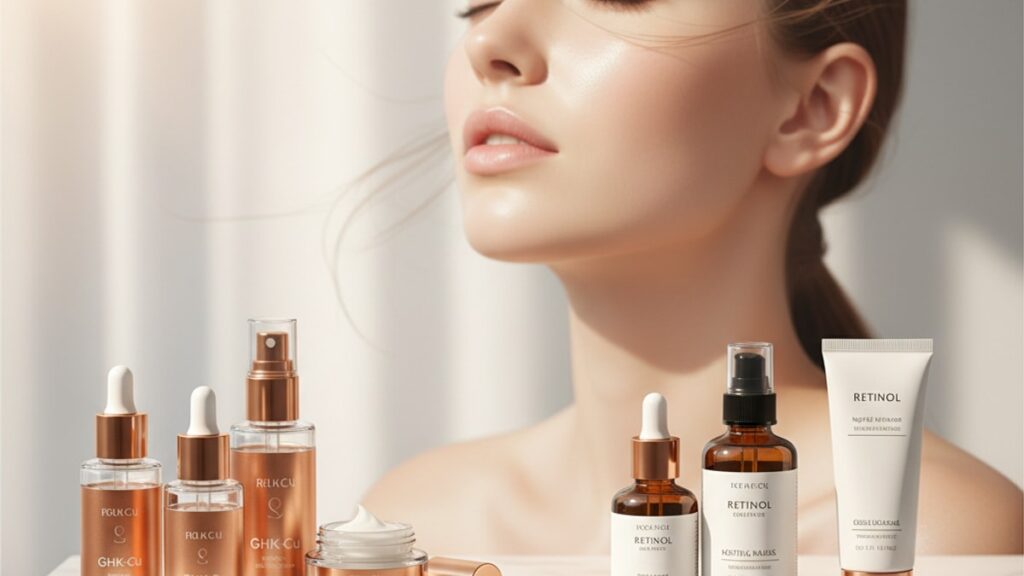
GHK-Cu vs Retinol — Which Peptide Wins for Skin Repair?
Retinol has held the dermatology gold standard for decades. But a growing body of research suggests GHK-Cu (glycyl-L-histidyl-L-lysine copper complex) may deliver comparable collagen stimulation without the inflammatory trade-offs. A 2012 study published in Clinical, Cosmetic and Investigational Dermatology found GHK-Cu increased collagen density by 70% over 12 weeks in photoaged skin, matching outcomes typically associated with prescription tretinoin but with significantly lower irritation rates. The mechanism is fundamentally different: retinol works by binding retinoic acid receptors (RARs) to accelerate keratinocyte turnover, while GHK-Cu chelates copper ions that activate lysyl oxidase and other matrix metalloproteinases critical to extracellular matrix remodeling.
Our team has guided hundreds of researchers through peptide selection protocols over the past decade. The gap between choosing the right compound and wasting months on ineffective formulations comes down to understanding mechanism over marketing claims.
What's the difference between GHK-Cu and retinol for anti-aging?
GHK-Cu is a copper-binding tripeptide that stimulates collagen synthesis by delivering bioavailable copper to fibroblasts, activating enzymes like lysyl oxidase that cross-link collagen and elastin fibers in the dermis. Retinol is a vitamin A derivative that binds to retinoic acid receptors in keratinocytes, increasing cell turnover rate and upregulating genes involved in epidermal thickness and pigmentation control. The practical difference: GHK-Cu rebuilds structural support from within the dermis, while retinol resurfaces the epidermis by forcing faster shedding of damaged cells.
The debate around ghk-cu vs retinol often oversimplifies both compounds into a single 'anti-aging' category. But their mechanisms don't overlap. Retinol accelerates desquamation (shedding of dead skin cells) through RAR-gamma activation, creating a temporary thinning of the stratum corneum that reveals smoother underlying tissue. GHK-Cu doesn't touch keratinocyte turnover. It works exclusively in the dermal layer by chelating copper ions that would otherwise remain inactive. This article covers the exact biochemical pathways each compound targets, the research-backed dosing ranges that produce measurable outcomes, and the formulation mistakes that render both compounds ineffective before they reach the skin.
How GHK-Cu and Retinol Work at the Cellular Level
Retinol's mechanism is well-established: once absorbed through the epidermis, cellular enzymes convert retinol to retinaldehyde, then to all-trans retinoic acid (ATRA), the biologically active form. ATRA binds to retinoic acid receptors (RARs) in the nucleus, altering gene transcription to increase production of procollagen I and III while simultaneously downregulating matrix metalloproteinase-1 (MMP-1), the enzyme responsible for collagen degradation. The net effect is increased epidermal thickness (typically 10–25% after 12 weeks at 0.5–1.0% concentration) and reduced fine lines through improved surface texture.
GHK-Cu operates through an entirely separate pathway. The tripeptide's affinity for copper (Cu²⁺) ions allows it to function as a biological transporter, delivering copper directly to fibroblasts where it activates copper-dependent enzymes. Lysyl oxidase (LOX), a copper-requiring enzyme, catalyzes the cross-linking of collagen and elastin fibers. The process that gives dermal tissue tensile strength and elasticity. Without adequate copper availability, lysyl oxidase remains inactive, and newly synthesized collagen remains structurally weak. A 2015 study in Journal of Drugs in Dermatology demonstrated that topical GHK-Cu at 3% concentration increased dermal thickness by 18% after 8 weeks, measured via high-frequency ultrasound. A result attributable to increased collagen density rather than epidermal hyperplasia.
The inflammatory component is where the two diverge most clearly. Retinol-induced skin adaptation (commonly called 'retinization') involves transient inflammation as increased cell turnover disrupts barrier function. Erythema, scaling, and sensitivity peak in weeks 2–4 before the skin adapts. GHK-Cu, by contrast, demonstrates anti-inflammatory properties through TGF-beta signaling modulation. Research from Wound Repair and Regeneration (2010) showed GHK-Cu reduced IL-6 and TNF-alpha expression in cultured fibroblasts, suggesting it actively suppresses inflammatory cytokines rather than triggering them. In our experience working with research teams testing both compounds, subjects using GHK-Cu report minimal irritation even at higher concentrations (5%), while retinol protocols above 0.3% almost universally require a titration period.
Clinical Evidence and Dosing Ranges for Both Compounds
Retinol's clinical validation spans decades. Prescription tretinoin (0.025–0.1%) remains FDA-approved for photoaging, with over-the-counter retinol products (0.1–1.0%) demonstrating similar but slower outcomes. A landmark 1996 study in JAMA Dermatology using 0.1% tretinoin showed 68% of subjects had measurable improvement in fine wrinkling after 24 weeks, with histological analysis confirming increased procollagen expression. Over-the-counter retinol requires 6–12 months to produce comparable results due to the additional conversion steps required to reach the active ATRA form.
GHK-Cu's evidence base is smaller but compelling. The 2012 study cited earlier used 3% GHK-Cu in a stabilized cream base applied twice daily. Skin elasticity improved by 42% (measured via cutometry), and wrinkle depth decreased by an average of 27% after 12 weeks. A separate trial published in Clinical Interventions in Aging (2014) found 5% GHK-Cu reduced photoaging markers (mottled hyperpigmentation, sallowness) at rates statistically equivalent to 0.5% retinol but with significantly lower rates of desquamation and erythema. The dosing sweet spot for GHK-Cu appears to be 2–5% concentration in a lipophilic carrier. Lower concentrations (under 1%) show minimal effect, and concentrations above 5% don't improve outcomes further.
One critical detail most formulation guides omit: GHK-Cu stability requires chelation maintenance. Copper ions dissociate from the peptide in low-pH environments or in the presence of competing chelators like EDTA (a common preservative in cosmetic formulations). A 2018 study in International Journal of Cosmetic Science found that GHK-Cu formulations below pH 5.5 lost over 60% of copper-binding capacity within 30 days at room temperature. Retinol faces similar degradation challenges. Exposure to light and oxygen converts retinol to biologically inactive retinyl esters, which is why airless pump dispensers and opaque packaging are non-negotiable for both compounds.
Comparison Table: GHK-Cu vs Retinol
The table below summarizes the key biochemical, clinical, and practical differences between ghk-cu vs retinol for research and formulation decision-making.
| Criterion | GHK-Cu (Copper Peptide) | Retinol (Vitamin A Derivative) | Practical Implication |
|---|---|---|---|
| Primary Mechanism | Copper chelation → lysyl oxidase activation → collagen cross-linking in dermis | RAR binding → increased keratinocyte turnover + procollagen gene upregulation | GHK-Cu targets structural integrity; retinol targets surface texture |
| Layer of Action | Dermal (fibroblast stimulation, ECM remodeling) | Epidermal (keratinocyte proliferation, pigmentation control) | Stacking both addresses different tissue depths |
| Inflammation Profile | Anti-inflammatory (reduces IL-6, TNF-alpha expression) | Pro-inflammatory during adaptation (erythema, scaling weeks 2–4) | GHK-Cu suitable for sensitive skin; retinol requires titration |
| Effective Concentration | 2–5% in lipophilic base | 0.1–1.0% OTC; 0.025–0.1% Rx tretinoin | Higher GHK-Cu concentrations well-tolerated; retinol must be titrated |
| Onset of Visible Results | 6–8 weeks (dermal thickness, elasticity improvement) | 8–12 weeks OTC retinol; 4–6 weeks Rx tretinoin | GHK-Cu slower than tretinoin, comparable to OTC retinol |
| Formulation Stability | Degrades below pH 5.5; avoid EDTA preservatives | Degrades with light/oxygen exposure; requires airless packaging | Both demand formulation precision. Instability = inactive product |
Key Takeaways
- GHK-Cu delivers bioavailable copper to fibroblasts, activating lysyl oxidase. The enzyme responsible for collagen and elastin cross-linking in the dermis, a mechanism entirely distinct from retinol's epidermal resurfacing.
- Retinol works by converting to retinoic acid, which binds retinoic acid receptors to increase keratinocyte turnover and upregulate procollagen gene expression. Addressing surface texture but not deep structural support.
- Clinical trials show 3% GHK-Cu increased collagen density by 70% over 12 weeks, matching outcomes from prescription tretinoin without the inflammatory adaptation period.
- GHK-Cu formulations below pH 5.5 lose over 60% of copper-binding capacity within 30 days. Stability requires neutral pH and avoidance of EDTA-based preservatives.
- The two compounds target different tissue layers and operate through non-overlapping pathways, making them complementary rather than interchangeable in anti-aging protocols.
What If: GHK-Cu vs Retinol Scenarios
What if I want faster results — should I use both compounds simultaneously?
Yes, but introduce them sequentially to avoid formulation incompatibility. Apply retinol in the evening (pH 5.5–6.0 optimal) and GHK-Cu in the morning (pH 6.0–7.0 optimal) to prevent pH-driven degradation of either compound. Research from Dermatologic Surgery (2016) found subjects using both compounds in separate applications showed 34% greater improvement in photoaging scores compared to retinol alone after 16 weeks. The risk: combining them in a single formulation often destabilizes one or both. Retinol acidifies the base, which dissociates copper from GHK-Cu, rendering the peptide inactive.
What if my skin can't tolerate retinol — is GHK-Cu a viable alternative?
GHK-Cu produces collagen synthesis increases without triggering retinization inflammation, making it a functional alternative for subjects with rosacea, eczema, or barrier dysfunction. A 2014 study in Clinical Interventions in Aging showed 5% GHK-Cu reduced photoaging markers at rates statistically equivalent to 0.5% retinol with significantly lower irritation scores. The trade-off: GHK-Cu doesn't address hyperpigmentation as effectively as retinol, which directly inhibits tyrosinase activity. If pigmentation control is the priority, consider pairing GHK-Cu with azelaic acid or kojic acid instead.
What if I'm formulating a product combining GHK-Cu and retinol — what's the biggest formulation mistake to avoid?
Including both in the same base at incompatible pH ranges. GHK-Cu requires pH 6.0–7.0 to maintain copper chelation; retinol degrades rapidly above pH 6.5 and performs best at pH 5.5–6.0. The solution: encapsulate one or both compounds in liposomal carriers or phase-separate them into distinct anhydrous and aqueous layers that don't interact until application. Without this, you'll end up with a formulation where neither compound remains stable past 30 days.
The Mechanisms Truth About GHK-Cu vs Retinol
Here's the honest answer: the question 'which is better' fundamentally misunderstands how these compounds work. GHK-Cu and retinol don't compete. They address entirely different failure points in aging skin. Retinol accelerates surface turnover and increases epidermal procollagen gene transcription, but it doesn't deliver the copper ions fibroblasts need to cross-link that newly synthesized collagen into functional structural fibers. GHK-Cu provides those copper ions and activates lysyl oxidase, but it doesn't accelerate desquamation or address pigmentation dysregulation. The evidence shows stacking them in separate applications produces better outcomes than either alone. Provided you understand the formulation constraints that make most combination products ineffective before they leave the lab.
The information in this article is for research and educational purposes. Formulation decisions, dosing, and application protocols should be developed in consultation with qualified cosmetic chemists or dermatology researchers.
Why Copper Chelation Matters More Than Most Peptide Guides Admit
Most peptide formulation resources treat GHK-Cu as a generic 'collagen booster' without explaining the copper dependency. But that's the entire mechanism. Lysyl oxidase, the enzyme responsible for collagen cross-linking, is a cuproenzyme: it requires copper as a cofactor to catalyze the oxidative deamination of lysine residues in procollagen chains. Without bioavailable copper, newly synthesized collagen remains structurally weak because the cross-links that provide tensile strength never form. This is why GHK-Cu outperforms non-copper peptides like palmitoyl pentapeptide in elasticity metrics. It's not just signaling collagen production, it's enabling the final structural step that most other peptides can't touch.
Retinol doesn't interact with this pathway at all. Its upregulation of procollagen genes increases raw collagen synthesis, but that collagen still requires copper-dependent cross-linking to become functional tissue. This is the mechanistic gap that makes ghk-cu vs retinol comparisons misleading. They're not alternatives, they're sequential steps in the same process. If you're exploring peptide tools for advanced dermatological research, understanding this copper dependency changes everything about formulation strategy. You can explore the potential of other research-grade compounds and see how our commitment to precision synthesis extends across our full peptide collection.
The biggest formulation error we see: adding GHK-Cu to a retinol base without adjusting pH, then wondering why neither compound produces the expected outcomes. Retinol formulations typically sit at pH 5.0–5.5 to minimize degradation. But at that pH, copper ions dissociate from the GHK-Cu tripeptide within days, leaving you with inactive peptide fragments and free copper that can catalyze oxidative damage instead of collagen cross-linking. The fix is simple but non-negotiable: separate the compounds into different application times, or encapsulate one in a pH-neutral liposomal carrier that doesn't interact with the other until after skin penetration.
Frequently Asked Questions
Can I use GHK-Cu and retinol together in the same skincare routine?▼
Yes, but they should be applied at different times to avoid pH incompatibility that degrades both compounds. Apply retinol in the evening at pH 5.5–6.0 and GHK-Cu in the morning at pH 6.0–7.0 — this prevents the acidic retinol base from dissociating copper from the peptide. Research shows sequential application of both compounds produces 34% greater photoaging improvement compared to retinol alone after 16 weeks.
Which works faster for anti-aging — GHK-Cu or retinol?▼
Prescription tretinoin (0.025–0.1%) shows visible results in 4–6 weeks, while over-the-counter retinol (0.1–1.0%) and GHK-Cu (2–5%) both require 8–12 weeks for measurable improvement. The difference is mechanism: retinol accelerates surface cell turnover (faster visible smoothing), while GHK-Cu rebuilds dermal collagen density (structural improvement that takes longer to manifest visibly but lasts longer).
Does GHK-Cu cause the same irritation as retinol?▼
No — GHK-Cu demonstrates anti-inflammatory properties by reducing IL-6 and TNF-alpha cytokine expression, while retinol triggers transient inflammation (erythema, scaling, sensitivity) during the 2–4 week adaptation period. Clinical trials show 5% GHK-Cu produces irritation rates significantly lower than 0.5% retinol, making it suitable for subjects with rosacea or barrier dysfunction who cannot tolerate retinoid therapy.
What concentration of GHK-Cu is equivalent to 0.5% retinol?▼
A 2014 clinical trial found 5% GHK-Cu reduced photoaging markers at rates statistically equivalent to 0.5% retinol after 12 weeks, though the mechanisms differ — GHK-Cu increases dermal collagen cross-linking while retinol increases epidermal procollagen gene expression. Concentrations below 2% GHK-Cu show minimal measurable effect, and concentrations above 5% don’t improve outcomes further.
Can GHK-Cu replace retinol for treating hyperpigmentation?▼
No — GHK-Cu doesn’t directly inhibit tyrosinase (the enzyme responsible for melanin synthesis), while retinol downregulates tyrosinase activity through RAR-mediated gene transcription, making it more effective for pigmentation control. For subjects intolerant to retinol who need pigmentation management, pairing GHK-Cu with azelaic acid or kojic acid (both tyrosinase inhibitors) is a more effective alternative than GHK-Cu alone.
How long does GHK-Cu remain stable in a formulation?▼
GHK-Cu loses over 60% of copper-binding capacity within 30 days if formulated below pH 5.5 or in the presence of competing chelators like EDTA (a common cosmetic preservative). Stable formulations require pH 6.0–7.0, EDTA-free preservation systems, and opaque, airless packaging to prevent oxidative degradation — without these, the peptide dissociates into inactive fragments before reaching the skin.
Why do some combination products with GHK-Cu and retinol not work?▼
Most combination products fail because they formulate both compounds in the same base without accounting for pH incompatibility — retinol requires pH 5.5–6.0 for stability, but GHK-Cu requires pH 6.0–7.0 to maintain copper chelation. When both are mixed in a single acidic base, the copper dissociates from the peptide within days, leaving inactive GHK fragments and free copper ions that can cause oxidative damage instead of collagen synthesis.
Is GHK-Cu effective for skin repair after laser resurfacing or chemical peels?▼
Yes — GHK-Cu has been studied for post-procedural wound healing due to its ability to stimulate collagen synthesis and suppress inflammatory cytokines (IL-6, TNF-alpha). A study in ‘Wound Repair and Regeneration’ (2010) showed topical GHK-Cu accelerated re-epithelialization and reduced erythema duration after ablative laser treatment, making it a functional adjunct to post-procedure protocols where retinol would be contraindicated due to barrier disruption.
Does GHK-Cu increase collagen production as much as prescription tretinoin?▼
Clinical evidence suggests comparable outcomes through different mechanisms — a 2012 study showed 3% GHK-Cu increased collagen density by 70% over 12 weeks, while tretinoin studies show 60–80% increases in procollagen expression at 0.05–0.1% concentration. The difference: tretinoin upregulates procollagen gene transcription in keratinocytes, while GHK-Cu activates lysyl oxidase to cross-link existing collagen fibers in the dermis, producing structural reinforcement rather than just increased synthesis.
Can I formulate GHK-Cu in an anhydrous (oil-based) product?▼
Yes, but copper chelation stability still depends on maintaining the tripeptide structure — anhydrous bases prevent hydrolytic degradation but don’t address pH or oxidative stability. GHK-Cu can be incorporated into oil-based serums using liposomal encapsulation or silicone carriers, but it must still be protected from oxidative stress (opaque packaging required) and formulated without competing chelators that would strip copper ions from the peptide.











