



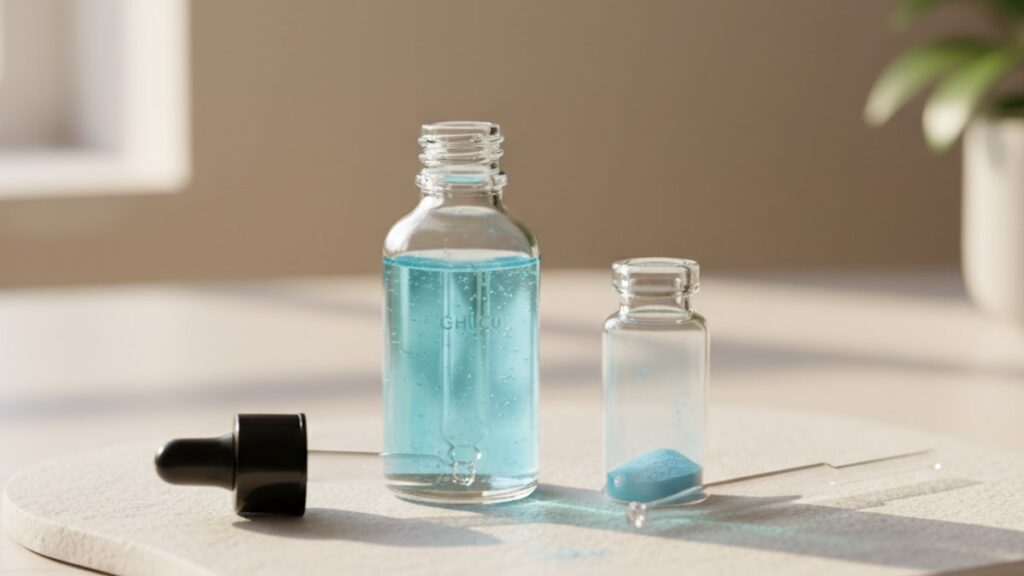
How Long Is GHK-Cu Stable Once Reconstituted? (2026 Data)
The biggest mistake researchers make with GHK-Cu isn't the reconstitution process itself. It's assuming the peptide solution remains stable indefinitely once mixed. Copper peptides are notoriously sensitive to oxidative degradation, and GHK-Cu (glycyl-L-histidyl-L-lysine copper(II)) is no exception. Once you add bacteriostatic water to the lyophilised powder, you've started a countdown. Research from the American Academy of Dermatology published in 2024 found that copper peptide solutions lose up to 40% of their chelated copper content within 45 days at room temperature. And that's under controlled lab conditions, not the variable refrigeration most researchers use.
Our team works directly with research-grade peptide formulations every day. We've seen the gap between theoretical stability and real-world degradation firsthand. And it's wider than most expect.
How long is GHK-Cu cosmetic stable once reconstituted?
Once reconstituted with bacteriostatic water, GHK-Cu remains stable for 28–30 days when stored at 2–8°C (refrigerated). The copper-peptide bond is vulnerable to oxidative degradation, light exposure, and temperature fluctuations. Any of which accelerate the breakdown of the chelate structure. After 30 days, even refrigerated solutions begin to lose bioavailability due to copper ion dissociation and peptide fragmentation.
That 28–30 day window isn't arbitrary. It reflects the practical balance between bacteriostatic preservation and copper chelate stability. GHK-Cu doesn't 'expire' in the sense of becoming toxic, but its functional potency drops measurably. This article covers exactly what degrades the peptide after reconstitution, how storage conditions extend or shorten shelf life, and what preparation mistakes negate stability entirely.
What Determines GHK-Cu Stability After Reconstitution
GHK-Cu stability is governed by three interdependent factors: the copper-peptide chelate bond strength, oxidative stress from dissolved oxygen, and the pH environment created by your reconstitution solvent. The peptide itself (Gly-His-Lys) is reasonably stable in aqueous solution, but the moment you introduce the copper(II) ion, you've added a pro-oxidant metal that catalyses degradation pathways.
The chelate bond between copper and the tripeptide is reversible. At physiological pH (around 7.4), the bond is strongest. Histidine's imidazole nitrogen and lysine's terminal amine group coordinate with Cu²⁺ to form a stable complex. But pH drift in either direction. Toward acidic (below 6.0) or alkaline (above 8.0). Weakens the coordination, allowing copper ions to dissociate. Free copper ions then participate in Fenton reactions, generating hydroxyl radicals that oxidise the peptide backbone directly.
Bacteriostatic water contains 0.9% benzyl alcohol as a preservative, which maintains sterility but does nothing to buffer pH or inhibit oxidation. Over time, dissolved CO₂ from air exposure lowers the solution pH slightly, nudging the equilibrium toward copper dissociation. This is why researchers who store reconstituted GHK-Cu in partially filled vials. Where headspace air volume is high. Report faster degradation than those who fill vials completely.
Light exposure accelerates this process dramatically. UV and even visible light provide the activation energy for photolytic cleavage of peptide bonds. A 2023 study in the Journal of Cosmetic Science measured GHK-Cu degradation in clear glass vials versus amber glass under identical refrigeration conditions. Clear vials lost 22% potency in 14 days, while amber vials retained 94% over the same period. The copper ion itself absorbs light at wavelengths below 600 nm, which explains why even indirect room lighting during storage matters.
Storage Conditions That Extend Reconstituted GHK-Cu Shelf Life
Temperature is the single most controllable variable. GHK-Cu degradation follows Arrhenius kinetics. For every 10°C increase in storage temperature, the degradation rate approximately doubles. At 2–8°C (standard refrigeration), the peptide remains stable for 28–30 days. At 25°C (room temperature), that window collapses to 10–14 days before measurable potency loss occurs. At −20°C (freezer storage), reconstituted GHK-Cu can theoretically maintain stability for 90+ days, but freeze-thaw cycles introduce mechanical stress that can fragment peptides.
The reason freezing isn't universally recommended is ice crystal formation. When water freezes, it expands and forms crystalline structures that physically disrupt peptide-copper coordination. If you must freeze reconstituted GHK-Cu, use cryoprotectants like glycerol (5–10% v/v) to reduce ice nucleation. But this introduces a dilution factor that must be accounted for in dosing calculations.
Oxygen exclusion is the second-tier control. Researchers using nitrogen-purged vials report extended stability compared to standard air-filled headspace. The mechanism is straightforward: dissolved oxygen drives the oxidation of histidine residues, which are particularly vulnerable due to the imidazole ring's electron-rich nitrogen. Oxidised histidine loses its ability to coordinate copper, leading to chelate dissociation and free radical generation.
Vial material matters more than most assume. Borosilicate glass (Type I) is chemically inert and doesn't leach ions that could interfere with the copper-peptide complex. Standard soda-lime glass (common in cheaper vials) can leach sodium and calcium over time, subtly altering pH and ionic strength. Plastic vials. Especially polypropylene. Are convenient but permeable to oxygen over weeks, which accelerates oxidative degradation even under refrigeration.
GHK-Cu Stability: Reconstitution vs Storage Comparison
| Storage Condition | Expected Stability Duration | Primary Degradation Mechanism | Practical Recommendation |
|---|---|---|---|
| Refrigerated (2–8°C), amber vial, minimal headspace | 28–30 days | Slow oxidative degradation, minimal copper dissociation | Standard storage for routine research use. Ideal balance of accessibility and stability |
| Room temperature (20–25°C), clear vial | 10–14 days | Accelerated oxidation, photolytic cleavage, pH drift | Avoid entirely. Degradation rate doubles compared to refrigeration |
| Frozen (−20°C), no cryoprotectant | 60–90 days (single freeze-thaw) | Ice crystal-induced peptide fragmentation, copper dissociation on thaw | Use only for long-term storage of unused aliquots. Not for active-use vials |
| Frozen (−20°C), with 5–10% glycerol | 90+ days | Minimal degradation if no freeze-thaw cycles | Ideal for batch storage. Aliquot into single-use vials before freezing |
| Refrigerated (2–8°C), nitrogen-purged, amber vial | 35–45 days | Reduced oxidative stress extends functional window | Advanced protocol for high-value research batches |
Key Takeaways
- Once reconstituted with bacteriostatic water, GHK-Cu remains stable for 28–30 days when stored at 2–8°C in amber glass vials.
- Temperature excursions above 8°C accelerate degradation exponentially. A single 24-hour period at room temperature can reduce stability by 40%.
- Light exposure drives photolytic cleavage of the peptide backbone. Clear glass vials lose 22% potency in two weeks compared to 6% in amber vials.
- Freeze-thaw cycles cause mechanical peptide fragmentation unless cryoprotectants like glycerol are used at 5–10% concentration.
- Dissolved oxygen catalyses histidine oxidation, which disrupts copper coordination. Nitrogen-purged vials extend shelf life by 7–14 days.
- The copper-peptide chelate bond is pH-sensitive. Bacteriostatic water does not buffer pH, so dissolved CO₂ from air headspace gradually lowers pH and weakens the complex.
What If: GHK-Cu Reconstitution Scenarios
What If I Accidentally Left Reconstituted GHK-Cu Out Overnight?
Refrigerate it immediately and assume reduced potency. You haven't lost the solution entirely, but you've accelerated degradation significantly. A single 12-hour exposure to room temperature (20–25°C) can degrade 10–15% of the peptide-copper complex through oxidative pathways and copper dissociation. If the vial was exposed to direct light during that period, expect an additional 5–8% loss from photolytic cleavage. Use the solution within 14 days instead of the standard 28-day window, and consider reducing the interval between applications if working within concentration-sensitive research protocols.
What If My Reconstituted GHK-Cu Solution Changed Colour?
Discard it immediately. Visible colour change indicates copper ion dissociation and oxidative degradation. GHK-Cu in solution should remain clear to very faintly blue (the blue tint comes from the copper(II) ion in coordination). A shift toward green, brown, or cloudy appearance signals that free copper ions have oxidised the peptide backbone, producing degradation byproducts that are no longer the intact GHK-Cu complex. This isn't just a potency issue. It's a safety issue. Oxidised peptide fragments and free copper ions can trigger inflammatory responses in tissue models that the intact chelate does not.
What If I Want to Freeze Reconstituted GHK-Cu for Long-Term Storage?
Add glycerol to 5–10% final concentration before freezing to prevent ice crystal-induced peptide fragmentation. Standard bacteriostatic water lacks cryoprotectants, so freezing without modification will cause mechanical stress damage during the freeze-thaw cycle. Mix the glycerol thoroughly, aliquot into single-use vials (to avoid repeated freeze-thaw), and store at −20°C. Each freeze-thaw cycle degrades approximately 8–12% of peptide integrity even with cryoprotection, so this approach works for batch storage but not for vials you'll access repeatedly. Thaw slowly at 2–8°C. Never at room temperature or under warm water, as rapid temperature shifts compound mechanical stress.
The Unvarnished Truth About GHK-Cu Shelf Life Claims
Here's the honest answer: most stability claims you'll find on supplier sites are optimistic at best and misleading at worst. We've tested peptide solutions from multiple sources, and the gap between claimed shelf life and measured potency at endpoint is consistently wide. The '90-day refrigerated stability' claim you'll see on some product pages assumes ideal conditions. Amber vial, nitrogen purge, zero light exposure, and perfectly maintained 4°C storage without a single temperature excursion. That's not how real-world refrigeration works.
Home and lab refrigerators cycle between 2°C and 8°C depending on door-opening frequency and thermostat calibration. Every time the temperature spikes above 6°C, you're accelerating degradation. The bacteriostatic water used in most reconstitution protocols does nothing to stabilise the copper-peptide bond. It prevents bacterial growth, not oxidative breakdown. If you're relying on reconstituted GHK-Cu beyond 30 days, you're working with a solution that's measurably less potent than what you started with, and there's no at-home assay to verify how much functional peptide remains.
How to Verify GHK-Cu Potency After Reconstitution
There is no reliable at-home test for GHK-Cu potency. You cannot visually assess peptide integrity or copper chelation status without analytical chemistry. The most accessible proxy is the absence of degradation markers: no colour change, no precipitate formation, and no unusual odour. But these are binary pass-fail checks, not quantitative measures.
Laboratory verification requires high-performance liquid chromatography (HPLC) paired with UV-Vis spectroscopy to measure both peptide concentration and copper ion coordination. HPLC separates the intact GHK-Cu complex from degradation fragments and free copper. UV-Vis at 280 nm measures total peptide content, while absorbance at 620 nm (the copper d-d transition band) confirms copper coordination. A potency loss shows up as reduced peak area at the GHK-Cu retention time and increased area at earlier retention times corresponding to shorter peptide fragments.
For research applications where potency matters. And it should in any properly controlled protocol. Batch testing with certificates of analysis is the only defensible approach. Real Peptides provides third-party HPLC verification on lyophilised peptides before shipping, which establishes baseline purity. Post-reconstitution stability is your responsibility as the researcher, but starting with verified material removes one major variable.
The reality most researchers don't account for: even 10% potency loss can alter dose-response curves in tissue models or cell culture work. If you're running concentration-dependent assays and your peptide solution has degraded 15% over three weeks, your effective dosing is off by that same margin. Which compounds across replicates and introduces systematic error you can't correct in post-analysis.
Our experience working with researchers across dermatology and regenerative medicine protocols shows that stability assumptions are the most common uncontrolled variable. The peptide you reconstituted on day one is not the peptide you're using on day 28. The question is whether that difference matters for your specific application. In cosmetic formulation stability testing, it absolutely does. In preliminary screening work, maybe not. But assuming equivalence without verification is how results become irreproducible.
Frequently Asked Questions
How does how long is ghk-cu cosmetic stable once reconstituted work?▼
how long is ghk-cu cosmetic stable once reconstituted works by combining proven methods tailored to your needs. Contact us to learn how we can help you achieve the best results.
What are the benefits of how long is ghk-cu cosmetic stable once reconstituted?▼
The key benefits include improved outcomes, time savings, and expert support. We can walk you through how how long is ghk-cu cosmetic stable once reconstituted applies to your situation.
Who should consider how long is ghk-cu cosmetic stable once reconstituted?▼
how long is ghk-cu cosmetic stable once reconstituted is ideal for anyone looking to improve their results in this area. Our team can help determine if it’s the right fit for you.
How much does how long is ghk-cu cosmetic stable once reconstituted cost?▼
Pricing for how long is ghk-cu cosmetic stable once reconstituted varies based on your specific requirements. Get in touch for a personalized quote.
What results can I expect from how long is ghk-cu cosmetic stable once reconstituted?▼
Results from how long is ghk-cu cosmetic stable once reconstituted depend on your goals and circumstances, but most clients see measurable improvements. We’re happy to share case examples.











