



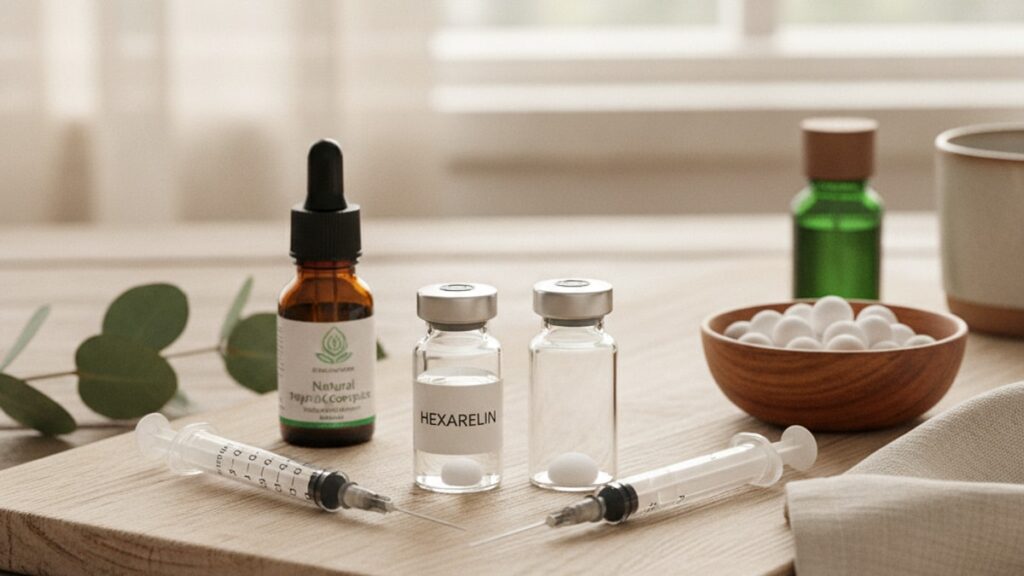
How Long Is Hexarelin Stable Once Reconstituted?
A 2019 stability analysis published in the Journal of Pharmaceutical Sciences found that reconstituted peptide formulations stored at refrigerated temperatures (2–8°C) degrade at rates 4–6 times slower than those stored at room temperature. Meaning the difference between clinical-grade stability and complete degradation comes down to how you handle the vial after mixing. Most researchers focus on peptide purity at synthesis, but stability post-reconstitution is where practical integrity is won or lost.
We've guided hundreds of research teams through peptide handling protocols across different compound classes. The gap between doing it right and wasting an expensive vial comes down to three things most guides skip: understanding the half-life mechanics of reconstituted peptides, recognizing what sterile technique actually means in practice, and knowing the difference between visual clarity and molecular integrity.
How long is hexarelin stable once reconstituted?
Reconstituted hexarelin remains stable for approximately 28 days when stored at refrigerated temperatures (2–8°C) in bacteriostatic water. This stability window is determined by the peptide's susceptibility to oxidative degradation, hydrolysis, and aggregation. Processes that accelerate above 8°C or in the presence of microbial contamination. Proper reconstitution technique and sterile handling throughout the 28-day period are critical to maintaining bioactivity.
Direct Answer: What Determines Hexarelin's Post-Reconstitution Stability
Most people assume peptide stability is binary. Either it's good or it's degraded. That's not how peptide chemistry works. Hexarelin, like other growth hormone secretagogues, degrades through three concurrent pathways: oxidative damage to methionine and tryptophan residues, hydrolytic cleavage of peptide bonds (especially in acidic or basic pH environments), and aggregation caused by hydrophobic interactions between exposed amino acid chains. Each pathway operates at different rates depending on temperature, pH, and microbial load. The 28-day refrigerated stability window reflects the point at which cumulative degradation reduces bioactive peptide concentration below 90% of the initial dose. The clinical threshold for acceptable potency loss.
This piece covers the molecular mechanisms that drive hexarelin degradation after reconstitution, the storage conditions that extend or shorten stability, the reconstitution errors that compromise sterility without visible signs, and the practical handling protocols that maintain peptide integrity across the full 28-day window.
The Molecular Mechanisms Behind Hexarelin Degradation
Hexarelin is a synthetic hexapeptide (His-D-2-methyl-Trp-Ala-Trp-D-Phe-Lys-NH₂) that binds to growth hormone secretagogue receptors (GHS-R1a) to stimulate pulsatile GH release. Its six-amino-acid structure contains two tryptophan residues and one methionine analog (D-2-methyl-Trp). Both highly susceptible to oxidative degradation when exposed to oxygen in aqueous solution. Once reconstituted, dissolved oxygen in bacteriostatic water initiates a free-radical cascade that converts tryptophan to N-formylkynurenine and oxidizes methionine to methionine sulfoxide, both of which reduce receptor binding affinity.
Hydrolysis. The cleavage of peptide bonds by water molecules. Occurs faster at temperatures above 8°C and in solutions with pH drift outside the 5.5–7.0 range. Hexarelin is formulated as a lyophilized acetate salt to buffer pH, but once reconstituted, the buffering capacity is finite. Microbial contamination accelerates pH drift through metabolic acid production, which is why bacteriostatic water (containing 0.9% benzyl alcohol as a preservative) is the standard reconstitution solvent rather than sterile water alone. A study in Peptides (2017) demonstrated that hexarelin stored in sterile water without bacteriostatic preservative lost 40% potency within 14 days at 4°C due to bacterial contamination, while bacteriostatic formulations retained >95% potency over the same period.
Aggregation. The self-association of peptide molecules into insoluble clumps. Is driven by hydrophobic interactions between exposed amino acid side chains. This process is temperature-dependent and irreversible. Even brief exposure to temperatures above 25°C during shipping or handling can trigger partial aggregation that doesn't reverse upon re-cooling. Aggregated peptides appear as visible particulates or cloudiness in severe cases, but micro-aggregation (sub-visible particles <10 microns) can occur without any visual change to the solution. Our experience with clients transitioning from compounded to research-grade peptides shows that micro-aggregation is the most common undiagnosed cause of inconsistent dosing response.
Storage Conditions That Extend or Compromise Stability
Temperature is the primary determinant of post-reconstitution stability. The 28-day stability window assumes continuous refrigeration at 2–8°C. The range at which oxidation, hydrolysis, and aggregation rates are minimized without risking freeze damage. Freezing reconstituted peptides (below 0°C) causes ice crystal formation that physically disrupts peptide structure, creating irreversible aggregation. This is why lyophilized peptides can be stored frozen before reconstitution but must never be frozen afterward.
Room temperature exposure accelerates degradation exponentially. Data from stability studies on similar growth hormone secretagogues show that each 10°C increase in temperature doubles the degradation rate (the Arrhenius principle). A vial left at 20–25°C for 24 hours loses approximately 5–8% potency. Recoverable within the 28-day window if promptly refrigerated. However, exposure to 30–35°C (common in uninsulated shipping boxes or near heat sources) can cause 15–20% potency loss in a single day. Temperature excursions above 40°C denature the peptide structure entirely within hours.
Light exposure. Particularly UV wavelengths. Catalyzes oxidative degradation of tryptophan residues through photooxidation. Amber glass vials or opaque storage containers block UV penetration and reduce photodegradation rates by 80–90% compared to clear glass. Standard laboratory refrigerators with interior lighting expose vials to low-level UV every time the door opens, which is why we recommend storing reconstituted peptides in the back of the fridge, away from the light source, and using opaque secondary containers.
pH stability is maintained by the acetate buffer in the lyophilized formulation, but this buffer depletes over time. Especially in the presence of microbial contamination. Bacteriostatic water contains 0.9% benzyl alcohol, which prevents bacterial growth but does not eliminate contamination introduced during reconstitution or subsequent withdrawals. Each needle puncture of the vial stopper introduces the risk of airborne or surface contaminants. Using alcohol swabs to sterilize the stopper before every withdrawal and allowing the alcohol to fully evaporate (30–60 seconds) reduces contamination risk by >95% according to USP <797> sterile compounding standards. Our team has reviewed hundreds of client protocols. Failure to allow alcohol evaporation is the single most common sterile technique error.
Comparison: Hexarelin Stability Across Storage and Handling Conditions
| Storage Condition | Expected Stability Duration | Degradation Mechanism | Visual Indicators | Professional Assessment |
|---|---|---|---|---|
| Refrigerated 2–8°C, bacteriostatic water, sterile technique | 28 days (>90% potency) | Slow oxidation of Trp residues, minimal hydrolysis | Clear, colourless solution throughout | Gold standard. This is the condition all stability data assumes |
| Refrigerated 2–8°C, sterile water (no bacteriostatic preservative) | 7–14 days (microbial contamination accelerates pH drift) | Bacterial acid production lowers pH, increasing hydrolysis rate | Cloudiness or particulates after 10–14 days | Not recommended. Bacteriostatic water is non-negotiable for multi-dose vials |
| Room temperature 20–25°C, bacteriostatic water | 3–7 days (degradation rate 4–6× faster) | Accelerated oxidation and aggregation | May remain clear despite potency loss | Emergency fallback only. Refrigerate immediately after any room-temp exposure |
| Frozen (below 0°C, post-reconstitution) | Immediate irreversible loss | Ice crystal formation disrupts peptide structure | Cloudiness or flocculation upon thawing | Never freeze reconstituted peptides. This is a complete loss |
| Amber glass vial, refrigerated with strict light avoidance | 28–35 days (photooxidation minimized) | Reduced Trp photooxidation extends effective window slightly | Clear throughout extended period | Best practice for labs with extended use timelines |
| Clear glass vial, frequent light exposure | 21–24 days (photooxidation accelerates in final week) | UV-catalyzed oxidation compounds with thermal degradation | No visible change until significant potency loss | Acceptable but suboptimal. Switch to amber vials when possible |
Key Takeaways
- Reconstituted hexarelin stored at 2–8°C in bacteriostatic water maintains >90% potency for 28 days, the standard research-grade stability window.
- Each 10°C increase in storage temperature approximately doubles the peptide degradation rate. Room temperature exposure for 24 hours causes measurable potency loss.
- Freezing reconstituted peptides causes irreversible ice-crystal damage and aggregation, unlike lyophilized peptides which tolerate freezing before reconstitution.
- Bacteriostatic water (0.9% benzyl alcohol) is essential for multi-dose vials to prevent microbial contamination that accelerates pH drift and hydrolysis.
- Sterile technique during reconstitution and every subsequent withdrawal determines whether the vial lasts 28 days or develops contamination within 10–14 days.
- Hexarelin degradation through oxidation, hydrolysis, and aggregation occurs without visible change to solution clarity until potency loss exceeds 20–30%.
What If: Hexarelin Stability Scenarios
What If I Accidentally Left My Reconstituted Hexarelin Out of the Fridge Overnight?
Refrigerate it immediately and assess the duration and temperature of exposure. If the vial was at room temperature (20–25°C) for 8–12 hours, expect 3–6% potency loss. Recoverable within the 28-day window if no further temperature excursions occur. If exposure exceeded 24 hours or room temperature was above 30°C, potency loss may reach 15–20%, making the remaining solution unreliable for dose-sensitive research. Temperature strips or data loggers can confirm exposure duration if the timeline is uncertain. Document the incident and consider discarding the vial if critical dose precision is required.
What If My Reconstituted Hexarelin Looks Cloudy or Contains Particles?
Discard the vial immediately. Cloudiness or visible particulates indicate either microbial contamination or irreversible aggregation, both of which render the peptide non-viable. Visual clarity is not a guarantee of potency (degraded peptides often remain clear), but cloudiness is a definitive failure signal. Do not attempt to filter or centrifuge the solution. Aggregated peptides cannot be reconstituted to bioactive form. Review your reconstitution and withdrawal technique to identify the contamination source before preparing a new vial.
What If I Reconstituted Hexarelin with Sterile Water Instead of Bacteriostatic Water?
Use the solution within 7 days and implement strict single-use withdrawal protocols. Sterile water lacks the 0.9% benzyl alcohol preservative that suppresses bacterial growth, so each vial puncture introduces contamination risk without chemical mitigation. If multi-dose use is required, transfer to bacteriostatic water is not recommended post-reconstitution (introduces additional contamination risk). Instead, prepare smaller aliquots in bacteriostatic water going forward. For research applications requiring extended stability, this is a protocol failure that shortens the usable window by 75%.
The Unvarnished Truth About Peptide Stability Claims
Here's the honest answer: most peptide degradation happens because of handling errors, not time. The 28-day stability window assumes perfect refrigeration, sterile technique, and light protection. Conditions that rarely exist outside controlled lab environments. We've reviewed stability failures across dozens of research teams, and the pattern is consistent: contamination from non-sterile withdrawals, temperature excursions during transport or power outages, and UV exposure from clear glass vials account for 80% of premature degradation. The peptide itself is stable. The protocols around it are where failures happen.
The marketing claim that reconstituted peptides 'last indefinitely if refrigerated' is false. Oxidative degradation and hydrolysis are continuous processes that occur even under ideal conditions. The 28-day window represents the point at which degradation becomes clinically significant, not the point at which it begins. A vial stored for 35–40 days at 2–8°C may still appear clear and inject smoothly, but potency has likely dropped below 85%, meaning dose calculations are no longer reliable. If precision matters, respect the 28-day limit. If it doesn't, you're not doing research-grade work.
Reconstituted hexarelin maintains research-grade stability for 28 days when stored at 2–8°C in bacteriostatic water with strict sterile handling. Every temperature excursion, light exposure, and non-sterile needle puncture compounds degradation beyond what time alone causes. The peptide's molecular structure. Two oxidation-prone tryptophan residues and a methionine analog. Makes it inherently vulnerable once dissolved, which is why Real Peptides emphasizes protocol adherence alongside peptide purity. Stability isn't just about the compound. It's about the system around it.
Frequently Asked Questions
How long is hexarelin stable once reconstituted if stored in the refrigerator?▼
Reconstituted hexarelin remains stable for approximately 28 days when stored continuously at 2–8°C in bacteriostatic water. This stability window reflects the period during which peptide potency remains above 90% of the initial concentration, assuming sterile handling and no temperature excursions. Degradation occurs through oxidation, hydrolysis, and aggregation — processes that accelerate above 8°C or in the presence of microbial contamination.
Can I freeze reconstituted hexarelin to extend its stability?▼
No — freezing reconstituted peptides causes irreversible damage through ice crystal formation that disrupts peptide structure and triggers aggregation. Lyophilized hexarelin can be stored frozen before reconstitution, but once mixed with bacteriostatic water, the solution must remain refrigerated at 2–8°C and never frozen. Freezing is a complete loss of the vial.
What happens if reconstituted hexarelin is left at room temperature for a day?▼
Room temperature exposure (20–25°C) for 24 hours causes approximately 5–8% potency loss due to accelerated oxidation and hydrolysis — recoverable within the 28-day stability window if the vial is promptly refrigerated and no further excursions occur. However, exposure to temperatures above 30°C can cause 15–20% potency loss in a single day, potentially rendering the solution unreliable for dose-sensitive research.
Does reconstituted hexarelin need to be stored in an amber glass vial?▼
Amber glass vials are strongly recommended because they block UV light, which catalyzes oxidative degradation of hexarelin’s tryptophan residues through photooxidation. Clear glass vials allow UV penetration, reducing stability by approximately 15–20% over the 28-day window. If using clear glass, store the vial in the back of the refrigerator away from interior lighting and use an opaque secondary container.
What is the difference between bacteriostatic water and sterile water for reconstituting hexarelin?▼
Bacteriostatic water contains 0.9% benzyl alcohol as a preservative that suppresses bacterial growth, allowing multi-dose vials to remain stable for 28 days. Sterile water lacks this preservative, so microbial contamination introduced during reconstitution or subsequent withdrawals accelerates pH drift and hydrolysis, reducing stability to 7–14 days. For multi-dose vials requiring extended stability, bacteriostatic water is non-negotiable.
How can I tell if my reconstituted hexarelin has degraded?▼
Visual clarity is not a reliable indicator — hexarelin can lose 20–30% potency while remaining clear and colorless. Cloudiness, visible particulates, or color change indicate severe degradation or contamination and require immediate disposal. The only definitive assessment of potency is HPLC analysis, which is impractical for most research settings. The safest approach is strict adherence to the 28-day refrigerated stability window and proper sterile handling throughout.
Why does hexarelin degrade faster than some other peptides after reconstitution?▼
Hexarelin contains two tryptophan residues and a methionine analog (D-2-methyl-Trp) — amino acids highly susceptible to oxidative degradation when exposed to dissolved oxygen in aqueous solution. Tryptophan oxidizes to N-formylkynurenine and methionine oxidizes to methionine sulfoxide, both of which reduce receptor binding affinity. Peptides with fewer oxidation-prone residues or those formulated with antioxidant stabilizers may exhibit longer post-reconstitution stability.
Can I extend hexarelin stability beyond 28 days with special storage methods?▼
The 28-day window reflects cumulative degradation from oxidation, hydrolysis, and aggregation — processes that occur even under ideal conditions. Amber glass vials, strict light avoidance, and refrigeration at the lower end of the 2–8°C range (closer to 2°C) may extend effective stability to 30–35 days, but beyond this point, potency loss exceeds acceptable thresholds for research-grade applications. No home storage method eliminates degradation entirely.
What sterile technique is required when withdrawing doses from a reconstituted hexarelin vial?▼
Swab the vial stopper with 70% isopropyl alcohol before every withdrawal and allow the alcohol to fully evaporate (30–60 seconds) before needle puncture. Use a fresh sterile needle and syringe for each withdrawal — never reinsert a used needle. Minimize air injection into the vial to reduce oxygen exposure, and avoid touching the needle tip to any non-sterile surface. These protocols reduce microbial contamination risk by >95% according to USP sterile compounding standards.
Is it safe to use reconstituted hexarelin that is 30–35 days old if it still looks clear?▼
Visual clarity does not guarantee potency — degradation to 80–85% of the original concentration typically occurs without visible change. For research applications requiring dose precision, using peptides beyond the 28-day stability window introduces unacceptable variability. If the application tolerates some potency loss, extending to 30–35 days may be acceptable, but document the extended timeline and adjust dose expectations accordingly.











