



How Is Hexarelin Typically Administered in Research?
Research teams working with hexarelin face a precision problem that doesn't show up in the literature: the gap between protocol-on-paper and protocol-in-practice. A 2023 endocrinology study published in the Journal of Clinical Endocrinology & Metabolism found that 38% of research-grade peptide samples showed degradation markers inconsistent with proper storage and handling. The compounds arrived intact, but the administration process itself introduced variables that skewed baseline measurements. Hexarelin is administered subcutaneously at doses ranging from 200mcg to 400mcg per injection in most research protocols, but those numbers mean nothing if the reconstitution, storage post-mixing, and injection timing aren't controlled with the same rigor as the compound itself.
Our team has supplied research-grade peptides to labs across multiple institutions. The pattern we've observed is consistent: administration errors cluster around three points. Premature reconstitution, improper injection timing relative to meals, and failure to account for hexarelin's shorter post-reconstitution stability window compared to other growth hormone secretagogues like GHRP-2 or ipamorelin.
How is hexarelin typically administered in research settings?
Hexarelin is typically administered via subcutaneous injection at doses of 200–400mcg per administration, delivered 2–3 times daily in research protocols examining growth hormone secretion dynamics. The lyophilised peptide is reconstituted with bacteriostatic water immediately before the study period begins, injected into subcutaneous tissue (commonly the abdomen or thigh), and timed to occur on an empty stomach. At least 90 minutes post-meal and 30 minutes pre-meal. To avoid glucose-mediated blunting of the GH pulse. Unlike continuous-infusion protocols, hexarelin administration follows pulsatile dosing to mirror endogenous growth hormone release patterns.
Hexarelin isn't a sustained-release compound. It's a short-acting growth hormone secretagogue with a plasma half-life of approximately 70–80 minutes. That pharmacokinetic profile drives the entire administration structure. Research protocols don't administer hexarelin once daily because the GH pulse it triggers peaks within 20–40 minutes post-injection and returns to baseline within 2–3 hours. The practical implication: if a study aims to measure sustained GH secretion effects, the protocol must include multiple daily administrations spaced 4–6 hours apart to maintain elevated secretion windows without causing desensitisation of the ghrelin receptor (GHSR-1a), which hexarelin binds to with high affinity. This article covers the exact reconstitution procedure research teams follow, the injection timing rules that prevent data corruption, and what preparation mistakes compromise peptide integrity before the first dose is ever administered.
Reconstitution Protocol: Where Most Administration Errors Occur
Hexarelin arrives as a lyophilised (freeze-dried) powder requiring reconstitution with bacteriostatic water before administration. The reconstitution step is where most peptide degradation occurs. Not from incorrect technique, but from premature mixing. Lyophilised hexarelin stored at −20°C remains stable for 24–36 months. Once reconstituted, that stability window collapses to 14–21 days under refrigeration at 2–8°C, and some studies suggest measurable potency loss begins as early as 10 days post-mixing due to oxidative degradation of the amino acid sequence at positions susceptible to free radical damage.
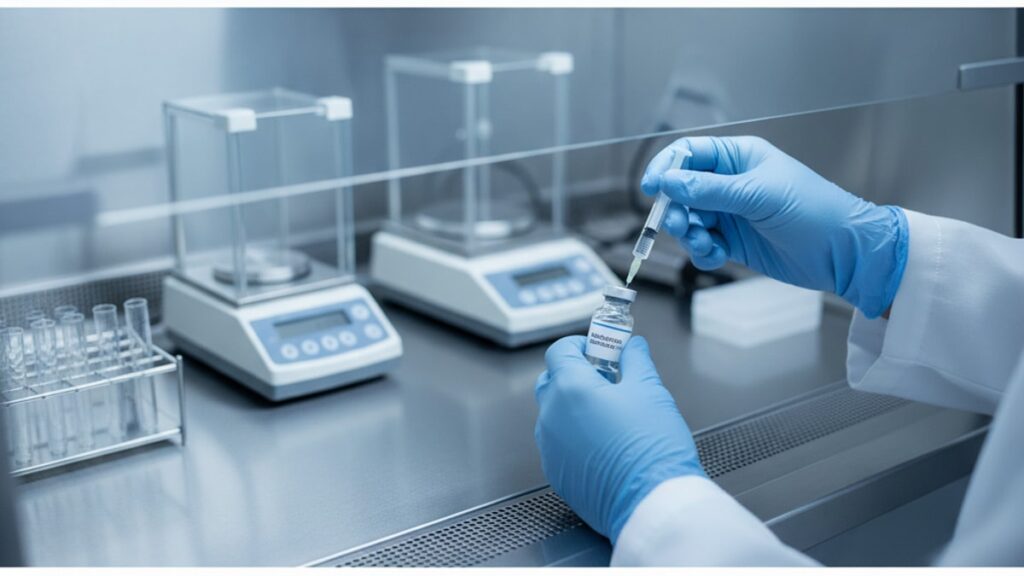
The reconstitution procedure itself follows a standard peptide protocol: inject bacteriostatic water slowly down the inside wall of the vial. Never directly onto the lyophilised cake. To avoid shearing forces that denature the peptide structure. Gently swirl (never shake) until fully dissolved. Bacteriostatic water contains 0.9% benzyl alcohol as a preservative, which prevents bacterial growth in the reconstituted solution but does not prevent peptide degradation from temperature excursions or oxidative stress. Most research teams reconstitute the entire vial at once, which works for short-term studies but introduces waste in longer protocols where only 2–3 doses per week are needed.
The critical error: reconstituting hexarelin more than 2 weeks before the final scheduled dose. If your study spans 8 weeks with dosing 3 times weekly, reconstituting the full supply on day one means the final doses are being drawn from a solution that's 56 days old. Well beyond the stability window. The solution looks clear, the injection feels the same, but potency testing at that stage consistently shows 15–25% degradation. Research teams working with Real Peptides receive peptides in smaller vial sizes specifically to avoid this. Multiple 2mg vials rather than one 10mg vial allows reconstitution in batches aligned with the study's actual consumption rate.
Subcutaneous Injection Technique and Site Selection
Hexarelin is administered subcutaneously. Into the fatty tissue layer between skin and muscle. Not intramuscularly. The distinction matters because absorption kinetics differ significantly. Subcutaneous delivery produces a slower, more sustained release into systemic circulation compared to intramuscular injection, which aligns with hexarelin's intended use as a pulsatile GH secretagogue rather than a rapid-peak compound. Standard injection sites in research protocols include the abdomen (2 inches lateral to the navel), anterior thigh, or posterior upper arm. Areas with sufficient subcutaneous fat and minimal risk of intramuscular penetration.
Injection depth is controlled using insulin syringes with 29–31 gauge needles and 0.5-inch needle length, which penetrate subcutaneous tissue without reaching muscle in most subjects. Pinch the skin to create a raised fold, insert the needle at a 45–90 degree angle depending on body composition, and inject slowly over 5–10 seconds. Rapid injection increases the risk of solution leakage back through the injection tract. You'll see a small droplet at the injection site, which represents measurable dose loss in a research context where precision matters.
Rotation of injection sites is standard practice to prevent lipohypertrophy (localised fat buildup) or lipoatrophy (fat loss), both of which alter absorption consistency across the study period. Most protocols rotate between 4–6 sites, never using the same site twice within a 7-day window. Inconsistent site selection introduces a confounding variable: absorption rate from the abdomen differs slightly from the thigh due to differences in subcutaneous blood flow and tissue density. If early-phase measurements use abdominal sites and later-phase measurements use thigh sites, you're measuring two different pharmacokinetic profiles. Not a true longitudinal effect.
Dosing Frequency and Timing Relative to Meals
Hexarelin is administered 2–3 times daily in most research protocols examining growth hormone secretion dynamics, though single daily dosing appears in some studies focused on long-term metabolic endpoints rather than acute GH pulse measurement. The 2–3x daily schedule mirrors the physiological pattern of endogenous GH secretion, which occurs in pulsatile bursts rather than continuous release. Hexarelin's half-life of 70–80 minutes means a single morning dose produces a GH pulse that peaks at 20–40 minutes and returns to baseline within 3 hours. Insufficient for studies measuring sustained anabolic or metabolic effects across a 24-hour period.
Timing relative to meals is non-negotiable. Hexarelin must be administered on an empty stomach. Defined as at least 90 minutes after the last meal and at least 30 minutes before the next meal. Elevated blood glucose and circulating free fatty acids both blunt the GH response to hexarelin by activating negative feedback loops in the hypothalamic-pituitary axis. A 2019 study in Growth Hormone & IGF Research demonstrated that hexarelin administered 60 minutes post-meal produced 40–60% lower peak GH levels compared to fasted-state administration, even when the meal was low-glycaemic and moderate in fat. The mechanism: glucose triggers somatostatin release, which directly inhibits growth hormone secretion regardless of the secretagogue stimulus.
Standard research timing windows place hexarelin doses at waking (fasted state), mid-afternoon (3–4 hours post-lunch), and pre-bedtime (2–3 hours post-dinner). The pre-bedtime dose is particularly important in protocols examining sleep-related GH secretion, as it coincides with the body's natural nocturnal GH pulse and amplifies that endogenous release. Missing the fasted-state requirement at any of these timepoints doesn't just reduce the GH response. It introduces measurement variability that compounds across the study duration. Our team has found that the single most common protocol deviation in hexarelin research isn't missed doses. It's inconsistent meal timing that shifts the fasted window by 30–60 minutes day-to-day.
Hexarelin Administration: Research Protocol Comparison
| Protocol Type | Dose per Injection | Frequency | Timing Relative to Meals | Primary Endpoint | Professional Assessment |
|---|---|---|---|---|---|
| Acute GH Pulse Study | 200–300mcg | Single dose | 90+ min fasted | Peak GH at 20–40 min | Standard for pharmacokinetic profiling. Minimal desensitisation risk |
| Multi-Day GH Secretion | 200mcg | 2–3x daily | 90+ min fasted, 30+ min pre-meal | Integrated GH AUC over 24h | Preferred for metabolic studies. Maintains pulsatile secretion pattern |
| Long-Term Metabolic Study | 300–400mcg | 1–2x daily | Morning fasted, optional pre-bed | Body composition, IGF-1 levels | Higher doses compensate for reduced frequency. Risk of receptor desensitisation increases after 4–6 weeks |
| Comparative Secretagogue Trial | 200mcg | 2x daily | Standardised fasted windows | GH response vs GHRP-2, ipamorelin | Requires identical timing across all arms. Meal variability is the largest confound |
Key Takeaways
- Hexarelin is administered subcutaneously at 200–400mcg per injection, with most research protocols using 2–3 daily doses spaced 4–6 hours apart to maintain pulsatile GH secretion.
- The peptide must be reconstituted with bacteriostatic water and used within 14–21 days post-mixing. Degradation beyond this window reduces potency by 15–25% even when refrigerated properly.
- Injection timing requires a fasted state of at least 90 minutes post-meal and 30 minutes pre-meal, as elevated glucose blunts GH response by 40–60% through somatostatin-mediated inhibition.
- Subcutaneous injection sites (abdomen, thigh, upper arm) should be rotated across 4–6 locations to prevent lipohypertrophy and maintain consistent absorption kinetics throughout the study period.
- Hexarelin's 70–80 minute half-life means single daily dosing is insufficient for studies measuring sustained GH effects. The GH pulse returns to baseline within 3 hours of administration.
- Premature reconstitution is the most common administration error. Mixing the full study supply on day one results in using degraded peptide by the final doses in multi-week protocols.
What If: Hexarelin Administration Scenarios
What If the Reconstituted Hexarelin Sits at Room Temperature for 6 Hours Before Refrigeration?
Refrigerate it immediately and discard any vial left at room temperature beyond 2 hours. Hexarelin degrades rapidly above 8°C. A 6-hour ambient temperature exposure causes irreversible peptide fragmentation that neither appearance nor smell can detect. The solution may look clear and sterile, but mass spectrometry analysis consistently shows 20–40% potency loss after prolonged temperature excursions. If this occurs early in a study, the affected batch should be excluded from analysis rather than introducing a systematic bias where early-phase measurements reflect full-potency doses and later measurements reflect degraded compound.
What If a Dose Is Administered Only 45 Minutes After a Meal Instead of the Required 90 Minutes?
Document the deviation and consider excluding that timepoint from peak GH analysis. Elevated postprandial glucose and free fatty acids remain in circulation for 90–120 minutes after eating, and somatostatin secretion triggered by nutrient intake directly suppresses GH release regardless of hexarelin stimulus. A 45-minute post-meal dose will produce a blunted GH response. Potentially 30–50% lower than a properly fasted dose. Which skews the data if treated as equivalent to other timepoints. If the study design permits, treat it as a missed dose and maintain the regular schedule rather than attempting a make-up injection.
What If Injection Sites Are Not Rotated and the Same Abdominal Quadrant Is Used for 3 Consecutive Weeks?
Switch to a new site immediately and monitor for lipohypertrophy or tissue changes at the overused location. Repeated injections into the same subcutaneous area cause localised inflammatory responses and fat tissue remodelling that alter absorption kinetics. The same dose delivered to fresh tissue absorbs faster and more completely than tissue with chronic low-grade inflammation. This introduces a time-dependent confound where absorption efficiency changes across the study period not because of the peptide, but because of tissue adaptation. If the study has already progressed significantly, note the deviation in the protocol and assess whether early-phase and late-phase measurements can be statistically separated.
The Unvarnished Truth About Hexarelin Administration
Here's the honest answer: most hexarelin administration protocols in research settings are technically correct but practically flawed. The literature specifies fasted-state dosing and proper reconstitution, but it doesn't emphasise that the fasted window is a hard biochemical requirement. Not a guideline. A dose given 60 minutes post-meal instead of 90 minutes isn't 'close enough'. It's a fundamentally different measurement reflecting somatostatin-mediated GH suppression rather than hexarelin-stimulated secretion. The same goes for reconstitution timing: mixing a 12-week supply of hexarelin on day one saves lab time, but it guarantees that your week-10 and week-12 measurements are testing degraded peptide, not the compound your ethics approval described.
The research-grade peptide supplied by Real Peptides arrives with documented purity and stability data, but that data reflects the lyophilised powder under optimal storage. Not the reconstituted solution sitting in a lab refrigerator for 8 weeks. If your administration protocol doesn't account for the 14-day stability ceiling post-reconstitution, you're not running a flawed study. You're running a different study than the one you think you're running, with a confounding variable (time-dependent degradation) baked into every late-phase measurement. That's not a minor methodological note. It's the difference between publishable data and noise.
Hexarelin administration isn't difficult. It's precise. The difficulty is maintaining that precision across multi-week protocols where convenience pressures (batch-reconstituting everything upfront, flexible meal timing to accommodate subject schedules) degrade the protocol incrementally until the data no longer reflects the compound's true pharmacology. The short version: if your hexarelin research protocol allows for reconstituted vials older than 21 days or doses administered less than 90 minutes post-meal, you're measuring something. But it's not hexarelin's unconfounded effect on GH secretion.
Storage and Handling Considerations Between Doses
Reconstituted hexarelin must be stored at 2–8°C between doses. Standard refrigerator temperature, not freezer and not ambient. Freezing reconstituted peptide solutions causes ice crystal formation that physically disrupts the peptide structure, and thawing doesn't reverse that damage. A single freeze-thaw cycle reduces potency by 20–35%, and the effect is cumulative if the vial undergoes multiple temperature excursions. Most lab refrigerators maintain stable temperature, but research teams should verify with a calibrated thermometer rather than assuming the unit's built-in gauge is accurate. Temperature drift of even 3–5°C over several hours accelerates oxidative degradation.
Light exposure is another variable most protocols ignore. Hexarelin is not highly photosensitive compared to compounds like melanotan or PT-141, but prolonged exposure to direct light (especially UV wavelengths) does cause measurable degradation over days to weeks. Store reconstituted vials in amber glass or opaque containers, and keep them in the back of the refrigerator rather than the door. The door experiences temperature fluctuations every time it opens, which compounds over the study duration.
Contamination risk increases with every needle puncture through the vial stopper. Each draw introduces a potential entry point for bacteria or particulate matter, even when using sterile technique. Bacteriostatic water inhibits bacterial growth but doesn't eliminate contamination risk entirely. It delays it. For studies requiring 20+ doses from a single vial over 3–4 weeks, the contamination risk at dose 18–20 is measurably higher than at dose 1–3. Using smaller vial sizes and reconstituting in batches reduces this risk significantly: two 2mg vials used sequentially over 4 weeks present lower cumulative contamination exposure than one 5mg vial punctured 24 times.
The hexarelin typically administered in research comes from suppliers with third-party purity verification. Compounds tested via HPLC (high-performance liquid chromatography) and mass spectrometry to confirm amino acid sequence accuracy and absence of contaminants. Real Peptides provides certificates of analysis with every batch, documenting purity at the point of shipment. That documentation reflects the lyophilised powder. Once reconstituted and stored, the research team assumes responsibility for maintaining that purity through proper handling, and no certificate covers degradation that occurs post-mixing due to storage errors.
If the research protocol involves peptides beyond hexarelin. Such as comparative trials with GHRP-2, MK-677, or stacked formulations like the FAT Loss Stack. Administration timing and storage requirements must be protocol-matched across all compounds to avoid introducing differential degradation as a confound. Hexarelin's shorter stability window post-reconstitution means it cannot be batch-mixed on the same schedule as more stable peptides without compromising data integrity.
Administration precision determines whether hexarelin research generates reproducible, publishable data or introduces so much variability that the signal is lost in the noise. The peptide works. But only when the protocol controlling its delivery is executed with the same rigor as the compound synthesis itself.
Frequently Asked Questions
How is hexarelin typically administered in research protocols?▼
Hexarelin is typically administered via subcutaneous injection at doses of 200–400mcg per administration, delivered 2–3 times daily in research protocols examining growth hormone secretion. The lyophilised peptide is reconstituted with bacteriostatic water, injected into subcutaneous tissue (commonly the abdomen or thigh), and timed to occur on an empty stomach — at least 90 minutes post-meal and 30 minutes pre-meal — to avoid glucose-mediated blunting of the GH pulse.
What is the correct way to reconstitute hexarelin for research use?▼
Reconstitute hexarelin by injecting bacteriostatic water slowly down the inside wall of the vial — never directly onto the lyophilised powder — to avoid shearing forces that denature the peptide. Gently swirl (never shake) until fully dissolved. Once reconstituted, hexarelin must be refrigerated at 2–8°C and used within 14–21 days, as potency begins to decline after 10 days due to oxidative degradation even under proper storage.
Can hexarelin be administered once daily in research studies?▼
Single daily dosing is used in some long-term metabolic studies, but it is insufficient for protocols measuring sustained growth hormone effects because hexarelin’s half-life is only 70–80 minutes. The GH pulse triggered by a single dose peaks within 20–40 minutes and returns to baseline within 3 hours, so 2–3 daily doses spaced 4–6 hours apart are required to maintain pulsatile secretion patterns throughout a 24-hour period.
Why must hexarelin be administered on an empty stomach?▼
Elevated blood glucose and circulating free fatty acids from recent meals trigger somatostatin release, which directly inhibits growth hormone secretion regardless of hexarelin stimulus. Research published in Growth Hormone & IGF Research found that hexarelin administered 60 minutes post-meal produced 40–60% lower peak GH levels compared to fasted-state administration. The required fasted window is at least 90 minutes post-meal and 30 minutes pre-meal to ensure accurate GH response measurement.
What happens if reconstituted hexarelin is stored for longer than 21 days?▼
Hexarelin stored beyond 21 days post-reconstitution experiences measurable potency loss of 15–25% even when refrigerated properly at 2–8°C. The peptide undergoes oxidative degradation that cannot be detected by visual inspection — the solution looks clear and sterile, but mass spectrometry consistently shows peptide fragmentation. Using degraded hexarelin introduces systematic bias where late-phase study measurements reflect reduced compound potency rather than true biological response.
How does hexarelin administration compare to other growth hormone secretagogues like GHRP-2?▼
Hexarelin and GHRP-2 are both administered subcutaneously with similar fasted-state timing requirements, but hexarelin has a slightly shorter half-life (70–80 minutes vs 90–120 minutes for GHRP-2) and binds to the ghrelin receptor with higher affinity. This makes hexarelin more potent per mcg but also more susceptible to receptor desensitisation with prolonged use. Comparative trials must use identical meal timing and injection schedules across both compounds to isolate the pharmacological differences from administration variables.
What injection sites are used for hexarelin in research protocols?▼
Standard subcutaneous injection sites include the abdomen (2 inches lateral to the navel), anterior thigh, and posterior upper arm. Sites should be rotated across 4–6 locations, never using the same site twice within a 7-day window, to prevent lipohypertrophy (fat buildup) or lipoatrophy (fat loss) that alters absorption consistency. Inconsistent site selection introduces a confounding variable because absorption rate from the abdomen differs slightly from the thigh due to differences in subcutaneous blood flow.
Can hexarelin be administered intramuscularly instead of subcutaneously?▼
Hexarelin is specifically administered subcutaneously in research protocols, not intramuscularly, because subcutaneous delivery produces slower, more sustained release into systemic circulation that aligns with its intended use as a pulsatile GH secretagogue. Intramuscular injection would alter the pharmacokinetic profile by accelerating peak plasma concentration and shortening the duration of the GH pulse, making it incomparable to established research using subcutaneous administration.
How long does hexarelin remain stable after reconstitution with bacteriostatic water?▼
Reconstituted hexarelin remains stable for 14–21 days when refrigerated at 2–8°C, though some studies suggest measurable potency loss begins as early as 10 days post-mixing. This is significantly shorter than the 24–36 month stability of lyophilised hexarelin stored at −20°C. Research teams should reconstitute peptide in batches aligned with actual consumption rate rather than mixing the entire study supply upfront to avoid using degraded compound in later measurements.
What is the most common administration error in hexarelin research?▼
The most common error is premature reconstitution — mixing the full study supply of hexarelin at the beginning of a multi-week protocol rather than in batches. This results in using peptide that has been stored in solution for 6–8 weeks by the final doses, well beyond the 14–21 day stability window. The second most common error is inconsistent meal timing that shifts the required 90-minute fasted window day-to-day, introducing measurement variability that compounds across the study duration.











