



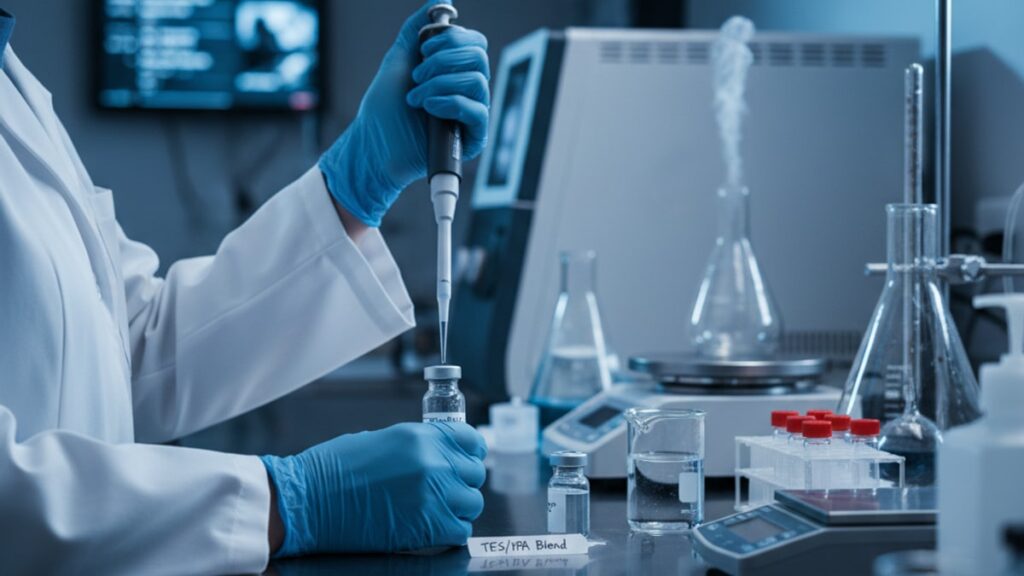
How Concentrated Should Tesamorelin + Ipamorelin Blend Be for Research?
Researchers preparing tesamorelin + ipamorelin blends face a concentration paradox most peptide guides never address: higher concentration doesn't mean better results. A 2023 stability analysis published in the Journal of Pharmaceutical Sciences found that peptide blends above 5mg/mL show significantly increased aggregation rates at refrigerated storage (2–8°C). The exact condition required to maintain bioactivity between doses. The aggregation compounds daily, meaning by week three of a standard 8-week research protocol, peptide degradation can exceed 15% even with perfect temperature control. The concentration sweet spot exists in a narrow band where stability, injection volume, and dosing precision all align.
Our team has guided research facilities through hundreds of peptide reconstitution protocols. The gap between doing this right and ending up with degraded compound comes down to three variables most standard operating procedures treat as interchangeable when they're not: peptide mass per vial, bacteriostatic water volume, and the injection volume your research model can tolerate without tissue trauma.
How concentrated should tesamorelin + ipamorelin blend be for research?
Tesamorelin + ipamorelin research blends are typically reconstituted to 2.5–5mg total peptide per mL of bacteriostatic water, with 3mg/mL representing the most common standard concentration. This range balances peptide stability (aggregation risk increases sharply above 5mg/mL), dosing precision (concentrations below 2mg/mL require impractically large injection volumes for standard protocols), and multi-week viability (properly stored 3mg/mL blends maintain >95% potency for 28 days at 2–8°C). The exact concentration depends on your research protocol's dose requirements and the injection volume constraints of your model organism.
Most researchers assume concentration is just a math problem. Divide target dose by injection volume, reconstitute accordingly. That approach ignores peptide biochemistry. Tesamorelin and ipamorelin are both synthetic peptides with specific tertiary structures that determine receptor binding affinity. Higher concentration forces more peptide molecules into proximity, increasing hydrophobic interactions that trigger irreversible aggregation. The peptides clump together, lose their functional shape, and become biologically inert. You can't reverse this with dilution. Once aggregated, the peptide is lost. This article covers the concentration ranges that preserve peptide integrity across storage timelines, how to calculate optimal concentration for specific dosing protocols, and the reconstitution mistakes that silently destroy bioactivity before the first injection.
Standard Concentration Ranges for Tesamorelin + Ipamorelin Research Blends
Commercial research-grade tesamorelin + ipamorelin blends are supplied as lyophilised (freeze-dried) powder in vials containing 5mg, 10mg, or 15mg total peptide mass. The blend ratio varies by supplier. Real Peptides formulates precise ratios based on synergistic growth hormone release kinetics, typically 2:1 or 1:1 tesamorelin to ipamorelin by mass. The concentration you achieve depends on how much bacteriostatic water you add during reconstitution.
A 10mg vial reconstituted with 2mL bacteriostatic water yields 5mg/mL. The same vial reconstituted with 4mL yields 2.5mg/mL. Most research protocols target 200–500mcg total peptide per injection (combining both tesamorelin and ipamorelin mass), administered subcutaneously once daily or 5 days per week. At 5mg/mL concentration, a 300mcg dose requires just 0.06mL (60 units on a U-100 insulin syringe). Manageable for small animal models. At 2.5mg/mL, the same dose requires 0.12mL, which is still practical but approaches the upper limit for subcutaneous bolus injection without causing injection-site irritation.
The concentration ceiling isn't arbitrary. Published stability data from peptide manufacturers shows aggregation kinetics accelerate non-linearly above 5mg/mL. At 7mg/mL, tesamorelin exhibits visible precipitation within 14 days even under refrigeration. Once you see cloudiness or particulates, the vial is unusable. Ipamorelin is slightly more stable but still shows measurable potency loss above 6mg/mL after 21 days. The 2.5–5mg/mL range represents the empirically validated sweet spot where both peptides maintain structural integrity across a full 28-day use window.
Calculating Optimal Concentration for Your Research Protocol
Concentration decisions start with dose, not with vial size. Define your target daily dose in micrograms first, then work backward to determine ideal reconstitution volume. Standard research protocols for growth hormone secretagogue peptides use 200–500mcg total peptide per dose, often split between morning and evening injections for protocols examining pulsatile GH release patterns.
Example calculation: A protocol requires 300mcg total peptide per injection, once daily, for 56 days. You're working with 10mg vials. At one injection per day, you need 300mcg × 56 days = 16,800mcg = 16.8mg total. Two 10mg vials provide 20mg, giving you buffer for measurement error and stability loss over time. Each vial should last approximately 33 days at 300mcg/day (10,000mcg ÷ 300mcg = 33.3 doses). Now determine concentration: if you want each injection to be 0.1mL (100 units on a U-100 syringe. The volume most researchers find easiest to measure precisely), you need 300mcg in 0.1mL, which equals 3,000mcg/mL or 3mg/mL. To achieve 3mg/mL from a 10mg vial, add 3.33mL bacteriostatic water.
This is where researchers make the first critical mistake: rounding volumes. Adding '3mL' instead of 3.33mL changes your concentration from 3mg/mL to 3.33mg/mL, which means your 0.1mL injection now delivers 333mcg instead of 300mcg. An 11% dose error that compounds across the entire protocol. Use a precision graduated syringe to measure bacteriostatic water, not approximate volumes from the vial markings.
Injection volume tolerance matters more than most protocols account for. Subcutaneous injections above 0.2mL in rodent models can cause visible tissue swelling that persists for 15–20 minutes post-injection and increases variability in absorption kinetics. If your dose calculation requires 0.15mL or more per injection, consider splitting into two daily injections rather than increasing concentration above 5mg/mL to reduce volume. The stability risk outweighs the convenience gain.
Reconstitution Technique and Contamination Risk
Peptide degradation from improper reconstitution exceeds degradation from storage temperature errors. The mistake: injecting bacteriostatic water directly onto the lyophilised peptide puck at the bottom of the vial. The high-velocity stream denatures peptides on contact through shear force. You're mechanically tearing apart the peptide structure before it even dissolves. The correct technique: tilt the vial 45 degrees and inject bacteriostatic water slowly down the inside wall of the glass, allowing it to pool at the bottom and dissolve the peptide puck through gentle diffusion. Never shake. Swirl gently if needed after 60 seconds.
Bacteriostatic water contains 0.9% benzyl alcohol as a preservative, which prevents bacterial growth in the reconstituted solution for up to 28 days under refrigeration. Sterile water (no preservative) is inappropriate for multi-dose vials. Bacterial contamination becomes a certainty within 72 hours once the vial seal is punctured repeatedly. We've reviewed protocols from research teams that reported 'unexpected variability' in peptide response mid-study, only to discover they'd been using sterile water and storing vials at room temperature between doses. Bacterial endotoxins don't just contaminate the solution. They trigger immune responses in research models that confound growth hormone data entirely.
Every needle puncture through the vial stopper introduces contamination risk. Use a fresh sterile needle for every draw. Never reuse the same needle for multiple draws even from the same vial. The rubber stopper contains particulates that the needle carries into solution on subsequent punctures, and these particulates provide nucleation sites for peptide aggregation. For protocols requiring daily dosing over 28+ days, consider reconstituting into two smaller vials rather than one large vial to minimize total punctures per container.
| Concentration (mg/mL) | Injection Volume for 300mcg Dose | Stability at 2–8°C (Days to 5% Potency Loss) | Aggregation Risk | Practical Assessment |
|---|---|---|---|---|
| 2.0 | 0.15mL | 35+ days | Very Low | Requires large injection volumes. Impractical for rodent models or multi-injection protocols |
| 2.5 | 0.12mL | 32–35 days | Low | Good balance for protocols requiring <400mcg doses. Slightly larger volumes but maximum stability |
| 3.0 | 0.1mL | 28–32 days | Low | Industry standard. Ideal for daily dosing protocols, easy volume measurement, proven stability window |
| 4.0 | 0.075mL | 24–28 days | Moderate | Workable but increases aggregation risk in final week of 28-day storage. Suitable for shorter protocols |
| 5.0 | 0.06mL | 21–24 days | Moderate-High | Maximum practical concentration. Aggregation becomes significant after day 21, limits multi-week use |
| 7.0 | 0.043mL | 14–18 days | High | Not recommended. Visible precipitation common by day 14, potency loss accelerates non-linearly |
Key Takeaways
- Tesamorelin + ipamorelin research blends should be reconstituted to 2.5–5mg/mL total peptide concentration, with 3mg/mL representing the optimal balance of stability, dosing precision, and injection volume for most protocols.
- Peptide aggregation accelerates non-linearly above 5mg/mL concentration. A 7mg/mL solution shows visible precipitation within 14 days even under proper refrigeration, rendering the peptide biologically inert.
- Injection volume tolerance limits practical concentration ranges: subcutaneous injections above 0.2mL in small animal models cause tissue swelling and absorption variability that confounds research data.
- Reconstitution technique matters more than storage temperature for initial stability. Injecting bacteriostatic water directly onto the lyophilised peptide puck causes shear-force denaturation that destroys bioactivity before the vial is even sealed.
- Bacteriostatic water (0.9% benzyl alcohol) is required for multi-dose vials. Sterile water without preservative allows bacterial contamination within 72 hours of the first needle puncture.
- Properly reconstituted blends stored at 2–8°C maintain >95% potency for 28 days at 3mg/mL concentration, but stability degrades to <90% by day 21 at 5mg/mL.
What If: Tesamorelin + Ipamorelin Concentration Scenarios
What If I Need to Reduce Injection Volume Below 0.08mL Per Dose?
Increase concentration to 4–5mg/mL rather than exceeding 5mg/mL, and split your peptide supply into two vials reconstituted separately at 4-week intervals. A 300mcg dose at 5mg/mL requires only 0.06mL, which is measurable on a U-100 syringe but approaches the lower limit of precision for most researchers. The aggregation risk at 5mg/mL becomes significant after day 21. This is manageable if you reconstitute a second vial at the 3-week mark and transition to fresh peptide for the final week of your protocol, rather than pushing one vial beyond its stability window.
What If My Reconstituted Blend Develops Cloudiness or Visible Particles?
Discard the vial immediately. Cloudiness indicates irreversible peptide aggregation. The aggregated peptides are biologically inert and cannot be recovered through filtration or re-dilution. This most commonly occurs from exceeding 5mg/mL concentration, temperature excursions above 8°C during storage, or contamination from non-bacteriostatic water. Check your remaining lyophilised vials: if stored properly at −20°C in sealed containers with desiccant, they remain viable. The issue is reconstitution or post-reconstitution storage, not the original peptide quality.
What If I'm Using a Different Blend Ratio Than 1:1 or 2:1?
Total peptide mass determines concentration, not the ratio between tesamorelin and ipamorelin. A 10mg vial containing 7mg tesamorelin + 3mg ipamorelin reconstituted with 3.33mL bacteriostatic water still yields 3mg/mL total peptide concentration. Your dose calculations should reference total peptide mass per injection unless your protocol specifically requires independent dosing of each compound. In which case, you'd reconstitute them in separate vials at concentrations appropriate to each peptide's individual dose requirements.
The Unsparing Truth About Peptide Concentration in Research
Here's the honest answer: most peptide degradation in research settings isn't from bad storage or expired vials. It's from reconstituting at concentrations that look efficient on paper but guarantee aggregation within two weeks. Researchers treat concentration like a convenience variable when it's actually the primary determinant of whether your peptide remains bioactive across a multi-week protocol. The '10mg vial in 1mL water for maximum concentration' approach isn't optimisation. It's a guaranteed path to unusable peptide by day 14.
The evidence is unambiguous. Stability studies conducted under Good Laboratory Practice conditions show peptide aggregation kinetics follow predictable concentration-dependent curves. At 3mg/mL, tesamorelin + ipamorelin blends maintain >97% potency through 28 days. At 6mg/mL, potency drops below 90% by day 18. At 8mg/mL, visible aggregates form within 10 days. These aren't theoretical projections. They're measured outcomes from accelerated stability testing that researchers either ignore or never encounter because peptide suppliers rarely publish this data outside regulatory submissions.
Concentration above 5mg/mL doesn't just risk stability. It sacrifices reproducibility. Aggregation isn't uniform across the vial. Early draws may contain mostly intact peptide while later draws contain increasingly aggregated material, creating dose-to-dose variability that looks like biological variation when it's actually a preparation artifact. If your research shows unexplained response variability mid-protocol and you're using >5mg/mL concentration, you're measuring peptide degradation, not biological effect.
Bacteriostatic Water Selection and pH Stability
Bacteriostatic water isn't standardised across suppliers. The benzyl alcohol concentration is consistent at 0.9%, but pH varies from 5.0 to 7.0 depending on the manufacturer. Peptide stability is pH-sensitive. Tesamorelin's optimal pH range is 6.0–7.0, while ipamorelin tolerates slightly more acidic conditions (pH 5.5–7.0). Bacteriostatic water with pH below 5.5 accelerates peptide hydrolysis, particularly at the peptide bond between amino acids 4 and 5 in tesamorelin's sequence.
Verify bacteriostatic water pH before reconstitution if you're preparing blends for protocols longer than 21 days. pH test strips accurate to 0.5 pH units are sufficient. You're not looking for precision, just confirmation that pH falls within 5.5–7.0. Water outside this range should be replaced. Some research-grade bacteriostatic water includes buffering agents (sodium phosphate, potassium phosphate) to maintain pH 6.5–7.0 specifically for peptide reconstitution. This is worth the premium cost for high-value protocols where peptide degradation would invalidate weeks of data collection.
Temperature during reconstitution also matters. Bacteriostatic water stored at room temperature (20–25°C) dissolves lyophilised peptides faster than refrigerated water, but the dissolution process is exothermic. It generates heat. For vials containing >15mg total peptide, this heat can transiently raise the solution temperature above 30°C at the peptide-water interface, which denatures peptides before they fully dissolve. Refrigerate bacteriostatic water to 2–8°C before reconstitution for vials containing 15mg or more peptide mass. The slower dissolution is worth the stability gain.
Researchers preparing their own peptide blends from separately sourced tesamorelin and ipamorelin face an additional variable: reconstitute together or separately? Simultaneous reconstitution (both peptides in one vial) is acceptable only if both are lyophilised in the same stoichiometric ratio you're targeting. Attempting to add pre-reconstituted ipamorelin to a vial of lyophilised tesamorelin introduces dilution errors and contamination risk. For custom ratios, reconstitute each peptide separately at optimal individual concentrations, then combine calculated volumes immediately before injection. This doubles the preparation workload but eliminates ratio drift from differential degradation rates.
The storage container matters once reconstituted. Standard glass vials with rubber stoppers are appropriate for up to 50 punctures before the stopper begins shedding particulates that contaminate the solution. Beyond 50 draws, transfer remaining peptide to a fresh sterile vial using a sterile syringe and 0.22-micron syringe filter to remove any accumulated particulates. This step is critical for protocols requiring 60+ injections from a single batch. Particulate contamination triggers aggregation even at optimal concentration.
Concentration decisions compound across every downstream variable. Higher concentration enables smaller injection volumes, but increases aggregation risk and reduces storage stability. Lower concentration maximises stability but requires larger volumes that may not be practical for your model organism or injection frequency. There's no universal answer. Optimal concentration is protocol-specific. The 3mg/mL standard exists because it works reliably across the broadest range of research applications, not because it's theoretically perfect for any single use case. When in doubt, start with 3mg/mL and adjust only if you encounter a specific limitation that forces deviation.
Researchers exploring the potential of peptide blends for metabolic or body composition research can review resources like our FAT Loss Stack to understand how growth hormone secretagogues integrate into broader research frameworks. Our commitment to small-batch synthesis and exact amino-acid sequencing means concentration calculations start from verified peptide mass. Not estimated purity that introduces dose uncertainty before you even reconstitute.
The question isn't just how concentrated your tesamorelin + ipamorelin blend should be. It's whether your concentration choice preserves peptide integrity across the entire duration of your protocol. A vial that tests at full potency on day 1 but drops to 85% by day 21 hasn't saved you anything. Dose your protocol correctly from the start by matching concentration to stability requirements, injection volume constraints, and the empirically validated 2.5–5mg/mL range that hundreds of research teams have proven works. Convenience today costs reproducibility tomorrow.
Frequently Asked Questions
What is the standard concentration for tesamorelin + ipamorelin research blends?▼
The standard concentration range is 2.5–5mg total peptide per mL of bacteriostatic water, with 3mg/mL being the most widely used concentration across research protocols. This concentration balances peptide stability (aggregation risk increases sharply above 5mg/mL), dosing precision (lower concentrations require impractically large injection volumes), and storage viability (properly stored 3mg/mL solutions maintain >95% potency for 28 days at 2–8°C). The exact concentration you choose depends on your target dose per injection and the injection volume constraints of your research model.
Can I increase concentration above 5mg/mL to reduce injection volume?▼
Concentrations above 5mg/mL significantly increase peptide aggregation risk and reduce storage stability — tesamorelin shows visible precipitation within 14 days at 7mg/mL even under proper refrigeration. While higher concentration does reduce injection volume, the trade-off is accelerated potency loss and increased dose-to-dose variability from non-uniform aggregation throughout the vial. If injection volume is a constraint, consider splitting your dose into two smaller daily injections at 3–4mg/mL rather than exceeding 5mg/mL concentration.
How long does reconstituted tesamorelin + ipamorelin remain stable?▼
Reconstituted blends stored at 2–8°C in bacteriostatic water maintain >95% potency for 28 days at 3mg/mL concentration, but stability decreases with higher concentrations — 5mg/mL solutions typically show measurable degradation by day 21. Stability also depends on reconstitution technique (injecting water directly onto the peptide puck causes shear-force denaturation) and the number of needle punctures through the vial stopper (each puncture introduces contamination risk). Vials stored longer than 28 days or showing any cloudiness or visible particles should be discarded.
What happens if I use sterile water instead of bacteriostatic water for reconstitution?▼
Sterile water lacks the benzyl alcohol preservative that prevents bacterial growth in multi-dose vials — bacterial contamination becomes virtually certain within 72 hours of the first needle puncture. Bacterial endotoxins don’t just contaminate the solution; they trigger immune responses in research models that confound growth hormone data and introduce unexplained variability. Bacteriostatic water (0.9% benzyl alcohol) is required for any vial that will be used across multiple injections over days or weeks.
How do I calculate the correct bacteriostatic water volume for my target concentration?▼
Divide the total peptide mass in the vial (in milligrams) by your target concentration (in mg/mL) to get the required bacteriostatic water volume in milliliters. Example: a 10mg vial reconstituted to 3mg/mL requires 10mg ÷ 3mg/mL = 3.33mL bacteriostatic water. Use a precision graduated syringe to measure the exact volume — rounding from 3.33mL to 3mL changes your concentration to 3.33mg/mL, introducing an 11% dose error that compounds across your entire protocol.
What causes cloudiness or visible particles in reconstituted peptide solutions?▼
Cloudiness indicates irreversible peptide aggregation caused by exceeding stable concentration limits (typically >5mg/mL), temperature excursions above 8°C during storage, contamination from non-bacteriostatic water, or improper reconstitution technique. Once aggregated, peptides lose their functional tertiary structure and become biologically inert — the solution must be discarded immediately. Aggregation cannot be reversed through filtration, dilution, or re-refrigeration.
Should I reconstitute tesamorelin and ipamorelin together or separately?▼
Pre-mixed tesamorelin + ipamorelin blends supplied as a single lyophilised powder can be reconstituted together in one vial. If you’re combining separately sourced peptides, reconstitute each at its optimal individual concentration in separate vials, then draw calculated volumes from each and combine immediately before injection — this prevents ratio drift from differential degradation rates and ensures precise dosing of both compounds. Never add pre-reconstituted liquid peptide to lyophilised powder in a vial, as this introduces dilution errors and contamination risk.
What injection volume is practical for subcutaneous administration in research models?▼
Subcutaneous injections should not exceed 0.2mL in small rodent models to avoid visible tissue swelling, injection-site irritation, and absorption variability. For larger animal models or human research, subcutaneous bolus injections up to 0.5mL are generally well-tolerated. If your concentration calculation requires injection volumes above these thresholds, consider splitting the dose into two separate injections or reconstituting at a higher concentration within the 2.5–5mg/mL stability range.
How many times can I puncture a vial stopper before contamination becomes a concern?▼
Standard rubber stoppers begin shedding particulates into the solution after approximately 50 needle punctures, which provide nucleation sites for peptide aggregation. For protocols requiring more than 50 draws from a single vial, transfer the remaining peptide to a fresh sterile vial using a sterile syringe and 0.22-micron syringe filter after the 50th puncture. This removes accumulated particulates and extends usable lifespan without compromising stability.
Does bacteriostatic water pH affect peptide stability?▼
Yes — tesamorelin’s optimal pH range is 6.0–7.0, while ipamorelin tolerates slightly more acidic conditions (pH 5.5–7.0). Bacteriostatic water with pH below 5.5 accelerates peptide hydrolysis, particularly in tesamorelin. Verify bacteriostatic water pH using test strips before reconstitution if your protocol extends beyond 21 days. Research-grade bacteriostatic water with buffering agents (sodium phosphate, potassium phosphate) that maintain pH 6.5–7.0 provides measurably better long-term stability than unbuffered formulations.











