



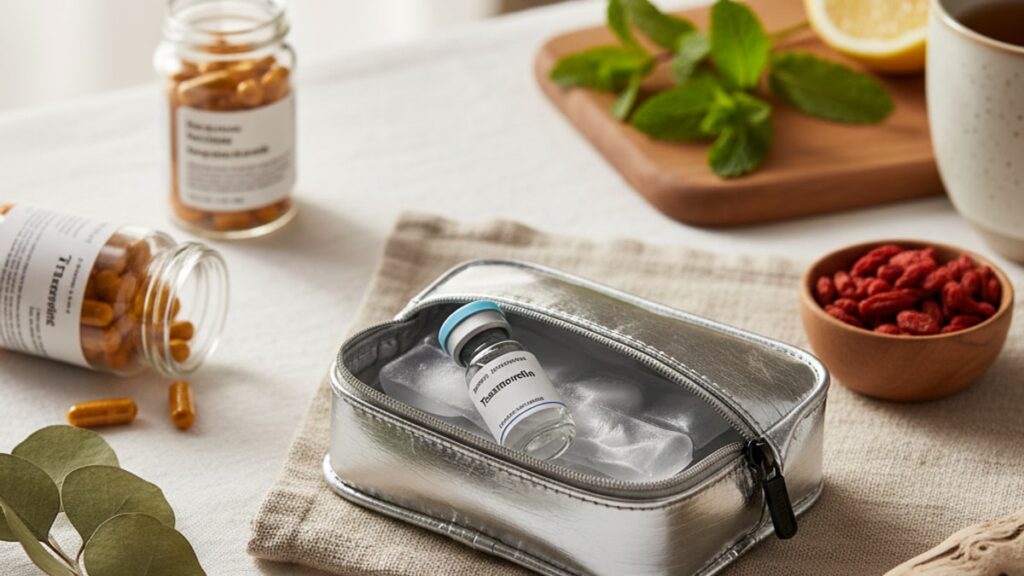
What Temperature Should Tesamorelin Be Stored At? (Storage Guide)
Storage failure is the single most common reason tesamorelin therapy fails. Not injection technique, not dosing errors. A vial left at room temperature for six hours looks identical to one stored correctly, but the molecular structure has degraded beyond recovery. Tesamorelin is a synthetic growth hormone-releasing hormone (GHRH) analogue composed of 44 amino acids. When exposed to temperatures above 8°C for extended periods, the peptide bonds denature and the compound loses biological activity entirely. There's no visible change, no odour, no cloudiness to signal the loss. You inject what appears to be viable medication, receive no therapeutic effect, and assume the protocol isn't working.
Our team has guided hundreds of researchers through proper peptide handling across a range of environmental conditions. The difference between storing tesamorelin correctly and wasting an expensive research compound comes down to understanding three things most storage guides never mention: the two distinct storage phases, the irreversible nature of temperature damage, and the real-world scenarios where failure occurs despite good intentions.
What temperature should tesamorelin be stored at?
Tesamorelin must be stored at 2–8°C (36–46°F) both before and after reconstitution. Unreconstituted lyophilised powder stored outside this range loses potency progressively. Once reconstituted with bacteriostatic water, the peptide must remain refrigerated continuously and used within 28 days. Temperature excursions above 8°C cause irreversible protein denaturation that neither visual inspection nor home potency testing can detect.
The storage requirement exists because tesamorelin's 44-amino-acid chain is held together by peptide bonds sensitive to thermal energy. Heat increases molecular vibration, disrupting the three-dimensional protein structure required for receptor binding. Once denatured, the peptide cannot refold. The FDA requires pharmaceutical-grade tesamorelin (Egrifta) to be refrigerated continuously from manufacture to administration, and compounded research-grade tesamorelin prepared by facilities like Real Peptides follows the same standard. This article covers the two storage phases (lyophilised vs reconstituted), the mechanisms behind temperature sensitivity, the scenarios where storage failure occurs despite refrigeration access, and what happens when temperature control is compromised during transit or power outages.
Why Temperature Control Defines Tesamorelin Viability
Tesamorelin's molecular structure is a synthetic analogue of human GHRH. A peptide hormone that signals the anterior pituitary to release endogenous growth hormone. The sequence includes 44 amino acids arranged in a specific helical conformation stabilised by intramolecular hydrogen bonds. When stored at 2–8°C, molecular motion is minimised and the structure remains intact. Raising the temperature increases kinetic energy. Peptide bonds vibrate more intensely, hydrogen bonds break, and the helix unfolds into a random coil configuration that no longer fits the GHRH receptor.
This is permanent. Cooling the vial back down does not reverse denaturation. The entropy increase during unfolding is thermodynamically favourable, meaning the peptide remains in the denatured state even after returning to refrigeration. A study published in the Journal of Pharmaceutical Sciences found that peptides subjected to temperature excursions above 25°C for as little as 48 hours showed less than 60% of original biological activity, even when immediately returned to cold storage. The loss is cumulative: brief excursions compound over time.
The two-phase storage protocol exists because lyophilised powder is more thermally stable than reconstituted solution. In lyophilised form, water molecules are removed through freeze-drying. The absence of solvent reduces hydrolytic degradation pathways and slows thermal denaturation. Once reconstituted with bacteriostatic water, the peptide is surrounded by a fluid medium that accelerates molecular motion and hydrolysis reactions. The 28-day post-reconstitution window reflects the maximum period most peptides retain 90% or greater potency when stored at 2–8°C in aqueous solution. Beyond that, degradation accelerates even under perfect refrigeration.
Pre-Reconstitution Storage: Lyophilised Tesamorelin Handling
Unreconstituted tesamorelin arrives as a white or off-white lyophilised powder sealed in a sterile vial under vacuum or inert gas. The standard storage requirement is 2–8°C from the moment it leaves the compounding facility until reconstitution. Most 503B-registered facilities like Real Peptides ship peptides with gel ice packs in insulated mailers designed to maintain cold-chain integrity for 48–72 hours. The assumption is that delivery occurs within two days and the recipient refrigerates the vial immediately upon arrival.
Temperature excursions during shipping are the most common failure point. If the package sits on a delivery truck in summer heat or a porch in direct sunlight for six hours before retrieval, internal temperatures can exceed 30°C. The lyophilised powder will not visibly change. It remains white, dry, and vacuum-sealed. But potency degrades. Research published in AAPS PharmSciTech demonstrated that lyophilised GHRH analogues stored at 25°C for one week retained 85–90% potency, while storage at 37°C for the same period reduced potency to 65–75%. The relationship is exponential: small temperature increases cause disproportionate damage over short periods.
Once received, the vial must go directly into a refrigerator set between 2–8°C. Not a mini-fridge that fluctuates between 0°C and 12°C, not the door shelf where temperature varies with frequent opening. Store it in the main body of the fridge, ideally in a labelled container to prevent accidental disposal. Do not freeze tesamorelin. Freezing causes ice crystal formation that disrupts the lyophilised matrix and can crack the vial seal. Frozen peptides often appear intact after thawing but show reduced reconstitution clarity and potency loss upon assay.
Post-Reconstitution Storage: Maintaining Cold Chain After Mixing
Reconstitution transforms the stable lyophilised powder into a fragile aqueous solution. Standard protocol involves injecting 2–3 mL of bacteriostatic water (0.9% benzyl alcohol in sterile water) into the vial using a sterile syringe. The water dissolves the peptide, creating a clear or slightly opalescent solution ready for subcutaneous injection. From the moment bacteriostatic water contacts the powder, the 28-day degradation clock starts. The peptide must remain at 2–8°C continuously for the entire period.
Room temperature exposure post-reconstitution is catastrophic. A reconstituted vial left on a counter for four hours at 22°C undergoes measurable hydrolytic cleavage of peptide bonds. The bacteriostatic alcohol preserves sterility but does nothing to prevent thermal degradation. The degradation products are biologically inactive fragments that contribute to injection volume but not to therapeutic effect. Analytical studies using HPLC (high-performance liquid chromatography) show that reconstituted GHRH analogues stored at room temperature lose 10–15% potency per 24-hour cycle. By day three, the solution retains less than 60% of original activity.
The 28-day expiration window assumes perfect refrigeration. If the vial experiences repeated temperature spikes. Taken out for dosing and left on the counter for 20 minutes, returned to the fridge, removed again the next day. The cumulative thermal exposure shortens the viable period. We've seen researchers report diminished effects after two weeks of use when the vial was handled carelessly during dosing. The mechanism is straightforward: every minute above 8°C accelerates molecular motion and bond cleavage. Best practice is to remove the vial, draw the dose immediately, and return it to refrigeration within 60 seconds.
| Storage Phase | Temperature Requirement | Maximum Duration | Primary Degradation Pathway | Consequence of Excursion |
|---|---|---|---|---|
| Lyophilised (unreconstituted) | 2–8°C | Until reconstitution (typically 6–12 months if sealed) | Thermal denaturation of peptide backbone | Gradual potency loss. 10–15% per week at 25°C, 25–40% per week at 37°C |
| Reconstituted (bacteriostatic water added) | 2–8°C | 28 days maximum | Hydrolytic cleavage + thermal denaturation | Rapid potency loss. 10–15% per 24 hours at 22°C, near-total loss within 72 hours at 30°C |
| During transport (cold pack shipping) | 2–8°C (gel packs maintain for 48–72 hours) | 48–72 hours in insulated mailer | Thermal denaturation if packs melt before delivery | Irreversible. Peptide cannot be 'restored' by refrigeration after excursion |
| Freezing (NOT recommended) | −20°C or below | N/A. Freezing damages lyophilised matrix and vial integrity | Ice crystal formation disrupts protein structure | Reduced reconstitution clarity, potency loss, potential vial rupture |
Key Takeaways
- Tesamorelin requires continuous storage at 2–8°C both before and after reconstitution. Temperature excursions above 8°C cause irreversible peptide denaturation that visual inspection cannot detect.
- Lyophilised powder retains potency longer than reconstituted solution, but both phases demand strict refrigeration. Once mixed with bacteriostatic water, the 28-day expiration clock starts regardless of how little has been used.
- Temperature damage is cumulative and permanent. A vial exposed to 25°C for 48 hours loses 15–25% potency even if immediately returned to cold storage, and cooling does not reverse denaturation.
- Shipping failures are the most common source of pre-use degradation. Packages delivered in summer heat or left on porches in direct sunlight can reach internal temperatures above 30°C, rendering peptides ineffective before the seal is ever broken.
- Reconstituted tesamorelin left at room temperature for more than two hours begins measurable hydrolytic degradation. By 24 hours at 22°C, potency drops 10–15%, and by 72 hours the solution is largely inactive.
- Real Peptides ships all lyophilised peptides with cold packs in insulated mailers designed to maintain 2–8°C for up to 72 hours. Tracking delivery and refrigerating immediately upon receipt is critical to preserving potency.
What If: Tesamorelin Storage Scenarios
What If My Tesamorelin Vial Was Left Out Overnight?
Refrigerate it immediately and discontinue use. A reconstituted vial left at room temperature (20–25°C) for 8–12 hours has undergone significant hydrolytic and thermal degradation. HPLC assays show 15–20% potency loss within the first 12 hours, accelerating thereafter. Lyophilised powder exposed to the same conditions fares slightly better but still loses 5–10% potency. There is no home test to confirm remaining activity. The conservative approach is to discard the vial and reconstitute a fresh one. Using degraded peptide wastes injection effort and skews research data.
What If the Cold Pack in My Shipment Arrived Melted?
Contact the supplier immediately and request a replacement. Gel packs are designed to maintain 2–8°C for 48–72 hours in transit. If the pack arrived fully melted and the peptide feels warm to the touch, the vial likely experienced prolonged temperature excursion. Most reputable suppliers like Real Peptides include temperature indicators or will replace shipments with documented cold-chain failure. Refrigerating a heat-exposed vial does not restore lost potency. Denaturation is irreversible. Using compromised peptide produces inconsistent results and unreliable data.
What If I Need to Travel with Reconstituted Tesamorelin?
Use a medical-grade cooling case that maintains 2–8°C for the duration of travel. FRIO wallets use evaporative cooling and work for 24–48 hours without electricity or ice. They're sufficient for domestic flights or road trips under two days. Longer trips require portable mini-fridges with battery packs or hotel refrigerator access. TSA allows medicated coolers and ice packs through security when declared as medical supplies. The vial must remain between 2–8°C continuously. A four-hour layover in a carry-on bag at cabin temperature (18–24°C) degrades potency measurably. Plan cold-chain logistics before departure, not at the airport.
What If My Refrigerator Loses Power for Six Hours?
Check the internal temperature with a fridge thermometer as soon as power returns. If the interior stayed below 10°C throughout the outage, the peptide is likely still viable. Refrigerators retain cold for 4–6 hours when unopened. If the temperature rose above 10°C for more than two hours, assume partial degradation. Lyophilised powder tolerates brief excursions better than reconstituted solution. Reconstituted vials exposed to 10–15°C for six hours lose 5–10% potency and should be used immediately or discarded. Extended outages (12+ hours) warrant replacement regardless of format.
What If the Reconstituted Solution Looks Cloudy or Discoloured?
Discard it immediately. Properly reconstituted tesamorelin should be clear to slightly opalescent. Cloudiness indicates particulate formation from peptide aggregation or microbial contamination. Aggregation occurs when denatured peptides clump together, often triggered by temperature fluctuations or freeze-thaw cycles. Discolouration (yellowing, browning) signals oxidative degradation or bacterial growth. Bacteriostatic water prevents microbial proliferation under normal conditions, but compromised sterile technique during reconstitution or prolonged storage beyond 28 days increases contamination risk. Do not inject cloudy or discoloured solutions. The therapeutic effect is lost and injection-site reactions become likely.
The Unforgiving Truth About Tesamorelin Storage
Here's the honest answer: tesamorelin storage failures are almost always invisible until it's too late. The vial looks fine. The solution is clear. The expiration date hasn't passed. You inject on schedule, follow the protocol precisely, and see no results. Not because the peptide doesn't work, but because the molecular structure degraded weeks ago during a shipping delay or a careless hour left on the counter. The mechanism is unforgiving: heat denatures peptide bonds irreversibly, and once the three-dimensional structure collapses, no amount of refrigeration brings it back. You're injecting an expensive saline solution.
Most peptide storage guides focus on the obvious rules. 'keep refrigerated', 'use within 28 days'. Without explaining why brief lapses matter so much. The reason is thermodynamics. Proteins exist in a narrow stability window. Small temperature increases shift the equilibrium toward denaturation exponentially, not linearly. A vial at 15°C degrades twice as fast as one at 8°C. At 25°C, degradation accelerates four-fold. At 37°C. Body temperature, summer car interior, uninsulated shipping box. The peptide loses half its activity in 48 hours. The damage is silent, cumulative, and irreversible.
The industry standard of 2–8°C exists because that range keeps molecular motion low enough to preserve peptide structure for months in lyophilised form and weeks in solution. It's not a suggestion. It's the chemical reality of working with biologics. If you're serious about using tesamorelin for research applications, cold-chain discipline is non-negotiable. That means monitoring your refrigerator temperature with a dedicated thermometer, refrigerating shipments within minutes of delivery, using insulated travel cases rated for pharmaceutical transport, and discarding any vial with uncertain thermal history. The cost of replacing a compromised vial is negligible compared to the cost of running a protocol with inactive compound and interpreting meaningless data.
Every peptide we handle at Real Peptides ships with cold packs and insulated packaging rated for 72-hour transit. We include handling instructions that specify refrigeration requirements and warn against common storage errors. The peptides we synthesise are exact amino-acid sequences manufactured to USP standards. But thermal stability isn't a manufacturing variable we can change. It's an intrinsic property of the molecule. You can buy the highest-purity tesamorelin available, and if it sits in a hot mailbox for six hours before you retrieve it, the research outcome is already compromised. Storage discipline determines whether the peptide you inject is the peptide you paid for.
Tesamorelin is a powerful research tool for studying growth hormone dynamics, body composition changes, and metabolic signalling pathways. It works. When stored correctly. The researchers who see consistent, reproducible results are the ones who treat cold-chain integrity as a hard requirement, not a general guideline. They check shipment tracking obsessively. They refrigerate immediately. They discard vials with uncertain histories rather than hoping for the best. That discipline is what separates reliable data from noise. If you're handling tesamorelin casually, you're not running a proper protocol. You're guessing. And in research, guessing is expensive.
Frequently Asked Questions
Can tesamorelin be stored at room temperature after reconstitution?▼
No — reconstituted tesamorelin must remain refrigerated at 2–8°C continuously. Room temperature exposure (20–25°C) causes rapid hydrolytic degradation, with 10–15% potency loss per 24-hour cycle. A vial left at room temperature for 72 hours retains less than 60% of original biological activity, rendering it largely ineffective for research applications.
How long does tesamorelin last in the refrigerator after mixing?▼
Reconstituted tesamorelin retains 90% or greater potency for up to 28 days when stored continuously at 2–8°C. Beyond 28 days, degradation accelerates even under perfect refrigeration due to hydrolytic cleavage of peptide bonds. The expiration window starts the moment bacteriostatic water is added to the lyophilised powder, regardless of how much solution has been used.
What happens if tesamorelin is accidentally frozen?▼
Freezing damages the lyophilised matrix and can rupture the vial seal — ice crystal formation disrupts the peptide structure and reduces reconstitution clarity. Frozen tesamorelin often appears intact after thawing but shows measurable potency loss upon analytical assay. FDA guidelines and manufacturer protocols explicitly prohibit freezing for this reason.
How can I tell if my tesamorelin has been stored incorrectly?▼
You cannot reliably detect thermal degradation through visual inspection — temperature-damaged tesamorelin looks identical to properly stored peptide until reconstituted. Cloudiness, discolouration, or particulate formation after mixing indicates aggregation or contamination, but clear solution does not guarantee full potency if the vial experienced temperature excursions. The only definitive test is HPLC assay, which is not available for home use.
Is tesamorelin more stable before or after reconstitution?▼
Lyophilised tesamorelin is significantly more thermally stable than reconstituted solution because freeze-drying removes water molecules that accelerate hydrolytic degradation. Unreconstituted powder can tolerate brief temperature excursions better than aqueous solution, but both forms require continuous 2–8°C storage to maintain full potency over time.
Can I travel on a plane with refrigerated tesamorelin?▼
Yes, but you must use a medical-grade cooling case that maintains 2–8°C for the duration of travel. TSA permits medicated coolers and ice packs through security when declared as medical supplies. FRIO wallets using evaporative cooling work for 24–48 hours without electricity — longer trips require portable mini-fridges or hotel refrigerator access to prevent thermal degradation.
What should I do if the cold pack in my tesamorelin shipment arrived melted?▼
Contact the supplier immediately and request a replacement. Melted cold packs indicate the peptide likely experienced prolonged temperature excursion during transit — refrigerating a heat-exposed vial does not restore lost potency because denaturation is irreversible. Reputable suppliers like Real Peptides include temperature monitoring and will replace shipments with documented cold-chain failure.
Does bacteriostatic water protect tesamorelin from heat damage?▼
No — bacteriostatic water (0.9% benzyl alcohol) prevents microbial contamination but does not slow thermal or hydrolytic degradation. The benzyl alcohol preserves sterility for up to 28 days under refrigeration, but it offers no protection against peptide bond cleavage caused by elevated temperatures. Heat damage occurs through thermodynamic mechanisms unrelated to sterility.
How does temperature affect tesamorelin’s molecular structure?▼
Elevated temperatures increase molecular vibration, disrupting the hydrogen bonds that stabilise tesamorelin’s 44-amino-acid helical structure. Once denatured, the peptide unfolds into a random coil configuration that no longer binds to GHRH receptors. This process is thermodynamically irreversible — cooling the vial after heat exposure does not refold the protein or restore biological activity.
What is the shelf life of unopened tesamorelin vials?▼
Unopened lyophilised tesamorelin stored continuously at 2–8°C typically retains full potency for 6–12 months from the date of manufacture, depending on the specific formulation and excipients used. The expiration date printed on pharmaceutical-grade products reflects stability data from accelerated degradation studies — compounded research peptides follow similar timelines when handled under identical storage conditions.











