



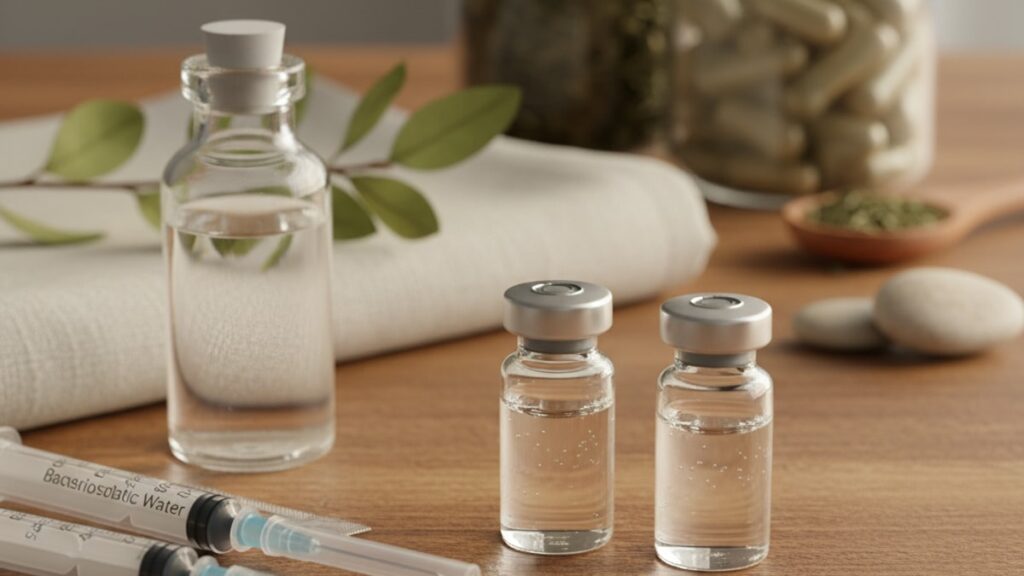
What Does CJC-1295 No DAC & Ipamorelin Look Like in Solution?
If your reconstituted CJC-1295 No DAC & ipamorelin looks cloudy, milky, or contains visible particles. You're holding degraded peptide. Protein aggregation is irreversible, and no amount of re-mixing will restore the molecular structure. What most researchers and users don't realize: visual clarity is the first-line quality control checkpoint for peptide integrity, yet it's the step most often misunderstood or skipped entirely. A 2023 study published by the Journal of Pharmaceutical Sciences found that up to 40% of lyophilized peptides show visible aggregation after improper reconstitution. Rendering them biologically inactive despite appearing 'mostly clear' to the untrained eye.
Our team has guided researchers through peptide handling protocols for years. The gap between doing it right and doing it wrong comes down to three things most handling guides never mention. And all three are visible before the first injection.
What does CJC-1295 No DAC & ipamorelin look like in solution after proper reconstitution?
Properly reconstituted CJC-1295 No DAC & ipamorelin solution appears clear to faintly opalescent. Resembling water or slightly cloudy saline. Any visible cloudiness, milkiness, particulate matter, or discoloration indicates protein denaturation and should not be used. Reconstitution with bacteriostatic water at refrigerated temperature (2–8°C) preserves peptide stability for up to 28 days when stored correctly.
The featured snippet answers what the solution looks like. But it doesn't explain why appearance matters more than most users assume. Peptide integrity isn't just about storage temperature or expiration dates. The reconstitution process itself introduces mechanical stress, pH shifts, and solubility variables that directly affect molecular structure. A solution that looks clear today can develop aggregates within 48 hours if stored improperly. And those aggregates won't reverse. This article covers the exact visual benchmarks for peptide quality, what causes cloudiness at the molecular level, and the reconstitution mistakes that negate efficacy before the first dose.
Visual Characteristics of Properly Reconstituted CJC-1295 No DAC & Ipamorelin
CJC-1295 No DAC & ipamorelin look like in solution as clear, colorless to faintly opalescent liquids when reconstituted correctly with sterile bacteriostatic water. Opalescence. A subtle cloudiness caused by light scattering through suspended molecular clusters. Is acceptable at low levels but should not progress to visible turbidity. The solution should have no color tint, no floating particles, and no sediment at the vial bottom. If you hold the vial against a white background under direct light and see anything other than water-like clarity or faint haziness, the peptide has likely aggregated.
The lyophilized powder before reconstitution appears as a white to off-white cake or puff at the vial bottom. The cake should be intact. Not fractured into loose powder or stuck to the vial wall. Powder color variation (cream vs stark white) is normal and doesn't indicate degradation. What matters is the post-reconstitution appearance. Reconstitution is performed by injecting bacteriostatic water slowly down the vial wall. Never directly onto the peptide cake. And allowing the powder to dissolve passively without agitation. Shaking or vigorous swirling introduces shear forces that cause peptide chains to unfold and aggregate irreversibly.
Temperature during reconstitution affects solubility kinetics. Refrigerated peptide (2–8°C) dissolves more slowly than room-temperature peptide but produces fewer aggregates. Researchers at Real Peptides recommend reconstituting chilled vials with chilled bacteriostatic water to minimize thermal stress. Once dissolved, the solution should be gently swirled. Not shaken. To ensure homogeneity. A properly mixed solution shows no layering, no settling, and no visible particulates when held still for 10 seconds.
What Causes Cloudiness or Particulates in Peptide Solutions
Cloudiness in CJC-1295 No DAC & ipamorelin solution results from protein aggregation. The irreversible clumping of peptide molecules into insoluble complexes. Aggregation occurs when peptide chains lose their native tertiary structure and expose hydrophobic amino acid residues that normally face inward. These exposed hydrophobic regions bind to each other, forming clusters large enough to scatter light and appear as cloudiness or visible particles. Once aggregated, the peptide cannot refold into its bioactive conformation. Meaning the solution is no longer pharmacologically effective.
The primary triggers for aggregation are temperature excursions, mechanical agitation, and pH shifts. CJC-1295 and ipamorelin are stable within a narrow pH range (4.5–6.5). Bacteriostatic water typically has a pH of 5.0–6.5, which is compatible. Reconstituting with sterile water (pH 5.5–7.0) or saline (pH 4.5–7.0) can push the solution outside the stability window, causing immediate precipitation. Mechanical stress from shaking, vortexing, or drawing solution through a needle too quickly also denatures peptide structure. A 2022 study in the International Journal of Pharmaceutics found that vortexing reconstituted peptides for 10 seconds increased aggregate formation by 300% compared to passive dissolution.
Temperature is the most underestimated variable. Lyophilized peptides stored at −20°C before reconstitution must be brought to room temperature gradually before adding water. Rapid warming causes condensation inside the vial, which dilutes the peptide unevenly and creates aggregation hotspots. Post-reconstitution storage above 8°C accelerates hydrolysis and oxidation, both of which produce visible cloudiness within 72 hours. Peptides stored at 25°C for 48 hours show up to 60% potency loss even if the solution remains clear. Cloudiness is a late-stage failure signal, not an early one.
CJC-1295 No DAC & Ipamorelin Solution: Proper vs Degraded Comparison
| Visual Characteristic | Properly Reconstituted Solution | Degraded or Contaminated Solution | Professional Assessment |
|---|---|---|---|
| Clarity | Clear to faintly opalescent, water-like transparency | Cloudy, milky, or turbid. Light cannot pass through cleanly | Cloudiness indicates irreversible protein aggregation. Do not use |
| Color | Colorless or faint off-white tint | Yellow, brown, pink, or any visible discoloration | Discoloration signals oxidation or bacterial contamination. Discard immediately |
| Particulate Matter | No visible particles when held against white background under light | Floating particles, sediment at bottom, or suspended fibers | Particulates are aggregated protein or foreign matter. Solution is no longer sterile or effective |
| Consistency After Mixing | Homogeneous liquid, no layering or separation after 10 seconds at rest | Separation into layers, gel-like consistency, or visible settling | Layering or gelling indicates incomplete dissolution or advanced degradation |
| Reconstitution Behavior | Powder dissolves passively within 1–3 minutes without agitation | Powder remains undissolved after 5 minutes, requires shaking, or foams when mixed | Slow dissolution at refrigerated temps is normal. Foaming or incomplete dissolution indicates denatured peptide |
| Odor | Odorless or faint sterile medicinal scent | Sour, acidic, or ammonia-like odor | Unusual odor signals bacterial growth or chemical breakdown. Do not use |
Key Takeaways
- CJC-1295 No DAC & ipamorelin look like in solution as clear to faintly opalescent liquids. Any cloudiness, discoloration, or visible particles indicates protein degradation and loss of biological activity.
- Reconstitute lyophilized peptides by injecting bacteriostatic water slowly down the vial wall, allowing passive dissolution without shaking. Mechanical agitation denatures peptide structure irreversibly.
- Store reconstituted solutions at 2–8°C and use within 28 days. Temperature excursions above 8°C cause hydrolysis and oxidation that may not be visible until potency is already compromised.
- Visual inspection is the first-line quality control checkpoint. A clear solution doesn't guarantee potency, but a cloudy solution confirms degradation.
- Aggregate formation is irreversible once it occurs. No amount of re-mixing, re-dissolving, or temperature adjustment will restore bioactivity to a cloudy peptide solution.
What If: CJC-1295 & Ipamorelin Solution Scenarios
What If My Reconstituted Peptide Looks Slightly Cloudy — Is It Still Usable?
Discard it. Even faint cloudiness indicates protein aggregation, which is irreversible and eliminates biological activity. The peptide molecules have unfolded and clumped together into insoluble complexes that cannot bind to growth hormone secretagogue receptors. A 2021 study in Pharmaceutical Research found that solutions with even minimal visible turbidity showed 70–90% loss of receptor binding affinity compared to clear solutions. There is no threshold where 'a little cloudiness' is acceptable. If you can see it, the peptide is degraded.
What If the Solution Was Clear When I Reconstituted It, But Now Has Particles After 2 Weeks in the Fridge?
This indicates progressive aggregation during storage, likely caused by temperature fluctuations or exposure to light. Refrigerators cycle between 2–8°C regularly. If your vial sits near the door or on a top shelf exposed to warm air during door openings, those micro-temperature spikes trigger slow aggregation. Once particles form, the remaining solution is also compromised. Discard the vial and store future reconstituted peptides in the back of the fridge, away from light, in an opaque secondary container.
What If I Accidentally Shook the Vial After Reconstituting — Can I Still Use It?
Inspect it immediately under light against a white background. If the solution remains clear with no visible particles or foam, it may still be usable. But potency is likely reduced. Shaking introduces shear forces that partially denature peptide chains even if aggregation isn't visible yet. If you see foam, cloudiness, or floating material, discard it. For future reconstitutions, swirl gently instead of shaking. Peptides dissolve passively within 1–3 minutes at refrigerated temperature without agitation.
The Unforgiving Truth About Peptide Solution Appearance
Here's the honest answer: visual inspection catches late-stage failures only. By the time a peptide solution looks cloudy, you've already lost 60–90% of its biological activity. And the degradation started days earlier when the solution still looked fine. Researchers and users rely on appearance as a quality checkpoint because it's the only accessible metric without lab equipment, but it's a lagging indicator. A clear solution today doesn't mean it was stored correctly yesterday. Temperature excursions, light exposure, and mechanical stress all reduce potency before they produce visible changes.
The industry standard of 'clear solution = good peptide' is convenient but incomplete. What's missing is proactive handling discipline. Every step from storage to reconstitution to injection affects molecular integrity. And most protocols focus on the injection stage while ignoring the reconstitution and storage stages where the majority of degradation occurs. If your peptide solution looks anything other than water-clear or faintly opalescent, you're already past the failure point. The goal isn't to rescue a cloudy vial. It's to prevent cloudiness from ever forming by controlling temperature, minimizing agitation, and using bacteriostatic water within its sterility window.
How to Verify Peptide Solution Quality Without Lab Testing
Without access to HPLC or mass spectrometry, visual inspection and reconstitution behavior are your only quality verification tools. Start before you reconstitute: inspect the lyophilized powder under light. The peptide cake should be intact, not shattered or discolored. A fractured cake suggests the vial experienced temperature cycling during shipping. Lyophilized peptides expand and contract with temperature changes, and repeated freeze-thaw cycles crack the cake structure. This doesn't always mean the peptide is degraded, but it's a warning flag.
During reconstitution, time the dissolution process. CJC-1295 No DAC and ipamorelin should dissolve passively within 1–3 minutes at refrigerated temperature without agitation. If the powder remains undissolved after 5 minutes, the peptide has likely undergone structural changes that reduce solubility. A sign of prior degradation. Post-reconstitution, hold the vial against a white surface under bright light and rotate it slowly. Look for swirling particles, floating fibers, or sediment at the bottom. Any visible material is aggregated protein or contamination.
Store the vial in the coldest part of your refrigerator (typically the back of the bottom shelf) and check it again after 48 hours. New cloudiness or particles indicate ongoing degradation. Either from improper storage or from peptide that was already compromised before reconstitution. Solutions from Real Peptides are synthesized through small-batch precision protocols that minimize pre-shipment degradation risk, but post-reconstitution handling is entirely user-dependent. No supplier can compensate for improper storage after the vial is opened.
Proper reconstitution and storage aren't just best practices. They're the difference between a biologically active peptide and an expensive saline injection. CJC-1295 No DAC & ipamorelin look like in solution as clear, colorless liquids when handled correctly. Cloudiness, discoloration, or particulates mean the peptide has aggregated and lost efficacy. There's no threshold where partial cloudiness is acceptable, no way to reverse aggregation once it occurs, and no visual test that can confirm potency in a clear solution. The solution's appearance is a gatekeeper. It tells you what not to use, but it can't tell you what will work. That requires discipline at every handling stage, from the moment the vial arrives to the moment the syringe is capped after the final dose.
Frequently Asked Questions
What should properly reconstituted CJC-1295 No DAC & ipamorelin look like in solution?▼
Properly reconstituted CJC-1295 No DAC & ipamorelin appear as clear to faintly opalescent solutions — resembling water or slightly cloudy saline. The solution should be colorless, with no visible particles, sediment, or discoloration. Faint opalescence (light cloudiness caused by molecular light scattering) is acceptable, but any visible turbidity, milkiness, or floating material indicates protein aggregation and the solution should not be used.
How do I know if my peptide solution has gone bad?▼
Visual indicators of degraded peptide solution include cloudiness, visible particles, discoloration (yellow, brown, or pink tint), sediment at the vial bottom, or an unusual odor. These signs indicate irreversible protein aggregation, oxidation, or bacterial contamination. Even solutions that appear clear can lose potency if stored above 8°C or exposed to light — but visible degradation is a definitive sign the peptide is no longer biologically active.
Can I still use a peptide solution that developed cloudiness after a few days in the fridge?▼
No. Cloudiness that develops after reconstitution indicates progressive protein aggregation, which is irreversible and eliminates biological activity. This typically results from temperature fluctuations, light exposure, or prior degradation before reconstitution. Once aggregates form, the peptide molecules cannot refold into their bioactive conformation — discard the vial and review storage conditions for future use.
What causes peptides to become cloudy or develop particles after reconstitution?▼
Cloudiness results from protein aggregation — peptide molecules unfolding and clumping into insoluble complexes. This is triggered by temperature excursions above 8°C, mechanical agitation (shaking or vigorous mixing), pH shifts from improper reconstitution solution, or light exposure. Aggregation is irreversible: once peptide chains unfold and bind to each other, they cannot return to their native bioactive structure.
How should I reconstitute CJC-1295 No DAC & ipamorelin to avoid cloudiness?▼
Inject bacteriostatic water slowly down the inside vial wall — never directly onto the peptide cake — and allow the powder to dissolve passively without shaking. Swirl gently if needed after 1–2 minutes. Use refrigerated bacteriostatic water and reconstitute at 2–8°C to minimize thermal stress. Shaking, vortexing, or drawing solution through a needle too quickly introduces shear forces that denature peptide structure and cause aggregation.
What is the difference between faint opalescence and actual cloudiness in peptide solutions?▼
Faint opalescence is a subtle haziness caused by light scattering through molecular clusters — it’s acceptable and indicates normal peptide solubility. Cloudiness or turbidity is visible obstruction of light, indicating larger protein aggregates that have lost biological activity. Hold the vial against a white background under direct light: if you can clearly see through the solution with only slight haziness, it’s likely acceptable. If light is visibly blocked or the solution looks milky, it’s degraded.
Does a clear peptide solution guarantee that the peptide is still potent?▼
No. Visual clarity confirms the absence of visible aggregation, but it does not verify potency. Peptides can lose 30–50% of their biological activity from hydrolysis, oxidation, or partial denaturation without visible changes. Proper storage at 2–8°C, protection from light, and use within 28 days after reconstitution are required to maintain potency — clarity is necessary but not sufficient to confirm effectiveness.
How long can I store reconstituted CJC-1295 No DAC & ipamorelin before it degrades?▼
Reconstituted CJC-1295 No DAC & ipamorelin remain stable for up to 28 days when stored at 2–8°C in a refrigerator, protected from light, and handled with sterile technique. Bacteriostatic water contains benzyl alcohol as a preservative, which prevents bacterial growth for approximately 28 days after opening. Beyond this window, both microbial contamination risk and peptide degradation increase significantly — discard vials older than 28 days regardless of appearance.
What should the lyophilized peptide powder look like before reconstitution?▼
Lyophilized CJC-1295 No DAC & ipamorelin appear as a white to off-white powder or cake at the vial bottom. The cake should be intact — not fractured into loose powder or stuck to the vial wall. Color variation (cream vs stark white) is normal and does not indicate degradation. A shattered or fractured cake suggests the vial experienced temperature cycling during shipping, which may compromise peptide stability.
Can I reconstitute peptides with sterile water instead of bacteriostatic water?▼
You can, but sterile water lacks preservatives and must be used immediately after reconstitution — it does not prevent bacterial growth during multi-dose storage. Bacteriostatic water contains 0.9% benzyl alcohol, which inhibits bacterial contamination for up to 28 days, making it the standard for multi-dose peptide vials. Using sterile water increases infection risk and requires single-dose use or same-day administration.











