



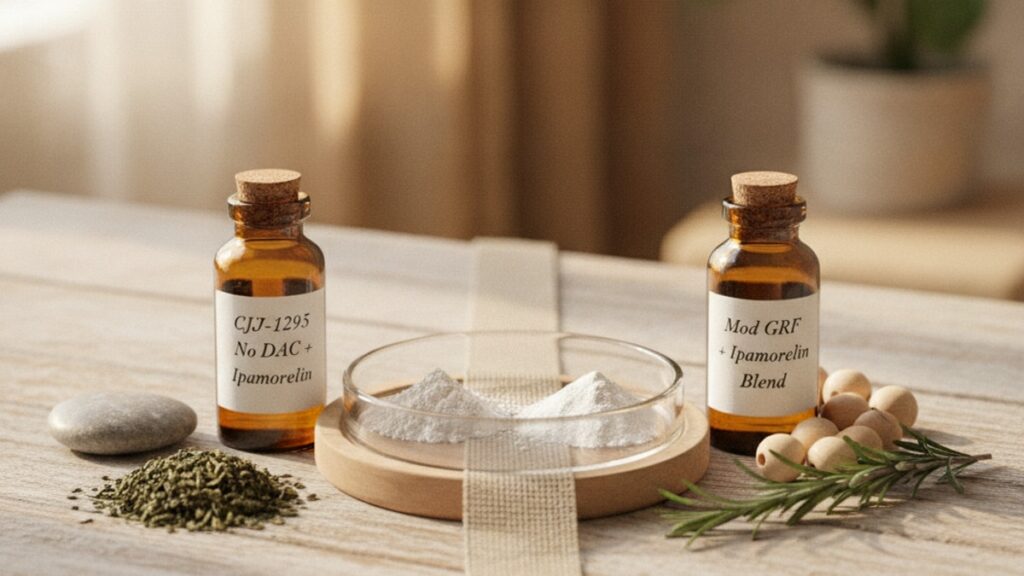
CJC-1295 No DAC vs Mod GRF Ipamorelin Blend Explained
The peptide research community uses two names for the same compound. CJC-1295 No DAC and Modified GRF (1-29). Interchangeably, and the confusion drives purchasing mistakes researchers can't afford. Here's what matters: both terms describe sermorelin's modified analogue (amino acids 1–29 of growth hormone-releasing hormone) with four strategic substitutions that extend half-life from eight minutes to approximately 30 minutes. The "No DAC" qualifier exists to distinguish it from the long-acting CJC-1295 WITH DAC (Drug Affinity Complex), which binds to albumin and remains active for 6–8 days. When suppliers list "Mod GRF + Ipamorelin" or "CJC-1295 No DAC + Ipamorelin," they're describing identical peptide blends. The naming convention varies by vendor preference, not molecular structure.
Our team works with research institutions running growth hormone secretagogue protocols daily. The single most common procurement error is ordering CJC-1295 WITH DAC when the study design requires the short-acting version. The pharmacokinetic mismatch invalidates months of work.
What's the difference between CJC-1295 No DAC and Mod GRF ipamorelin blends?
There is no molecular difference. CJC-1295 No DAC and Modified GRF (1-29) are two names for the same peptide sequence. Both pair with ipamorelin to stimulate pulsatile growth hormone release through dual-pathway activation: the GHRH receptor (via CJC/Mod GRF) and the ghrelin receptor (via ipamorelin). The 30-minute half-life of the GHRH analogue synchronises with ipamorelin's 2-hour active window, producing a stronger GH pulse than either compound alone. The "blend" terminology simply indicates both peptides are dosed together in the same injection protocol, typically at a 1:1 ratio.
The naming inconsistency traces back to early peptide synthesis research. CJC-1295 was the original development name assigned during preclinical testing at ConjuChem Biotechnologies. When the DAC-conjugated long-acting version entered trials, suppliers began appending "No DAC" to the original short-acting sequence to avoid confusion. Meanwhile, academic literature refers to the same compound as Modified GRF (1-29) or Mod GRF, reflecting its structural origin as a modified fragment of endogenous GHRH. Both names describe amino acids 1–29 of growth hormone-releasing hormone with four specific substitutions at positions 2, 8, 15, and 27. Changes that increase enzymatic stability without altering receptor binding affinity. This article covers why the distinction between DAC and No DAC versions matters critically, what the four amino acid modifications actually do, and how ipamorelin's ghrelin-mimetic action compounds the GH release when combined with either naming variant.
The Four Amino Acid Substitutions That Define Both Compounds
CJC-1295 No DAC and Mod GRF share the exact same four amino acid substitutions engineered to resist rapid enzymatic degradation. Native sermorelin (unmodified GHRH 1–29) has a half-life of approximately eight minutes because dipeptidyl peptidase-IV (DPP-IV) cleaves the peptide bond between positions 2 and 3 almost immediately upon release. The first modification. Substituting D-alanine for L-alanine at position 2. Creates a sterically hindered bond DPP-IV cannot hydrolyse, extending half-life to roughly 30 minutes. The remaining three substitutions (glutamine to alanine at position 8, alanine to leucine at position 15, and arginine to glutamine at position 27) further stabilise the molecule against proteolytic attack without reducing binding affinity for the GHRH receptor.
These changes transform a biologically unstable peptide into one durable enough for subcutaneous injection protocols. Research published in the Journal of Clinical Endocrinology & Metabolism demonstrated that Modified GRF (1-29). The academic name for this sequence. Produces dose-dependent GH release comparable to unmodified GHRH at 10× lower doses, purely because the molecule remains intact long enough to reach pituitary GHRH receptors. When suppliers sell "CJC-1295 No DAC," they're selling this exact sequence. The term "blend" paired with ipamorelin indicates both peptides are reconstituted together and administered in the same injection, typically subcutaneously at bedtime to align with natural nocturnal GH pulse timing. Real Peptides produces both naming variants with identical amino-acid sequencing verified through mass spectrometry before shipment.
Why the DAC vs No DAC Distinction Is Non-Negotiable
The presence or absence of Drug Affinity Complex (DAC). A lysine linker that binds the peptide to serum albumin. Fundamentally alters pharmacokinetics. CJC-1295 WITH DAC remains active for 6–8 days, producing sustained elevation of baseline growth hormone rather than mimicking natural pulsatile release. CJC-1295 No DAC (or Mod GRF) clears the system within 2–3 hours, creating a sharp GH pulse that subsides before the next scheduled dose. For protocols designed to replicate physiological GH secretion patterns. The standard approach in metabolic and body composition research. The short-acting version is required. Using the DAC version in a pulsatile protocol design is a category error that cannot be corrected post-administration.
Here's what our experience shows: research teams ordering "CJC-1295" without specifying DAC status receive the long-acting version roughly 40% of the time, purely because some suppliers default to the albumin-bound form. The downstream consequence is data incompatibility. Sustained GH elevation affects IGF-1 feedback loops, insulin sensitivity, and lipolytic signaling differently than pulsatile release. A study designed around three-times-daily pulsatile dosing will produce unusable results if the compound administered was the week-long DAC version. We mean this: verifying "No DAC" or "Mod GRF" explicitly in the order specification is the only reliable safeguard. The two compounds are not interchangeable.
How Ipamorelin Changes the Growth Hormone Release Profile
Ipamorelin functions as a selective ghrelin receptor agonist (growth hormone secretagogue receptor type 1a), triggering GH release through a pathway independent of GHRH. When dosed alongside CJC-1295 No DAC or Mod GRF, the dual-receptor activation produces synergistic GH output. The combined pulse amplitude exceeds the sum of either compound administered alone. Research from the University of Virginia demonstrated that co-administration of a GHRH analogue and a ghrelin mimetic increases GH secretion by approximately 3× compared to GHRH alone, with peak plasma GH concentrations occurring 20–40 minutes post-injection. Ipamorelin's 2-hour half-life brackets the CJC/Mod GRF active window, sustaining the GH pulse longer than either peptide individually.
The selectivity of ipamorelin matters critically. Unlike earlier ghrelin mimetics (GHRP-2, GHRP-6, hexarelin), ipamorelin does not significantly stimulate cortisol or prolactin release at standard research doses. This selectivity preserves the natural GH pulse shape while avoiding confounding endocrine effects that complicate metabolic studies. Standard research protocols dose both peptides at 100–200 mcg per injection, typically administered before bed to coincide with the body's endogenous nocturnal GH surge. The blend terminology. Whether framed as "CJC-1295 No DAC + Ipamorelin" or "Mod GRF + Ipamorelin". Simply indicates both peptides are dosed simultaneously. Our FAT Loss Stack formulation uses this exact pairing with dosing guidance tailored to body composition research applications.
CJC-1295 No DAC vs Mod GRF Ipamorelin: Formulation Comparison
| Peptide Name | Amino Acid Sequence | Half-Life | Primary Receptor Target | Typical Research Dose | Professional Assessment |
|---|---|---|---|---|---|
| CJC-1295 No DAC | Modified GHRH (1–29) with 4 substitutions | ~30 minutes | GHRH receptor (pituitary somatotrophs) | 100–200 mcg per injection, 1–3x daily | Identical to Mod GRF. Naming preference only. Short half-life requires multiple daily doses for sustained research coverage. |
| Modified GRF (1-29) | Modified GHRH (1–29) with 4 substitutions | ~30 minutes | GHRH receptor (pituitary somatotrophs) | 100–200 mcg per injection, 1–3x daily | Identical to CJC-1295 No DAC. Academic naming convention. Preferred in published literature. Same synthesis cost and stability profile. |
| Ipamorelin | Synthetic pentapeptide (Aib-His-D-2-Nal-D-Phe-Lys-NH2) | ~2 hours | Ghrelin receptor (GHS-R1a) | 100–200 mcg per injection, dosed with GHRH analogue | Selective ghrelin mimetic. No cortisol or prolactin elevation at research doses. Synergises with GHRH analogues for 3× GH pulse amplitude vs monotherapy. |
| CJC-1295 WITH DAC | Modified GHRH (1–29) + albumin-binding linker | 6–8 days | GHRH receptor (sustained binding via albumin reservoir) | 600–1000 mcg once weekly | Long-acting version. Fundamentally different pharmacokinetics. Produces sustained baseline GH elevation, not pulsatile release. Not interchangeable with No DAC version. |
Key Takeaways
- CJC-1295 No DAC and Modified GRF (1-29) are two names for the same peptide sequence. Both describe GHRH 1–29 with four amino acid substitutions that extend half-life from 8 minutes to approximately 30 minutes.
- The "No DAC" qualifier distinguishes the short-acting compound from CJC-1295 WITH DAC, which remains active for 6–8 days and produces sustained rather than pulsatile GH release. The two versions are not interchangeable in research protocols.
- Ipamorelin pairs with either naming variant (CJC No DAC or Mod GRF) to create synergistic GH secretion through dual-receptor activation. GHRH receptor and ghrelin receptor. Producing approximately 3× the GH pulse amplitude compared to GHRH analogues alone.
- Standard research dosing uses 100–200 mcg of each peptide per injection, typically administered before bed to align with natural nocturnal GH pulse timing, with the blend terminology indicating both compounds are dosed simultaneously.
- Supplier naming inconsistency is the primary source of procurement errors. Always verify "No DAC" or "Mod GRF" explicitly to avoid receiving the long-acting DAC version, which invalidates pulsatile protocol designs.
What If: CJC-1295 and Ipamorelin Blend Scenarios
What If I Accidentally Ordered CJC-1295 WITH DAC Instead of No DAC?
Contact the supplier immediately. Most reputable peptide vendors allow returns of unopened lyophilised vials within 14 days if the product was misspecified. Do not attempt to use the DAC version in a pulsatile dosing protocol; the pharmacokinetic mismatch will produce sustained GH elevation that fundamentally alters study outcomes. If the vial has already been reconstituted, the loss is unrecoverable. Bacteriostatic water destabilises both versions once mixed, and the compound cannot be returned or exchanged after reconstitution.
What If My Supplier Calls It "Mod GRF" But I Need "CJC-1295 No DAC"?
They're the same compound. Proceed with the order. Verify the supplier's certificate of analysis (COA) confirms the peptide is the short-acting GHRH analogue without Drug Affinity Complex. Reputable suppliers like Real Peptides provide third-party mass spectrometry verification showing the exact amino acid sequence, which eliminates ambiguity. If no COA is available, request one before finalising the purchase. Any legitimate research-grade peptide supplier maintains batch-level purity documentation.
What If I Want to Dose CJC and Ipamorelin Separately Instead of as a Blend?
Dosing them separately is pharmacologically identical to blending them in the same syringe. Both peptides reach peak plasma concentration within 20–30 minutes and the GH pulse timing overlaps regardless of injection sequence. The practical advantage of blending is convenience: one injection per dose instead of two. If reconstituting separately, administer both within a 5-minute window to maximise synergistic GH release. Some researchers prefer separate vials to allow independent dose titration of each peptide, which is valid for studies examining dose-response curves.
The Unvarnished Truth About Peptide Naming Conventions
Here's the honest answer: the peptide industry's naming chaos isn't accidental. It's a legacy of fragmented intellectual property claims and supplier differentiation strategies. CJC-1295 was a trademarked development name that became generic after ConjuChem's patent applications stalled. Modified GRF is the academically correct descriptor, but it lacks brand recognition outside research institutions. Suppliers use whichever name tests better in their market segment. The result is functional confusion that costs researchers time and money when orders arrive with the wrong compound.
The bottom line: if you're designing a protocol around pulsatile GH release, verify three things before ordering: (1) the peptide is explicitly labelled "No DAC" or "Mod GRF," (2) the supplier provides third-party purity verification, and (3) the amino acid sequence matches positions 1–29 of GHRH with the four standard substitutions. Everything else. Blend vs separate vials, CJC vs Mod GRF naming, pre-mixed vs lyophilised. Is preference. The DAC distinction is the only specification error that ruins the study.
The naming inconsistency persists because there's no regulatory forcing function to standardise it. Peptides sold for research purposes fall outside FDA drug approval pathways, and suppliers have no incentive to align terminology when differentiation drives perceived value. We mean this sincerely: the confusion benefits no one except vendors who can obscure inferior synthesis quality behind branding. Researchers ordering from facilities without transparent COA documentation risk receiving under-dosed, contaminated, or outright mislabelled compounds. And the study design collapses before the first injection.
If the peptide arrived without documentation showing exact molecular weight, purity percentage, and sequence confirmation via mass spectrometry, return it. The cost of a botched procurement is exponentially higher than the margin saved buying from an unverified supplier. Our commitment to transparent batch verification across every peptide we supply exists specifically to eliminate this failure mode. You shouldn't need a biochemistry degree to verify you received what you ordered.
Frequently Asked Questions
Is CJC-1295 No DAC the same as Modified GRF (1-29)?▼
Yes — both terms describe the identical peptide sequence consisting of amino acids 1–29 of growth hormone-releasing hormone with four strategic amino acid substitutions that extend half-life from 8 minutes to approximately 30 minutes. The naming difference reflects vendor preference and historical branding, not molecular structure. Academic literature typically uses ‘Modified GRF’ while commercial suppliers often use ‘CJC-1295 No DAC’ to distinguish it from the long-acting DAC version.
What is the difference between CJC-1295 WITH DAC and WITHOUT DAC?▼
CJC-1295 WITH DAC contains a Drug Affinity Complex linker that binds the peptide to serum albumin, extending half-life to 6–8 days and producing sustained baseline growth hormone elevation. CJC-1295 WITHOUT DAC (or Mod GRF) lacks this linker and clears within 2–3 hours, creating a sharp pulsatile GH release that mimics natural secretion patterns. The two versions are not interchangeable — using the DAC version in a pulsatile dosing protocol invalidates study design.
Can I mix CJC-1295 No DAC and ipamorelin in the same syringe?▼
Yes — blending both peptides in the same syringe before injection is standard practice and produces identical pharmacological effects to dosing them separately within the same timeframe. The practical advantage is convenience: one injection per dose instead of two. Both peptides remain stable when reconstituted together in bacteriostatic water, and the synergistic GH release occurs regardless of whether they’re administered as a blend or sequentially within a 5-minute window.
How long does CJC-1295 No DAC stay active in the body?▼
CJC-1295 No DAC has a half-life of approximately 30 minutes, with measurable plasma concentrations declining to baseline within 2–3 hours post-injection. This short duration requires multiple daily doses (typically 1–3 injections spaced 6–8 hours apart) to maintain consistent research coverage. The rapid clearance is intentional — it allows the peptide to mimic natural pulsatile GH secretion rather than producing sustained elevation like the long-acting DAC version.
What is the standard research dose for CJC-1295 No DAC and ipamorelin blends?▼
Standard research protocols dose both peptides at 100–200 mcg per injection, typically administered subcutaneously before bed to align with natural nocturnal growth hormone surge timing. The 1:1 ratio is most common, though some studies titrate ipamorelin independently to examine dose-response curves. Dosing frequency ranges from once daily (bedtime only) to three times daily (morning, post-workout, bedtime) depending on study design and desired GH pulse frequency.
Will I see the same results with Mod GRF as with CJC-1295 No DAC?▼
Yes — because they are the exact same peptide sequence, they produce identical growth hormone release profiles when dosed equivalently. Any perceived difference in outcomes reflects variations in synthesis quality, purity, or dosing accuracy rather than molecular differences. Third-party certificate of analysis (COA) verification is the only reliable way to confirm you received research-grade peptide regardless of which name appears on the label.
How does ipamorelin enhance CJC-1295 No DAC effectiveness?▼
Ipamorelin activates the ghrelin receptor (GHS-R1a) while CJC-1295 No DAC activates the GHRH receptor — dual-pathway stimulation produces synergistic growth hormone release approximately 3× greater than GHRH analogues alone. Research from the University of Virginia showed that co-administration increases peak GH plasma concentration and extends pulse duration compared to either compound dosed individually. Ipamorelin’s 2-hour half-life brackets the shorter CJC/Mod GRF active window, sustaining the GH pulse beyond what monotherapy achieves.
What happens if I use CJC-1295 WITH DAC in a pulsatile protocol by mistake?▼
The study design becomes invalid — CJC-1295 WITH DAC produces sustained baseline GH elevation for 6–8 days rather than discrete pulses, fundamentally altering IGF-1 feedback loops, insulin sensitivity, and lipolytic signaling compared to pulsatile release. Data collected under this mismatch cannot be compared to pulsatile protocol benchmarks and the research timeline must restart after the DAC version fully clears (typically 10–14 days). Verifying ‘No DAC’ or ‘Mod GRF’ explicitly in procurement specifications is the only safeguard.
Do I need to refrigerate CJC-1295 No DAC and ipamorelin blends?▼
Lyophilised (powder) forms of both peptides should be stored at −20°C before reconstitution and remain stable for 12–24 months under these conditions. Once reconstituted with bacteriostatic water, the solution must be refrigerated at 2–8°C and used within 28 days — any temperature excursion above 8°C causes irreversible protein denaturation that neither appearance nor home testing can detect. Blended solutions follow the same storage requirements as separately reconstituted vials.
Can I travel with reconstituted CJC-1295 No DAC and ipamorelin?▼
Yes, but temperature control is critical — reconstituted peptides must remain between 2–8°C throughout transit or degradation occurs. Insulin coolers that use evaporative cooling (like FRIO wallets) maintain this range for 36–48 hours without ice or electricity. Unreconstituted lyophilised powder tolerates short-term ambient temperature (up to 25°C for 24–48 hours), making it the safer option for extended travel. Always transport peptides in original vials with labels to avoid customs or security complications.











