



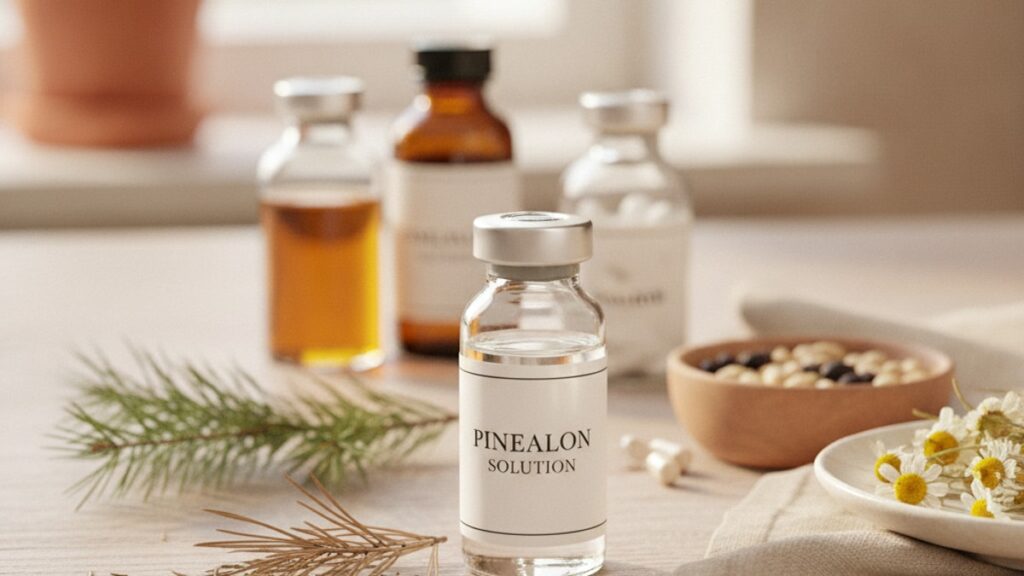
What Does Pinealon Look Like in Solution? (Visual Guide)
Pinealon in solution should be invisible.
When properly reconstituted with bacteriostatic water, research-grade pinealon forms a clear, colorless liquid that looks identical to sterile water under normal lighting. No cloudiness. No particulates. No amber tint. If you're holding a vial up to the light and seeing anything other than complete transparency, the peptide has degraded. Either during reconstitution, storage, or shipping. What you're seeing is protein aggregation, oxidative breakdown, or bacterial contamination. None of those outcomes are recoverable.
We've worked with researchers across hundreds of peptide protocols at Real Peptides. The visual inspection step is where most handling errors surface. Not during injection or dosing, but immediately after mixing. The gap between a usable solution and a contaminated one comes down to three things most protocols never mention: reconstitution technique, sterile handling during the mixing phase, and temperature control during the first 30 minutes post-mixing.
What does pinealon look like in solution when properly prepared?
Properly reconstituted pinealon appears as a clear, colorless solution with no visible particles, cloudiness, or discoloration. The liquid should have the same optical clarity as the bacteriostatic water used to reconstitute it. Any deviation from complete transparency indicates peptide degradation, contamination, or improper mixing technique.
Why Visual Clarity Matters
The appearance of pinealon in solution isn't cosmetic. It's a direct indicator of molecular integrity. Pinealon is a synthetic tripeptide (Glu-Asp-Arg) with a molecular weight of 404.4 Da. When dissolved in bacteriostatic water at concentrations between 1–5 mg/mL, the peptide remains in a fully solvated monomeric state. The solution remains optically clear because individual peptide molecules are smaller than the wavelength of visible light (380–750 nm).
Cloudiness develops when peptide molecules aggregate into clusters large enough to scatter light. Typically 100+ nm in diameter. This aggregation happens when the peptide's hydrophilic residues (glutamic acid, aspartic acid) lose their stabilising hydration shells. Once aggregation begins, the process is irreversible. You can't restore molecular dispersion by warming, shaking, or re-diluting the solution. The peptide's tertiary structure has collapsed.
Particulate matter. Visible as floating specks or settled sediment. Indicates one of three failure modes: (1) incomplete dissolution of lyophilised powder, (2) precipitation of degraded peptide fragments, or (3) bacterial or fungal contamination introduced during mixing. The first can sometimes be resolved by gentle agitation and time. The second and third cannot.
Reconstitution Technique and Solution Appearance
How pinealon looks in solution depends almost entirely on how you reconstitute it. The lyophilised peptide arrives as a white to off-white powder compressed at the bottom of a sterile vial. This powder is hygroscopic. It absorbs atmospheric moisture on contact with air. Which is why vials are sealed under vacuum or inert gas.
The standard reconstitution protocol: (1) Allow the lyophilised vial and bacteriostatic water to reach room temperature (20–25°C) before opening. Cold peptides dissolve slower and trap air bubbles. (2) Swab the rubber stopper with 70% isopropyl alcohol and allow it to air-dry for 30 seconds. (3) Inject bacteriostatic water slowly down the inside wall of the vial. Never directly onto the peptide cake. Direct injection causes foaming and protein denaturation at the air-liquid interface. (4) Allow the vial to sit undisturbed for 2–5 minutes. The peptide will dissolve passively as water diffuses through the powder. (5) Swirl gently. Do not shake. Shaking introduces microbubbles that denature peptides at the gas-liquid boundary.
A properly executed reconstitution produces a solution that turns completely clear within 5 minutes. If the solution remains cloudy after 10 minutes of passive dissolution, one of three things happened: the bacteriostatic water was too cold, the peptide powder was expired or heat-damaged before you opened it, or the vial was contaminated during opening.
What Cloudiness Actually Indicates
Cloudiness in a peptide solution is peptide aggregation made visible. At the molecular level, pinealon's structure includes two acidic residues (glutamic acid, aspartic acid) and one basic residue (arginine). In aqueous solution at physiological pH (6.5–7.5), these residues remain ionised and hydrated. The electrostatic repulsion between charged residues keeps individual peptide molecules dispersed.
Aggregation occurs when that repulsion is lost. Typically through one of these mechanisms: (1) pH shift outside the stable range (below 5.0 or above 8.5), which neutralises charged residues and eliminates electrostatic repulsion. (2) Temperature excursion above 30°C, which increases the kinetic energy of peptide molecules enough to overcome electrostatic barriers. (3) Introduction of divalent cations (Ca²⁺, Mg²⁺) from tap water or unfiltered diluents, which cross-link anionic residues and precipitate the peptide. (4) Prolonged exposure to light, which generates reactive oxygen species that oxidise methionine and cysteine residues. Though pinealon lacks these residues, oxidative damage to the peptide backbone still occurs.
Once cloudiness appears, the solution is no longer usable. You cannot reverse aggregation. Filtering the solution through a 0.22 µm syringe filter will remove visible particles but won't restore monomeric peptide. You're just concentrating aggregated fragments in the filter membrane.
Pinealon Look Like in Solution: Comparison Table
Before presenting the table, it's critical to understand that peptide solution appearance exists on a pass/fail binary. There is no 'acceptable cloudiness' threshold. Any deviation from complete transparency indicates molecular compromise.
| Visual Characteristic | What It Indicates | Usability | Professional Assessment |
|---|---|---|---|
| Clear, colorless | Fully solvated monomeric peptide; proper reconstitution and storage | Usable | This is the only acceptable appearance. Solution should be indistinguishable from sterile water. |
| Slight cloudiness (diffuse, no particles) | Early-stage aggregation; likely caused by temperature excursion or pH drift | Not usable | Aggregation is irreversible. Discard and reconstitute fresh peptide using verified sterile technique. |
| Visible floating particles | Incomplete dissolution, precipitated degradation products, or contamination | Not usable | Particulates indicate either mixing error or pre-existing peptide degradation. Do not filter and use. |
| Amber or yellow tint | Oxidative degradation; exposure to light, heat, or reactive contaminants | Not usable | Color indicates covalent modification of peptide backbone. Bioactivity is compromised regardless of clarity. |
| Sediment at vial bottom | Severe aggregation or crystallised degradation products; prolonged improper storage | Not usable | This level of precipitation cannot occur during normal handling. Peptide was compromised before reconstitution. |
Key Takeaways
- Properly reconstituted pinealon appears as a clear, colorless solution identical in appearance to sterile water. Any cloudiness, particles, or discoloration indicates degradation.
- Cloudiness develops when peptide molecules aggregate into light-scattering clusters above 100 nm. This process is irreversible and renders the solution unusable.
- Reconstitution technique determines solution clarity: inject bacteriostatic water down the vial wall, allow passive dissolution for 2–5 minutes, swirl gently without shaking.
- Temperature excursions above 8°C during storage or above 30°C during reconstitution cause immediate aggregation. Peptides must remain refrigerated at 2–8°C post-mixing.
- Particulate matter indicates incomplete dissolution, precipitation of degraded fragments, or bacterial contamination. None of these can be corrected by filtering or re-diluting.
- Oxidative degradation produces an amber or yellow tint even in clear solutions. Color indicates backbone modification and loss of bioactivity.
- Once cloudiness or discoloration appears, the peptide is not salvageable. Discard the solution and reconstitute a fresh vial using verified sterile technique.
What If: Pinealon Solution Scenarios
What If My Pinealon Solution Is Slightly Cloudy Right After Mixing?
Discard it and reconstitute a fresh vial. Cloudiness immediately post-reconstitution indicates one of three failures: the bacteriostatic water was contaminated, the lyophilised peptide was degraded before you opened it, or you introduced air bubbles during injection that caused foaming and denaturation. The third cause is the most common. Injecting water directly onto the peptide cake generates foam at the air-liquid interface, which irreversibly denatures peptides. Next reconstitution, inject the water slowly down the inside wall of the vial and allow 5 minutes of passive dissolution before any agitation.
What If the Solution Was Clear Yesterday but Looks Cloudy Today?
The peptide aggregated during storage. Most likely due to a temperature excursion. Reconstituted peptides must be stored at 2–8°C continuously. Even a single 2-hour period at room temperature (20–25°C) can trigger aggregation in sensitive peptides like pinealon. Check your refrigerator's actual temperature with an independent thermometer. Many units fluctuate between 4–12°C depending on door-opening frequency. If the cloudiness developed within 24 hours of reconstitution, the storage temperature was too high.
What If I See Tiny Floating Particles but the Solution Is Otherwise Clear?
Do not use it. Particulates indicate either incomplete dissolution of the lyophilised powder or contamination introduced during handling. If the particles appeared immediately after reconstitution, they're likely undissolved peptide. Allow the vial to sit for an additional 10 minutes and check again. If particles persist or appear after initial clarity, the solution is contaminated. Filtering through a 0.22 µm syringe filter will not make the solution safe. You're concentrating unknown contaminants, not removing them.
The Unfiltered Truth About Pinealon Solution Appearance
Here's the honest answer: most researchers don't know what properly reconstituted pinealon should look like because most peptide suppliers don't provide visual reference standards. The peptide research industry operates on the assumption that buyers already know sterile technique, peptide chemistry, and quality control protocols. That assumption is wrong.
Properly reconstituted pinealon looks like nothing. And that invisibility is the entire quality signal. A clear, colorless solution means the peptide dissolved completely, remains monomeric, and wasn't contaminated during handling. Cloudiness, color, or particulates mean the peptide is compromised. There is no middle ground. There is no 'acceptable turbidity' threshold. There is no way to salvage a cloudy solution.
The reason this matters: aggregated peptides don't just lose bioactivity. They can trigger immune responses when injected. Peptide aggregates above 1 µm diameter are recognised as foreign particles by dendritic cells, which can initiate inflammatory cascades or antibody production against the peptide itself. This is why pharmaceutical GMP manufacturing includes mandatory turbidity testing at multiple stages. Research-grade peptides don't undergo that testing. The visual inspection is your only quality checkpoint.
Storage and Stability After Reconstitution
Once reconstituted, pinealon's appearance stability depends entirely on storage conditions. At 2–8°C in a sealed sterile vial, properly prepared pinealon remains clear and colorless for 28–30 days. Beyond 30 days, hydrolytic degradation of the peptide backbone begins even under ideal conditions. The solution may remain clear, but potency declines as peptide fragments accumulate.
Freeze-thaw cycles destroy peptide solutions. Freezing causes ice crystal formation, which mechanically shears peptide molecules and promotes aggregation during thawing. A solution that was clear before freezing will turn cloudy or develop precipitates after a single freeze-thaw cycle. If you need longer storage, keep the peptide in lyophilised form at −20°C and reconstitute only the volume needed for immediate use.
Light exposure accelerates degradation. UV wavelengths (280–320 nm) directly damage peptide bonds, while visible light generates reactive oxygen species in solution that oxidise amino acid side chains. Store reconstituted peptides in amber glass vials or wrap clear vials in aluminium foil. Even under refrigeration, a peptide solution exposed to laboratory lighting will show visible yellowing within 7–10 days.
Temperature monitoring is non-negotiable. A single 4-hour excursion to room temperature can trigger aggregation in reconstituted pinealon. If you're transporting peptides between facilities, use a validated cold-chain container with continuous temperature logging. The FRIO cooling wallet maintains 2–8°C for 36–48 hours without ice or electricity using evaporative cooling. Our Cognitive Function bundle includes peptides with similar storage requirements, and we've found that proper cold-chain management during the first 72 hours post-reconstitution determines long-term solution stability.
Proper reconstitution and storage aren't optional steps. They determine whether your research-grade peptide remains research-grade or becomes an expensive saline solution. If you're seeing cloudiness, discoloration, or particulates in your pinealon solution, the peptide has already degraded. Explore our full peptide collection to find research-grade compounds synthesised with exact amino-acid sequencing and shipped under verified cold-chain protocols.
Frequently Asked Questions
What should pinealon look like in solution immediately after reconstitution?▼
Pinealon should appear completely clear and colorless immediately after proper reconstitution — visually identical to the bacteriostatic water used to dissolve it. The solution should show no cloudiness, particulates, or tint when held up to light. Any deviation from complete transparency within 10 minutes of mixing indicates either peptide degradation, contamination, or improper reconstitution technique.
Can I still use pinealon if the solution is slightly cloudy?▼
No. Cloudiness in a peptide solution indicates irreversible aggregation — individual peptide molecules have clustered into light-scattering particles that no longer retain bioactivity. Once aggregation occurs, the peptide cannot be restored to its monomeric state through filtering, warming, or dilution. The solution must be discarded and a fresh vial reconstituted using verified sterile technique.
How long does reconstituted pinealon stay clear when stored correctly?▼
Reconstituted pinealon remains clear and stable for 28–30 days when stored continuously at 2–8°C in a sealed sterile vial protected from light. Beyond 30 days, hydrolytic degradation begins even under ideal conditions — the solution may remain visually clear, but peptide fragments accumulate and potency declines. Never freeze reconstituted peptides; freeze-thaw cycles cause aggregation and permanent cloudiness.
What causes pinealon solution to turn yellow or amber?▼
Amber or yellow discoloration indicates oxidative degradation of the peptide backbone, typically caused by prolonged light exposure, temperature excursions above 30°C, or contamination with reactive oxygen species. Even if the solution remains clear, any color shift signals covalent modification of amino acid residues and loss of bioactivity. Peptides showing discoloration should not be used regardless of clarity.
How does pinealon solution appearance compare to other research peptides?▼
All properly reconstituted research-grade peptides — including pinealon, epitalon, selank, and semax — should appear as clear, colorless solutions indistinguishable from sterile water. The visual standard is universal across synthetic peptides: complete transparency with no cloudiness, particles, or color. Peptides that contain copper ions (like GHK-Cu) may show a faint blue tint, but pinealon contains no metal cofactors and should remain entirely colorless.
What specific reconstitution mistakes cause pinealon to look cloudy?▼
The three most common reconstitution errors that cause cloudiness are: (1) injecting bacteriostatic water directly onto the lyophilised peptide cake, which generates foam and denatures peptides at the air-liquid interface; (2) shaking the vial instead of swirling gently, which introduces microbubbles that cause aggregation; and (3) using cold bacteriostatic water straight from refrigeration, which slows dissolution and promotes incomplete mixing. All three are prevented by injecting water down the vial wall, allowing 5 minutes of passive dissolution, and using room-temperature diluent.
Does pinealon degrade faster than other neuropeptides in solution?▼
Pinealon’s stability profile is comparable to other synthetic tripeptides like epitalon — both remain stable for 28–30 days at 2–8°C when properly reconstituted. However, pinealon contains two acidic residues (glutamic acid, aspartic acid) that make it more sensitive to pH shifts than peptides with neutral residues. Solutions prepared with non-sterile water or exposed to alkaline contaminants will aggregate faster than peptides with more pH-tolerant sequences.
Can I filter a cloudy pinealon solution to make it usable again?▼
No. Filtering a cloudy peptide solution through a 0.22 µm syringe filter removes visible particles but does not restore peptide bioactivity. The cloudiness is caused by irreversible aggregation of peptide molecules into clusters too large to pass biological membranes — filtering concentrates those aggregates in the membrane while passing degraded fragments and contaminants. The filtered solution is still compromised and should not be used.
What temperature range keeps pinealon solution clear during storage?▼
Reconstituted pinealon must be stored continuously at 2–8°C to maintain optical clarity and molecular stability. Temperatures below 0°C cause ice crystal formation and aggregation during thawing. Temperatures above 8°C accelerate hydrolysis and peptide backbone degradation. Even a single 2-hour excursion to room temperature (20–25°C) can trigger visible cloudiness within 24 hours. Use a calibrated refrigerator thermometer to verify actual storage temperature.
How do I know if my lyophilised pinealon was degraded before reconstitution?▼
If your pinealon solution turns cloudy within 5 minutes of reconstitution despite proper technique, the lyophilised peptide was likely degraded during shipping or storage before you opened it. Pre-degraded peptides show incomplete dissolution, immediate cloudiness, or visible color even with correct mixing. Verify that your supplier ships lyophilised peptides at −20°C with cold-chain monitoring and that vials arrive frozen or with intact cold packs.











