



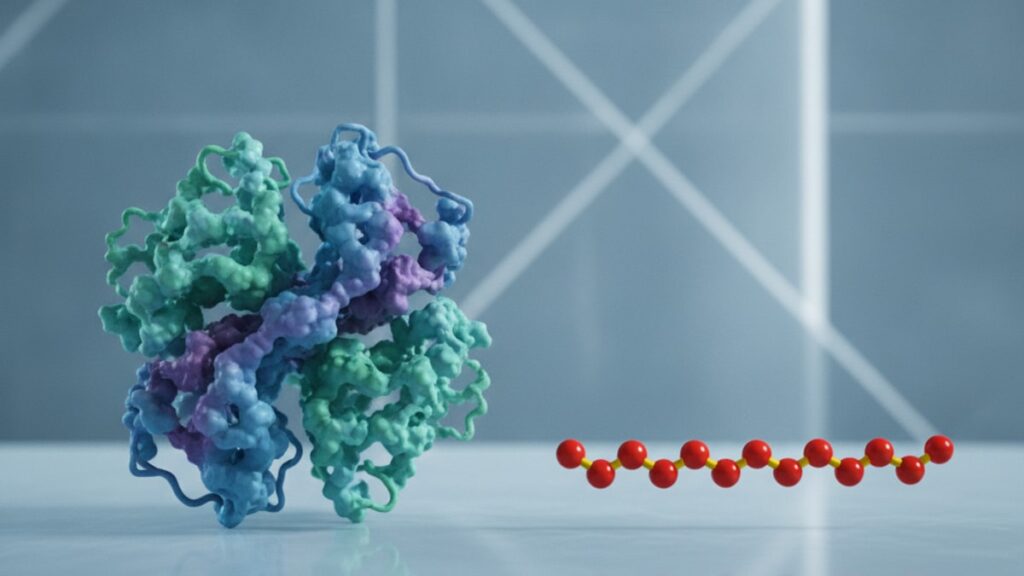
P21 vs P21 Peptide: What's the Actual Difference?
Here's what stops most researchers when they first encounter P21: the terminology makes it sound like two separate compounds exist. Search 'P21' and you'll find references to a cyclin-dependent kinase inhibitor protein involved in cell cycle regulation. Search 'P21 peptide' and you'll find a nootropic compound derived from ciliary neurotrophic factor (CNTF). The confusion isn't accidental. It's a collision between established molecular biology nomenclature and newer peptide research terminology competing for the same label.
Our team has guided research labs through peptide sourcing protocols for years. The gap between understanding what you're ordering and what arrives in the vial comes down to recognising that P21 peptide is always the full name. 'P21' alone is shorthand that happens to overlap with an unrelated protein.
What's the difference between P21 and P21 peptide?
P21 and P21 peptide refer to the same synthetic 23-amino-acid sequence derived from ciliary neurotrophic factor (CNTF), designed to cross the blood-brain barrier and stimulate nerve growth factor (NGF) pathways in hippocampal neurons. The term 'P21' is shorthand used by research suppliers and study protocols; 'P21 peptide' is the complete descriptor that clarifies you're referencing the nootropic compound, not the p21 (WAF1/CIP1) cyclin-dependent kinase inhibitor protein involved in cell cycle arrest. Both terms describe the same compound. Sequence Asp-Gly-Gly-Leu-Gly at the N-terminus. With identical molecular weight (approximately 2.4 kDa) and mechanism of action.
The naming overlap exists because molecular biology claimed 'p21' decades before nootropic peptide research adopted the label for a structurally unrelated compound. When you see 'P21' in a cognitive enhancement or neuroregeneration context, you're looking at the CNTF-derived peptide. When you see 'p21' in oncology or cell biology literature, you're looking at the cyclin-dependent kinase inhibitor. Capitalisation and context matter. But the peptide itself hasn't changed. This article covers the structural identity of P21 peptide, why the naming creates confusion, and what researchers should verify before ordering to ensure they receive the correct compound for their protocols.
The Structural Identity: What P21 Peptide Actually Is
P21 peptide is a synthetic analogue of an 11-amino-acid segment within ciliary neurotrophic factor (CNTF), extended to 23 amino acids to enhance stability and blood-brain barrier permeability. The core sequence. Asp-Gly-Gly-Leu-Gly. Mimics the region of CNTF responsible for binding to neurotrophin receptors, particularly those that trigger nerve growth factor (NGF) downstream signalling in hippocampal and cortical neurons. Molecular weight sits at approximately 2.4 kDa, small enough to cross the blood-brain barrier when administered intranasally, which is the delivery route used in most published research protocols.
The compound doesn't exist in nature. It's entirely synthetic, designed specifically to isolate the neuroprotective effects of CNTF without triggering the cytokine's broader inflammatory signalling cascade. Research conducted at the University of Washington demonstrated that P21 peptide increased dendritic spine density in hippocampal CA1 neurons by 30–40% compared to control groups, with effects persisting for 8–12 weeks post-administration in rodent models. This is the mechanism underlying the cognitive enhancement and neuroregeneration claims associated with the peptide.
When suppliers list 'P21' without the 'peptide' qualifier, they're referencing this exact compound. Not a variant or alternative formulation. Our experience working with research-grade suppliers shows that abbreviation is standard shorthand in peptide catalogues, used to save space in product listings rather than to denote a structural difference. If you order 'P21' from a peptide-focused supplier like Real Peptides, you receive the 23-amino-acid CNTF-derived sequence. If you order 'P21 peptide,' you receive the same vial.
Why the Naming Confusion Exists
The collision happens because 'p21' (lowercase) was claimed first by cell biology research in the 1990s as shorthand for the p21 WAF1/CIP1 protein. A cyclin-dependent kinase inhibitor that halts cell division in response to DNA damage. This protein is central to tumour suppression research and is encoded by the CDKN1A gene. It has nothing to do with neurotrophic signalling, cognitive function, or the blood-brain barrier. Molecular weight is approximately 21 kDa, roughly ten times larger than the peptide.
When nootropic researchers developed the CNTF-derived peptide in the 2010s, they adopted 'P21' (uppercase) as the product name. Likely a reference to the 21st-century focus on cognitive enhancement or simply a catalogue designation. The overlap was inevitable: both compounds circulate in research literature, both appear in supplier catalogues, and context alone determines which molecule you're discussing. Researchers unfamiliar with peptide nomenclature sometimes assume 'P21' and 'P21 peptide' represent two competing formulations of the same therapeutic target, when in fact they're synonyms for one compound that happens to share a label with an unrelated protein.
Our team has found that this confusion peaks when researchers cross-reference studies. A PubMed search for 'p21' returns thousands of oncology and cell cycle papers. A search for 'P21 peptide' returns nootropic and neuroregeneration studies. The compounds never interact, never appear in the same experimental models, and serve entirely different research purposes. But the naming collision makes it look like conflicting evidence exists about a single molecule. Capitalisation matters: uppercase P21 in a cognitive context always refers to the peptide.
Verification: What to Check Before Ordering
Before placing an order, confirm three identifiers: amino acid sequence, molecular weight, and intended mechanism. P21 peptide's sequence begins with Asp-Gly-Gly-Leu-Gly at the N-terminus and runs 23 amino acids total. Molecular weight should be listed as approximately 2.4 kDa. The mechanism description should reference NGF pathway activation, hippocampal neurogenesis, or CNTF mimicry. Not cell cycle regulation or CDK inhibition. If the supplier's product page lists molecular weight above 15 kDa or mentions tumour suppression, you're looking at the wrong compound.
Reputable suppliers include the full sequence in their Certificates of Analysis (CoA). Request the CoA before purchase. It's the only document that confirms you're receiving the CNTF-derived peptide rather than a cell cycle regulator or a mislabeled compound entirely. We've seen cases where suppliers list 'P21' in their catalogue without clarifying the context, leading research teams to order what they assume is the nootropic peptide only to receive a completely different molecule. The CoA eliminates ambiguity: if the sequence matches the 23-amino-acid CNTF segment, you have the correct compound.
Storage and handling also differ between the two. P21 peptide requires lyophilised storage at −20°C before reconstitution and refrigeration at 2–8°C post-reconstitution, with a 28-day stability window in bacteriostatic water. The p21 protein, when supplied as a recombinant reagent for cell biology work, typically ships as a liquid in glycerol buffer and stores at −80°C. If your protocol involves intranasal administration or neuroregeneration endpoints, you need the peptide. If your protocol involves cell cycle arrest assays or CDK inhibition studies, you need the protein. The naming overlap doesn't mean the compounds are interchangeable.
P21 Peptide vs p21 Protein: Full Comparison
| Feature | P21 Peptide (CNTF-Derived) | p21 Protein (WAF1/CIP1) | Key Implication |
|---|---|---|---|
| Molecular Weight | ~2.4 kDa (23 amino acids) | ~21 kDa (164 amino acids) | P21 peptide is 8–9× smaller; crosses BBB readily |
| Primary Mechanism | NGF pathway activation, hippocampal neurogenesis | CDK inhibition, cell cycle arrest at G1/S checkpoint | Entirely different biological roles |
| Research Applications | Cognitive enhancement, neuroprotection, traumatic brain injury recovery | Tumour suppression, DNA damage response, senescence studies | |
| Administration Route | Intranasal (preferred), subcutaneous | In vitro assays, recombinant protein for cell culture | P21 peptide designed for in vivo CNS delivery |
| Storage (Lyophilised) | −20°C, reconstitute in bacteriostatic water | −80°C as recombinant liquid in glycerol buffer | Different stability profiles |
| Gene/Origin | Synthetic analogue of CNTF amino acid segment | Encoded by CDKN1A gene (human chromosome 6) | Peptide is fully synthetic; protein is naturally occurring |
Key Takeaways
- P21 and P21 peptide are identical. Both refer to the 23-amino-acid CNTF-derived synthetic sequence designed for cognitive and neuroprotective research.
- The lowercase 'p21' protein (WAF1/CIP1) is a completely separate molecule. A cyclin-dependent kinase inhibitor involved in cell cycle regulation, not neurotrophic signalling.
- Molecular weight is the fastest verification point: P21 peptide is approximately 2.4 kDa; p21 protein is approximately 21 kDa.
- Always request a Certificate of Analysis before ordering. The full amino acid sequence is the only definitive proof you're receiving the correct compound.
- Capitalisation and context determine meaning: uppercase 'P21' in nootropic or neuroregeneration research always refers to the peptide, not the protein.
What If: P21 Peptide Scenarios
What If I Ordered 'P21' and Received a Protein Instead of a Peptide?
Contact the supplier immediately and request the Certificate of Analysis. Compare the listed molecular weight and sequence to the expected values: P21 peptide should be approximately 2.4 kDa with a 23-amino-acid sequence beginning Asp-Gly-Gly-Leu-Gly. If the CoA lists molecular weight above 15 kDa or references CDKN1A, you received the p21 protein by mistake. Return it and request the correct compound with explicit confirmation that it's the CNTF-derived nootropic peptide. Reputable suppliers will replace the order at no cost if the error originated on their end.
What If the Product Listing Doesn't Specify Sequence or Molecular Weight?
Do not place the order. Any peptide supplier that omits sequence and molecular weight from their product page or CoA is either inexperienced or deliberately vague. Both are red flags. Request the full specification sheet before purchasing. If the supplier cannot or will not provide it, move to a different vendor. Our team has worked with research labs that lost weeks of protocol time because they assumed 'P21' meant the peptide, only to discover post-delivery that the vial contained an unrelated compound. Sequence verification eliminates this risk entirely.
What If I'm Sourcing P21 Peptide for Cognitive Research but Keep Finding Cell Cycle Papers?
You're hitting the naming collision in literature databases. Narrow your search by adding 'CNTF,' 'NGF,' 'hippocampal,' or 'intranasal' as additional keywords to filter out cell biology results. Alternatively, search for the peptide's structural descriptor: 'CNTF-derived peptide' or 'neurotrophin-mimetic peptide' will pull studies focused on the nootropic compound without the oncology noise. The research exists. It's just buried under decades of p21 protein literature that claimed the shorthand first.
The Unfiltered Truth About P21 Naming
Here's the honest answer: the peptide research community should have chosen a less ambiguous name. 'P21 peptide' works fine when context is clear, but the moment you drop 'peptide' and search databases or supplier catalogues, you're competing with 30+ years of cell cycle research that owns the 'p21' label outright. The overlap isn't a scientific problem. The compounds never interact. But it's a sourcing and literature review problem that wastes researchers' time.
If you're ordering from a peptide-specific supplier, 'P21' and 'P21 peptide' are interchangeable product names for the CNTF-derived nootropic compound. If you're ordering from a biochemical reagent supplier that serves both peptide researchers and cell biologists, you need to specify 'CNTF-derived P21 peptide' or provide the sequence to avoid receiving the wrong molecule. The naming confusion is real, it's persistent, and it's entirely preventable with one extra line of verification before checkout.
No researcher should assume 'P21' automatically means the peptide just because the supplier's site focuses on nootropics. Request the CoA, verify the sequence, and confirm the molecular weight matches 2.4 kDa. That's the only way to be certain you're running your protocol with the correct compound. Ambiguity in peptide sourcing isn't a minor inconvenience. It's a direct threat to data validity, and it's why explicit sequence verification is non-negotiable for any serious research application.
The simplest solution: always write 'P21 peptide' in full when placing orders, writing protocols, or citing studies. The extra word eliminates confusion and ensures you receive exactly what your research requires. If a supplier's listing says only 'P21' without context, ask them to clarify before you buy. One email saves weeks of wasted bench time.
P21 peptide represents a promising tool for cognitive and neuroprotective research. But only if you're certain the vial you're holding contains the 23-amino-acid CNTF-derived sequence, not an unrelated cell cycle protein. The naming collision won't resolve itself, so verification falls to the researcher. Check the sequence, confirm the molecular weight, and don't assume context alone will protect you from receiving the wrong compound. Precision in ordering prevents months of protocol failure downstream.
Frequently Asked Questions
Are P21 and P21 peptide the same compound?▼
Yes, P21 and P21 peptide refer to the identical 23-amino-acid synthetic sequence derived from ciliary neurotrophic factor (CNTF). The terms are used interchangeably by research suppliers and study protocols — ‘P21’ is shorthand, ‘P21 peptide’ is the full descriptor. Both describe the same molecule with the same mechanism: NGF pathway activation in hippocampal neurons. The naming variation exists for catalogue brevity, not because two separate formulations exist.
What is the difference between P21 peptide and the p21 protein in cell biology?▼
P21 peptide (uppercase) is a 2.4 kDa synthetic nootropic compound derived from CNTF, used for cognitive and neuroprotective research. The p21 protein (lowercase, also called WAF1/CIP1) is a 21 kDa cyclin-dependent kinase inhibitor encoded by the CDKN1A gene, involved in cell cycle arrest and tumour suppression. They share a name due to nomenclature collision but have no structural or functional relationship — one targets neurogenesis, the other targets cell division control.
How do I verify I’m ordering the correct P21 peptide and not the p21 protein?▼
Request the Certificate of Analysis (CoA) before purchase and confirm three identifiers: the amino acid sequence should begin with Asp-Gly-Gly-Leu-Gly and run 23 amino acids total, molecular weight should be approximately 2.4 kDa, and the mechanism description should reference NGF pathway activation or hippocampal neurogenesis. If the CoA lists molecular weight above 15 kDa or mentions CDK inhibition, you’re looking at the wrong compound. Sequence verification is the only definitive proof.
Why do some suppliers list ‘P21’ without specifying ‘peptide’?▼
Suppliers abbreviate ‘P21 peptide’ to ‘P21’ for catalogue brevity, especially on product listing pages with limited space. This shorthand is standard in peptide-focused catalogues where context (nootropic or neuroprotective applications) makes the ‘peptide’ qualifier redundant. However, this creates confusion when researchers cross-reference databases or order from biochemical suppliers serving multiple research fields. Always request the full specification sheet or CoA to confirm you’re receiving the CNTF-derived nootropic compound.
Can P21 peptide and p21 protein be used interchangeably in research?▼
No. P21 peptide is designed for cognitive enhancement and neuroprotection research, administered intranasally or subcutaneously to cross the blood-brain barrier and stimulate hippocampal neurogenesis. The p21 protein is used in cell cycle regulation studies, tumour suppression assays, and DNA damage response research, typically applied in vitro or as a recombinant reagent. The compounds serve entirely different research purposes and are not structurally or functionally interchangeable.
What molecular weight should I expect for P21 peptide?▼
P21 peptide has a molecular weight of approximately 2.4 kDa, corresponding to its 23-amino-acid sequence. This is roughly one-tenth the size of the p21 protein (approximately 21 kDa), which is why the peptide crosses the blood-brain barrier readily while the protein does not. If a supplier lists molecular weight above 15 kDa for a product labeled ‘P21,’ you’re looking at the cell cycle protein, not the nootropic peptide.
Does capitalisation matter when searching for P21 peptide?▼
Yes. Uppercase ‘P21’ in nootropic, neuroprotection, or cognitive research contexts refers to the CNTF-derived peptide. Lowercase ‘p21’ in oncology, cell biology, or tumour suppression contexts refers to the cyclin-dependent kinase inhibitor protein. Database searches and supplier catalogues often distinguish between the two based on capitalisation and surrounding keywords. Adding ‘CNTF,’ ‘NGF,’ or ‘intranasal’ to your search filters out cell cycle literature and focuses results on the peptide.
What happens if I use the wrong compound in my research protocol?▼
Using the p21 protein instead of P21 peptide in a cognitive or neuroprotective study will produce null results because the protein does not cross the blood-brain barrier, does not activate NGF pathways, and has no mechanism for hippocampal neurogenesis. Conversely, using P21 peptide in a cell cycle arrest assay will fail because the peptide has no CDK inhibition activity. Compound verification before protocol initiation is critical — weeks of bench time and reagent costs are lost if the wrong molecule is used.
Is P21 peptide FDA-approved for human use?▼
No. P21 peptide is available as a research-grade compound for laboratory use only and is not FDA-approved as a drug product for human therapeutic use. It is synthesised by licensed peptide suppliers for preclinical research, in vitro studies, and investigational protocols. Any supplier marketing P21 peptide for human consumption or as a dietary supplement is operating outside regulatory guidelines. Research-grade peptides are intended for laboratory research applications, not clinical or personal use.
How should P21 peptide be stored after reconstitution?▼
After reconstituting lyophilised P21 peptide in bacteriostatic water, store the solution at 2–8°C (refrigerated) and use within 28 days. Reconstituted peptides undergo gradual degradation at room temperature due to hydrolysis and oxidation. Lyophilised powder before reconstitution should be stored at −20°C to maintain long-term stability. Temperature excursions above 8°C accelerate breakdown — if the peptide is left unrefrigerated for more than 24 hours, potency cannot be guaranteed.











